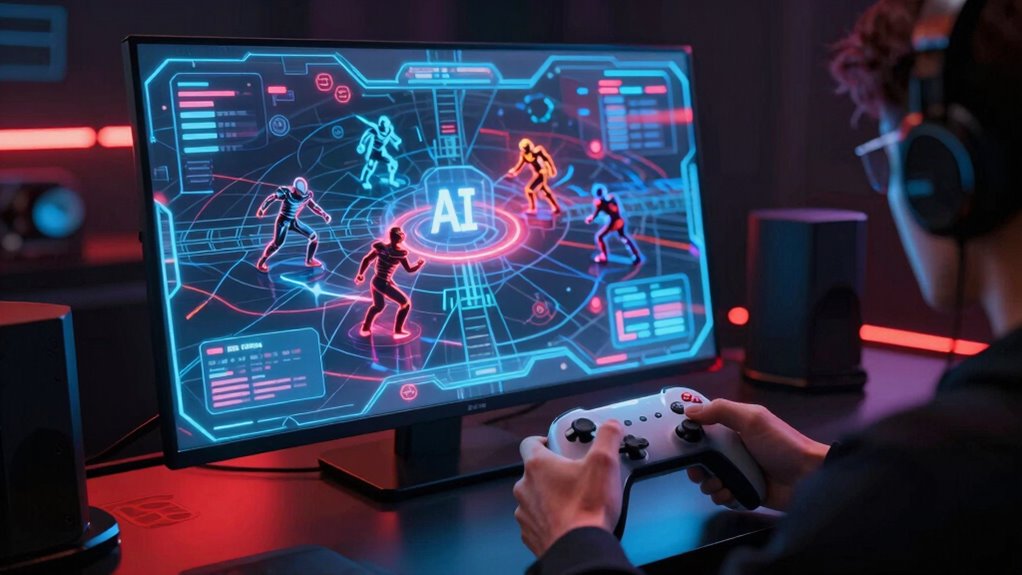

AI is making video game enemies smarter by enabling them to learn from your actions and adapt in real time. Advanced algorithms now analyze your playstyle, predict your moves, and respond dynamically, creating more challenging and realistic encounters. Developers also use AI to generate personalized content and adjust difficulty levels seamlessly. If you want to discover how these innovations are transforming your gaming experiences and what’s next, keep exploring how AI is shaping the future of gaming.
Key Takeaways
- AI enables enemies to analyze and predict player strategies, creating more challenging and realistic encounters.
- Machine learning allows enemies to adapt dynamically to individual playstyles for personalized gameplay.
- Advanced algorithms facilitate real-time behavior adjustments, increasing unpredictability and engagement.
- Procedural content generation powered by AI creates varied environments and challenges, enhancing immersion.
- Ethical AI practices ensure fair, balanced, and responsible enemy behaviors, improving overall game quality.

Lenovo LOQ AI-Powered Gaming Laptop, AMD Ryzen 7-250, 32 GB DDR5 RAM, 1 TB PCIe SSD, 15.6" FHD(1920×1080) 144Hz Display, Nvidia G-Force RTX 5060, Backlit Keyboard, W11 Home, Luna Grey+Traix Mousepad
【Instant Gratification】Unthrottled Performance via Lenovo LA1 AI Chip: Unleash the full potential of elite hardware with dedicated AI…
As an affiliate, we earn on qualifying purchases.
As an affiliate, we earn on qualifying purchases.
The Evolution of Enemy AI in Video Games

The evolution of enemy AI in video games reflects decades of technological advancements and creative experimentation. Early games embraced retro aesthetics, with simple patterns and predictable behaviors that defined their charm. As technology progressed, developers began integrating multiplayer features, making AI opponents more responsive and challenging in cooperative or competitive settings. This shift pushed enemy AI beyond static patterns, encouraging more dynamic interactions that kept players engaged. You can see how these changes fostered a richer gaming experience, blending nostalgic visuals with smarter, more adaptable enemies. Over time, developers experimented with different styles, balancing retro visuals with modern AI capabilities. These innovations laid the groundwork for increasingly sophisticated enemy behaviors, shaping how you encounter challenges and interact with others in multiplayer environments today. Additionally, advancements in AI algorithms have enabled enemies to analyze player strategies, making encounters more predictive and realistic. Furthermore, the development of adaptive AI systems has allowed enemies to learn from player actions, creating more personalized and engaging challenges.
adaptive game AI accessories
As an affiliate, we earn on qualifying purchases.
As an affiliate, we earn on qualifying purchases.
Machine Learning and Adaptation in Gaming Opponents

As enemy AI continues to evolve, machine learning has become a game-changer, enabling opponents to adapt dynamically to your playstyle. Neural networks analyze your actions in real time, identifying patterns and predicting your next moves. This allows enemies to respond more intelligently, making encounters feel more realistic and challenging. Some advanced systems incorporate emotion recognition, detecting your frustration or excitement through voice tone or facial expressions, and adjusting their tactics accordingly. This creates a more immersive experience, as enemies seem to understand your emotional state and react appropriately. By continuously learning from your behavior, these AI opponents become less predictable and more engaging, pushing you to develop new strategies and enhancing the overall gameplay experience. Additionally, adaptive AI systems leverage ongoing data collection to refine their strategies over time, ensuring that each gaming session offers a personalized challenge and increasingly challenging experience.

Enstixsm Upgraded for Luna Controller with Back Paddles,Turbo,Wireless Fire TV Game Controllers for PC,GeForce NOW,Firestick,Replacement for Luna Gamepad with ALPS Joystick,No Drift Stick, Blue
🎮【𝐄𝐧𝐡𝐚𝐧𝐜𝐞𝐝 𝐆𝐚𝐦𝐢𝐧𝐠 𝐂𝐨𝐧𝐭𝐫𝐨𝐥𝐥𝐞𝐫 𝐟𝐨𝐫 𝐋𝐮𝐧𝐚】Ymir Upgrade for luna controller for fire tv has Patent: No.US D998,043 S. Experience…
As an affiliate, we earn on qualifying purchases.
As an affiliate, we earn on qualifying purchases.
Dynamic Difficulty Adjustment Through AI

AI enables real-time challenge scaling, adjusting the game difficulty based on your performance. This means your skill level directly influences how tough or easy the game feels at any moment. As a result, you get a more personalized gaming experience that keeps you engaged without becoming frustrated. Additionally, Free Floating elements can be incorporated into game environments to enhance immersion and realism, making the gameplay more dynamic and responsive.
Real-Time Challenge Scaling
Real-Time Challenge Scaling dynamically modifies game difficulty based on your performance, ensuring a balanced and engaging experience. It uses AI to monitor your actions and adapt enemy behavior, making each encounter feel appropriate to your skill level. This tech enhances emotional storytelling by maintaining tension without overwhelming you, allowing you to stay immersed in the narrative. In multiplayer coordination, it guarantees that difficulty remains fair, preventing frustration or boredom among players. The AI analyzes how well you’re doing and tweaks challenges accordingly, keeping the game challenging but not discouraging. This seamless adjustment helps you stay invested, as the game evolves with your abilities, providing a personalized experience that feels natural and compelling. Additionally, integrating connected equipment can provide real-time data to AI systems, further enhancing adaptive difficulty and overall player engagement. Incorporating real-time data analysis allows AI to respond even more precisely to individual player behaviors, making the experience feel intuitive and responsive.
Player Skill Adaptation
Player Skill Adaptation takes the concept of challenge scaling further by tailoring difficulty directly to your evolving abilities. AI analyzes your performance in real-time, adjusting enemy tactics or resource availability to keep the game engaging. This seamless adaptation enhances player immersion, making each encounter feel authentic and personalized. It also influences the virtual economy, as smarter enemies can impact resource flow and trading dynamics, creating a more dynamic environment. Here’s how it feels:
| Experience Level | AI Response |
|---|---|
| Novice | Slightly easier enemies, encouraging learning |
| Skilled | Balanced challenges to maintain excitement |
| Expert | Tougher foes, pushing your strategic thinking |
| Master | High-stakes encounters, testing your mastery |
Personalized Gaming Experience
When the game adjusts its difficulty dynamically, it creates a tailored experience that responds directly to your skill level and playstyle. AI analyzes your actions and adapts enemy behavior, ensuring challenges remain engaging without becoming frustrating. This personalized approach enhances immersion and keeps you motivated to improve. Additionally, safety measures are essential to prevent the AI from making the game too unpredictable or unfair. Implementing effective error handling and fallback options can help maintain a balanced gameplay experience even if the AI encounters unexpected data or behavior. Furthermore, incorporating local automation techniques can improve responsiveness and reduce latency in real-time decision-making processes. Incorporating robust algorithms can also help ensure that AI behavior remains consistent and fair under varying conditions. Developers should also consider adaptive learning methods to fine-tune AI responses based on ongoing player interactions, creating a more seamless experience. However, AI ethics and player privacy are important considerations. Developers must be transparent about how data is collected and used, respecting your privacy rights. Balancing customization with ethical standards guarantees that your gaming experience feels private and secure while still benefiting from AI-driven personalization. By thoughtfully implementing these technologies, games can deliver smarter enemies and a more satisfying experience without compromising your trust or privacy.

Procedural Generation in Game Design
As an affiliate, we earn on qualifying purchases.
As an affiliate, we earn on qualifying purchases.
AI-Driven Non-Player Characters (NPCs) and Their Behaviors

AI-driven non-player characters (NPCs) have transformed gaming by making interactions more dynamic and believable. With advances in procedural storytelling, NPCs can adapt their dialogues and actions based on your choices, creating a more immersive experience. Voice recognition integration allows NPCs to understand and respond to your spoken commands naturally, enhancing realism. These AI behaviors enable NPCs to react intelligently to your tactics, making encounters more challenging and authentic. Instead of scripted responses, NPCs now exhibit complex behaviors that evolve throughout the game, providing a sense of unpredictability. As a result, your interactions feel less mechanical and more like engaging conversations with real characters, deepening your connection to the game world. This evolution elevates gameplay, making every encounter unique and memorable.
Procedural Content Generation and Its Impact on Gameplay
Procedural content generation reshapes your gaming experience by creating dynamic level designs that adapt to your playstyle. It offers personalized experiences, making each game feel unique to you. Plus, it boosts replayability, encouraging you to return for new challenges every time. Additionally, integrating visual and auditory cues can enhance the immersive quality of these generated environments. Incorporating dynamic environment design further increases the sense of realism and engagement for players. The use of adaptive difficulty can also help tailor challenges to individual skill levels, maintaining player interest and satisfaction. Moreover, leveraging player behavior analysis enables developers to refine the AI systems, making enemies smarter and more responsive over time, which aligns with evidence-based insights about improving user engagement.
Dynamic Level Design
Have you ever wondered how game worlds stay fresh and unpredictable without constant developer input? Dynamic level design, powered by AI, makes this possible through procedural storytelling. The game adapts its environment and challenges in real-time, ensuring each playthrough feels unique. AI algorithms analyze your actions and modify levels accordingly, creating a seamless flow of surprises. This approach also enhances immersive sound design, where audio cues respond dynamically to your movements and events, deepening your engagement. By generating content on the fly, developers save time and resources while providing a more enthralling experience. You’ll find yourself exploring ever-changing worlds that respond intelligently to your playstyle, making every session fresh, exciting, and deeply personalized.
Personalized Player Experiences
Ever wonder how some games feel tailor-made just for you? That’s the magic of personalized player experiences driven by procedural content generation. AI analyzes your play style to craft unique challenges, storylines, and environments that match your preferences. This customization enhances engagement and makes each session feel fresh. It also influences the virtual economy, as tailored content encourages more in-game transactions and investment. Social integration becomes richer when AI adapts multiplayer interactions based on your behavior, fostering deeper connections with others. By dynamically adjusting game elements, developers create immersive worlds that respond to your actions, making every playthrough distinct. Additionally, advancements in generative AI facilitate real-time content creation, further personalizing the gaming experience. These innovations rely on adaptive algorithms that continuously learn from player input to refine content quality. Ultimately, procedural content generation enables games to evolve with you, delivering a truly personalized experience that keeps you hooked.
Replayability Enhancement
Personalized experiences keep players engaged by offering unique challenges and stories, but maintaining long-term interest requires more than just customization. Procedural content generation boosts replayability by creating dynamic environments, varied encounters, and unpredictable challenges that keep you motivated. This approach encourages exploration and discovery, making each playthrough feel fresh. By seamlessly integrating narrative elements, game developers ensure that the generated content aligns with the story, enhancing immersion. The unpredictability prevents gameplay from becoming repetitive, while tailored content sustains your interest over time. With AI-driven procedural generation, you’re constantly presented with new scenarios that challenge your skills and deepen your connection to the game world, ultimately making every session more engaging and rewarding.
The Role of Reinforcement Learning in Creating Smarter Enemies

Reinforcement learning has revolutionized how enemies in games adapt to players’ strategies, making them smarter and more challenging. By leveraging neural networks, these enemies can analyze complex player behaviors and respond dynamically. The core of reinforcement learning involves reward systems that incentivize enemies to improve their tactics over time. When an enemy successfully predicts or counters your moves, it receives positive reinforcement, strengthening those behaviors. Conversely, poor decisions lead to fewer rewards, encouraging better strategies. This continuous feedback loop enables enemies to learn from experience rather than relying solely on predefined scripts. Additionally, adaptive behavior allows enemies to modify their tactics in real-time, creating more engaging encounters. As a result, you face more unpredictable and adaptive opponents, creating a more engaging and immersive gaming experience. Reinforcement learning therefore pushes enemy AI beyond static patterns, making gameplay more challenging and realistic.
Enhancing Player Engagement With Predictive AI Tactics
As AI systems become more advanced, developers are now focusing on predictive tactics that anticipate your next move, keeping gameplay dynamic and engaging. By leveraging neural networks, game designers can analyze your behavior patterns and adapt enemy strategies in real-time. Emotion modeling adds another layer, allowing enemies to respond emotionally based on your actions, making interactions feel more authentic. These tactics create a more immersive experience by continuously challenging you and preventing predictability. Incorporating local cultural elements into AI behaviors can also enhance the sense of immersion, making encounters feel more authentic within the game’s setting.
Challenges and Ethical Considerations of AI in Gaming

What are the main challenges and ethical concerns surrounding AI in gaming? One major issue is data privacy. As AI systems gather player data to personalize experiences, there’s a risk of sensitive information being mishandled or exposed. Ensuring player privacy requires strict data security measures and transparent data collection policies. Developer accountability also poses a challenge. When AI behaves unpredictably or causes harm, determining responsibility becomes complex. Developers must be responsible for designing ethical AI systems that avoid exploiting players or reinforcing harmful stereotypes. Balancing innovation with ethical standards demands ongoing oversight, clear guidelines, and transparency. Additionally, integrating alarm clocks into gaming environments could raise concerns about user distraction and safety, emphasizing the need for ethical design considerations. Addressing these concerns is *fundamental* to creating a gaming environment that respects players’ rights and fosters trust in AI-powered experiences. Furthermore, ongoing research into ethical AI development is essential to navigate these evolving issues responsibly, especially in the context of cybersecurity vulnerabilities associated with AI systems.
Future Trends: The Next Frontier of Intelligent Virtual Adversaries
Advancements in AI are transforming virtual adversaries from simple algorithms into sophisticated opponents that adapt and challenge players in real time. Future trends focus on creating smarter enemies that use AI ethics to balance challenge and fairness, ensuring immersive experiences. In virtual reality, these adversaries will become more realistic, reacting seamlessly to your actions and emotions. You’ll see enemies that learn from your tactics, offering unique challenges each time you play. Additionally, AI will facilitate more personalized gameplay, tailoring difficulty levels and strategies to your skill. Developers will explore ethical considerations surrounding AI behavior, ensuring responsible innovation. As machine learning techniques become more advanced, virtual enemies will continuously improve their strategies and responsiveness, elevating the gaming experience. This includes incorporating insights from biographies of influential figures, which can inspire more nuanced character development and behavior modeling. Expect virtual adversaries to push the boundaries of realism and adaptability, making gameplay more engaging, immersive, and ethically conscious. This evolution promises a new frontier in gaming interaction.
Frequently Asked Questions
How Does AI Improve Enemy Unpredictability in Video Games?
AI enhances enemy unpredictability in video games by utilizing procedural generation to create varied behaviors and environments, keeping you guessing. It also adapts difficulty levels based on your skills, making enemies more or less challenging as needed. This dynamic approach ensures encounters stay fresh and unpredictable, forcing you to think strategically and stay alert, enhancing your overall gaming experience.
What Are the Limitations of Current AI Enemy Technologies?
You’ll find that current AI enemy technologies face limitations like reliance on procedural generation, which can make enemies predictable over time, and challenges with real-time adaptation, causing enemies to struggle against unpredictable player tactics. These systems often lack the flexibility to develop truly dynamic responses, making encounters feel less authentic. Improvements are needed to enhance variability and responsiveness, creating more immersive and challenging gaming experiences.
How Do Ethical Concerns Influence AI Development in Gaming?
Imagine a game where your every move is watched—ethical implications and privacy concerns shape AI development, making developers cautious. You realize that respecting players’ rights and avoiding manipulation guide how AI evolves. Ethical concerns influence choices about data use, fairness, and transparency. You understand that prioritizing these concerns guarantees AI enhances your experience without crossing moral lines, fostering trust and responsibility in gaming’s future.
Can AI Enemies Learn From Player Strategies Over Time?
Yes, AI enemies can learn from your strategies over time through adaptive learning. They analyze your tactics and adjust their behavior, leading to strategy evolution that challenges you more effectively. This dynamic learning process makes encounters more engaging and realistic, as enemies become smarter and more unpredictable. By constantly evolving, these AI adversaries keep the gameplay fresh and push you to develop new tactics, enhancing your overall gaming experience.
What Role Does Player Feedback Play in AI Enemy Design?
Player feedback secretly holds the key to smarter enemies, so don’t hold back. Your preferences shape their tactics through feedback loops, making foes more challenging and less predictable. Developers *enthusiastically* analyze your comments to tweak AI behavior, ensuring every boss fight feels personalized. So, next time you rage-quit, remember: your feedback isn’t just whine—it’s the secret sauce for crafting enemies that actually keep you on your toes.
Conclusion
As AI continues to evolve, it transforms your gaming experience into a smarter, more immersive adventure. With enemies that adapt and NPCs that react unpredictably, every challenge feels fresh and exciting. Can you imagine a future where virtual foes anticipate your moves before you even make them? As you step into this brave new world, one thing’s certain: AI is shaping the future of gaming into something truly extraordinary.