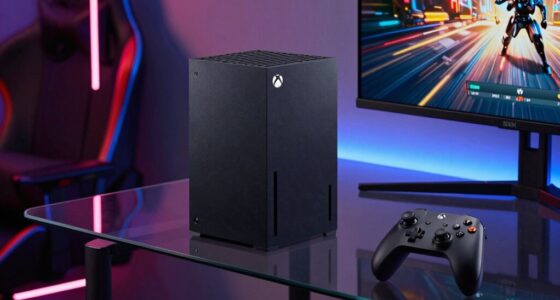

Ray tracing enhances your gaming experience by realistically simulating how light interacts with surfaces, creating stunning reflections, shadows, and natural lighting effects. It makes environments look more authentic and immersive, with dynamic shadows and reflections that change with movement. To enjoy these visuals, your system needs powerful GPUs with dedicated RT cores and sufficient VRAM. If you’re curious about how this technology transforms games and what hardware is involved, you’ll find more details ahead.
Key Takeaways
- Ray tracing simulates real-world light physics, creating highly realistic reflections, shadows, and lighting effects in games.
- It enhances visual immersion by delivering natural-looking environments and dynamic shadow play.
- Ray tracing produces accurate reflections on surfaces like water, glass, and metal, increasing scene authenticity.
- Modern hardware with dedicated RT cores enables real-time ray tracing without excessive performance loss.
- This technology pushes gaming visuals toward hyper-realism, offering players more immersive and visually stunning experiences.
What Is Ray Tracing and How Does It Work?
Have you ever wondered how realistic lighting and shadows are created in computer-generated images? Game engine innovations have considerably advanced how developers simulate light, especially with ray tracing technology. Ray tracing works by simulating the way light interacts with surfaces, mimicking real-world physics. It traces the path of individual light rays as they bounce off objects, creating natural reflections and shadows. Additionally, real-time rendering requires immense processing, which can slow down gameplay or demand high-end hardware. Despite these challenges, developers continue refining techniques to make ray tracing more efficient, bringing us closer to lifelike visuals without sacrificing performance. This ongoing development is supported by European cloud innovation, which provides the scalable and secure infrastructure necessary to handle such demanding computations. These advancements are also fueled by ongoing research into hardware acceleration, which aims to optimize processing power for real-time ray tracing. As technology progresses, graphics card capabilities are increasingly becoming a crucial factor in enabling more accessible ray tracing experiences for gamers. Furthermore, improvements in computational algorithms contribute significantly to balancing visual fidelity with performance. This balance between innovation and limitations shapes the future of realistic game graphics.
The Visual Impact of Ray Tracing in Modern Games
Ray tracing transforms how modern games look by making lighting more realistic and immersive. You’ll notice how shadows shift dynamically and surfaces reflect their surroundings accurately. This technology brings a new level of detail, making every scene feel more lifelike. Incorporating high-quality content that highlights the visual enhancements of ray tracing further amplifies its impact on game realism. Additionally, the visual impact of ray tracing can be appreciated through real-time demonstrations that showcase its ability to simulate natural light behavior. Understanding game graphics technology helps explain why players are so excited about these advancements, especially as it seamlessly integrates realistic lighting into gameplay. Recognizing the importance of lighting techniques in rendering realistic scenes underscores how ray tracing elevates the overall graphics experience.
Enhanced Lighting Realism
Enhanced lighting realism is one of the most striking benefits of ray tracing in modern games, transforming how scenes look and feel. With accurate light source positioning, your game environments gain a natural, immersive glow, making each scene more convincing. Ray tracing enhances ambient occlusion techniques, adding subtle shading where objects meet, which deepens the sense of depth and spatial relationships. This creates realistic reflections and soft shadows that respond dynamically to changes in lighting. You’ll notice how light interacts seamlessly with surfaces, emphasizing textures and details. The overall effect is a more lifelike atmosphere, drawing you further into the game world. This improved lighting elevates visual fidelity and makes virtual environments feel more authentic and engaging.
Dynamic Shadow Play
Ever wondered how modern games produce shadows that shift and deepen with the movement of characters and lights? That’s thanks to dynamic shadow play enabled by ray tracing. This technology creates realistic shadows by calculating how light interacts with objects in real time lighting conditions. Instead of static, flat shadows, you see accurate, soft-edged shadows that respond instantly to your actions and camera angles. As you move through a scene, shadows stretch, shrink, and change shape naturally, immersing you deeper into the game world. Ray tracing’s ability to simulate light’s behavior results in more convincing shadows, adding depth and authenticity to environments. Additionally, the computational power required for real-time ray tracing is significant, but advancements in hardware have made it more accessible for gamers. This dynamic shadow play enhances visual realism, making scenes feel alive and more immersive without sacrificing performance. As hardware continues to evolve, real-time rendering of complex lighting scenarios is becoming increasingly feasible, pushing the boundaries of visual fidelity even further. The ongoing improvements in graphics processing are making these advanced lighting effects more widely available, further elevating the gaming experience. Moreover, ongoing research in light simulation is expected to further refine how realistic lighting effects can be achieved in future titles.
Reflective Surface Details
Reflective surfaces in modern games become astonishingly realistic thanks to ray tracing. This technology enhances reflective surface details, creating lifelike mirror effects that mimic real-world physics. You’ll notice how reflections respond dynamically to changes in lighting, angles, and objects around them, adding depth and immersion. Ray tracing allows surfaces like water, glass, and polished metal to reflect their environments accurately, making scenes more believable. The realistic mirror effects help blend foreground and background elements seamlessly, heightening visual fidelity. With ray tracing, reflections no longer feel flat or fake but instead act as natural extensions of the scene. This breakthrough considerably elevates the overall visual quality, making environments more immersive and visually stunning. By accurately simulating how light interacts with different surfaces, ray tracing provides more authentic visual experiences, which significantly enhances the realism of reflective surfaces. These advanced reflections also contribute to a more cohesive aesthetic, ensuring that every reflected detail aligns perfectly with the surroundings. Additionally, the technology’s ability to simulate complex light interactions creates a dynamic lighting environment that adapts seamlessly to in-game changes. Experience how these realistic reflections transform your gaming world for the better.
Hardware Requirements for Ray Tracing Implementation
To run ray tracing effectively, your hardware needs enough GPU power to handle complex calculations in real time. You’ll also want sufficient VRAM to store detailed textures and scene data without bottlenecks. Making sure your system has compatible hardware components to support these demanding features can lead to optimized gaming performance. Additionally, ensuring your system meets the hardware requirements for gaming can help optimize ray tracing capabilities and overall gaming experience. Paying attention to power supply capacity and proper cooling is also essential to maintain system stability during intensive rendering tasks. Upgrading to a high-performance GPU designed for ray tracing can significantly enhance your gaming experience. Keeping an eye on system compatibility ensures all components work seamlessly together for the best ray tracing performance.
GPU Power Needs
Implementing real-time ray tracing demands substantially more GPU power than traditional rendering methods. To run ray tracing software smoothly, your GPU needs to handle complex calculations for realistic lighting and shadows. This means higher frame rates and better visuals, especially in demanding scenarios like cloud gaming. Here’s what you should consider:
- Modern GPUs with dedicated RT cores, such as NVIDIA’s RTX series
- A powerful GPU with ample CUDA cores for handling intense workloads
- Compatibility with latest graphics APIs like DirectX Raytracing (DXR)
- Upgraded power supply and cooling to support increased GPU demand
- Ensuring your system meets hardware requirements for ray tracing implementation, which are essential for an optimal gaming experience.
These requirements ensure your system can deliver the immersive, realistic visuals that ray tracing offers, making it worth the investment for gamers and streamers alike.
VRAM Specifications
As you upgrade your GPU to handle the demands of real-time ray tracing, paying attention to VRAM specifications becomes equally important. VRAM capacity determines how much data your GPU can hold, directly affecting texture quality and resolution. VRAM speed influences how quickly this data is accessed, impacting rendering efficiency. For *ideal* ray tracing performance, aim for at least 8GB of VRAM, with higher capacities offering better future-proofing. Faster VRAM can improve frame rates and reduce latency during complex scenes. Here’s a quick comparison:
| VRAM Capacity | VRAM Speed |
|---|---|
| 8GB | 14 Gbps |
| 12GB | 16 Gbps |
| 16GB | 18 Gbps |
Choosing the right specs ensures smooth, stunning visuals without bottlenecks.
Compatible Hardware Requirements
Having compatible hardware is essential for effective ray tracing performance. Your GPU must support hardware compatibility with ray tracing technology to deliver realistic lighting and reflections. Make sure your graphics card has dedicated RT cores or equivalent features. Driver support is equally important—up-to-date drivers optimize performance and fix bugs. Check that your system meets the minimum requirements for ray tracing-enabled games or software.
- GPU with dedicated ray tracing cores (e.g., NVIDIA RTX or AMD RX 6000 series)
- Sufficient VRAM for high-quality textures and effects
- Compatible motherboard and power supply
- Updated graphics drivers supporting ray tracing features
Comparing Traditional Rendering Techniques With Ray Tracing
Traditional rendering techniques, such as rasterization, have long been the standard in computer graphics because they process 3D models into 2D images quickly and efficiently. Rasterization excels at producing real-time visuals, making it ideal for gaming and interactive applications. However, it simplifies complex lighting and reflections, often sacrificing realism. In contrast, ray tracing mimics how light interacts with objects, creating more accurate reflections, shadows, and lighting effects. This leap enhances the artistic styles achievable, adding depth and realism to scenes. Here’s a quick comparison:
| Feature | Traditional Rendering | Ray Tracing |
|---|---|---|
| Speed | Faster | Slower |
| Realism | Moderate | High |
| Artistic Styles | Limited | Wide range |
The Future of Gaming Graphics With Ray Tracing
Ray tracing is poised to revolutionize gaming graphics by delivering unprecedented realism and immersion. As technology advances, you’ll see more AI integration, making real-time rendering smarter and more efficient. Cloud gaming will also benefit, allowing you to enjoy high-quality ray-traced visuals without needing powerful hardware locally. This combination means smoother gameplay, faster updates, and more dynamic environments. Future titles will feature hyper-realistic lighting, reflections, and shadows that adapt instantly to your actions. Plus, AI-driven enhancements will improve visual fidelity even further, creating more lifelike worlds. Cloud platforms will enable broader access, making cutting-edge graphics available to everyone. Overall, the future of gaming with ray tracing promises to blur the line between virtual and reality, elevating your gaming experience to new heights.
How Ray Tracing Enhances Player Immersion

When ray tracing accurately simulates the way light interacts with surfaces, it creates visuals that feel more real and immediate. This realism immerses you deeper into the game’s world, making cinematic storytelling more impactful. Enhanced lighting and shadows draw you into scenes, heightening emotional engagement. Realistic reflections and ambient occlusion add depth, making environments feel alive. Additionally, improved sound design complements these visuals by syncing audio cues with realistic lighting, further strengthening immersion. As you navigate through richly detailed worlds, ray tracing blurs the line between virtual and real, making every moment feel authentic. Ultimately, this combination of visual fidelity and immersive sound elevates your gaming experience, pulling you closer into the story and environment with every scene.
Frequently Asked Questions
How Does Ray Tracing Affect Game Development Timelines?
Ray tracing can extend your game development timelines because it demands better hardware compatibility, which may require you to optimize or upgrade your tools. Additionally, it increases your developer workload, as implementing realistic lighting and reflections takes extra effort and testing. While it enhances visual quality, balancing these technical challenges can slow down the process, making it essential to plan for potential delays when integrating ray tracing into your projects.
Are There Any Energy Consumption Concerns With Ray Tracing Hardware?
Imagine your gaming rig as a tiny, overworked chef in a bustling kitchen—every ray traced is like firing up the stove. Yes, ray tracing hardware can boost power consumption, raising concerns about energy efficiency. While it delivers stunning visuals, it also demands more from your power supply. So, consider your energy efficiency goals before diving into the shimmering, pixel-perfect world, or you might just cook your electricity bill too high.
Can Ray Tracing Be Effectively Implemented on Older Gaming Consoles?
You might find that implementing ray tracing on older gaming consoles is challenging due to hardware compatibility issues. These consoles often lack the powerful GPUs needed for real-time ray tracing. Software optimization can help, but it can’t fully compensate for hardware limitations. As a result, you’ll likely experience reduced performance or visual quality, making it less effective compared to newer systems designed specifically for ray tracing.
How Does Ray Tracing Influence Multiplayer Game Performance?
Ray tracing can impact multiplayer game performance by improving lighting accuracy, making environments look more realistic. However, it may increase latency, potentially causing slight delays in gameplay if your system struggles to handle the higher demands. If your hardware is optimized, you’ll enjoy enhanced visuals with minimal latency improvements. Keep in mind, balancing graphics settings can help maintain smooth multiplayer experiences while still benefiting from ray tracing’s realistic lighting effects.
What Are the Best Settings for Balancing Visuals and Performance?
To balance visuals and performance, start with lighting optimization by reducing ray tracing reflections and shadows where possible. Adjust shader complexity to lower the strain on your GPU without sacrificing too much visual quality. Turn off or limit features like global illumination if needed. Experiment with these settings incrementally—test how each change affects performance and visuals—until you find a smooth, visually appealing gaming experience that suits your hardware.
Conclusion
Ray tracing is like opening a secret door to a world of breathtaking realism, where every glow and shadow dances in perfect harmony. As you step through this gateway, gaming transforms into an immersive universe bursting with life and depth. With each flicker of light, it’s as if you’re holding a magic wand that paints a vivid, dynamic masterpiece before your eyes. Embrace this technology, and watch your gaming experience soar to new, dazzling heights.