
Spatial audio works by simulating how sound comes from different directions, making you feel like you’re in the middle of the action. It uses techniques like sound localization based on timing, intensity, and phase differences, along with specialized hardware and algorithms. Different types, such as surround sound and binaural audio, aim to create a natural sense of space. If you want to understand how these techs come together to transform your listening, you’ll find more details below.
Key Takeaways
- Spatial audio creates immersive sound by simulating the direction and distance of audio sources in 3D space.
- It uses techniques like sound localization cues—timing, intensity, and phase differences—to position sounds accurately.
- Different types include surround sound, binaural audio, and object-based audio, all aiming for natural spatial perception.
- Hardware compatibility, such as headphones with head-tracking sensors, is essential for experiencing true spatial audio.
- Limitations include device quality, content availability, and potential implementation issues, but future tech aims to improve realism.
What Is Spatial Audio?
Have you ever wondered how sound can seem to come from different directions around you? That’s the magic of spatial audio. It creates a sense of surround sound, making you feel like you’re in the middle of the action. Unlike traditional stereo, which mixes sounds into two channels, spatial audio uses advanced processing to position audio cues precisely. This technology often employs 3D audio algorithms to simulate how sound travels in space. It enhances audio immersion, so every footstep, whisper, or explosion feels like it’s happening right beside you or behind you. To achieve this, many systems utilize head-tracking to adjust sound placement based on your movements, further increasing realism. It’s not just about louder sound; it’s about accurate placement in three-dimensional space. Sound localization helps your brain interpret where sounds are coming from, making the experience even more convincing. advanced processing allows for more precise positioning and movement of sound within the environment. Whether you’re watching a movie or playing a game, spatial audio transforms your experience by convincingly mimicking how sound travels in real life, pulling you deeper into the environment. High-impact recommendations ensure you get the most out of this technology without the noise.
The Basics of How It Works
You can understand how spatial audio creates a sense of direction by exploring sound localization techniques, which mimic how our ears identify where sounds come from. The design of speaker arrays plays a vital role, as their placement and arrangement help deliver immersive sound experiences. Together, these elements work to position audio accurately in a three-dimensional space around you. Additionally, understanding how sound localization works enhances the appreciation of spatial audio’s capabilities, especially when combined with technological advancements in audio processing. Recognizing the importance of accurate speaker placement further improves the realism and effectiveness of spatial audio systems. Exploring natural hearing principles can also provide deeper insight into how our brains interpret spatial cues for sound. An awareness of listening environment can significantly influence the effectiveness of spatial audio experiences, ensuring optimal immersion.
Sound Localization Techniques
Sound localization techniques enable us to determine the origin of a sound within a space, and they rely on the brain’s ability to interpret subtle differences in audio cues. These cues include timing, intensity, and phase differences between ears, which are essential in surround sound setups and binaural cue processing. Your brain compares these signals to identify whether a sound is coming from the left, right, above, or behind. Additionally, understanding the role of essential oils in health and well-being highlights the importance of sensory perception in our daily experiences. Recognizing how auditory cues influence our perception can deepen our appreciation of how we navigate complex acoustic environments. The brain’s capacity to process skilled sound cues allows us to navigate and interpret our auditory surroundings effectively. Moreover, the ability to differentiate subtle audio differences is crucial for activities such as listening in noisy environments or enjoying immersive audio experiences. The accuracy of sound localization depends on our brain’s effective interpretation of these cues, enhancing our overall auditory perception.
Speaker Array Design
Speaker array design involves arranging multiple speakers in specific configurations to create immersive audio experiences. Your goal is to optimize speaker placement to achieve accurate sound localization and a wide soundstage. The array configuration determines how each speaker interacts, whether in a line, circle, or grid, influencing the directionality and depth of the sound. Proper placement ensures that sound waves blend seamlessly, mimicking how humans perceive space. By adjusting the spacing and orientation of each speaker, you can control how sound reaches your ears from different directions, enhancing spatial realism. Understanding sound wave interaction is essential for fine-tuning the array configuration. Additionally, considering phase alignment helps ensure that sounds from different speakers combine constructively for clarity and depth. Achieving optimal speaker placement is crucial for precise sound localization and creating a convincing immersive environment. Properly managing audio signal phase also plays a vital role in preventing sound cancellation and maintaining sound quality throughout the setup. To achieve the best results, it’s important to consider how acoustic properties of the environment influence sound propagation and speaker performance.
Different Types of Spatial Audio

There are several types of spatial audio, each offering a unique way to create immersive sound experiences. Surround sound is one of the most common, using multiple speakers or channels to simulate a three-dimensional environment around you. Binaural audio, on the other hand, records sound with two microphones placed in a way that mimics human ears, delivering a highly realistic experience through headphones. Head-tracking spatial audio adjusts sound based on your head movements, enhancing immersion. Object-based audio allows sound engineers to position individual audio elements precisely in space, creating a dynamic and lifelike soundscape. Each type differs in complexity and application, but all aim to make you feel like you’re inside the scene, whether through speakers or headphones. Creating a sense of spatial awareness is a key goal across these different technologies, helping to make the experience more natural and engaging. Additionally, advancements in audio processing continue to refine how effectively these technologies can deliver realistic sound environments. As these innovations evolve, they contribute to more natural auditory experiences, making virtual environments increasingly convincing and immersive.
How Spatial Audio Enhances Listening Experiences
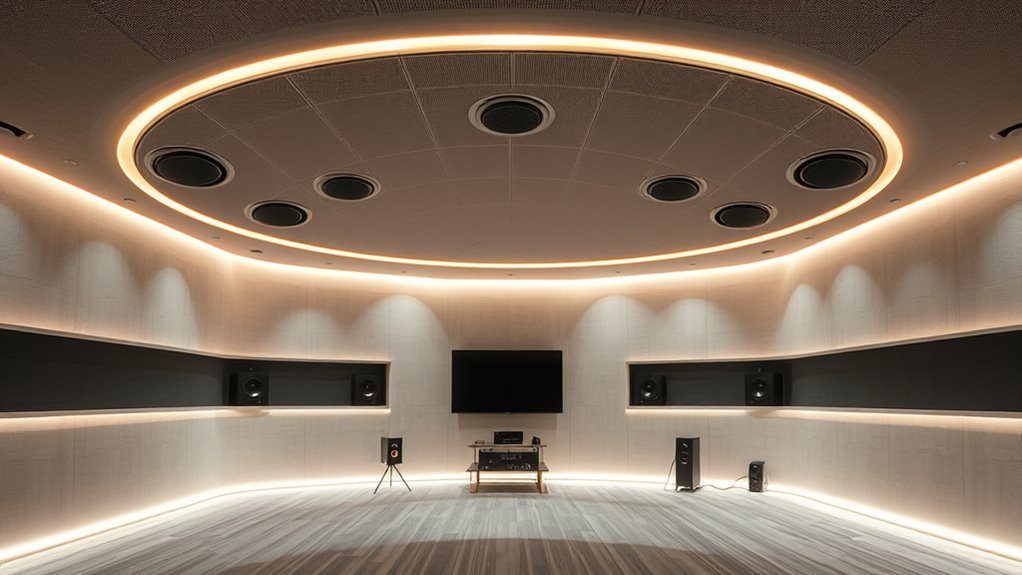
Spatial audio transforms your listening experience by making it more immersive and realistic. Instead of just hearing sounds from your headphones or speakers, you feel as if you’re inside the scene. This creates a richer, more engaging environment that captures your attention. By precisely positioning sounds in 3D space, spatial audio deepens your emotional connection to music, movies, or games. It enhances subtle details and nuances, making quiet sounds feel more present and loud sounds more impactful. The sense of space and depth draws you into the content, elevating your overall enjoyment. Whether you’re listening to a concert or an action scene, spatial audio helps you experience it more vividly and intimately, transforming passive listening into an active, emotionally resonant encounter.
Common Devices and Platforms Supporting Spatial Audio
Many devices and platforms now support spatial audio to enhance your listening experience. Apple devices like iPhones and AirPods Pro are popular options, while streaming services such as Apple Music and Disney+ offer spatial sound content. To enjoy this feature, your hardware must meet specific requirements, including compatible headphones and updated software.
Apple Devices Supporting Spatial Audio
Apple has integrated Spatial Audio into several of its devices, allowing you to experience immersive sound on popular platforms. When using compatible Apple devices, you can enjoy a surround sound experience that closely mimics real-world audio environments, enhancing Virtual Reality applications and media consumption. The AirPods Pro, AirPods Max, and recent iPhone and iPad models support Spatial Audio, delivering dynamic sound that moves with your head for a more natural feel. MacBook Pro and MacBook Air models with M1 chips also support this feature, making your listening more engaging across different platforms. These devices use advanced algorithms to create a sense of depth and direction, providing an easy way to experience immersive, surround sound without needing external speakers or complex setups.
Streaming Platforms Offering Spatial Sound
Several popular streaming platforms now support Spatial Audio to enhance your listening experience. Platforms like Apple Music, Spotify, and Amazon Music offer immersive sound that adapts to your device’s capabilities. To get the best experience, proper audio calibration is essential; this ensures your device accurately reproduces spatial cues. Additionally, room acoustics play a significant role, as a well-treated space minimizes reflections and echoes that could distort spatial effects. These platforms often optimize playback based on your device and environment, but manual adjustments can improve immersion. Keep in mind that the quality of your headphones or speakers also impacts how effectively spatial sound is conveyed. By considering audio calibration and room acoustics, you can enjoy a more realistic, engaging spatial audio experience.
Hardware Requirements for Compatibility
To experience spatial audio, your device must support specific hardware features, such as advanced surround sound codecs, multiple drivers, or built-in accelerometers for head tracking. Ensuring headphone compatibility is essential, as not all headphones deliver the immersive experience. Here are key hardware requirements to check:
- Compatible Headphones: Look for models with built-in spatial audio support or that work seamlessly with spatial sound platforms.
- Powerful Processors: Devices need the hardware capability to decode advanced surround sound codecs without lag.
- Sensor Integration: Built-in accelerometers or gyroscopes enable head tracking, enhancing spatial accuracy.
Meeting these hardware requirements guarantees an immersive, true-to-intent spatial audio experience, making your listening richer and more engaging.
Limitations and Challenges of Spatial Audio

Although spatial audio offers immersive sound experiences, it faces notable limitations and challenges that can hinder its effectiveness. One major issue is inconsistent audio quality, which depends heavily on device capabilities and content optimization. Poor implementation can lead to distorted or missing spatial cues, reducing realism. Additionally, privacy concerns arise because spatial audio often requires extensive data collection to map your environment and preferences. This can lead to fears of intrusive tracking or data misuse. Moreover, compatibility issues may restrict access across devices, limiting the technology’s reach. These challenges highlight that, despite its potential, spatial audio’s effectiveness depends on technological advancements and privacy safeguards. Overcoming these hurdles is essential for delivering truly seamless and trustworthy immersive sound experiences.
Is Spatial Audio Worth the Investment?
Determining whether spatial audio is worth the investment depends on how much you value immersive sound experiences and the reliability of the technology. If you’re seeking richer audio, consider these factors:
Deciding if spatial audio is worth it depends on your love for immersive sound and content availability.
- The cost comparison shows spatial audio setups can range from affordable upgrades to premium systems, so evaluate your budget carefully.
- Content availability is improving but still limited, meaning not all your favorite movies or music support spatial sound yet.
- Think about how much you’ll use it—if immersive audio enhances your entertainment, the investment might feel justified.
While the technology continues to evolve, weighing the initial expense against the immersive experience and content options will help you decide if it’s worth it for you.
Future Trends in Spatial Sound Technology
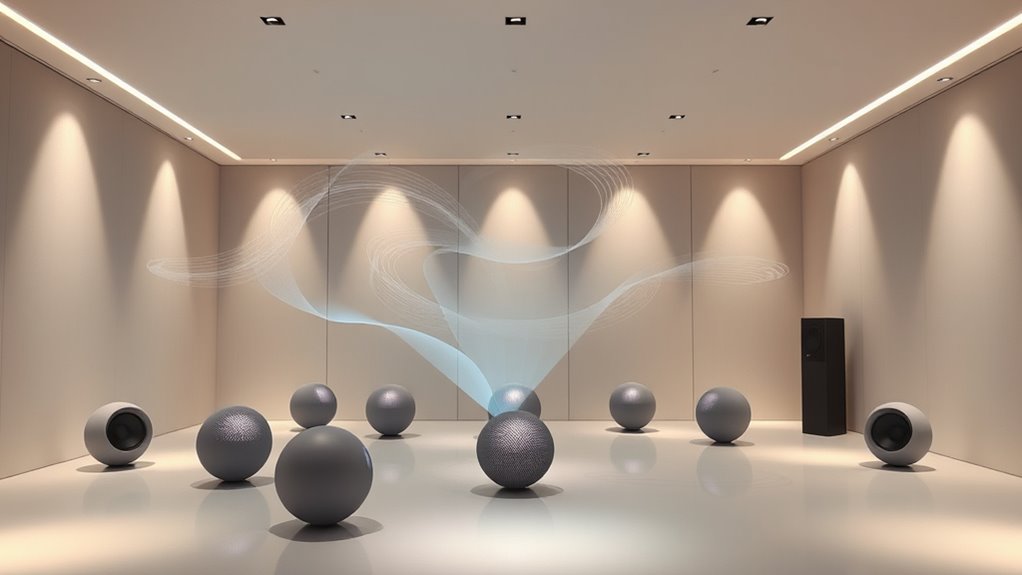
As spatial sound technology continues to advance, we can expect significant improvements in both accuracy and accessibility. Future trends will likely enhance surround sound capabilities, making immersive experiences more natural and precise. Developers are working on smarter algorithms that adapt audio in real-time to your environment, ensuring consistent quality whether you’re using headphones or speakers. Portable devices will feature improved spatial audio processing, allowing you to enjoy rich, three-dimensional sound on the go. Additionally, integration with virtual and augmented reality will deepen immersion, creating more convincing simulations. As these innovations roll out, you’ll find it easier to access high-quality spatial sound without expensive setups. Overall, upcoming technologies aim to make immersive, surround sound experiences more realistic and user-friendly.
Making an Informed Choice: Should You Care About Spatial Audio?
With advancements in spatial sound technology making immersive audio more realistic and accessible, it’s worth asking whether paying attention to this trend really matters to you. Consider these points:
- If you love cinematic surround sound, spatial audio enhances your experience, making movies and games more engaging.
- Binaural recording creates a personal, lifelike sense of space, perfect for relaxing or immersing yourself in music.
- But if you’re content with traditional stereo or don’t notice subtle sound differences, it might not be a priority.
Ultimately, caring about spatial audio depends on your passion for immersive sound and how much you value detailed spatial cues. Whether it’s worth it hinges on your desire for richer, more realistic audio experiences.
Frequently Asked Questions
How Does Spatial Audio Differ From Traditional Stereo Sound?
Spatial audio differs from traditional stereo sound by creating a more immersive experience through enhanced channel separation and sound localization. You’ll notice sounds appear to come from specific directions and distances, mimicking real life. Unlike stereo, which mixes sounds into two channels, spatial audio uses multiple channels and advanced algorithms to position audio around you, making it feel like you’re in the middle of the action.
Can Spatial Audio Be Experienced Without Specialized Headphones?
Sure, you can experience spatial audio without specialized headphones, but it’s tricky. Alternative setups like soundbars or compatible speakers can deliver some spatial effects, creating an immersive environment. However, headphone compatibility is key for the full experience. Without the right gear, you miss out on the precise positioning and depth. So, while alternatives exist, for maximum immersion, high-quality headphones remain the best bet.
What Are the Costs Associated With Upgrading to Spatial Audio Devices?
Upgrading to spatial audio devices involves costs that vary based on device compatibility and your existing setup. You’ll need to take into account the cost analysis of new headphones or speakers, which can range from budget-friendly options to premium models. Keep in mind, some devices might require specific hardware or software updates, adding to the expense. Overall, budgeting for these upgrades ensures you get the best immersive experience without surprises.
Does Spatial Audio Require an Internet Connection to Function?
No, spatial audio doesn’t always require an internet connection to work. It depends on your device and content source. If you’re streaming content that uses spatial audio, you’ll need an internet connection for streaming requirements. However, many devices can play spatial audio locally from downloaded files without internet dependency, making it versatile for different setups. Just check your device’s capabilities and the content source to confirm seamless playback.
Are There Any Health Concerns Linked to Prolonged Spatial Audio Use?
Think of prolonged spatial audio use as standing too close to a roaring fire—you might enjoy the warmth, but over time, it could cause discomfort or burns. While generally safe, health risks from extended exposure include ear fatigue, hearing damage, or discomfort. To stay safe, take regular breaks and keep the volume at a moderate level. Listening mindfully guarantees you enjoy the immersive experience without risking your health.
Conclusion
Ultimately, understanding spatial audio’s significance helps you decide if you should immerse yourself in its dynamic, detailed, and immersive dimensions. While the technology offers a tantalizing taste of theater-like sound, it’s essential to weigh its wonders against its worries. By considering your needs, devices, and desires, you can confidently choose whether spatial audio’s spectacular soundscapes are worth exploring or simply eluding. Make your move wisely—your listening experience awaits a world of wonder!