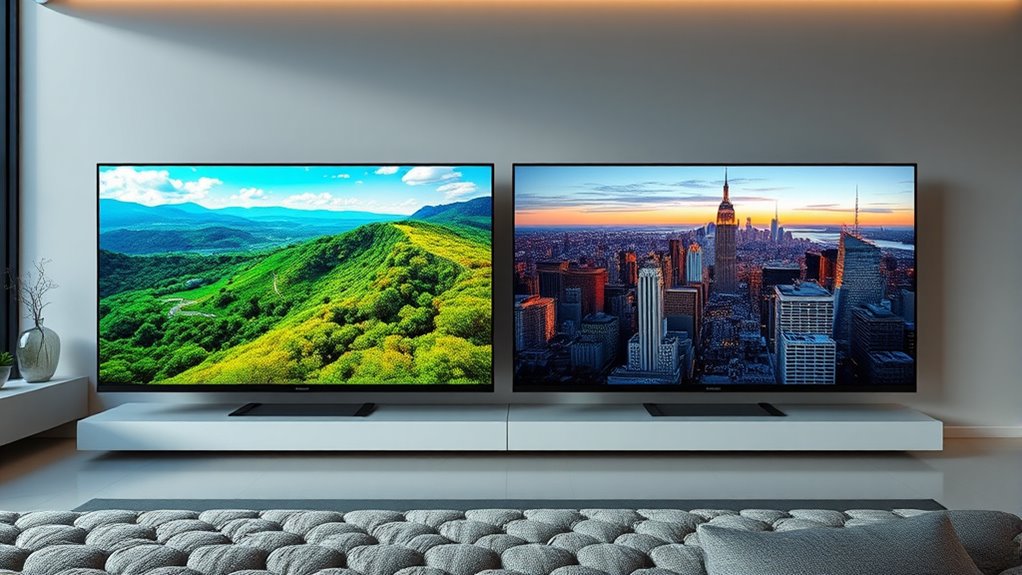

Whether your eyes can see the difference with 8K TVs depends on your screen size, viewing distance, and content quality. With four times the resolution of 4K, 8K offers sharper images, especially on larger screens or when viewed up close. But on smaller screens or from typical distances, the difference is less noticeable. Curious to understand if an upgrade makes sense for your setup? Keep going to discover more insights.
Key Takeaways
- 8K TVs have four times the resolution of 4K, offering over 33 million pixels for detailed images.
- Larger screens and closer viewing distances make the difference between 4K and 8K more noticeable.
- Advanced processing technology enhances picture quality but cannot create true 8K detail from lower-resolution content.
- Most content is produced in 4K, limiting the practical benefits of upgrading to 8K TVs.
- The higher cost of 8K models may not be justified for typical viewing environments or smaller screens.
Have you ever wondered what makes 8K TVs stand out from other screens? It all comes down to picture quality. An 8K TV offers four times the resolution of a 4K, which already boasts stunning clarity. With such a high pixel count—over 33 million pixels—you get incredibly detailed images that can make you feel like you’re looking through a window rather than at a screen. But is that level of detail noticeable to your eyes? That depends on the size of the TV and how close you sit to it. On larger screens, the difference becomes more apparent because the increased pixel density delivers sharper images, even when you’re up close. However, on smaller TVs or from a typical viewing distance, the differences can be subtle, making it harder to distinguish between 4K and 8K. Additionally, the benefits of advanced processing technology further enhance picture quality, providing better color accuracy, higher contrast ratios, and improved HDR performance—features that contribute to a more vibrant and lifelike picture. But keep in mind that the quality of the source content matters too. If most of what you watch is in 4K or lower, the benefits of 8K may not be fully realized unless the TV has sophisticated upscaling features. Upscaling algorithms are designed to enhance lower-resolution content, but they can’t create true 8K detail from 4K or HD sources.
8K TVs deliver incredible detail, especially on larger screens or when viewed up close.
Price comparison is another vital factor. 8K TVs are generally much more expensive than their 4K counterparts. You’re paying a premium for the higher resolution, even if you might not notice a significant difference in everyday viewing. For most consumers, a high-quality 4K TV offers a fantastic picture at a more reasonable price. As technology advances and manufacturing costs decrease, prices for 8K models are starting to become more competitive, but they still tend to be out of reach for many budgets. If you’re considering an upgrade, think about whether the extra investment aligns with your viewing habits and room setup. For example, if you have a large wall space and sit close to the screen, 8K could be more worthwhile. Otherwise, a top-tier 4K TV might give you better value for your money, especially since most content is still mainly produced in 4K.
Ultimately, whether you notice the difference with an 8K TV depends on your viewing environment, the size of the screen, and the content you watch. While picture quality benefits are real, they may not justify the extra cost for everyone. Weighing the price comparison alongside your specific needs will help you decide if an 8K TV is a smart upgrade for you.
Top picks for "explain eyes even"
Open Amazon search results for this keyword.
As an affiliate, we earn on qualifying purchases.
Frequently Asked Questions
How Much Do 8K TVS Cost Compared to 4K Models?
You’ll find that 8K TVs cost markedly more than 4K models, with price comparisons showing a steep increase for higher resolution screens. However, if you’re on a budget, there are some affordable 8K options, though they tend to have fewer features. For most people, 4K TVs offer excellent picture quality at a lower price, making them the smarter choice unless you’re seeking cutting-edge tech and have a bigger budget.
Are There Enough 8K Content Sources Available Now?
Like a barren garden waiting for seeds, the 8K content sources are scarce. You won’t find many streaming quality options yet, making the landscape seem empty. As content scarcity persists, your 8K TV’s potential remains largely untapped, limiting your viewing experience. Until more 8K content becomes available, you’ll find that upgrading might feel like planting seeds in an unready soil—beautiful but ultimately underused.
Will 8K TVS Become More Affordable in the Future?
Yes, 8K TVs will become more affordable in the future. As technology advances, manufacturing improvements drive down production costs, leading to a consistent price trend downward. You can expect more budget-friendly options as brands optimize their supply chains and develop innovative methods. So, if you’re eyeing an 8K TV, patience and watching for these price drops will get you a better deal later on.
How Do 8K TVS Impact Gaming Performance?
You’ll be blown away by how 8K TVs revolutionize gaming performance! With their incredible resolution bandwidth, visuals become mind-blowingly sharp, immersing you like never before. However, beware of increased gaming latency, which can slow your reactions during intense moments. While the stunning detail elevates your experience, make certain your console or PC’s hardware keeps pace to truly enjoy the full 8K advantage without sacrificing performance.
Is There Any Health Risk From Viewing 8K Screens?
There’s no significant health risk from viewing 8K screens, but you might experience eye strain or impact on your vision health if you watch for long periods without breaks. To protect your eyes, follow the 20-20-20 rule, adjust brightness, and maintain a proper distance. Taking regular breaks can help minimize eye discomfort and preserve your overall eye health while enjoying high-resolution content.
Conclusion
By now, you’ve seen that 8K TVs offer a stunning visual experience, even if your eyes might not notice every tiny detail. Think of it as enjoying a beautifully wrapped gift—you don’t need to see every ribbon to appreciate the thought and craftsmanship inside. So, whether you’re captivated or just curious, embracing the future of TV technology can be a delightful journey. After all, sometimes the magic lies in the experience, not just the resolution.