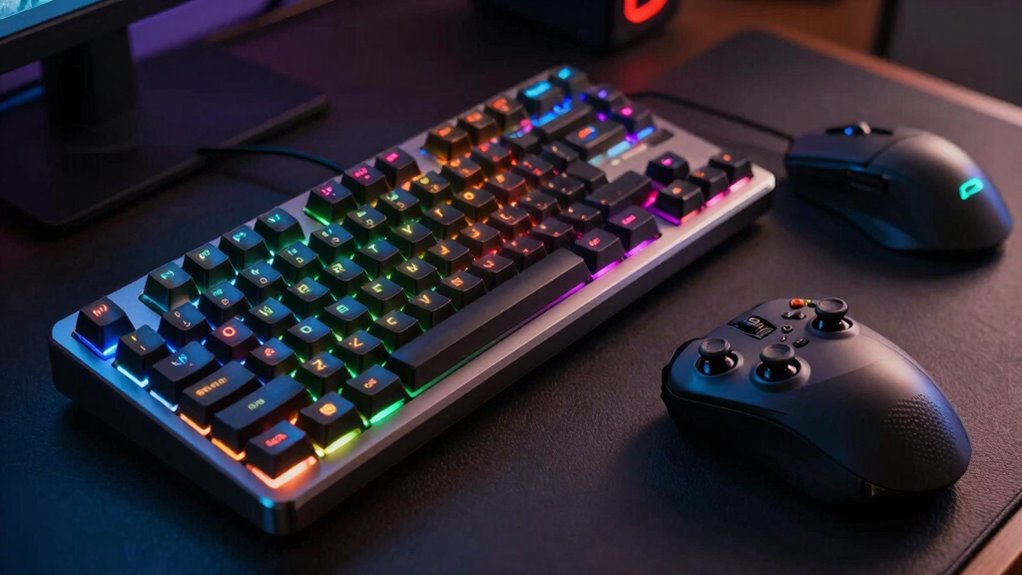

If you prioritize precision, quick reactions, and customization, a keyboard and mouse suit your gaming style best, especially for FPS or strategy games. They offer more control, adjustable comfort, and lower input lag, making aiming and complex commands easier. Controllers, on the other hand, excel with smooth motion control and comfort for relaxed play across various genres. Want to discover how to choose what’s right for you? Keep exploring these options to find your perfect match.
Key Takeaways
- Keyboard and mouse offer superior precision, control, and customization, ideal for FPS and strategy games.
- Controllers provide comfortable, natural movement suited for action, racing, and platformer genres.
- Low input lag and tactile feedback enhance responsiveness for both methods, depending on hardware quality.
- Keyboard/mouse setups are highly customizable with macros and remapping, while controllers have limited options.
- Choice depends on personal preference, game type, and comfort, as both methods excel in different gaming styles.
Precision and Control in Shooting Games
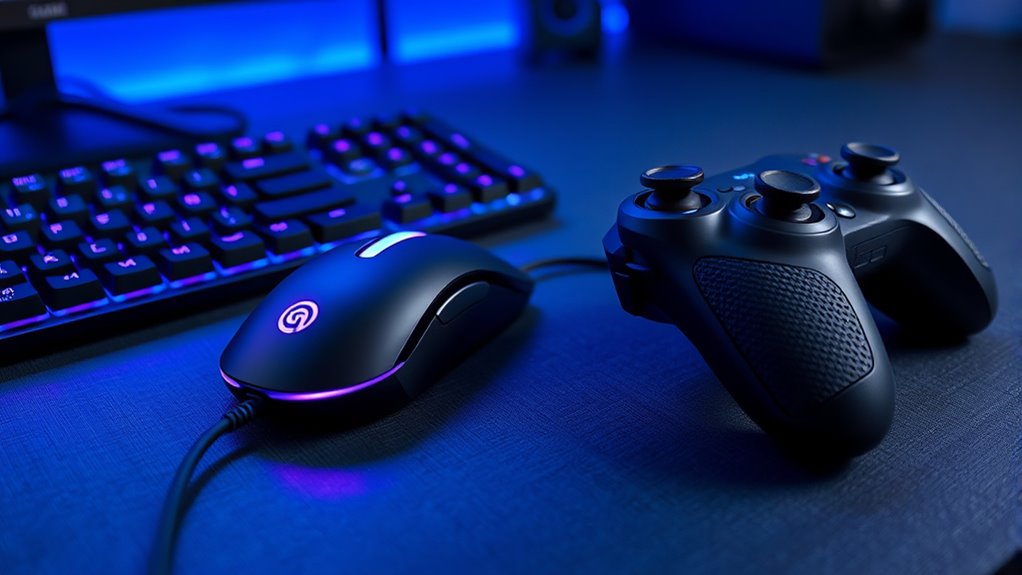
When it comes to precision and control in shooting games, many players find that a keyboard and mouse offer a significant advantage over controllers. With a mouse, you can make small, accurate movements, essential for aiming and quick reactions. Customizable button mapping lets you assign commands exactly how you like, streamlining your gameplay and reducing misclicks. Unlike controllers, which often rely on limited buttons, a keyboard provides a wide range of options for complex actions. Additionally, high refresh rates improve responsiveness and smoothness in fast-paced gameplay, giving players an edge in competitive scenarios. While haptic feedback adds immersion, it doesn’t directly influence your aiming precision. Overall, the combination of precise mouse movements and tailored button mapping gives you better control, making it easier to land shots and react swiftly in high-stakes moments. Additionally, understanding Youngster Choice can help players develop better gaming strategies and improve overall performance. Moreover, the use of ergonomic setups can reduce fatigue during extended gaming sessions, enhancing your overall precision and comfort. Proper ergonomic design ensures that your hands and wrists stay comfortable, which can help maintain consistent accuracy over long gaming periods.
Comfort and Accessibility for Extended Play

While precision and control are essential for competitive play, comfort and accessibility considerably impact your performance over long gaming sessions. An ergonomic design ensures your hands and wrists stay comfortable, reducing fatigue and preventing strain during extended play. Keyboards and controllers with adjustable grips, padded surfaces, and customizable buttons enhance comfort and make gameplay less tiring. Accessibility features, such as programmable keys or adaptive controllers, allow you to tailor your setup to your needs, making prolonged gaming sessions more manageable. If you prioritize comfort and accessibility, choose equipment that supports your natural posture and offers easy customization. Incorporating ergonomic design principles can further optimize your setup for extended play, and selecting products with ergonomic features can make a significant difference. Paying attention to user-centered design ensures that your gear adapts to your unique gaming style and physical needs, promoting longer, more comfortable gaming sessions. Additionally, considering adaptive technology can help address specific physical limitations and enhance overall comfort during extended gameplay. Using ergonomics as a guiding principle helps prevent discomfort and supports sustained performance.
Responsiveness and Input Lag

Responsiveness and input lag directly influence how quickly your commands translate into in-game actions, which can make or break your performance. With a keyboard and mouse, you generally experience lower input lag, giving you faster reactions, especially in competitive games. Controllers often introduce slight delays, but advancements like haptic feedback can help you feel in-game events, compensating somewhat for slower response times. The ergonomic design of a controller also impacts responsiveness; a comfortable grip allows for steadier inputs, reducing accidental moves. Haptic feedback adds a tactile layer, making delays less noticeable by providing immediate physical cues. Properly calibrated hardware can further optimize response times, ensuring your inputs are as precise as possible. Ultimately, if quick reactions are critical, a keyboard and mouse tend to offer superior responsiveness, but well-designed controllers with good ergonomic features and haptic feedback can still deliver a satisfying, responsive experience.
Adaptability Across Different Game Genres
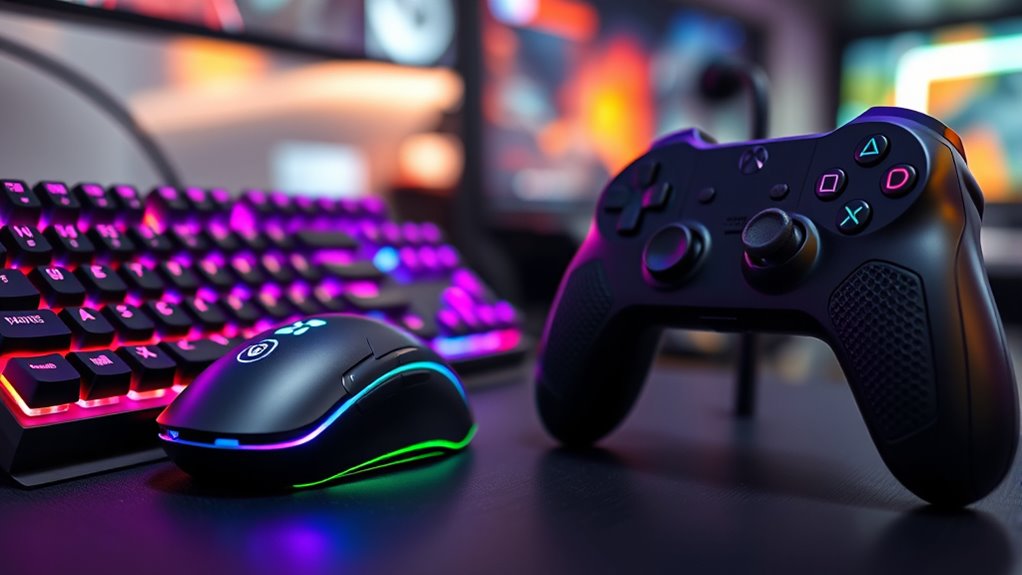
The way a control method adjusts to different game genres can substantially impact your overall experience. Keyboard versatility shines in genres like first-person shooters and strategy games, offering precise aiming and quick commands that enhance gameplay. Its adaptability makes it suitable for complex control schemes, allowing you to switch seamlessly between tasks. Additionally, piercing aftercare practices can serve as a reminder of the importance of proper maintenance and hygiene in all aspects of body modifications. While keyboards offer quick access to numerous functions, controllers provide smooth, natural motion controls. Research into user preferences shows that players often choose their preferred method based on comfort and familiarity, which can influence overall enjoyment. Your choice depends on the genre you play most; understanding how each method adapts ensures you’re equipped for a versatile gaming experience.
Customization and Personalization Options
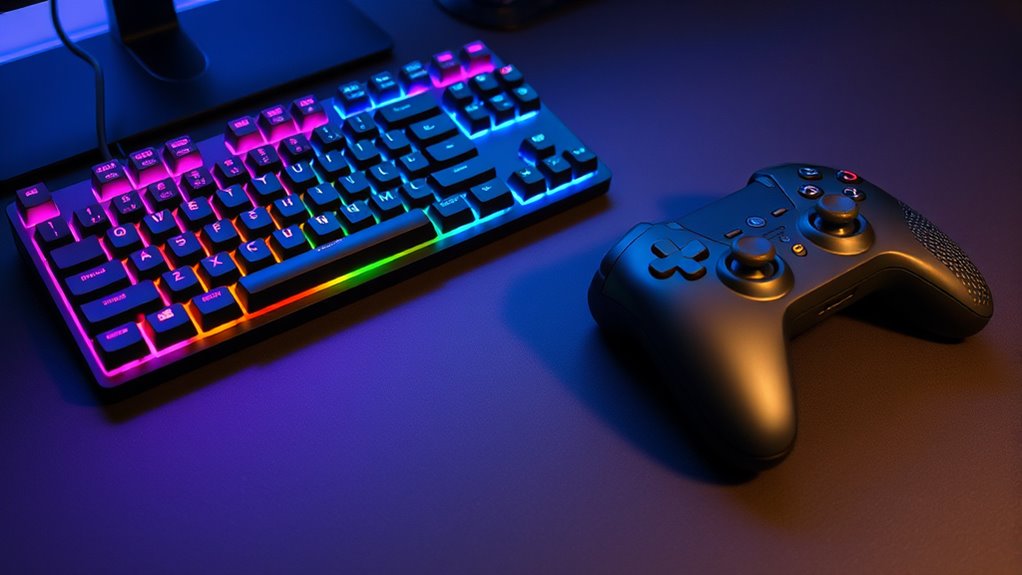
When it comes to customization and personalization, keyboards generally offer more extensive options than controllers. You can tailor your keyboard’s ergonomic design to fit your comfort, reducing strain during long gaming sessions. Many keyboards allow you to remap keys, create macros, and assign shortcuts, giving you a personalized setup for different games. Aesthetic customization is also highly flexible; you can choose mechanical switches, keycap colors, backlighting, and even custom designs to match your style. Controllers typically have fewer options—limited button remapping and limited visual customization. This means you have less control over your gaming environment’s look and feel. Overall, keyboards let you craft a setup that’s both comfortable and visually aligned with your personal preferences.
Frequently Asked Questions
Which Device Is More Cost-Effective Long-Term?
A keyboard and mouse are more cost-effective long-term because they offer better cost savings over time. They tend to have greater device durability, meaning you won’t need frequent replacements. Plus, their versatility ensures you can use them across various games and tasks without extra costs. While controllers might be cheaper upfront, investing in a good keyboard and mouse pays off with durability and long-term value, saving you money in the long run.
Can Controllers Be Used Effectively on PC?
Yes, controllers can be used effectively on PC. Many games support console compatibility, making it easy to connect your controller and play seamlessly. Plus, you can enjoy controller customization options to tailor your experience, adjusting button mappings or sensitivity settings. This flexibility guarantees you can optimize your gameplay, whether you’re playing casual or competitive titles, giving you a smooth and personalized gaming experience on your PC.
Do Controllers Support Macros or Advanced Inputs?
Did you know that around 40% of gamers customize their controllers? Yes, controllers can support macros and advanced inputs through button remapping and programmable keys. This allows you to assign complex commands or sequences to a single button, enhancing your gameplay. Whether you’re aiming for quick combos or strategic moves, using programmable keys helps you execute actions faster and more efficiently, tailored exactly to your gaming style.
How Do Input Devices Impact Multiplayer Game Fairness?
Input devices substantially impact multiplayer game fairness by affecting input precision and competitive advantage. If you use a keyboard and mouse, you typically gain better accuracy and faster reactions, giving you an edge over controller users. Conversely, controllers can offer more comfort and ease for some players but might compromise input precision. To keep fairness, many games implement cross-platform restrictions or input-based matchmaking, so your device choice can directly influence your competitive advantage.
Are There Ergonomic Benefits to One Device Over the Other?
You’ll find that keyboards and mice often offer better ergonomic comfort, reducing wrist strain thanks to adjustable angles and supported wrist rests. Controllers, on the other hand, tend to be more compact and can cause more wrist fatigue during extended play. If you prioritize long gaming sessions without discomfort, a keyboard and mouse may be the better choice for minimizing wrist strain and promoting ergonomic comfort.
Conclusion
Ultimately, choosing between a keyboard and mouse or a controller depends on your gaming style. Think of your setup as a trusty compass guiding your adventure—each tool offers unique paths to victory. Whether you crave pinpoint precision or effortless comfort, pick what feels right in your hands. Remember, the best choice is the one that makes your gaming journey feel like a smooth sail across your favorite digital seas.