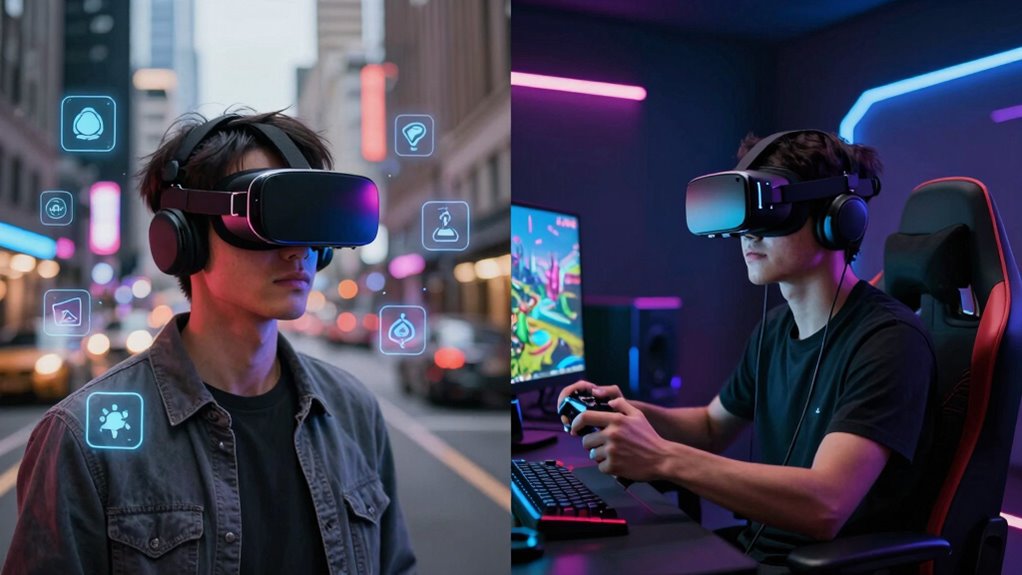

AR gaming blends digital content with your real-world surroundings, perfect for outdoor fun and social exploration, while VR immerses you fully in a digital universe, ideal for intense, solitary experiences. AR offers more natural interactions using smartphones or glasses, whereas VR requires headsets and controllers for full immersion. If you’re curious about which type provides more immersive fun and how their features compare, exploring further reveals exciting insights into these immersive worlds.
Key Takeaways
- AR overlays digital content onto the real world, while VR immerses users in fully digital environments.
- VR offers deep immersion and complete sensory isolation, whereas AR maintains spatial awareness and blends with reality.
- AR gaming is more accessible, using smartphones or glasses, while VR requires specialized headsets and hardware.
- VR supports immersive genres like first-person shooters and fantasy, with a focus on virtual social interactions.
- The fun factor depends on personal preference: full virtual immersion (VR) or engaging real-world interaction (AR).
Understanding the Technology Behind AR and VR
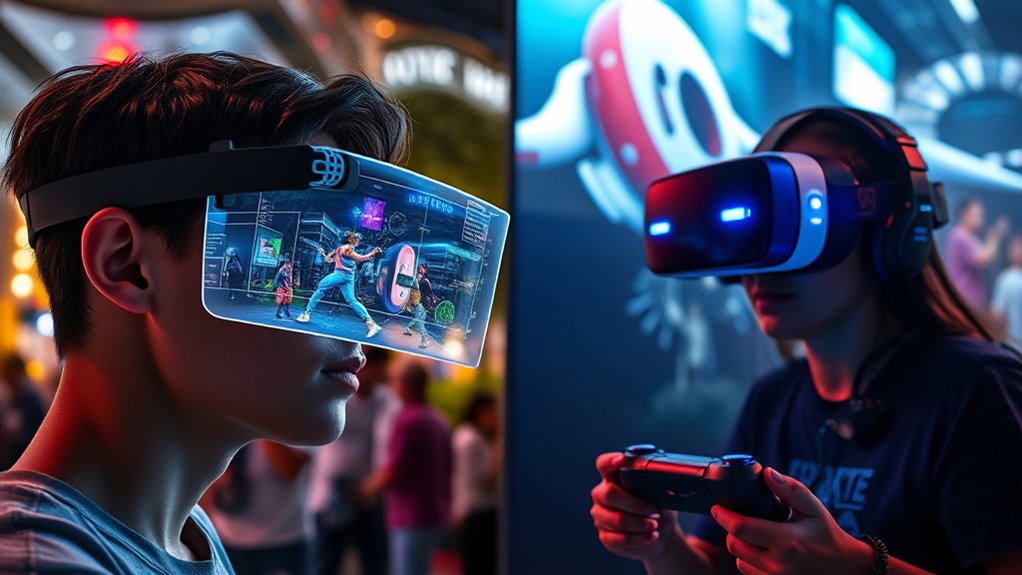
Have you ever wondered how AR and VR technologies create such immersive experiences? It all comes down to how they blend digital and real environments. Augmented reality overlays digital images directly onto your real-world view, usually via smartphones or smart glasses, enhancing your surroundings with virtual elements. Virtual environments, on the other hand, are entirely computer-generated worlds that you enter through VR headsets. These headsets track your movements and adjust the visuals accordingly, making you feel like you’re truly inside a different space. Both technologies rely on sensors, displays, and processing power to deliver seamless experiences. Contrast ratio also plays a role in how vivid and realistic these visuals appear. By understanding these core differences, you can better appreciate how AR enhances reality and how VR transports you into entirely new virtual environments. Additionally, the processing power involved is crucial for creating smooth, responsive experiences that feel natural and engaging. Furthermore, the quality of visual rendering significantly impacts the realism and immersion of both AR and VR experiences.
How Users Experience AR and VR Environments

When you explore AR and VR environments, you’ll notice differences in immersion, interaction, and spatial awareness. VR often provides a fully immersive experience, while AR overlays digital elements onto your real surroundings. Your sense of space and how you interact with the environment greatly influence your overall experience. Additionally, family photoshoot fails can sometimes occur during AR or VR gaming sessions, adding humorous or unexpected moments to your experience. Understanding the spatial awareness involved can help you better appreciate the unique qualities of each technology.
Immersion Levels
Immersion levels in AR and VR gaming profoundly shape how you experience virtual environments. With augmented reality, you remain aware of your real-world surroundings while digital elements overlay your view, creating a blended experience. This enhances immersion by integrating virtual objects into your real environment, making interactions feel natural. Conversely, virtual reality offers a fully immersive experience by transporting you into a completely digital world. Wearing a VR headset isolates you from your physical surroundings, heightening your sense of presence within the game. The depth of immersion in VR can feel almost tangible, while AR’s immersion depends on how seamlessly digital content interacts with the real world. Both technologies aim to captivate you, but VR tends to provide a more intense, all-encompassing experience. In Free Floating environments, the level of spatial awareness also plays a crucial role in how immersive the experience feels.
Interaction Methods
Interaction methods in AR and VR gaming define how you engage with virtual environments, shaping the overall experience. In AR, you often use gesture control to manipulate digital objects or navigate menus, making interactions feel natural and intuitive. Voice commands also play a significant role, allowing you to control functions hands-free, enhancing immersion without breaking the flow. VR gaming, on the other hand, relies heavily on motion controllers that track your hand movements, enabling precise interactions like grabbing or pointing. Some VR setups incorporate gesture control and voice commands as well, adding layers of realism. Both platforms aim to make your interactions seamless, but the methods differ in how directly they connect you to the environment. Your choice depends on which interaction style feels more natural to you. Detecting passive voice can help make your interactions more engaging and dynamic.
Spatial Awareness
Spatial awareness in AR and VR gaming shapes how you perceive and navigate virtual environments. With augmented perception, you become more attuned to your surroundings, blending real-world cues with digital elements. In AR, your spatial navigation relies on integrating virtual objects into your real environment, making movements feel natural and intuitive. VR, on the other hand, immerses you in a fully digital space, where your sense of space depends on tracking devices that monitor your head and body movements. This heightened spatial awareness enhances immersion, making you feel genuinely present. As a result, your ability to understand and interact with virtual environments improves, creating a seamless experience that bridges the gap between reality and the virtual world.
Hardware Requirements for AR and VR Gaming
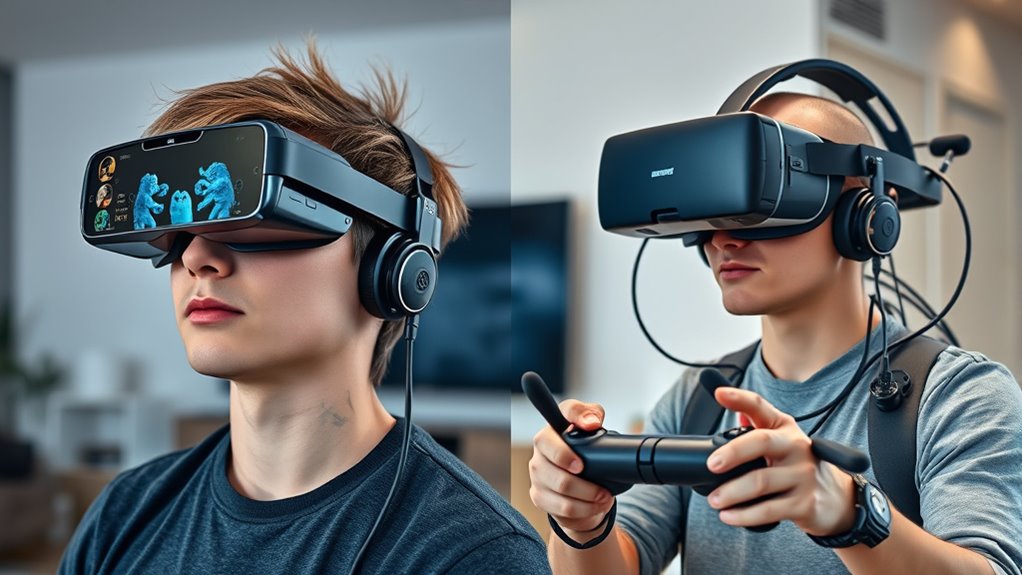
To enjoy AR and VR gaming at their best, your hardware needs to meet specific requirements that can vary considerably between the two. For augmented reality, hardware compatibility is vital; you’ll need a device with a camera, sensors, and sufficient processing power. VR gaming demands more robust equipment, like high-performance GPUs and dedicated headsets, to guarantee smooth experiences. Check the table below for key hardware components:
| Component | AR Requirements | VR Requirements |
|---|---|---|
| Display | Smartphone or AR glasses | VR headset with high resolution |
| Sensors & Cameras | Cameras for environment mapping | Motion sensors and tracking |
| Processing Power | Moderate (smartphones/tablets) | High (gaming PC or console) |
Additionally, hardware compatibility plays a crucial role in ensuring seamless integration and device calibration is also essential for an immersive and comfortable gaming experience. Proper calibration can significantly impact the immersive experience, making it more comfortable and realistic. Guaranteeing hardware compatibility is essential to fully enjoy immersive AR and VR gaming experiences.
Types of Games Popular in AR and VR Platforms
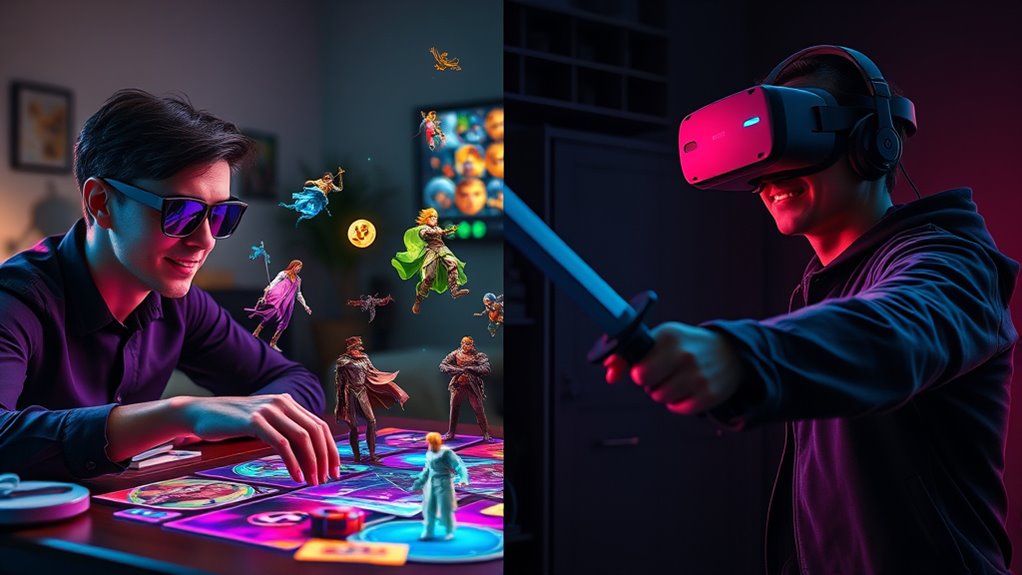
The variety of games found on AR and VR platforms reflects their unique capabilities and user experiences. In augmented reality, you’ll find games that blend digital elements with the real world, like scavenger hunts, interactive puzzles, and location-based adventures. These games often encourage exploration and real-world movement, making them highly engaging. Additionally, AR games frequently utilize location-based technology to enhance gameplay, adding an extra layer of interactivity. The use of consecration in game design can deepen players’ emotional connection and sense of achievement. Moreover, the integration of social features in AR gaming allows for multiplayer interactions that foster community engagement and shared experiences. Virtual reality, on the other hand, offers immersive experiences such as first-person shooters, fantasy adventures, and simulated sports. You can explore fantastical worlds or participate in realistic training scenarios. Both platforms support genres that capitalize on their strengths—AR enhances real-world interaction, while VR creates entirely new environments. Whether you prefer the blended reality of AR or the total immersion of VR, each platform offers a diverse range of popular game types tailored to different interests. Additionally, the technological capabilities of each platform continue to evolve, expanding their potential for innovative gaming experiences. Furthermore, advancements in hardware and software development are consistently pushing the boundaries of what’s possible in both AR and VR gaming.
The Social Aspect of AR and VR Gaming

While AR and VR gaming both offer immersive experiences, their social aspects differ considerably. In AR gaming, multiplayer dynamics often involve real-world interactions, encouraging social connectivity through shared locations and casual play with friends nearby. You can easily team up or compete with others in your environment, making the experience feel more spontaneous. Additionally, AR games often foster a sense of local community engagement, as players interact in shared physical spaces that strengthen social bonds. This physical interaction can enhance social bonds more effectively than purely virtual connections. Moreover, AR gaming encourages outdoor activity, which can promote healthier social interactions and physical well-being. The integration of augmented reality technology into daily life can further amplify these social benefits by blending digital interactions with real-world experiences. VR gaming, on the other hand, emphasizes virtual social connectivity, allowing you to meet people from around the world in shared digital spaces. You can chat, collaborate, or compete in multiplayer environments that feel remarkably real. However, VR’s social interactions can sometimes be limited by hardware requirements or social comfort levels. Additionally, understanding the net worth of public figures involved in the gaming industry can influence perceptions of the platforms’ growth and development. Overall, both platforms foster social connections, but AR emphasizes physical interaction, while VR focuses on virtual community building.
Advantages and Limitations of AR Gaming

Augmented Reality (AR) gaming offers several compelling advantages, such as blending digital content seamlessly with the real world, which enhances immersion and encourages outdoor activity. With AR hardware like smartphones or smart glasses, you can interact with virtual objects overlaid onto your surroundings, making gameplay feel natural and engaging. Additionally, AR hardware continues to improve, enabling more precise interactions and richer experiences. As AR technology advances, developers are creating more sophisticated interactive environments that enhance user engagement. Furthermore, the integration of sensor technology can improve the accuracy and responsiveness of AR interactions, making gameplay more seamless. Moreover, cultural symbols can be incorporated into AR experiences to add meaningful context and depth to gameplay, enriching the user’s connection to the virtual content. However, AR gaming also has limitations. Its performance heavily depends on the quality of your device’s AR hardware, which can vary markedly. Unlike VR controllers, which provide precise input in virtual environments, AR often relies on simpler gestures or device sensors, reducing accuracy. Additionally, AR games can be constrained by environmental factors, such as lighting conditions and physical obstacles, which may limit where and how you play effectively. Smart Home Technology can sometimes optimize AR experiences by adjusting lighting or environmental settings to improve gameplay conditions.
Advantages and Limitations of VR Gaming

Virtual Reality (VR) gaming immerses you completely in digital worlds, offering a sense of presence that traditional gaming can’t match. It transports you to virtual environments where you can interact naturally, making gameplay more engaging. However, VR has limitations, such as the need for bulky equipment and space. Unlike augmented reality, which overlays digital info onto the real world, VR isolates you from your surroundings. This can cause discomfort or motion sickness for some players. Also, VR setups can be costly and require technical know-how. Additionally, navigation and mapping can be complex, impacting user experience and safety. To ensure a safe experience, proper space awareness and setup are essential, especially in confined areas.
Which Experience Offers More Immersive Fun?

Both VR and AR gaming aim to create immersive experiences, but they do so in fundamentally different ways. Virtual reality fully transports you to a digital world, surrounding you with detailed environments and realistic interactions that make you feel like you’re really there. It blocks out your physical surroundings, offering intense immersion. Augmented reality, on the other hand, overlays digital elements onto your real environment, blending virtual objects with the world around you. While AR can be engaging and fun, it often doesn’t provide the same level of deep immersion as VR. If you seek a totally immersive experience that transports you to another universe, VR is more immersive. However, if you prefer a mix of real and virtual, AR offers a different, engaging type of fun.
Frequently Asked Questions
Can AR and VR Gaming Be Combined for a Hybrid Experience?
Yes, you can combine augmented reality and virtual reality for a hybrid experience. This integration lets you enjoy immersive virtual worlds while still interacting with the real environment through augmented reality elements. Developers are exploring ways to blend these technologies, creating more engaging and versatile gaming experiences. As a player, you’ll get the best of both worlds—immersive virtual gameplay with real-world interactions—making your gaming sessions more dynamic and fun.
How Does Motion Sickness Affect AR and VR Gamers Differently?
Imagine you’re on a roller coaster, feeling the thrill yet sometimes overwhelmed—that’s similar to motion sickness in VR and AR gaming. VR gamers often experience more motion sickness because of full immersion and head tracking, which can disrupt your comfort level. AR tends to cause less discomfort since it overlays digital images onto the real world, helping you stay grounded. Your comfort level varies, so take breaks to enjoy gaming without feeling queasy.
ARe There Age Restrictions for AR and VR Gaming Platforms?
Yes, there are age restrictions for AR and VR gaming platforms, typically based on safety guidelines. You should verify each platform’s specific age requirements before allowing children to play. Usually, VR headsets recommend users aged 12 or older, while AR games are often suitable for younger players. Following safety guidelines is essential to prevent injuries and ensure an enjoyable experience for users of all ages.
What Are the Environmental Space Requirements for Safe Gameplay?
Sure, you’re about to become a digital hero, but first, check your space! For safe gameplay, you need enough room for spatial awareness and obstacle navigation—usually at least 6.5 by 6.5 feet for VR, and a clear area for AR to avoid smashing lamps or tripping over pets. Clear clutter, stay aware of your surroundings, and remember: even virtual worlds demand real-world caution.
How Do AR and VR Gaming Impact Physical Health Over Long Periods?
Long-term AR and VR gaming can affect your physical health by causing visual strain and posture issues. You might experience eye discomfort or headaches from prolonged screen time, and poor posture during extended gameplay can lead to neck or back pain. To minimize these risks, take regular breaks, adjust your equipment properly, and maintain good posture. Staying mindful of these factors helps you enjoy immersive gaming without compromising your health.
Conclusion
Whether AR or VR gaming is more fun depends on what you value—AR offers seamless real-world integration, but VR delivers full immersion. Some worry VR might cause motion sickness, yet many find the immersive experience worth it. Ultimately, trying both lets you see which suits your style. Don’t dismiss one just because it’s new; embracing both can broaden your gaming horizons and deepen your enjoyment. So, plunge into and discover your favorite virtual adventure.