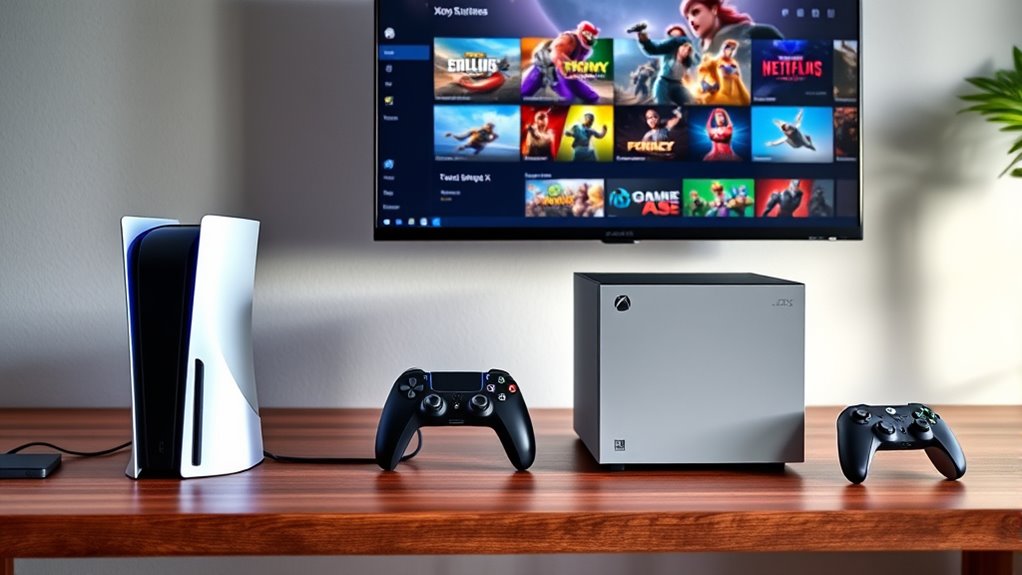

Cross-play lets you play multiplayer games with friends on different platforms like PlayStation, Xbox, or PC, breaking hardware barriers and expanding your gaming options. Cross‑save, on the other hand, allows you to transfer your game progress, settings, and accessible content between devices seamlessly. While cross‑play connects you with a larger community, cross‑save keeps your personalized experience intact across multiple devices. To get a clear picture of how they differ, explore more about these features and what they bring to your gaming journey.
Key Takeaways
- Cross-play enables multiplayer gaming across different platforms, while cross-save transfers game progress between devices.
- Cross-play connects players in the same session regardless of hardware, whereas cross-save allows seamless continuation of saved data.
- Cross-play requires real-time server synchronization for fair multiplayer interaction; cross-save relies on cloud storage or account linking.
- Cross-play broadens multiplayer engagement by including diverse platforms; cross-save enhances game continuity across devices.
- Both features improve gaming experience but serve different purposes: one for multiplayer access, the other for progress transfer.

When exploring modern gaming features, it’s important to understand the difference between cross-play and cross-save. These terms are often used interchangeably, but they serve distinct purposes. Cross-play allows you to play with friends on different gaming platforms, meaning you can jump into the same multiplayer session regardless of whether you’re on PlayStation, Xbox, PC, or another device. Think of it as a way to break down barriers between platforms, creating a larger, more connected gaming community. On the other hand, cross-save focuses on game data continuity. It enables you to transfer your saved game progress, settings, and unlocks across different devices or platforms. So, if you start a game on your console and want to continue on your PC or handheld device, cross-save makes that seamless transition possible.
Cross-play connects you with friends across platforms; cross-save keeps your progress intact across devices.
Understanding multiplayer synchronization is key when it comes to cross-play. When you join a multiplayer match, the game must synchronize your actions, stats, and game state with other players in real time. This synchronization guarantees that everyone experiences the game fairly and smoothly, regardless of their platform. Without proper multiplayer synchronization, you could face lag, inconsistent gameplay, or even unfair advantages, ruining the experience for everyone involved. Cross-play also requires robust server infrastructure to manage these real-time interactions across different hardware setups. This infrastructure guarantees that your inputs, such as movement, attacks, or communications, are reflected accurately and promptly on everyone’s screens.
Game data continuity, which is central to cross-save, means your progress is preserved across devices. Imagine completing a challenging level on your console, then picking up right where you left off on your laptop during a commute. This continuity relies on cloud storage or account linking, ensuring your saved data isn’t confined to one device. This feature becomes especially valuable if you own multiple platforms or are considering switching devices. It saves you from the frustration of starting over or manually transferring files. Cross-save also preserves your unlocked content, customization, and settings, making the transition between devices effortless.
Both features critically enhance your gaming experience, but they do so in different ways. Cross-play expands your multiplayer options by connecting you with a broader community, while cross-save ensures your personal progress remains intact across multiple devices. Knowing how they differ helps you leverage each feature to get the most out of your games. Whether you’re battling alongside friends on different consoles or continuing your adventure on another device, understanding these concepts guarantees you’re making the most of what modern gaming has to offer.
Top picks for "cros play save"
Open Amazon search results for this keyword.
As an affiliate, we earn on qualifying purchases.
Frequently Asked Questions
Can Cross-Play and Cross-Save Be Used Together?
Yes, you can use cross-play and cross-save together. They work hand-in-hand to enhance your gaming experience by enabling multiplayer synchronization across platforms. To do this, you need to link your accounts properly, ensuring your progress and purchases are consistent. This way, you can seamlessly switch devices and play with friends on different platforms without losing your saved data, making your gaming more flexible and enjoyable.
Which Platforms Support Cross-Play and Cross-Save?
Imagine a vast digital universe where your adventure spans PlayStation, Xbox, PC, and Nintendo Switch. Most major platforms support cross-play and cross-save, enhancing your gaming freedom. However, platform compatibility varies, and some titles face feature limitations, meaning not all games or features sync perfectly across devices. Always check the specific game’s support details to guarantee seamless multiplayer experiences and shared progress across your chosen platforms.
Are There Any Costs Associated With Enabling Cross-Play or Cross-Save?
Enabling cross-play or cross-save usually doesn’t cost extra, but some games might have microtransactions or subscription fees that affect access. For example, if you’re using a premium service like PlayStation Plus or Xbox Game Pass, you might need a subscription to play online or save progress across devices. Always check the game’s specific requirements, as some developers charge for additional features or enhanced cross-platform functionality.
Do All Games Support Both Cross-Play and Cross-Save?
Not all games support both cross-play and cross-save. Some focus only on multiplayer connectivity, allowing you to play with others on different platforms, while others emphasize data synchronization, enabling your progress to transfer across devices. You’ll find many titles support cross-play but lack cross-save, and vice versa. Always check the game’s features before purchasing to guarantee it offers the multiplayer connectivity and data sync you want.
How Secure Is Cross-Save Data Across Different Devices?
Did you know that over 80% of gamers worry about data security? Cross-save data across devices is generally secure if companies use strong data encryption and require account linking. These measures protect your progress from hacking or theft. However, always make sure your accounts have strong, unique passwords, and enable two-factor authentication. While no system is completely invulnerable, these steps considerably boost your data’s security across different devices.
Conclusion
Now that you understand the difference, imagine your gaming experience as a seamless bridge connecting your friends across devices and worlds. Cross-play lets you jump into matches together, like stepping onto a shared stage, while cross-save is your trusty backpack, carrying your progress wherever you go. Whether you’re battling side by side or continuing your adventure on a different device, these features guarantee your gaming journey flows effortlessly, like a river that never stops moving forward.