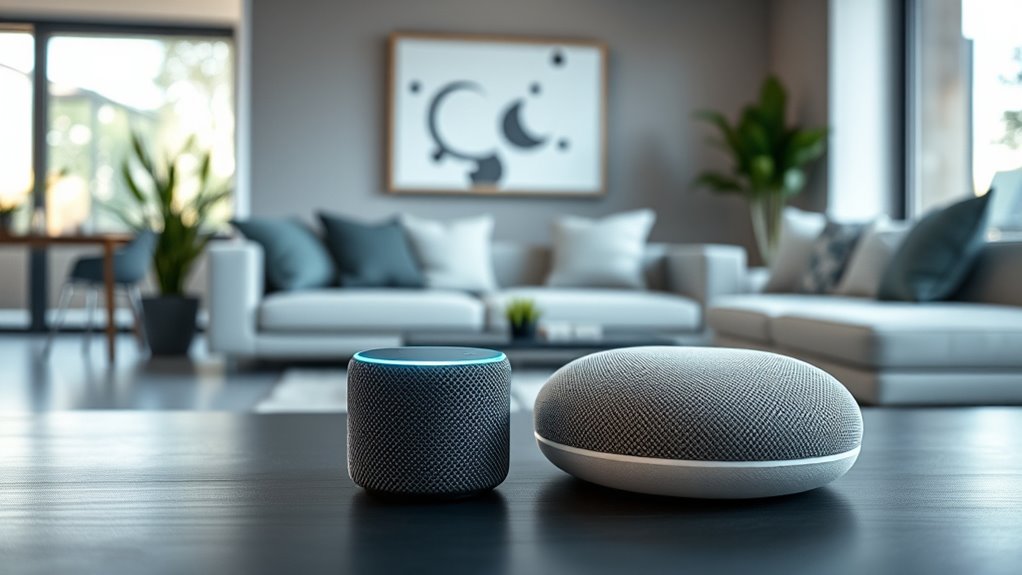

Choosing between Alexa and Google Assistant depends on your existing devices and priorities. If you use many Amazon products or want tight integration with Amazon Music, Alexa is a solid choice. If you prefer Google’s better natural language understanding and seamless connection with Google services like Gmail or Calendar, then Google Assistant suits you better. To make the most of your smart home, understanding their differences can help you choose the right one—there’s more to discover.
Key Takeaways
- Google Assistant excels in natural language processing and multi-language support, providing more conversational and nuanced interactions.
- Alexa offers broader device compatibility within Amazon’s ecosystem and tends to be more affordable across various price points.
- Google Assistant integrates seamlessly with Google services like Gmail and Chromecast, ideal for users invested in Google’s ecosystem.
- Alexa provides robust routines and customization options, especially for controlling smart home devices from various brands.
- Both platforms prioritize privacy and security, but choosing depends on ecosystem preferences and specific device compatibility needs.
Compatibility With Devices and Ecosystems

When it comes to compatibility with devices and ecosystems, Alexa and Google Assistant each have their strengths and limitations. Alexa excels with broad device compatibility, supporting thousands of smart home gadgets, especially from Amazon’s lineup. Its ecosystem integration works seamlessly within Amazon’s ecosystem, making it ideal if you already use Amazon products. On the other hand, Google Assistant offers robust ecosystem integration with Google services like Gmail, Calendar, and Chromecast, providing a more unified experience if you’re invested in Google’s ecosystem. While Alexa’s device compatibility is extensive, some devices may not work as smoothly outside Amazon’s ecosystem. Conversely, Google Assistant’s compatibility is slightly narrower but highly effective within Google’s ecosystem. Your choice depends on which devices and services you already rely on daily. Additionally, smart home integration is continually evolving, so staying informed about device compatibility updates can help optimize your smart home setup. Furthermore, understanding voice assistant ecosystems can guide your decision to ensure seamless smart home control and personal digital assistant use. Recognizing the importance of interoperability standards can also help you select devices that work well across different platforms and brands. A notable aspect is the power output of electric bikes, which can influence your choice depending on your riding needs and performance expectations. Staying updated on compatibility updates can ensure your devices remain compatible over time.
Voice Recognition and Natural Language Processing
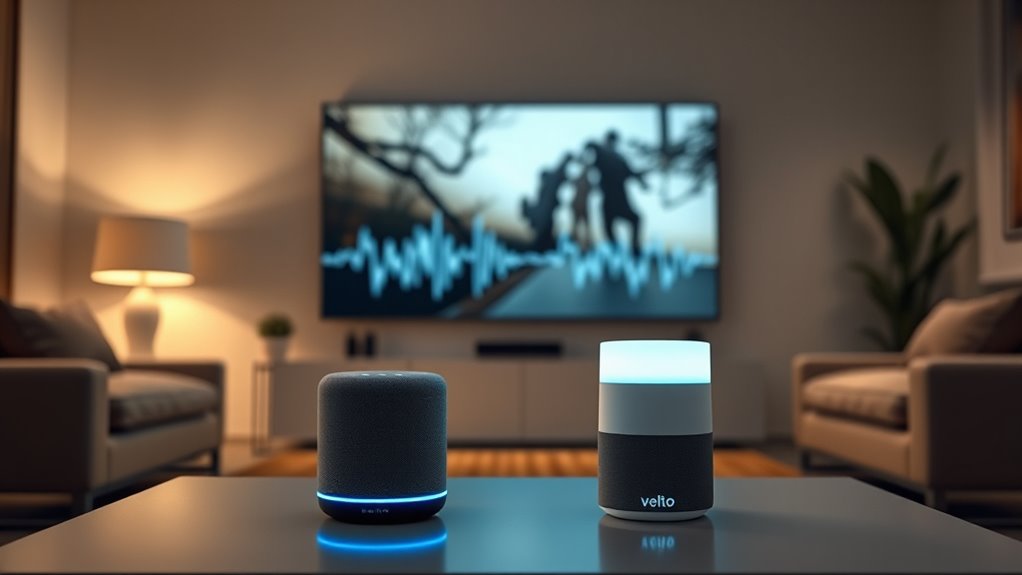
You’ll notice how well each assistant understands your commands through their speech comprehension accuracy. They also manage more natural conversations by recognizing context, making interactions smoother. Additionally, their language support ranges vary, affecting how many languages they can effectively interpret and respond to. Incorporating visual and auditory cues can further enhance users’ understanding and engagement with these voice assistants. Moreover, their adaptability to different user environments can influence overall effectiveness and user satisfaction, especially when considering voice recognition and natural language processing capabilities. The integration of advanced speech recognition technologies plays a crucial role in improving communication accuracy and responsiveness, which is essential for seamless smart home integration.
Speech Comprehension Accuracy
Speech comprehension accuracy is a critical factor that distinguishes Alexa and Google Assistant, as it directly affects how well each device understands and responds to your commands. Both platforms excel at voice training and accent adaptation, but Google Assistant often leads with more nuanced natural language processing. You may notice that Google can better understand diverse accents over time, improving its accuracy with ongoing use. Alexa, however, offers robust voice training features that help it recognize your speech more precisely. Here’s a quick comparison:
| Feature | Alexa | Google Assistant |
|---|---|---|
| Voice training | Strong, customizable | Adaptive, improves with use |
| Accent adaptation | Good, requires effort | Better at handling accents |
| Natural language | Slightly limited | More conversational |
| Overall accuracy | Reliable, improves over time | Slightly more precise |
Both assist you effectively, but your experience depends on your speech patterns. Additionally, speech recognition technology continues to advance, making these devices more accurate than ever before. As machine learning algorithms evolve, the gap in recognition accuracy between these assistants may further narrow. Furthermore, continuous updates enhance their capabilities, ensuring ongoing improvements in understanding.
Contextual Conversation Handling
While both Alexa and Google Assistant aim to maintain natural, flowing conversations, they differ markedly in how well they understand and respond to contextual cues. Google Assistant excels in contextual conversation handling by better interpreting follow-up questions and maintaining the thread of a dialogue. Its sophisticated natural language processing allows it to grasp subtle cues, making interactions feel more intuitive. Alexa has made improvements, but its voice command sensitivity sometimes falters with complex or layered requests. Additionally, Google Assistant offers broader multilingual support, seamlessly switching between languages during conversations, which enhances its contextual understanding for multilingual households. Overall, if handling context-rich conversations with nuanced understanding is important to you, Google Assistant offers a more advanced experience for natural, engaging interactions.
Language Support Range
Which assistant offers broader language support for voice recognition and natural language processing? Google Assistant leads with impressive multilingual capabilities, allowing you to speak in multiple languages seamlessly. It excels at dialect recognition, understanding regional accents and linguistic nuances, making interactions more natural for diverse users. Additionally, Google’s advanced natural language processing enables it to interpret complex commands across various dialects more accurately. If you need a voice assistant that comfortably handles multiple languages and dialects in your home, Google Assistant provides a broader and more flexible language support range. This makes it especially suitable for multilingual households or users who speak regional dialects. Furthermore, ear wax odor detection tools can help improve the clarity and naturalness of your commands. Improving voice recognition accuracy can further enhance your experience with these assistants. Incorporating multilingual support features can significantly boost the efficiency of your voice-controlled smart home systems, especially when paired with speech clarity enhancements.
Smart Home Integration and Automation Capabilities
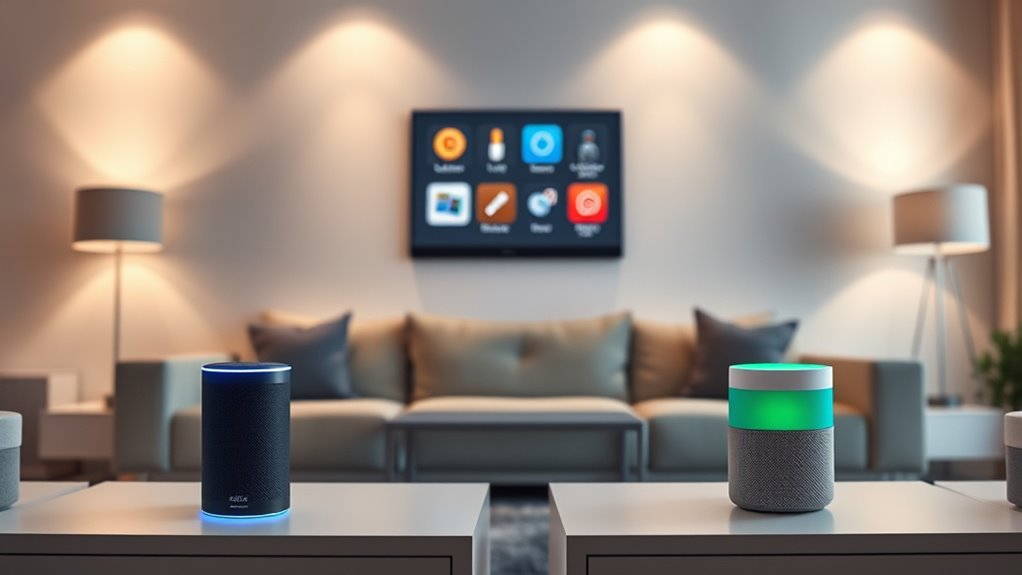
When it comes to smart home integration and automation capabilities, both Alexa and Google Assistant offer impressive features, but they approach connectivity differently. Alexa excels with its extensive device compatibility, making it easy to connect a wide range of smart home products. Its hardware design prioritizes energy efficiency, helping to reduce power consumption across your setup. Google Assistant, on the other hand, provides seamless automation through Google Home, integrating well with devices that support Google’s ecosystem. You’ll find it especially useful if you want a more streamlined setup that adapts to your routines. Both platforms support routines and voice commands, but Alexa’s broader hardware options give it an edge for versatile home automation. Additionally, smart device compatibility explains how choosing the right platform can maximize your smart home ecosystem. Your choice depends on your existing devices and priorities for energy efficiency, which can impact overall device performance and sustainability. Considering automation capabilities, both systems can be customized to fit different lifestyles and preferences, making smart home management more intuitive and responsive. Furthermore, customization options allow users to tailor routines and device controls to better suit their individual needs.
Music and Media Playback Features

Both Alexa and Google Assistant deliver strong music and media playback features, but they approach this function differently. Alexa excels with broad music streaming support, including Amazon Music, Spotify, and Apple Music, with seamless media controls. Google Assistant offers robust media controls and integrates smoothly with YouTube Music and Spotify, making it easy to switch tracks or pause playback. Your choice depends on your preferred streaming service and device ecosystem. Here’s a quick comparison:
| Feature | Alexa | Google Assistant |
|---|---|---|
| Music streaming support | Amazon Music, Spotify, Apple Music | YouTube Music, Spotify |
| Media controls | Voice commands for playback, volume | Voice commands, device controls |
| Compatibility | Wide range of Echo devices | Google Nest devices |
| Playlists & Stations | Easy to access and customize | Smart suggestions and playlists |
| Multi-room audio | Supported with compatible speakers | Supported with compatible speakers |
Additionally, content delivery methods play a significant role in how effectively each assistant manages media playback across devices.
Privacy and Security Measures
As you compare Alexa and Google Assistant, it’s crucial to contemplate how each handles your privacy and security. Both platforms have detailed privacy policies that explain how your data is collected, stored, and used. Alexa allows you to review and delete voice recordings through the app, giving you some control over your privacy. Google Assistant also offers options to manage your data, including deleting activity logs. Security updates are regularly pushed to both devices to patch vulnerabilities and enhance protection. However, it’s vital to stay informed about each company’s latest security practices. While both assistants prioritize user safety, understanding their privacy policies and ensuring your devices receive timely security updates helps you maintain control over your personal information.
Routine Customization and Personalization Options

Both Alexa and Google Assistant let you customize routines to fit your daily habits, making your smart home more responsive. You can set up personalized features that trigger specific actions based on your preferences, time, or location. Plus, their flexibility with custom commands means you can tailor interactions to suit your unique needs effortlessly.
Personalized Routine Features
When it comes to personalized routines, Alexa and Google Assistant each offer robust customization options to tailor your smart home experience. You can set routines that trigger with a specific voice command, adjusting your environment seamlessly. Imagine waking up to your favorite music streaming playlist, lights gradually brightening, and your coffee brewing—all with a single voice control.
- Create custom routines that activate based on time, location, or device status
- Personalize voice commands for different family members
- Sync routines with your music streaming services for instant playlists
Both assistants let you craft routines that fit your lifestyle, making daily tasks effortless. Whether you prefer Alexa’s extensive skill integrations or Google’s smart device compatibility, personalized routine features put your smart home at your command.
Custom Command Flexibility
While both Alexa and Google Assistant allow you to customize routines, they differ considerably in the flexibility and depth of personalization options they offer. Alexa provides extensive user customization options, letting you create complex routines with multiple steps triggered by simple or intricate voice commands. You can tailor responses and add conditional logic to make routines more dynamic. Google Assistant, on the other hand, tends to favor straightforward routines with less emphasis on voice command complexity. Its customization options focus on ease of use, but it may limit the depth of personalization you can achieve. If you prefer intricate, multi-layered routines, Alexa’s platform offers greater flexibility. For simpler, more intuitive customization, Google Assistant can still meet your needs effectively.
Pricing, Availability, and Additional Features
How do Alexa and Google Assistant compare when it comes to pricing, availability, and extra features? Both offer a range of devices at different price points, with Alexa devices generally slightly more affordable. You can find smart speakers in various sizes and capabilities, catering to different needs. Availability-wise, both assistants are widely accessible globally, though regional features may vary. When it comes to additional features, Alexa’s smart speaker design emphasizes seamless integration with Amazon’s ecosystem, strengthening its branding strategies. Google Assistant, on the other hand, focuses on superior voice recognition and smarter search capabilities.
- Think of sleek, modern smart speaker designs that blend into your home decor.
- Visualize Amazon and Google branding strategies shaping your perception of quality.
- Picture feature-rich devices offering voice control, streaming, and smart home integration effortlessly.
Frequently Asked Questions
Which Device Offers Better Multilingual Support?
Google Assistant offers better multilingual support, making it easier for you to communicate in multiple languages. Its multilingual capabilities allow seamless language switching without needing to change settings, which is especially useful if you speak more than one language at home. Alexa also supports multilingualism but isn’t as smooth with language switching. If you prioritize effortless multilingual capabilities, Google Assistant is the better choice for your smart home.
How Do Updates Impact Device Performance Over Time?
Software updates considerably impact your device’s performance over time by providing performance improvements, bug fixes, and new features. When you install updates promptly, your device runs more smoothly, responds faster, and stays secure against vulnerabilities. Neglecting updates can lead to sluggish performance and compatibility issues. Regularly updating ensures your device remains optimized, making your experience more reliable and enjoyable as it adapts to evolving technology and user needs.
Can Both Assistants Control Third-Party Smart Devices Equally?
Both assistants support third-party integration, but Google Assistant tends to offer broader compatibility with smart devices, making it easier for you to control various brands. Alexa also supports many third-party devices, but its voice customization options often give you more personalized control. Overall, if seamless third-party integration is key, Google Assistant might serve you better, while Alexa offers more voice customization for tailored commands.
Which Assistant Provides More Accurate Weather Forecasts?
Google Assistant generally provides more accurate weather forecasts, thanks to its superior forecast reliability and voice accuracy. When you ask about the weather, you’ll find its responses are more precise and up-to-date, helping you plan your day better. Alexa’s forecasts are good too, but Google’s integration with reliable weather data sources often gives it the edge in delivering the most accurate, current weather information for your location.
Are There Differences in Customer Support Quality?
In the sphere of customer support, you’ll find that Google Assistant generally offers better support responsiveness, leading to higher customer satisfaction. Like a well-oiled machine, their support teams tend to respond more swiftly and effectively to your concerns. Alexa’s support can sometimes be slower, but they still aim to resolve issues promptly. Overall, if quick, reliable assistance is your priority, Google Assistant’s customer support might be the better choice for you.
Conclusion
So, which smart assistant will truly transform your home? Imagine walking into a space where your voice commands effortlessly, your favorite music fills the room, and your devices respond seamlessly. Will Alexa’s compatibility or Google’s smarter AI take the crown? The choice isn’t just about features; it’s about how you envision your perfect smart home. The decision is yours—are you ready to make the leap into the future?