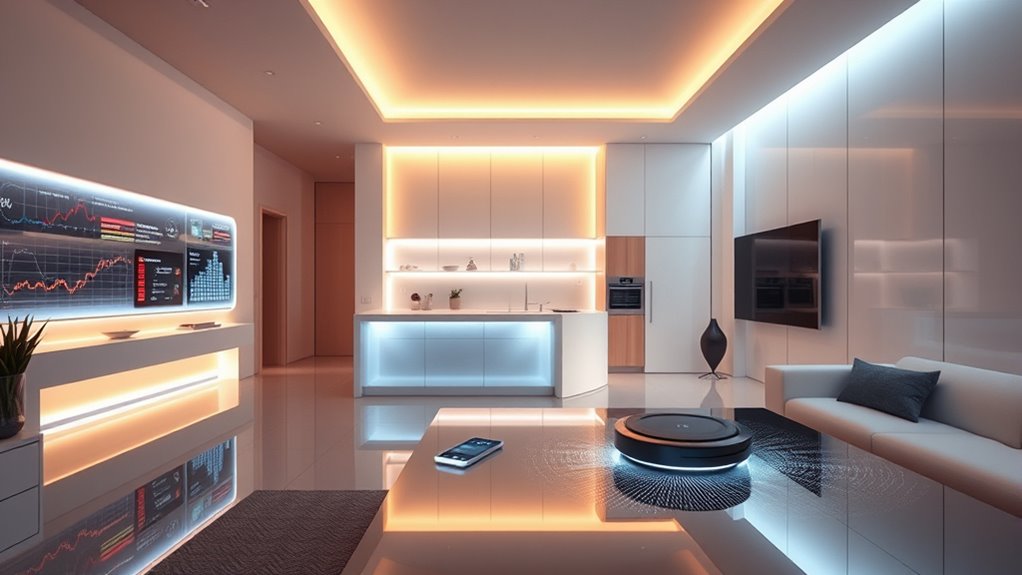

In 10 years, your smart home will be a highly integrated, intuitive space. Security systems will recognize you, disarm when you arrive, and alert authorities if needed. Energy management will optimize power use, saving costs and environmental impact. Devices will communicate seamlessly to automate routines like adjusting temperatures or locking doors. Over time, your home will proactively enhance comfort, safety, and efficiency. Stay tuned to discover how these smart features will transform your everyday life.
Key Takeaways
- Homes will proactively adapt to residents’ routines, optimizing comfort, energy use, and security automatically.
- IoT devices will be fully integrated, enabling seamless communication and synchronized responses across security, lighting, and energy systems.
- Advanced AI will enable homes to learn preferences and behaviors, providing personalized automation and predictive maintenance.
- Energy management will become more efficient with smart grids, solar storage, and real-time usage adjustments reducing costs and environmental impact.
- Living environments will evolve into intelligent partners, enhancing safety, convenience, and sustainability through real-time, automated decision-making.
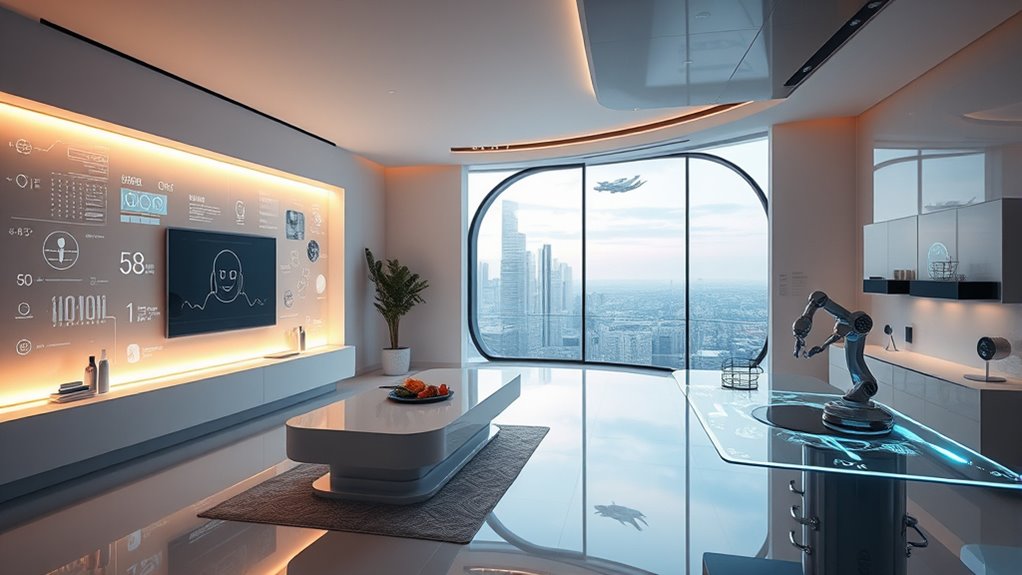
Over the next decade, the integration of Internet of Things (IoT) devices in homes will transform the way you live, making everyday tasks more seamless and personalized. One of the most noticeable changes will be in smart security and energy management. Your home will be equipped with intelligent systems that proactively protect you and optimize resource use without you needing to lift a finger. Imagine walking into your house and being greeted by a smart security system that recognizes you, disarms itself, and adjusts the lighting and climate to your preferences. These systems will analyze data from cameras, motion sensors, and doorbells to detect unusual activity, alerting you instantly if something seems off. They’ll also learn your routines over time, enabling automated responses that keep your home safer without constant manual input.
Energy management will become smarter and more efficient, saving you money and reducing your carbon footprint. IoT devices will monitor your energy consumption in real-time, providing detailed feedback and suggestions for reducing waste. Your smart thermostat will learn your schedule, adjusting the temperature automatically so you’re never heating or cooling an empty house. Solar panels and smart energy grids will work in harmony with your home systems, storing excess energy and distributing it where needed. You’ll be able to control all these aspects from your smartphone or voice assistant, ensuring your home is always optimized for comfort and efficiency, whether you’re home or away. Additionally, advancements in home automation will allow for even greater customization and adaptability, seamlessly integrating all these systems for a truly intelligent home environment.
As these systems evolve, they’ll become more intuitive and interconnected. Your security cameras, locks, lighting, and energy controls will communicate seamlessly, creating a cohesive ecosystem that responds to your needs in real time. For example, if your smart security system detects an intruder, it can lock doors, turn on exterior lights, and send alerts to your phone—all automatically. If you forget to turn off the oven or switch off unused lights, your home’s IoT network will handle it for you, preventing waste and potential hazards.
This level of integration will also extend to your daily routines, making your home more responsive and personalized. You might wake up to a morning routine where your coffee brews, blinds open, and your home adjusts to a perfect temperature—all triggered by your usual wake-up time and preferences. With IoT devices managing security and energy, your home will not only be safer but also more efficient, reducing costs and environmental impact while enhancing your comfort. In ten years, your home won’t just be a place to live—it’ll be an intelligent partner working tirelessly to improve your everyday life.
Top picks for "future home might"
Open Amazon search results for this keyword.
As an affiliate, we earn on qualifying purchases.
Frequently Asked Questions
How Will Iot Devices Ensure User Privacy?
IoT devices will protect your data privacy by implementing robust security protocols that prevent unauthorized access. They’ll encrypt your data during transmission and storage, ensuring only you can access sensitive information. Regular software updates and strong authentication methods will keep your devices secure. By prioritizing data privacy and security, IoT devices will give you peace of mind, knowing your personal information stays safe from malicious threats.
What Are the Energy Implications of Smarter Homes?
Have you considered how smarter homes impact energy use? They can markedly reduce energy consumption by optimizing heating, cooling, and appliance operation. Integrating renewable energy sources like solar panels further enhances efficiency and sustainability. While these innovations may initially increase device and infrastructure energy needs, overall, they promote smarter energy management, cutting costs and carbon footprint. Isn’t it worth embracing these changes for a greener, more efficient home?
Will Iot Homes Be Affordable for Everyone?
IoT homes will become more affordable as cost reduction efforts and market accessibility improve. As technology advances, prices for smart devices drop, making it easier for you to upgrade your home without breaking the bank. Increased competition and wider availability mean more options at various price points, so you’ll likely find IoT solutions that fit your budget. Over time, smart home technology will become a standard, accessible feature for many households.
How Will Iot Impact Home Insurance Policies?
You’ll likely see home insurance policies become more personalized thanks to IoT data management. Smart home security devices can detect risks early, reducing claims and premiums. Insurance providers may offer discounts for homes with connected sensors that monitor fire, water leaks, or break-ins. This proactive approach rewards responsible homeownership, giving you peace of mind and potentially lower costs as your smart home security systems work tirelessly to protect your family.
What Are the Risks of Increased Reliance on Iot?
You face risks like privacy concerns and security vulnerabilities as you rely more on IoT devices. Hackers can exploit weak points, putting your personal data at risk and potentially controlling your smart home systems. To protect yourself, make sure your devices have strong passwords, keep software updated, and limit data sharing. Staying vigilant helps you mitigate these risks and enjoy the convenience IoT offers without compromising your security.
Conclusion
In ten years, your home will be like a symphony, each device playing in perfect harmony to create a seamless living experience. IoT will anticipate your needs, turning your house into a responsive partner rather than just a space. Embrace this future, where technology becomes an extension of yourself, orchestrating comfort and convenience with every note. Together, you’ll dance through a home that’s smarter, more intuitive, and endlessly adaptable to your life.