
5G is the latest wireless technology that gives you faster internet speeds, lower delays, and more reliable connections compared to 4G. It uses advanced antennas and broader bandwidth to handle more devices at once and improve performance, especially in crowded areas. This means smoother streaming, quicker downloads, and better online experiences. If you’re curious about how 5G is transforming connectivity and what it can do for you, there’s much more to explore.
Key Takeaways
- 5G is the latest wireless technology that offers faster speeds, lower latency, and more reliable connections than 4G.
- It builds on 4G with technological improvements like increased bandwidth, advanced antennas, and network slicing.
- 5G supports more devices simultaneously and better handles crowded areas compared to 4G.
- It enables new innovations such as smart cities and autonomous vehicles with its enhanced connectivity.
- Overall, 5G provides quicker, more efficient, and more responsive wireless communication than 4G.
What Is 5G and Why Is It Important?

5G is the latest generation of wireless technology, designed to deliver faster speeds, lower latency, and more reliable connections than its predecessor, 4G. It drives wireless innovation by enabling smarter cities, autonomous vehicles, and advanced IoT devices. One key to its success is spectrum allocation, which involves distributing radio frequencies efficiently to support increased data demands. This improved spectrum management allows 5G networks to handle more devices simultaneously and provide consistent performance. Additionally, European cloud infrastructure plays a vital role in supporting the deployment of 5G networks across regions, ensuring secure and sustainable connectivity. The development of advanced antenna technology further enhances signal strength and coverage, contributing to more robust network performance. As a result, 5G isn’t just about faster browsing; it’s about transforming how you connect and interact with technology daily. Its importance lies in accessing new possibilities for industries, improving user experiences, and fostering future innovations that depend on high-speed, low-latency wireless connectivity. Effective study techniques and expert support can help users better understand and utilize this evolving technology.
How Does 5G Work Compared to 4G?
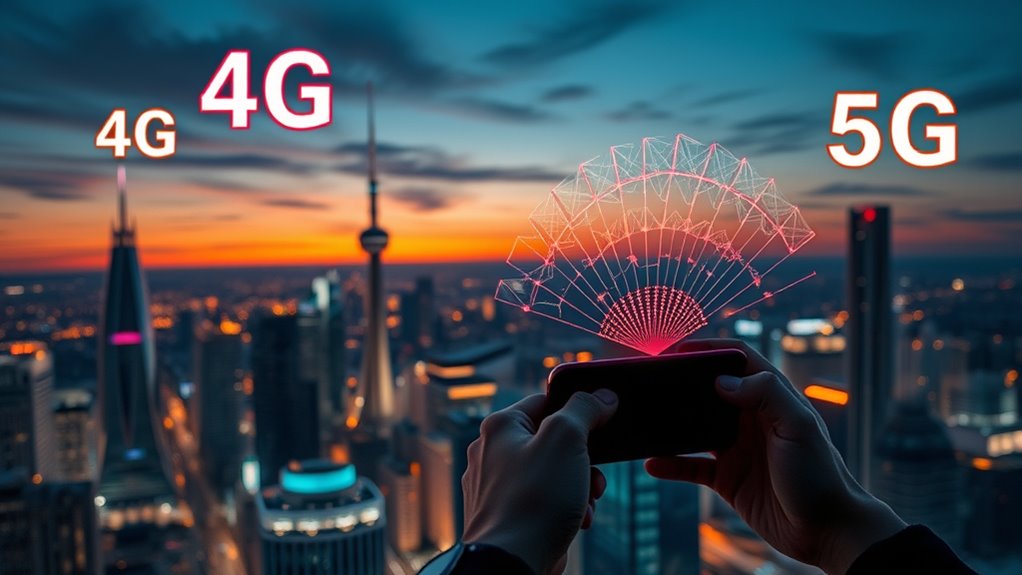
While 5G builds on the foundation set by 4G, it introduces significant technological advancements that set it apart. You’ll notice faster data transfer, thanks to increased bandwidth capacity, which allows more information to flow simultaneously. Additionally, 5G reduces network latency, so your connections are more responsive and real-time. Here’s how it differs:
5G offers faster data transfer, lower latency, and enhanced connectivity for a more responsive experience.
- *Higher bandwidth capacity* enables smoother streaming and downloads.
- *Lower network latency* means less delay during online gaming or video calls.
- *Advanced antenna technology* improves signal strength and coverage.
- *Massive MIMO* allows multiple data streams to send and receive simultaneously.
- *Network slicing* creates dedicated virtual networks for different uses, increasing efficiency.
- Understanding network infrastructure helps explain how these technological improvements are implemented and maintained. These improvements are made possible by advanced antenna technology, which enhances signal distribution and coverage across diverse environments. Upgrading to next-generation network hardware is essential to fully leverage these 5G capabilities.
Key Features of 5G Technology

One of the most impressive aspects of 5G technology is its array of key features that substantially enhance your wireless experience. Central to these features is an improved network infrastructure that supports faster speeds, lower latency, and greater reliability. 5G’s advanced network architecture allows for seamless connectivity even in crowded areas. Device compatibility is also a major feature, as many modern smartphones and gadgets are designed to work with 5G networks, ensuring you can upgrade without replacing all your devices. Additionally, 5G offers increased capacity, meaning more devices can connect simultaneously without slowing down. These key features work together to provide a more robust, efficient, and future-proof wireless experience, setting the stage for innovations like smart cities, autonomous vehicles, and enhanced streaming.
Benefits of Upgrading to 5G
Upgrading to 5G enables faster internet speeds, allowing you to stream, download, and browse with minimal delays. This leap enhances your online experience with smoother video calls and quicker app responses. Plus, 5G improves network security, making your data safer from cyber threats. It also offers better device compatibility, meaning more gadgets can connect seamlessly to the network. Additionally, you’ll benefit from higher capacity, reducing congestion during peak times. With 5G, your smart devices, IoT gadgets, and wearables work more efficiently, expanding your digital ecosystem. Overall, upgrading boosts your connectivity, security, and device integration, making everyday tasks faster and more reliable. Embracing 5G means a more robust, secure, and versatile mobile experience tailored to your needs.
Challenges and Future of 5G
Despite its promising benefits, 5G faces significant challenges that could hinder its widespread adoption. Security concerns are a major issue, as the increased connectivity opens more avenues for cyberattacks and data breaches. Ensuring data privacy and protecting networks will require robust security measures. Infrastructure challenges also pose hurdles; deploying 5G requires extensive new infrastructure, including small cell antennas and upgraded networks, which can be costly and time-consuming. Additionally, coverage in rural or remote areas remains limited, slowing overall growth. Looking ahead, the future of 5G depends on addressing these obstacles, improving security protocols, and expanding infrastructure. With ongoing advancements, 5G has the potential to revolutionize connectivity, but overcoming these challenges is essential for its full potential to be realized.
Frequently Asked Questions
Will 5G Coverage Be Available in Rural Areas Soon?
Yes, 5G coverage is gradually expanding to rural areas. Telecom companies are investing in infrastructure expansion to improve rural connectivity, but it may take some time before widespread coverage is available. Your best bet is to stay updated with local provider announcements, as they work to build the necessary infrastructure. In the meantime, you might experience limited 5G access in some rural locations, with full coverage coming in the future.
How Does 5G Impact Battery Life of Devices?
You might notice that 5G can increase battery consumption on your devices because it requires more power to maintain faster, more reliable connections. While this may slightly reduce device longevity, many smartphones optimize power usage to mitigate this effect. To extend your device’s battery life, consider turning off 5G when not needed or enabling power-saving modes. Overall, you’ll find that 5G’s benefits often outweigh its impact on battery life.
Is 5G Safe for Health and the Environment?
You might wonder if 5G is safe for health and the environment. Current research shows that 5G radiation safety standards limit exposure to levels considered safe, with no conclusive evidence linking it to health issues. Its environmental impact is minimal compared to other technologies. While ongoing studies continue, regulatory agencies maintain that 5G’s radiation emissions are within safe limits, making it a responsible choice for connectivity without significant environmental concerns.
What Are the Costs Associated With Upgrading to 5G?
Upgrading to 5G involves significant cost implications and upgrade expenses. You’ll need to invest in new compatible devices and potentially pay higher service fees. Network providers also face costs to upgrade infrastructure, which can lead to increased prices for consumers. While the benefits of faster speeds and improved connectivity are attractive, it’s important to contemplate these costs before making the switch to 5G.
How Will 5G Affect Current 4G Networks and Users?
You’ll notice that 5G can reduce network congestion, improving your overall experience. However, it might cause some initial issues for current 4G users if devices aren’t compatible yet, leading to slower speeds or connectivity hiccups. As 5G rolls out, it gradually enhances network capacity, but you’ll need compatible devices to fully benefit. Overall, 5G aims to complement and improve your existing 4G network, not replace it immediately.
Conclusion
As you explore 5G, you’ll discover it’s a game-changer, offering speeds up to 100 times faster than 4G. Imagine streaming HD videos seamlessly or downloading a full movie in seconds. With over 1.3 billion 5G connections worldwide by 2023, it’s clear this technology is transforming how you connect and communicate. Embracing 5G means unleashing faster, more reliable, and innovative experiences that will shape your digital future.