Many gadgets once seen only in sci-fi have become part of your daily life. Think back to Star Trek communicators—that inspired today’s smartphones, which now combine calls, internet, and videos. Wearable tech like smartwatches and AR glasses change how you see and interact with the world. Brain-computer interfaces let you control devices with your thoughts, while personal drones and flying taxis are making urban travel faster. Keep exploring to discover the fascinating journey from imagination to reality.
Key Takeaways
- Fictional communicators like *Star Trek* inspired the development of real-world smartphones with multifunction capabilities.
- Wearable AR devices such as smart glasses and jewelry now blend digital overlays with physical environments.
- Neural interfaces and brain-computer technologies enable thought-controlled gadgets, transforming assistive and gaming devices.
- Personal flight gadgets like drone taxis and jet packs are transitioning from science fiction to practical urban mobility solutions.
- Smart home and IoT devices, once imagined in sci-fi, now automate and optimize living environments through AI integration.
The Evolution of Communicators: From Star Trek to Smartphones

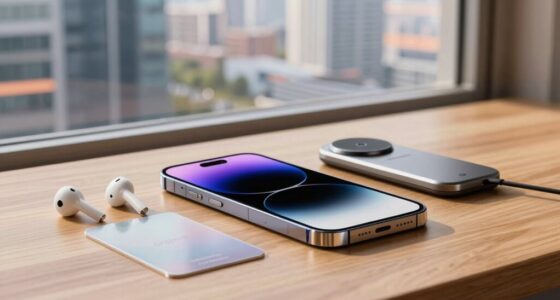
The concept of communicators has come a long way since their fictional debut in Star Trek. You’ve seen how communication evolution has transformed sci-fi ideas into everyday devices. Early on, these communicators were simple flip phones, but device innovation has pushed their capabilities far beyond. Today’s smartphones are the pinnacle of this evolution, combining voice calls, messaging, internet access, and even video chats in one sleek device. You no longer rely on bulky gadgets; instead, you carry powerful, multifunctional tools that connect you instantly across the globe. The journey from fictional communicators to smartphones showcases how technological breakthroughs continually redefine what’s possible. This relentless device innovation keeps you connected, making communication faster, easier, and more integrated into your daily life. Additionally, advancements in display technology have enhanced how we interact with these devices, making screens more vibrant and responsive than ever before. Furthermore, integration with energy-efficient cloud servers supports seamless, sustainable connectivity, ensuring these devices operate reliably and with reduced environmental impact.
Wearable Tech: Making the Impossible Possible

Although once considered science fiction, wearable tech now seamlessly integrates into daily life, making the impossible possible. You can wear gadgets that monitor your health, enhance your style, or even boost productivity. Fashion tech combines practicality with aesthetics, transforming clothing and accessories into smart devices. From fitness trackers to smartwatches, these innovations prove that wearable gadgets are no longer futuristic visions—they’re here now. Additionally, wearable technology trends continue to evolve, offering even more innovative features. As technology advances, the integration of AI-driven personalized experiences in wearable devices is becoming increasingly prevalent, enhancing user engagement and functionality. As the connectivity capabilities expand, these devices are becoming more intuitive and responsive to individual needs. The increasing miniaturization of components also allows for sleeker designs that blend seamlessly with everyday fashion. Moreover, user-friendly interfaces are making it easier for users of all ages to navigate and customize their wearable devices effortlessly. Here’s a quick look at some key examples:
| Device | Functionality | Style Element |
|---|---|---|
| Smartwatch | Notifications, fitness tracking | Sleek, customizable |
| Smart glasses | Augmented reality, notifications | Modern, discreet |
| Fitness bands | Heart rate, activity monitoring | Sporty, minimal |
| Smart jewelry | Notifications, wellness insights | Elegant, trendy |
| Clothing tech | Temperature control, sensors | Fashion-forward |
Augmented Reality: Blurring the Lines Between Virtual and Real

Wearable tech has already transformed how you stay connected and monitor your health, but augmented reality (AR) pushes those boundaries even further by blending digital elements with your physical environment. With AR, you experience virtual overlays that enhance your perception of the real world, creating seamless real world interaction. Imagine walking down the street and seeing directions or information floating right in your line of sight, or playing games that integrate perfectly with your surroundings. This technology allows you to access data instantly without pulling out a device, making interactions more intuitive. AR’s ability to merge digital and real-world experiences opens up exciting possibilities across entertainment, education, and even navigation, truly blurring the lines between virtual and tangible reality. Additionally, the integration of AR with advanced energy distribution systems could revolutionize how we manage and visualize energy consumption in real time, providing more efficient resource management. As AR continues to evolve, its potential to enhance user interfaces and create immersive environments will further transform our daily lives. The incorporation of virtual reality environments into AR experiences could also enhance training and simulation applications across various industries, making learning more engaging and effective. Incorporating essential oils into AR environments could also introduce calming or alertness-enhancing effects to improve user experiences in various settings.
Smart Homes and IoT Devices: Sci-Fi Dreams Turned Everyday Reality

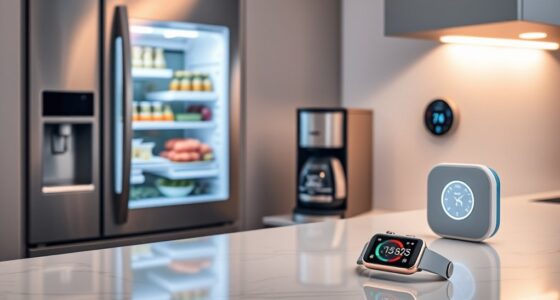
Smart homes and IoT devices have rapidly transformed from futuristic concepts into everyday essentials, allowing you to control lighting, thermostats, security cameras, and more with a simple tap or voice command. With smart security systems, you can monitor your home remotely, receive alerts, and automate locks for added safety. Energy management becomes effortless as you optimize heating, cooling, and lighting to save power and reduce bills. These devices learn your routines, adjusting settings automatically for comfort and efficiency. The integration of smart security and energy management creates a seamless experience, giving you peace of mind and control over your environment. Additionally, adaptive lighting systems can support circadian rhythms and accessibility needs, enhancing overall well-being. As these technologies become more sophisticated, they are increasingly integrating seamlessly with other smart home devices to create a cohesive living environment. Moreover, the development of artificial intelligence allows these systems to better anticipate and adapt to your preferences, making smart homes even more intuitive and user-friendly. This ongoing innovation ensures that smart homes remain a practical and accessible home automation solution for everyday life, transforming how we live and interact with our environment. The continuous advancement of connectivity plays a crucial role in enabling these seamless integrations. What once seemed like science fiction is now a practical, accessible part of daily life, making homes smarter and more secure than ever before.
Mind-Controlled Devices: Reading Thoughts and Controlling Gadgets

Brain-computer interface technology is making it possible to control devices with just your thoughts. You can now imagine controlling gadgets or reading your mind in real time. This breakthrough opens new possibilities for seamless interaction between humans and technology. For instance, neural interfaces of individuals involved in related fields can influence the development and funding of such innovations. As these devices become more sophisticated, they hold the potential to revolutionize at-home beauty tech by enabling personalized skincare routines controlled through thoughts. These advancements are grounded in ongoing research into brain signal decoding, allowing machines to interpret complex neural patterns with increasing accuracy. Additionally, the integration of neural decoding algorithms is helping improve the precision of thought-to-action translations, further enhancing device responsiveness.
Brain-Computer Interface Tech
Recent advances in brain-computer interface technology have made it possible to read your thoughts and control devices directly with your mind. This innovation pushes the boundaries of neural enhancement, allowing your brain to communicate seamlessly with external gadgets. Cognitive augmentation becomes more than just a concept; it’s an achievable goal, boosting mental capabilities through direct neural interaction. By placing sensors on your scalp or implanting microelectrodes, scientists can interpret neural signals and translate them into commands. This opens up possibilities for restoring mobility, aiding communication, or enhancing mental performance. As the technology evolves, you could soon experience a future where controlling devices feels intuitive, all while expanding your brain’s potential through neural enhancement. It’s a thrilling step toward merging mind and machine.
Thought-Driven Device Control
As brain-computer interface technology advances, controlling devices with your thoughts is becoming increasingly practical. Neural interfaces now enable you to operate thought-activated gadgets simply by thinking. These systems read your brain signals and translate them into commands, allowing you to control everything from computers to home appliances without physical input. With real-time feedback, you can switch lights on, scroll through playlists, or even adjust your thermostat by merely focusing your mind. This seamless interaction makes technology more intuitive and accessible, especially for those with mobility challenges. As neural interfaces continue to improve, the gap between thought and action narrows, transforming the way you interact with your environment and paving the way for smarter, more responsive gadgets driven directly by your brain. Additionally, ongoing research into Free Floating technology provides new opportunities for creating unobtrusive and versatile neural devices.
Real-Life Mind Reading
Thanks to advances in neural decoding, devices can now interpret your thoughts with surprising accuracy, turning mental signals into real-world actions. Neural decoding involves translating electrical signals from your brain into commands that machines can understand. With thought extraction techniques, researchers can identify specific mental patterns linked to intentions or desires. This technology enables you to control gadgets simply by thinking. For example, you might imagine moving your hand, and a device responds accordingly. These breakthroughs are making mind-controlled interfaces more precise and accessible. Although still in development, they open the door to assistive devices for those with disabilities and futuristic applications like mind-powered gaming. As neural decoding improves, controlling devices with your thoughts will become increasingly seamless and natural, bringing sci-fi concepts into everyday reality.
Flying Cars and Personal Drones: Taking off From Science Fiction

Imagine soaring through the skies with vertical takeoff technology that makes personal flight a reality. This innovation is transforming the way we think about transportation, putting the dream of flying cars within reach. Now, you can be part of the personal flight revolution, where mobility takes off from science fiction to everyday life. Exploring document management solutions can help you stay organized amidst these exciting technological advances. Staying informed about sleep hygiene and routines can ensure you’re well-rested to embrace these futuristic innovations. As these innovations evolve, understanding home renovation tools can help you adapt your living space for new mobility options and ensure your environment is ready for the future.
Vertical Takeoff Innovation
Vertical takeoff innovation has rapidly moved from science fiction to reality, transforming the way you think about transportation. Advances in vertical propulsion allow drones and small aircraft to lift off and land vertically, eliminating the need for runways. Companies now develop drone taxis that can navigate urban skies, offering quick, congestion-free travel. These craft use powerful rotors or fans to generate lift, making point-to-point travel faster and more efficient. As technology improves, the integration of autonomous systems and safety features becomes more reliable, bringing this futuristic mobility closer to everyday use. You can now imagine a skyline filled with personal drones and flying taxis, reshaping urban landscapes and reducing commutes. Vertical takeoff innovation is truly turning science fiction into everyday reality.
Personal Flight Revolution
The advancements in vertical takeoff technology are paving the way for a personal flight revolution, turning once-futuristic ideas into everyday possibilities. Today, jet packs and personal aircraft are no longer just science fiction; they’re becoming viable options for personal transportation. Imagine zipping above traffic with a sleek personal aircraft or effortlessly strapping on a jet pack for quick, vertical ascents. Companies are developing compact, easy-to-use devices that let you take control of your own flight. These innovations could drastically cut commute times and redefine urban mobility. While still in early stages, the progress is undeniable. Personal flight gadgets are inching closer to mainstream use, transforming the way you think about travel—flying cars may still be on the horizon, but jet packs and personal aircraft are already making waves.
Frequently Asked Questions
How Close Are We to Having Fully Autonomous Flying Cars?
You’re getting closer to fully autonomous flying cars, with urban air mobility and autonomous taxi services leading the way. Companies are testing drone-like vehicles and pilot programs, aiming for commercial launches soon. While regulations and safety concerns still need addressing, advancements in AI and battery tech are accelerating progress. So, in the next few years, you might see self-flying taxis becoming a regular part of city transportation.
Can Wearable Tech Fully Replace Traditional Medical Devices?
Wearable tech is making big strides in medical device advancements, and it’s already capable of replacing some traditional devices for routine monitoring. You can now use wearable health monitoring gadgets that track heart rate, oxygen levels, and even detect irregularities in real-time. While they won’t fully replace all traditional medical devices yet, they certainly improve convenience and early detection, making healthcare more accessible and proactive for you.
Are Mind-Controlled Gadgets Safe and Privacy-Protected?
Did you know that over 60% of users worry about neural privacy and gadget security? Mind-controlled gadgets are generally safe if built with strong encryption and strict data protocols. However, vulnerabilities still exist, so it’s vital to stay informed about updates. While these devices offer amazing convenience, always prioritize secure connections and be cautious about sharing sensitive neural data to protect your privacy.
Will Augmented Reality Replace Smartphones in the Future?
Yes, augmented reality could replace smartphones in the future. You might use virtual fitting rooms instead of traditional shopping, and digital tattoos could serve as permanent AR displays on your skin. With AR glasses or contact lenses, you’ll access information seamlessly, making phones less necessary. This technology promises more immersive experiences, blending digital and physical worlds, and transforming how you communicate, shop, and stay connected daily.
How Long Until Smart Homes Are Completely Automated?
The ball is already rolling; fully automated homes could be a reality within the next decade. With advancements in voice assistants and home automation, you might soon have smart devices working seamlessly together, making daily routines effortless. While some homes are close, complete automation depends on technological upgrades and affordability. Keep an eye on innovations — the future of smart homes is just around the corner, ready to change your lifestyle.
Conclusion
You might wonder if science fiction is just fantasy, but history shows otherwise. Many gadgets once imagined, like smartphones and smart homes, now shape your daily life. While flying cars and mind control are still evolving, evidence suggests these ideas could become reality sooner than you think. Keep imagining—today’s sci-fi could be tomorrow’s standard. The line between fiction and fact continues to blur, proving that what once seemed impossible is often just the beginning.