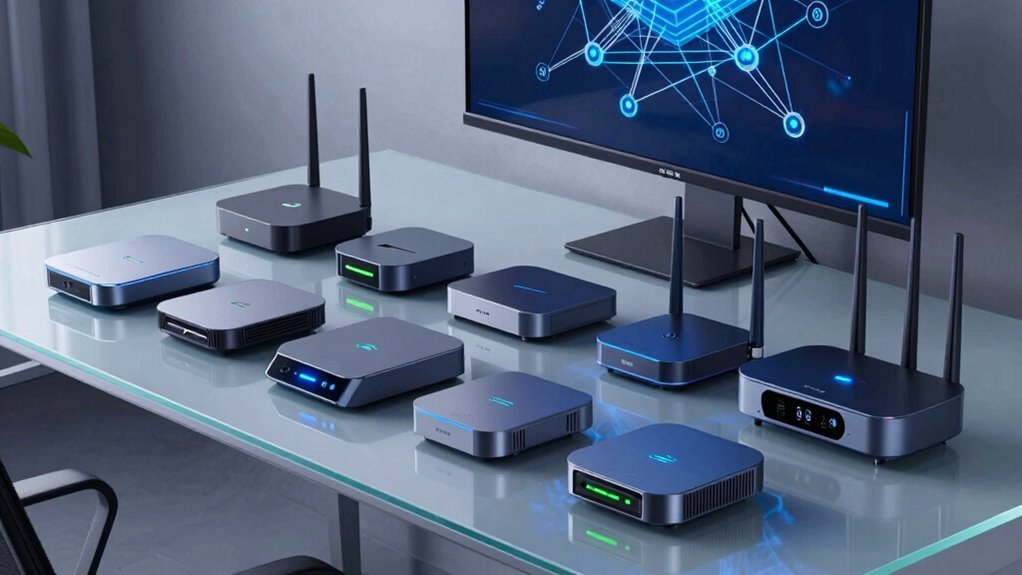

If you’re looking for the best Thread border routers of 2026, I recommend considering options like the ESP32-H2 development board, Aqara Smart Hubs M100 and M200, and the SmartSetup Outlet, all supporting protocols like Thread, Zigbee, and Matter. These devices offer secure, seamless connectivity, multi-protocol support, and easy installation. To find out which one fits your needs best and discover more top picks, keep going—you’ll get all the details you need.
Key Takeaways
- Features support for multiple protocols like Thread, Zigbee, Matter, Wi-Fi 6, ensuring versatile IoT connectivity.
- Notable devices such as Aqara Smart Hubs and ESP32-H2 offer seamless ecosystem integration and easy setup.
- Emphasize security with WPA3, NAT64, local control, and automatic firmware updates for reliable network protection.
- Designed with user-friendly interfaces, flexible placement, and modular options for simplified installation.
- Power options include USB-C, PoE, and backup solutions like power banks for continuous, reliable operation.
ESP32-H2 Thread Border Router Development Board

The ESP32-H2 Thread Border Router Development Board stands out for its high reliability and performance, making it an ideal choice for professionals and serious hobbyists who need a stable, long-lasting solution. Built with top-tier electronic components, it delivers dependable, long-term operation. Its design emphasizes stability and precision, supporting demanding applications across industrial, automotive, and household sectors. The board is user-friendly, featuring clear instructions and easy installation, which speeds up setup. Plus, it offers strong customer support and a money-back guarantee, giving users confidence in its quality. Overall, this development board combines performance, versatility, and ease of use for seamless IoT connectivity.
Aqara Smart Hub M100 for Home Automation
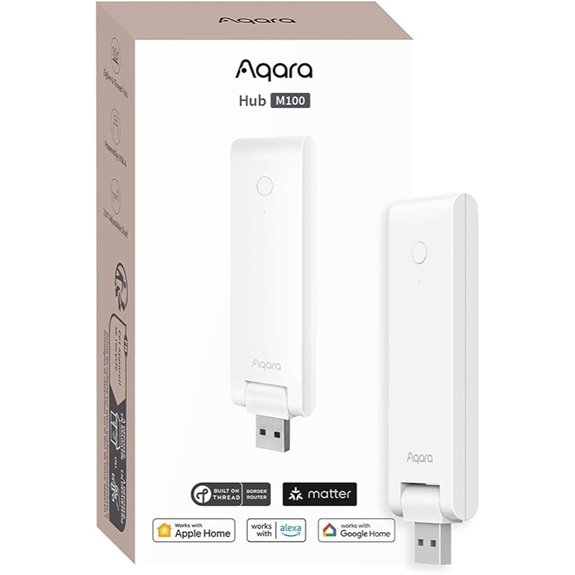
If you’re looking to expand your smart home network with reliable Thread connectivity, the Aqara Smart Hub M100 stands out as an excellent choice. It supports multi-protocol connectivity, including Aqara Zigbee and Thread devices, managing up to 20 of each. As a Matter Bridge, it links Aqara products to Apple Home, Alexa, and Home Assistant, ensuring seamless integration. The hub enables advanced automation with local execution, so automations run instantly without relying on the cloud. Its flexible power options, supporting USB-A connections, and dual-band Wi-Fi 6 with WPA3 security make it versatile and secure. Its role as a Thread border router enhances network stability and expandability, making it ideal for a scalable smart home.
SmartSetup Outlet with USB, App & Voice Control

SmartSetup Outlet with USB, App & Voice Control stands out for homeowners seeking a reliable, future-proof smart socket that integrates seamlessly with popular platforms. It features USB-C and USB-A ports, supporting up to 15 A and 2500 W, making it perfect for charging devices and powering appliances. Using the Matter protocol over Thread, it offers secure, local control without relying on the internet, even during Wi-Fi outages. Compatible with Apple Home, Alexa, Google Home, and SmartThings, it supports app and voice commands, ensuring flexible management. Its robust mesh network enhances security, reliability, and easy integration into existing smart home setups.
Eve Energy 2-Pack Smart Plugs with Voice Control
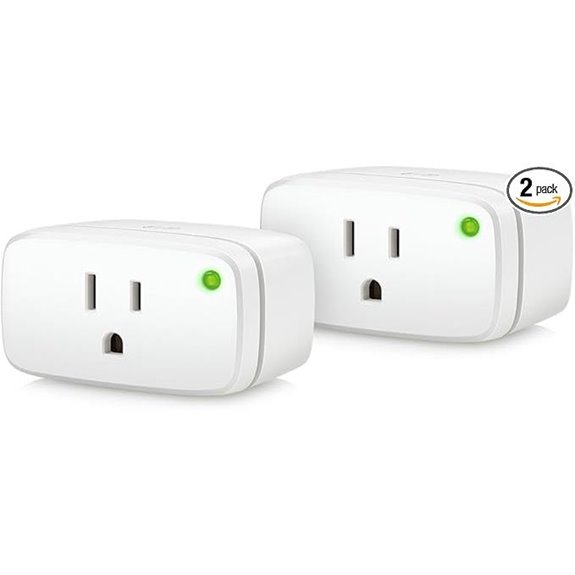
Eve Energy 2-Pack Smart Plugs with Voice Control stand out for their seamless integration with various smart home ecosystems, making them ideal for users seeking reliable, local control without cloud dependency. These smart plugs support Apple Home, Alexa, Google Home, and SmartThings, all powered by Matter over Thread technology. They enable effortless voice and app control of lights and appliances, with quick setup and local operation for enhanced stability. Plus, they prioritize privacy—no Eve cloud, tracking, or registration. With UL certification and robust Thread connectivity, they’re a secure, reliable choice for expanding your smart home network effortlessly.
ESP Thread Border Router/Zigbee Gateway Sub-Ethernet Board.
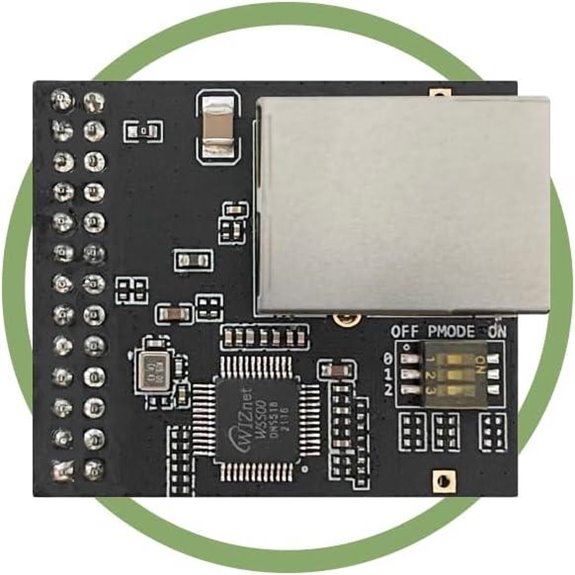
The ESP Thread Border Router/Zigbee Gateway Sub-Ethernet Board stands out as an ideal choice for developers seeking a versatile and expandable IoT gateway solution. It combines the ESP32-S3 SoC and ESP32-H2 RCP to support Thread 1.3, Zigbee, and Matter, providing bi-directional IPv6 connectivity, multicast forwarding, NAT64, and a user-friendly Web GUI. Compatible with various daughter boards, including Ethernet, HMI, and Voice Control, it offers flexible customization. Operating on FreeRTOS and Linux, it’s lightweight yet powerful, perfect for building robust IoT gateways, network routers, and smart home hubs. Its modular design makes it a standout in seamless IoT connectivity solutions.
Switch Matter Smart Switch with Voice & App Control

If you’re looking for a versatile switch that seamlessly integrates into your smart home, the Switch Matter Smart Switch with Voice & App Control stands out. Its Decora style design features a solid green indicator when ON and dim green when OFF, making it easy to see in the dark. It supports Apple HomeKit, Google Home, Alexa, SmartThings, Tuya, and more, ensuring broad compatibility. The switch works with Thread, requiring a Thread Border Router, and supports Matter over Thread for future-proofing. With app and voice controls, local automation, and no cloud dependence, it offers reliable, private operation while extending your mesh network.
Aqara Smart Hub M200: Matter Controller & Router
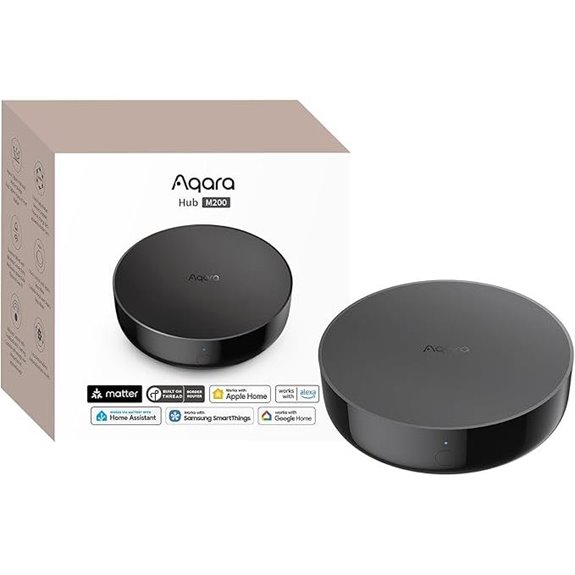
For those seeking a versatile and future-proof smart home hub, the Aqara Smart Hub M200 stands out as a top choice. It functions as a Matter Controller, Thread Border Router, and Matter Bridge, supporting up to 40 Zigbee and 40 Thread devices. It seamlessly integrates with ecosystems like Apple HomeKit, Alexa, Google Home, and Home Assistant. Connectivity options include dual-band Wi-Fi, PoE, and a USB-C port for uninterrupted power. Its advanced IR blaster can control air conditioning units and provide feedback. With local automation support and security features like a built-in speaker, the M200 ensures reliable, fast, and secure operation for thorough smart home management.
Aqara Smart Home Hub M3 with Matter and Zigbee

Looking for a versatile smart home hub that seamlessly integrates multiple protocols? The Aqara Smart Home Hub M3 is an excellent choice. It functions as a Matter controller, Thread border router, Zigbee, Bluetooth, Wi-Fi, PoE, and IR hub, supporting up to 127 Zigbee devices and 127 Thread devices with repeaters. Compatible with Alexa, Apple HomeKit, SmartThings, and more, it combines local control and automation with cloud options. Its privacy-focused design lacks microphones and cameras, while features like a smart IR blaster and easy setup make it user-friendly. With flexible placement options and robust connectivity, the M3 enhances your smart home ecosystem effortlessly.
Aqara Smart Hub M100 for Home Automation
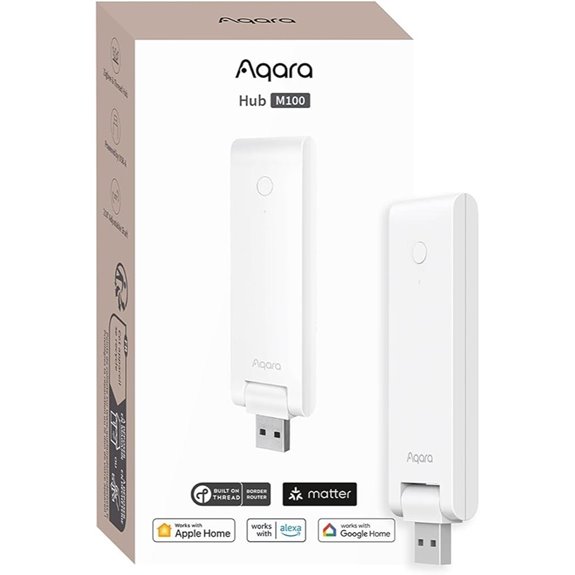
The Aqara Smart Hub M100 stands out as an ideal choice for anyone seeking a versatile, reliable smart home hub that seamlessly connects multiple protocols. It supports Aqara Zigbee (not third-party Zigbee devices) and Thread, managing up to 20 devices of each type. As a Matter Bridge, it links Aqara products with ecosystems like Apple Home, Amazon Alexa, and Home Assistant, enabling smooth integration. Its local automation capabilities ensure quick, dependable responses even without Wi-Fi, while Wi-Fi 6 guarantees secure, high-speed connectivity. With a flexible design, universal USB-A power port, and Thread border router functionality, the M100 offers expandability and stability for a truly scalable smart home system.
Matter Smart Home Hub with Zigbee & Thread
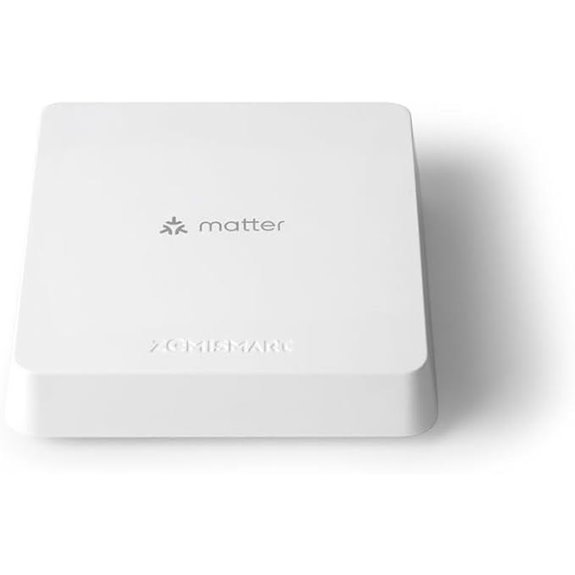
If you want a smart home hub that seamlessly connects Zigbee and Thread devices, the Matter Smart Home Hub with Zigbee & Thread is a top choice. It supports Tuya Zigbee 3.0, Thread, and Matter standards, but only controls compatible Tuya devices and verified Zemismart options for peak performance. This hub enables cross-platform control via QR codes, integrating with Google Home, Apple HomeKit, and more. It supports remote management through popular apps and offers voice control via Siri and Google Assistant. With Matter certification and a compatible border router, it ensures reliable, interoperable connectivity across your smart home ecosystem.
Factors to Consider When Choosing Thread Border Routers
When selecting a Thread border router, I focus on compatibility with my existing smart home ecosystem and the protocols it supports. I also consider network security features and how easy it is to install, along with power options that suit my setup. These factors help make certain I choose a reliable and seamless device for my connected home.
Compatibility With Ecosystems
Choosing a Thread border router that seamlessly integrates with your existing smart home ecosystem is essential for smooth operation. I check if it supports popular platforms like Apple HomeKit, Google Home, or Amazon Alexa to guarantee compatibility. It’s also important that the router works with the protocols your devices use, such as Zigbee, Thread, or Matter. A device that functions as a Matter bridge can simplify multi-device, multi-ecosystem setups. I look for multi-protocol connectivity to maximize interoperability across different standards. Additionally, compatibility with my existing hub or controller infrastructure guarantees a hassle-free setup and reliable network performance. Ensuring these factors helps create a cohesive smart home environment where all devices communicate effortlessly, avoiding frustrations and maximizing the value of my connected ecosystem.
Protocol Support Range
Supporting a wide protocol range is essential for a Thread border router’s effectiveness, as it determines how well it can connect and communicate with various smart home devices. A good border router should support IPv6 and 6LoWPAN protocols to facilitate efficient mesh networking. Compatibility with multiple wireless standards like Wi-Fi 6 and Zigbee markedly expands its protocol support range, allowing seamless integration across different ecosystems. The ability to connect with both Thread and Zigbee devices enhances coverage and flexibility. Additionally, supporting future protocol updates ensures the device remains relevant and functional as standards evolve. A wide communication range, typically between 6 to 20 feet, also improves network stability and coverage, reducing dead spots and maintaining a reliable connection across your smart home.
Network Security Features
Security is a critical factor when selecting a Thread border router, as it safeguards your entire smart home network from potential threats. I look for routers supporting WPA3, which offers stronger encryption and protection against eavesdropping. Robust authentication methods are essential to prevent unauthorized access, so I check for secure login options. Automatic firmware updates are a must—they keep the device patched against vulnerabilities without hassle. Built-in security features like intrusion detection and network traffic monitoring help me spot threats early. I also prioritize routers that support local control and automation, reducing reliance on cloud services that could be compromised. Overall, these features ensure my network remains secure, private, and resilient against evolving cyber threats.
Ease of Installation
Installing a Thread border router shouldn’t be a complicated task. Look for devices with clear, step-by-step setup instructions that guide you through the process easily. User-friendly interfaces, like web GUIs or mobile apps, make configuration quick and straightforward, saving you time and frustration. Choose border routers with plug-and-play features or automatic network detection to minimize manual setup efforts. Hardware designs with adjustable antennas or mounting brackets can simplify placement, allowing flexible positioning to suit your environment. Additionally, ensure the device is compatible with your existing home or network infrastructure to avoid extra adapters or complex wiring. Prioritizing these ease-of-installation features helps you get your IoT network up and running smoothly, with minimal hassle.
Power Supply Options
Choosing the right power supply options for your Thread border router is essential to guarantee reliable operation and flexible placement. Most border routers need a stable power source, like USB-C, USB-A, or AC power, to keep functioning continuously. Some models support Power over Ethernet (PoE), which simplifies installation by combining power and data into one cable. The power supply should match the device’s voltage and current needs, typically around 5V⎓0.5A to 12V, depending on the router. Many routers also include USB ports or sockets that let you connect a power bank or mini-UPS for backup during outages. Considering compatibility with your existing outlets and exploring alternative power sources can boost both reliability and installation options.
Expandability and Ports
When selecting a Thread border router, it’s vital to assess its expandability and ports to guarantee it can grow with your network needs. I look for models with a variety of ports, like Ethernet, USB, or serial, to connect different devices and enhance functionality. Compatibility with multiple protocols and device standards is key for future scalability, so I prioritize routers supporting Wi-Fi, Zigbee, or additional modules. The ability to add expansion modules or daughter boards, such as Ethernet interfaces or HMI panels, offers flexibility as your network evolves. User-friendly expansion options via web GUIs or APIs are also important, making upgrades and customization straightforward. Ultimately, a router with versatile ports and easy expansion ensures my IoT network remains adaptable and future-proof.
Frequently Asked Questions
How Does Thread Border Router Improve Iot Device Security?
Thread border routers notably improve IoT device security by acting as a secure gateway between your local network and the internet. They use robust encryption protocols to protect data transmission and authenticate devices, preventing unauthorized access. I’ve found that this layered approach reduces vulnerabilities, ensuring your IoT ecosystem stays safe from cyber threats while maintaining seamless connectivity. This security boost gives me peace of mind knowing my smart devices are protected.
What Are the Energy Consumption Differences Among Top Border Routers?
Did you know that some top border routers consume up to 30% less energy than others? I’ve found that newer models like the Apple HomePod mini use optimized chips, reducing power use without sacrificing performance. In contrast, older or less efficient routers can drain power faster, increasing operational costs. When choosing a border router, I always consider energy efficiency as it impacts both sustainability and long-term savings.
Can Multiple Border Routers Work Together for Enhanced Coverage?
Yes, multiple border routers can work together to enhance coverage. I’ve seen this setup boost network reliability and eliminate dead zones, especially in large or complex environments. By strategically placing several routers, they coordinate to extend the network’s reach and improve performance. It’s like creating a seamless web of connectivity that keeps all my IoT devices connected without interruptions, making my smart home or office much more efficient.
What Firmware Updates Are Necessary for Optimal Performance?
To keep your border router performing at its best, I recommend regularly updating its firmware. These updates often fix bugs, improve security, and enhance connectivity features essential for IoT devices. I make it a habit to check the manufacturer’s website or app notifications monthly. Installing the latest firmware ensures your network remains stable, secure, and capable of supporting the latest IoT innovations, giving you peace of mind and seamless connectivity.
How Does Mesh Networking Impact Latency in Iot Setups?
Mesh networking is like a web of interconnected roads, reducing latency by allowing data to take the fastest route. It critically improves IoT setup responsiveness by minimizing delays and avoiding bottlenecks. I’ve seen it make devices communicate almost instantly, which is vital for real-time applications. Overall, mesh networks optimize performance, making your smart devices more reliable and responsive, enhancing the entire IoT experience.
Conclusion
So, there you have it—my top picks for Thread border routers in 2026. Because, of course, the real challenge isn’t choosing the best device, but resisting the urge to turn your entire home into a sci-fi set. Remember, seamless IoT connectivity is great, but maybe don’t forget who’s really in charge of your smart home—your Wi-Fi, and apparently, your patience. Happy connecting!