
If you’re looking for the top Thunderbolt 4 PCIe add-in cards for 2026, I recommend the ASUS ThunderboltEX 5, ASUS ThunderboltEX 4, and GIGABYTE GC-MAPLE RIDGE. These cards offer high-speed data transfer, multi-port configurations, and robust power delivery, making them perfect for ultimate connectivity. I’ll guide you through their features and compatibility, so if you want to maximize your system’s potential, stay tuned for more details.
Key Takeaways
- Ensure the cards support PCIe 4.0 or higher for maximum data transfer speeds and future-proofing.
- Check for multiple Thunderbolt 4 ports with full power delivery (up to 100W) for expanded device connectivity.
- Verify compatibility with your motherboard’s chipset, socket, and BIOS for seamless installation and operation.
- Confirm the physical dimensions and case fitment to avoid installation issues and optimize airflow.
- Prioritize cards with high-resolution video output options like DisplayPort 2.1 and multi-monitor support for ultimate connectivity.
| ASUS ThunderboltEX 5 PCIe Expansion Card |  | High-Performance Powerhouse | Number of Ports: 2 Thunderbolt 5 USB-C, 1 DisplayPort 2.1 | Power Delivery (Wattage): Up to 130W total charging (96W for single device) | Bandwidth: 120 Gbps | VIEW LATEST PRICE | See Our Full Breakdown |
| ASUS ThunderboltEX 4 with Thunderbolt 4 USB-C DisplayPort | 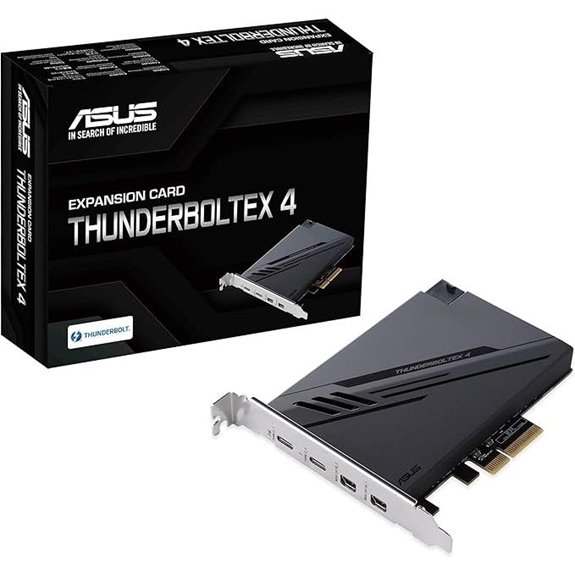 | Versatile Connectivity | Number of Ports: 2 Thunderbolt 4 USB-C, 2 mini DisplayPort 1.4 | Power Delivery (Wattage): Up to 100W | Bandwidth: 40 Gbps | VIEW LATEST PRICE | See Our Full Breakdown |
| GIGABYTE GC-MAPLE RIDGE PCIe Card with Thunderbolt 4 |  | Budget-Friendly Reliability | Number of Ports: 2 Thunderbolt 4 USB-C, 1 DisplayPort 1.4, 2 Mini DisplayPort | Power Delivery (Wattage): Up to 100W | Bandwidth: 40 Gbps | VIEW LATEST PRICE | See Our Full Breakdown |
More Details on Our Top Picks
ASUS ThunderboltEX 5 PCIe Expansion Card
If you’re looking for a powerful expansion card that delivers lightning-fast data transfer and supports multiple high-resolution displays, the ASUS ThunderboltEX 5 PCIe Expansion Card is an excellent choice. Certified by Intel and compatible with Intel 800 Series motherboards, it features Thunderbolt 5 technology, dual USB-C ports, and a PCIe 4.0 x4 interface. It supports daisy-chaining up to five Thunderbolt devices and provides up to 130W charging power. With 120 Gbps bandwidth and DisplayPort 2.1, it handles demanding data tasks and high-res multi-monitor setups seamlessly. This card is perfect for high-performance computing, creative work, and versatile connectivity.
- Number of Ports:2 Thunderbolt 5 USB-C, 1 DisplayPort 2.1
- Power Delivery (Wattage):Up to 130W total charging (96W for single device)
- Bandwidth:120 Gbps
- Compatibility:Intel 800 Series motherboards
- Daisy-Chaining Support:Up to 5 devices
- Certification:Intel Thunderbolt 5 certified
- Additional Feature:Supports DisplayPort 2.1
- Additional Feature:PCIe 4.0 x4 interface
- Additional Feature:Compatible with Intel 800 Series
ASUS ThunderboltEX 4 with Thunderbolt 4 USB-C DisplayPort
The ASUS ThunderboltEX 4 stands out as the ideal choice for users with ASUS motherboards seeking fast, versatile connectivity. It features Intel’s Thunderbolt 4 JHL 8540 controller, supporting two Thunderbolt 4 ports with USB 4 technology, delivering up to 40Gb/s bandwidth. You can daisy-chain up to five devices and connect high-resolution displays via two mini DisplayPort 1.4 ports, supporting up to 8K resolution. It also offers up to 100W quick charging, making it perfect for power-hungry peripherals. Compact and durable, this card guarantees seamless performance with Windows 10, but it’s exclusive to ASUS motherboards, so compatibility is key.
- Number of Ports:2 Thunderbolt 4 USB-C, 2 mini DisplayPort 1.4
- Power Delivery (Wattage):Up to 100W
- Bandwidth:40 Gbps
- Compatibility:ASUS motherboards only
- Daisy-Chaining Support:Up to 5 devices
- Certification:Intel Thunderbolt 4 certified
- Additional Feature:Supports USB 4 technology
- Additional Feature:8K DisplayPort output
- Additional Feature:Only compatible with ASUS motherboards
GIGABYTE GC-MAPLE RIDGE PCIe Card with Thunderbolt 4
For professionals who need high-speed connectivity and reliable expansion for their workstations, the GIGABYTE GC-MAPLE RIDGE PCIe Card with Thunderbolt 4 stands out as an excellent choice. It features dual Thunderbolt 4 ports (USB Type-C), along with two additional USB Type-C ports, and supports DisplayPort 1.4 for 4K video. With a max bandwidth of 40 Gb/s and the ability to daisy-chain up to 10 devices, it’s perfect for demanding workflows. Certified by Intel Thunderbolt 4, this PCIe card offers robust performance and versatility in a compact form factor, making it ideal for professionals seeking seamless, high-speed connectivity.
- Number of Ports:2 Thunderbolt 4 USB-C, 1 DisplayPort 1.4, 2 Mini DisplayPort
- Power Delivery (Wattage):Up to 100W
- Bandwidth:40 Gbps
- Compatibility:Compatible with Intel JHL8540 Thunderbolt 4 controller
- Daisy-Chaining Support:Up to 10 devices (5 per port)
- Certification:Intel Thunderbolt 4 certified
- Additional Feature:Dual Thunderbolt 4 ports
- Additional Feature:Supports Daisy-chain up to 10 devices
- Additional Feature:Certified with Intel Thunderbolt 4
Factors to Consider When Choosing Thunderbolt 4 PCIe Add-In Cards
When selecting a Thunderbolt 4 PCIe add-in card, I focus on key factors like compatibility with my motherboard, transfer speeds, and the number of available ports. I also consider whether it supports power delivery and offers video output options to meet my setup needs. Understanding these points helps guarantee I choose a card that fits my performance and connectivity requirements perfectly.
Compatibility With Motherboards
Ensuring compatibility between your motherboard and a Thunderbolt 4 PCIe add-in card is essential for a smooth setup. First, check that the card matches your motherboard’s chipset and socket type. Make sure your motherboard has available PCIe slots that support the necessary bandwidth, ideally PCIe 4.0 or higher, for peak performance. It’s also important to verify if your BIOS or UEFI firmware includes support or updates needed for Thunderbolt 4 functionality. Consult your motherboard’s manufacturer to ensure the card is explicitly listed as compatible or to find guidance on installation. Some boards may require BIOS adjustments or firmware updates to activate full Thunderbolt 4 support. Taking these steps helps prevent compatibility issues and ensures reliable, high-speed connectivity.
Transfer Speed Capabilities
Transfer speed is a critical factor to contemplate when choosing a Thunderbolt 4 PCIe add-in card, as it directly impacts how quickly you can transfer large files and run high-bandwidth applications. Thunderbolt 4 supports data transfer rates of up to 40 Gb/s, ensuring fast file transfers and smooth operation of multiple high-speed devices when daisy-chained. However, the actual speed you experience can be limited by the PCIe interface, with PCIe 4.0 offering higher throughput than PCIe 3.0. Additionally, the connected device’s capabilities and your system’s overall bandwidth influence real-world transfer speeds. While Thunderbolt 4’s maximum bandwidth guarantees seamless performance, understanding these factors helps you choose a card that delivers peak speed for your specific needs.
Number of Ports
The number of Thunderbolt 4 ports on a PCIe add-in card directly affects how many devices you can connect at once, whether through daisy-chaining or hub setups. Multiple ports give you greater flexibility to expand your peripheral ecosystem, including displays, storage, and docking stations. Some cards feature two Thunderbolt 4 ports, while others may include extra USB-C or DisplayPort connections for added versatility. Having more ports can streamline your workflow by reducing the need for additional expansion cards. However, it’s vital to verify that all ports support full Thunderbolt 4 features, including power delivery for connected devices. Balancing your connectivity needs with the number of ports available helps optimize your setup for both productivity and convenience.
Power Delivery Support
When selecting a Thunderbolt 4 PCIe add-in card, it’s vital to verify that it supports at least 100W of power delivery, allowing you to fast charge compatible devices conveniently. Check the maximum power output per port, as some cards allocate different wattages to each Thunderbolt port, which can affect charging speeds. Confirm the card complies with Thunderbolt 4 specifications, including mandatory support for 15W per port and up to 100W total power delivery. It’s also important to verify that its power capabilities match your device requirements to avoid insufficient charging or power issues during use. Additionally, consider the overall power management features of the card to ensure stable operation when multiple Thunderbolt devices are connected simultaneously, maintaining consistent power flow.
Video Output Options
Choosing a Thunderbolt 4 PCIe add-in card with the right video output options is essential for achieving your desired display setup. These cards typically feature DisplayPort 1.4 or 2.1, supporting high-resolution video output, including 8K at 60Hz with DSC technology on DisplayPort 2.1. Many cards also support daisy-chaining multiple monitors, often up to three 8K displays or several 4K monitors simultaneously, which is perfect for expanding your workspace. The available ports—like USB-C with Thunderbolt 4 or Mini DisplayPort—can be adapted to HDMI or other standards to suit your needs. Your choice depends on the maximum resolution and refresh rate your setup requires, which are determined by the card’s DisplayPort version and the displays you plan to connect.
Device Daisy-Chaining Capacity
Daisy-chaining multiple Thunderbolt devices can streamline your workspace, but it’s important to comprehend the limitations of your PCIe add-in card. Most Thunderbolt 4 cards support daisy-chaining up to five devices simultaneously, but this varies depending on the card’s design and the Thunderbolt protocol’s constraints. The maximum number of devices depends on the manufacturer’s specifications and is influenced by the total bandwidth available per port. Supporting multiple devices effectively requires a PCIe card with solid port and bandwidth management features to prevent bottlenecks and signal degradation. Proper daisy-chaining ensures smooth, efficient connectivity, allowing you to expand your setup without sacrificing performance. Always check the card’s daisy-chaining capacity to match your needs and avoid potential connectivity issues.
Physical Size and Fit
Selecting a Thunderbolt 4 PCIe add-in card that fits well inside your PC requires careful attention to its physical dimensions. First, verify the card’s length and height match your case’s space constraints to avoid installation issues. Check if your case has limited room or obstructions that could interfere with the card’s placement. It’s also essential to confirm that your motherboard’s PCIe slot (e.g., PCIe 4.0 x4) is compatible with the card’s interface for ideal performance. Additionally, consider the number and placement of ports to prevent interference with other hardware. For small or compact cases, confirm that the card’s form factor aligns with your system’s expansion slot capacity. Proper sizing ensures a smooth fit and reliable connectivity.
Frequently Asked Questions
What Is the Maximum Data Transfer Speed Supported by Thunderbolt 4 Cards?
The maximum data transfer speed supported by Thunderbolt 4 cards is 40 Gbps. I find this impressive because it allows me to transfer large files quickly, connect multiple high-speed devices, and enjoy seamless performance. This speed is consistent across Thunderbolt 4 devices, ensuring that I get the most out of my setup. If you’re looking for fast, reliable connectivity, Thunderbolt 4 truly delivers, making it perfect for demanding tasks.
Are Thunderbolt 4 PCIE Cards Compatible With All Motherboard Brands?
In my experience, Thunderbolt 4 PCIe cards are generally compatible with most motherboard brands, but it’s not guaranteed universally. I’ve found compatibility depends on whether your motherboard has an available PCIe slot and supports Thunderbolt standards. Sometimes, BIOS updates or additional drivers are necessary to make sure seamless operation. So, I always double-check the motherboard specifications and manufacturer recommendations before investing, to avoid any compatibility surprises.
Can Thunderbolt 4 Cards Support Daisy Chaining Multiple Devices?
Yes, I can confirm that Thunderbolt 4 PCIe cards do support daisy chaining multiple devices. They allow you to connect up to six devices in a series, which is perfect for expanding your workspace without clutter. I’ve used this setup myself, and it works seamlessly, providing fast data transfer and power delivery. Just make certain your motherboard and devices also support Thunderbolt 4 for maximum performance.
What Are the Power Requirements for Installing Thunderbolt 4 PCIE Expansion Cards?
Installing a Thunderbolt 4 PCIe expansion card isn’t just a simple task; it demands a power supply capable of handling the extra load, typically around 15-25W per card. I always make sure my system’s PSU surpasses this to prevent any hiccups. Most cards draw power directly from the PCIe slot, but some may need an auxiliary power connector. Always check your card’s specifications to ensure smooth, reliable operation.
Do Thunderbolt 4 PCIE Cards Support Hot-Swapping Devices?
Yes, Thunderbolt 4 PCIe cards typically support hot-swapping devices, allowing you to connect or disconnect peripherals without shutting down your system. I’ve used them seamlessly, appreciating how they enable quick, convenient access to external drives, displays, or other peripherals. Just make sure your system’s BIOS and operating system support hot-swapping, and you’re set to plug and unplug devices safely and efficiently.
Conclusion
Choosing the right Thunderbolt 4 PCIe add-in card can transform your setup, offering lightning-fast data transfer and seamless device connectivity. Did you know that Thunderbolt 4 supports speeds up to 40Gbps? That’s like transferring a full HD movie in just a few seconds! With options like ASUS and GIGABYTE leading the way in 2026, you’ll have the ultimate connectivity at your fingertips. Make your choice wisely, and unleash your system’s full potential today.