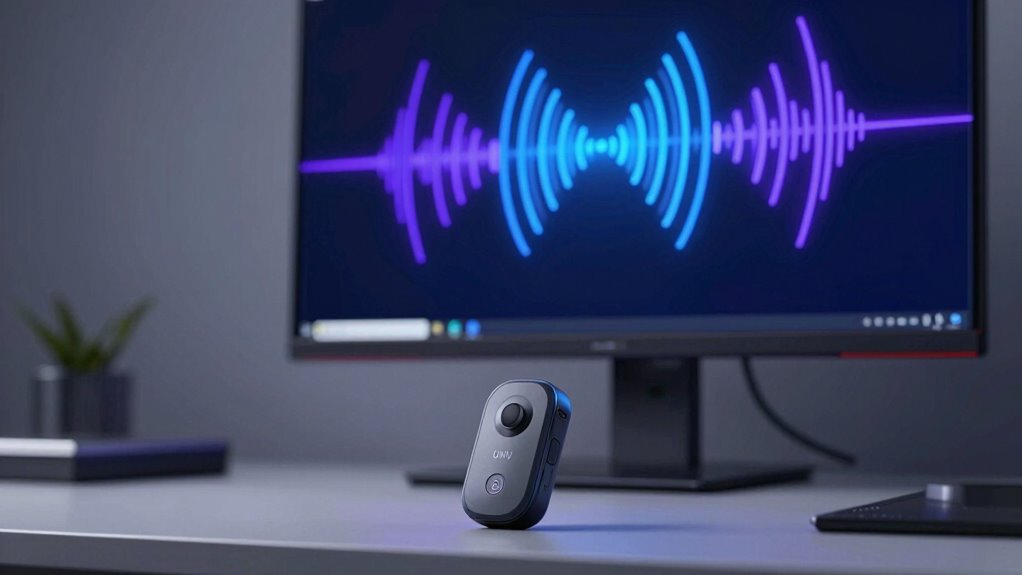

Ultra Wideband (UWB) is a fast, secure wireless technology that uses a broad frequency range to provide precise location tracking and data transfer. It sends short pulses for accurate distance measurement and penetrates walls easily, making it ideal for smart trackers and indoor navigation. UWB outperforms traditional methods like Bluetooth or RFID in accuracy and reliability, especially indoors. Explore more about how this innovative tech transforms our smart devices and environments.

Get the latest gadgets delivered free with Prime
- Fast, free delivery on millions of items
- Prime Video, Amazon Music and more included
- Member-only deals all year
Key Takeaways
- UWB uses a wide frequency spectrum to transmit short pulses for precise location tracking.
- It provides centimeter-level accuracy, ideal for smart trackers and indoor navigation.
- UWB signals penetrate walls and obstacles, ensuring reliable performance in complex environments.
- It is resistant to interference, making it more dependable than other wireless tracking methods.
- UWB enables real-time, highly accurate tracking for applications like asset management and smart home automation.
As an affiliate, we earn on qualifying purchases.
What Is Ultra Wideband Technology?

What exactly is Ultra Wideband (UWB) technology? UWB is a wireless communication method that uses a wide frequency spectrum to transmit data with high precision. Its ability to provide accurate location tracking makes it ideal for smart trackers and access controls. Additionally, the high-precision localization capabilities of UWB enable it to support advanced smart home features such as enhanced security and automation. However, deploying UWB introduces security implications, as its precise signals could potentially be intercepted or exploited if not properly secured. Additionally, regulatory challenges exist because UWB operates across multiple frequencies, raising concerns about interference with other wireless systems. Governments worldwide are working to establish standards and frameworks to manage these issues, ensuring UWB’s safe and effective use. Regulatory compliance is crucial to navigate these challenges and facilitate broader adoption of UWB technology. Understanding these aspects helps you appreciate UWB’s potential while recognizing the hurdles that need addressing for widespread adoption. Furthermore, considerations around vetted wave and wind are essential when evaluating UWB’s environmental impact and feasibility. A comprehensive understanding of wireless spectrum management further supports the responsible deployment of UWB systems.
As an affiliate, we earn on qualifying purchases.
How UWB Works in Practice
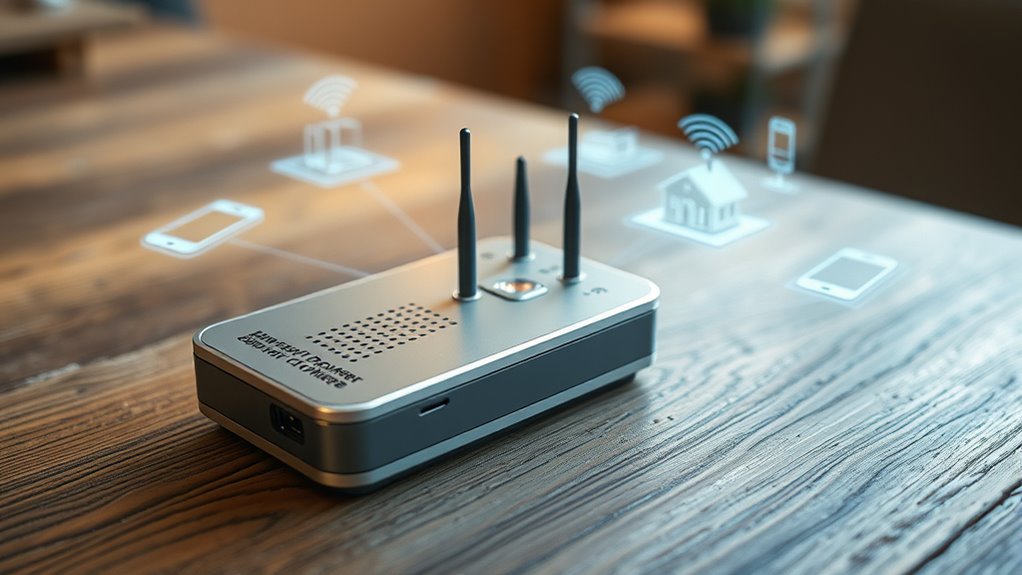
Ultra Wideband (UWB) works in practice by transmitting very short pulses across a wide frequency range, which allows you to determine precise distances and locations. UWB signals excel at signal penetration, going through obstacles like walls and furniture, making tracking more reliable indoors. To manage interference from other wireless devices, UWB uses advanced interference management techniques, ensuring accurate data exchange even in crowded environments. This combination of signal penetration and interference control helps UWB deliver highly accurate positioning in real-world scenarios. Additionally, robustness to interference is a key advantage, enabling UWB to perform reliably amidst diverse wireless signals. The technology’s ability to operate effectively in challenging environments further enhances its practical application for smart trackers. Its capacity for precise location tracking makes it particularly useful in complex indoor settings where accuracy is critical. The integration of interference mitigation techniques helps maintain performance even when multiple devices operate nearby. Moreover, natural environment integration allows UWB to function effectively in various outdoor and indoor conditions, broadening its usability.
UWB-based smart home security system
As an affiliate, we earn on qualifying purchases.
As an affiliate, we earn on qualifying purchases.
Comparing UWB to Other Tracking Methods
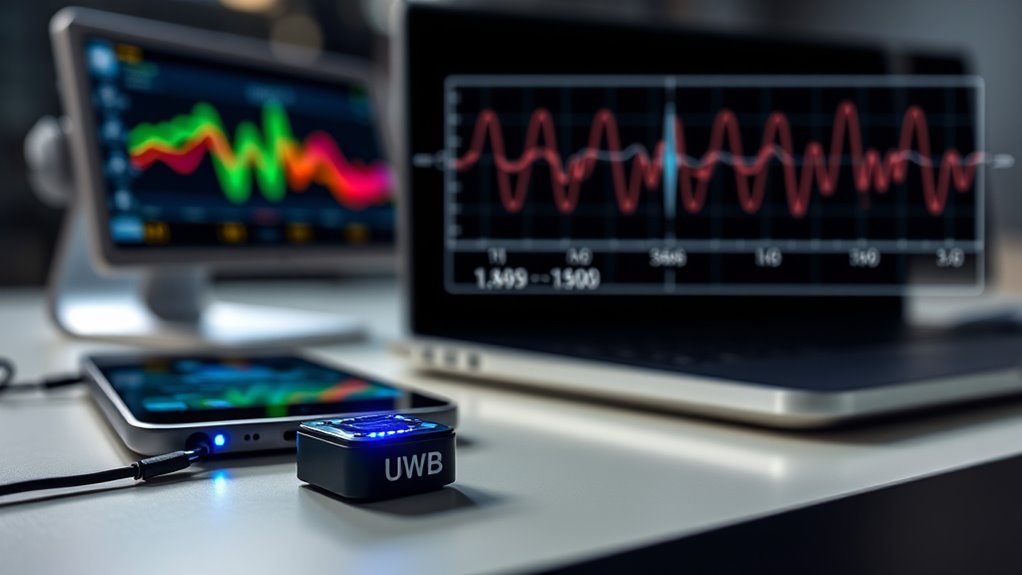
Compared to other tracking methods, UWB offers distinct advantages in accuracy and reliability, especially in complex indoor environments. Unlike radio frequency (RF) signals used in Bluetooth or Wi-Fi, UWB transmits ultra-wideband signals that are less affected by signal interference. This broad spectrum helps UWB distinguish its signals amid competing RF noise, resulting in more precise location data. While RFID relies on proximity and line-of-sight, UWB can provide real-time, centimeter-level accuracy even in cluttered spaces. Additionally, UWB’s resistance to signal interference makes it more dependable in environments crowded with electronic devices. Overall, UWB surpasses traditional RF-based methods by delivering highly accurate, interference-resistant tracking, especially when precise indoor positioning matters most.
As an affiliate, we earn on qualifying purchases.
Real-World Applications of UWB
Have you ever wondered how UWB is transforming industries and everyday life? UWB enhances indoor navigation, allowing you to find objects or people precisely in complex environments. It’s also revolutionizing asset management by tracking valuable equipment in real-time, reducing loss and improving efficiency. Businesses use UWB for warehouse inventory, hospitals track medical devices, and retail stores locate products instantly. The following table highlights some key applications:
| Application Area | How UWB Helps | Benefits |
|---|---|---|
| Indoor Navigation | Precise positioning | Accurate, real-time location |
| Asset Management | Real-time asset tracking | Reduced loss, increased efficiency |
| Healthcare | Tracking medical equipment | Faster response times |
| Warehousing | Inventory management | Streamlined operations |
UWB’s versatility makes it a game-changer in countless sectors. Its wireless communication capabilities continue to expand its reach across various industries. As UWB technology advances, it is becoming more cost-effective and easier to implement in everyday products.
The Future of UWB and Connectivity

As UWB continues to prove its value in various industries, its potential to enhance connectivity and communication networks grows even more promising. In smart cities, UWB can revolutionize how wireless sensors communicate, enabling more accurate, real-time data exchange. This technology will support seamless integration of devices, improving traffic management, public safety, and energy efficiency. You’ll see UWB-driven networks become more robust, with faster, more reliable connections that facilitate smart infrastructure. As the industry advances, UWB’s precise positioning will enable better asset tracking and automation. Additionally, the integration of wireless sensor networks will be crucial in creating more adaptive and resilient urban environments. The development of interoperable wireless technologies will further enhance how devices communicate within these networks. Future connectivity will be more dynamic, efficient, and interconnected, empowering cities and businesses to operate smarter and more sustainably. UWB’s evolving role will be pivotal in shaping the next generation of wireless communication, especially as data-driven comparisons support smarter decision-making.
Frequently Asked Questions
How Secure Is UWB Technology Against Hacking and Signal Interception?
You can rest assured that UWB technology is quite secure against hacking and signal interception. It uses advanced encryption protocols and signal encryption, making it difficult for hackers to access or manipulate the data. UWB’s short-range, high-frequency signals also reduce the risk of interception from outside sources. While no technology is completely invulnerable, UWB’s robust security measures offer strong protection for your devices and data.
What Are the Limitations of UWB in Dense Urban Environments?
In dense urban environments, UWB faces challenges like urban interference and signal attenuation. Buildings, metal structures, and crowded areas block or weaken signals, reducing accuracy and range. While UWB excels indoors, skyscrapers and dense infrastructure can hinder its effectiveness. You might notice inconsistent tracking or limited performance, especially when signals bounce or fade behind obstacles. These limitations highlight UWB’s struggle to maintain precise communication amid urban interference and signal attenuation.
How Does UWB Impact Battery Life in Portable Devices?
UWB impacts your portable device’s battery life by requiring higher power consumption for precise positioning, but it’s designed with power efficiency in mind. This tech balances accuracy and battery longevity, so you can enjoy accurate tracking without draining your device quickly. Proper implementation and optimized usage help conserve power, ensuring your device stays functional longer while benefiting from UWB’s advanced features.
Are There Any Health Concerns Associated With UWB Signals?
Think of UWB signals like a gentle breeze, barely noticeable yet ever-present. Current research shows that radiation exposure from UWB is minimal, and there’s no clear evidence of harmful long-term effects. While some worry about possible health risks, experts agree UWB is safe for everyday use. You can rest assured; the low power levels mean your exposure remains well within safe limits, just like a soft whisper in a quiet room.
What Certifications Are Required for Uwb-Enabled Products?
You need to guarantee your UWB-enabled products meet specific certifications related to manufacturing standards and compliance regulations. These certifications vary by region but typically include FCC approval in the U.S. and CE marking in Europe. By obtaining these certifications, you demonstrate your product’s adherence to safety, electromagnetic compatibility, and radio frequency standards, ensuring it’s legally authorized for sale and safe for users. Always verify regional requirements before launching your device.
Conclusion
Ultimately, Ultra Wideband unites unmatched accuracy with innovative integration, inspiring intelligent interactions. As UWB advances, you’ll witness a world where wireless wonders weave seamlessly into daily life, transforming tracking, teamwork, and technology. Embrace the evolution, and you’ll experience the extraordinary edge of engagement, empowering every environment with enhanced efficiency and elegance. With UWB’s unstoppable surge, your connected future is just a heartbeat away, promising precision, progress, and powerful possibilities.
Halloween Picks
halloween
As an affiliate, we earn on qualifying purchases.