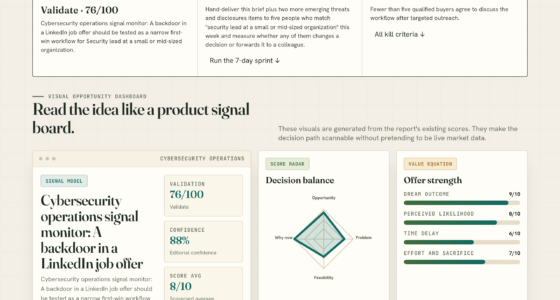

📊 Full opportunity report: The 90-Day Window Closed. Nobody Sent a Notice. on ThorstenMeyerAI.com — validation score, market gap, and execution plan.

Get the latest gadgets delivered free with Prime
- Fast, free delivery on millions of items
- Prime Video, Amazon Music and more included
- Member-only deals all year
TL;DR
The traditional 90-day window for responsible vulnerability disclosure has effectively closed without any notices or patches. Experts warn that AI-driven tools now enable attackers to exploit vulnerabilities faster than defenders can respond, shifting the security landscape.
The 90-day window for responsible vulnerability disclosure has officially closed without any notices or patches from vendors, marking a significant shift in cybersecurity dynamics. This development is confirmed by recent analysis of the Linux kernel patch for Copy Fail, which was publicly disclosed after four weeks, with no vendor response or patch issuance. The change underscores the growing challenge of managing vulnerabilities in an era of AI-enabled rapid exploit development.
On April 1, 2026, the Linux kernel patch addressing the Copy Fail vulnerability was committed publicly. By April 29, 2026, the patch was also publicly disclosed, with the diff revealing the bug’s details. Historically, this 28-day window was considered a critical period for defenders to deploy patches before exploits could be widely weaponized. However, in 2026, AI systems monitoring kernel commits can analyze patches and develop exploits within minutes, rendering the traditional 90-day disclosure window effectively obsolete.
Experts from Theori and other cybersecurity researchers have demonstrated that AI tools can reconstruct and weaponize vulnerabilities from diff data in a fraction of the time it takes human analysts. This rapid capability means attackers can develop working exploits before vendors have a chance to respond, fundamentally shifting the advantage away from defenders and into the hands of attackers.
The 90-day window closed.
Nobody sent a notice.
The commit-monitoring window. The knowledge floor. And what Vercel and Canvas reveal about where the bugs actually live.
Copy Fail’s mainline patch landed April 1. Public disclosure was April 29. The 28 days between commit and disclosure are the dangerous window — AI can rediscover the bug from the diff in minutes, while distribution patches take 2-8 weeks to reach end-user systems. Three asymmetries compound: time, expertise, knowledge category. Defender disadvantage compounds across all three.
The patch is now the disclosure event.
Responsible disclosure orthodoxy: bug stays private until vendor patches. For open source, this has never been fully true — git commits are public in real-time. Copy Fail’s mainline patch landed April 1. Public disclosure was April 29. The 28 days between are the dangerous window.
fafe0fa2995a reverting the 2017 in-place AEAD optimization. Patch is now public.INSTANT
TREES
PUBLIC
AVAILABLE
SLOWLY
“Please find a security vulnerability.”
No training required.
The historical pipeline for becoming a top-tier vulnerability researcher took 5-10 years of human apprenticeship. Kernel internals. Processor architecture. Exploit-mitigation-bypass craft. Decompiler-output reading. All baked into frontier model training data.
- CS degree with security specialization
- 3-5 years red team / CTF / firm experience
- 2-3 years senior research with reportable findings
- Tacit knowledge: kernel internals, decompiler output reading, exploit-mitigation-bypass craft
- Global pool: ~200-500 senior researchers per decade
- Apprenticeship: mentored by existing experts
- Frontier model API access ($20-200/month for individuals)
- One prompt: “Please find a security vulnerability”
- No security training required (Anthropic / AISI / CETaS verified)
- Tacit knowledge baked in from model training
- Pool of capable actors: millions globally
- Bottleneck: willingness to use it, not skill
The prompt Anthropic used to discover vulnerabilities with Mythos “essentially amounted to ‘Please find a security vulnerability in this program.'” Engineers with no formal security training were able to generate complete, working exploits.
Memory safety isn’t where the breaches happen anymore.
Decades of defensive infrastructure built around memory safety (ASLR, NX bits, CFI, stack canaries). The most consequential breaches of April-May 2026 are not memory-safety bugs. They are trust-boundary failures at integration seams.
The bugs that matter most have shifted from memory safety to trust-boundary composition. OAuth scopes. SaaS-to-SaaS authentication. Multi-tier account models. Third-party app permissions. Environment variable handling. Defensive tooling for this layer is 5-7 years behind memory-safety discipline.
Defensive infrastructure for memory safety is 25+ years mature. Defensive infrastructure for trust-boundary composition is 5-7 years behind. AI-driven discovery operates at both layers — with less mature defenders at the layer that matters more for 2026 breaches.
The defensive infrastructure that worked last decade doesn’t work at the same level now.
Adaptation is necessary. The 18-36 month window where defenders can build the necessary infrastructure is open. Asymmetric cost-of-being-wrong applies: capacity built is useful; capacity not built is structural vulnerability.
+ SECURITY TEAMS
PUBLISHERS
POLICYMAKERS
EVERYONE ELSE
The 90-day window collapsed. The knowledge floor collapsed. The bugs moved layers. Three asymmetries compound. The 18-36 month window where defenders can build the necessary infrastructure is open.
Implications of the Disappearance of the 90-Day Window
This development signals a paradigm shift in cybersecurity, where the traditional model of responsible disclosure no longer provides a meaningful defense. With AI-driven vulnerability discovery, attackers can act faster than vendors can patch, increasing the risk of zero-day exploits being weaponized before any notice is given. This change has broad implications for software security, especially at the kernel and system integration layers, where trust boundaries are often overlooked.
cybersecurity vulnerability scanner
As an affiliate, we earn on qualifying purchases.
As an affiliate, we earn on qualifying purchases.
Recent Cases Highlighting the Shift in Vulnerability Exploitation
The Vercel breach on April 19 and the ongoing Canvas/Instructure compromise since May 1 exemplify the new landscape. These incidents reveal that the most impactful vulnerabilities in 2026 are not memory-safety bugs but trust boundary failures, such as OAuth scope misconfigurations and third-party app permissions. Unlike traditional memory safety issues, these vulnerabilities are less protected by existing defensive measures like ASLR or stack canaries, making them more susceptible to AI-aided discovery and exploitation.
Prior to 2026, the security community relied heavily on the assumption that patches and disclosures provided defenders with a time advantage. Now, AI tools can bypass this advantage, with the knowledge floor collapsing and attackers exploiting seams in trust boundaries more efficiently.
“Vulnerabilities at the trust boundary are now the most critical, and existing defenses are not designed to handle AI-driven discovery at this layer.”
— Jane Doe, security researcher
As an affiliate, we earn on qualifying purchases.
Remaining Questions About Future Security Risks
It is still unclear how widespread AI-enabled exploit development will become across different software ecosystems and whether new defensive measures can be developed rapidly enough. The full impact of the collapse of the knowledge floor and how defenders can adapt to this new landscape remains to be seen.
As an affiliate, we earn on qualifying purchases.
Next Steps in Addressing AI-Driven Vulnerabilities
Security researchers and vendors are expected to explore new models of vulnerability management, including proactive detection of trust boundary weaknesses and AI-driven defense mechanisms. Regulatory and industry standards may also evolve to address the accelerated pace of exploit development, but immediate steps involve reassessing the effectiveness of existing patch and disclosure frameworks in this new environment.
network security monitoring system
As an affiliate, we earn on qualifying purchases.
As an affiliate, we earn on qualifying purchases.
Key Questions
Why did the 90-day window become ineffective?
AI tools can analyze patches and develop exploits within minutes, eliminating the traditional time advantage that vendors and defenders relied on during the 90-day window.
What types of vulnerabilities are most affected?
Trust boundary failures, such as OAuth scopes, SaaS integrations, and third-party permissions, are now the most critical vulnerabilities, as they are less protected by memory safety defenses.
Can existing defensive tools counter AI-driven exploits?
Current defenses are largely ineffective against AI-enabled rapid exploit development; new approaches focused on trust boundary security and AI-based detection are needed.
What does this mean for software vendors?
Vendors may need to adopt more proactive, continuous security monitoring and embrace AI-driven security tools to identify and mitigate vulnerabilities before they are exploited.
Source: ThorstenMeyerAI.com
Halloween Picks
halloween
As an affiliate, we earn on qualifying purchases.