
TL;DR

Get the latest gadgets delivered free — and shop member deals
- Fast, free delivery on millions of items
- Access to Prime Big Deal Days deals on October 6–7
- Prime Video, Amazon Music and more included
ReactOS has successfully run the classic game Half-Life with 3D acceleration on real hardware. This marks a significant milestone in its pursuit of Windows binary compatibility after 28 years of development.
ReactOS has successfully run the Windows version of Half-Life with 3D acceleration on actual hardware, marking a major milestone in its 28-year development journey.
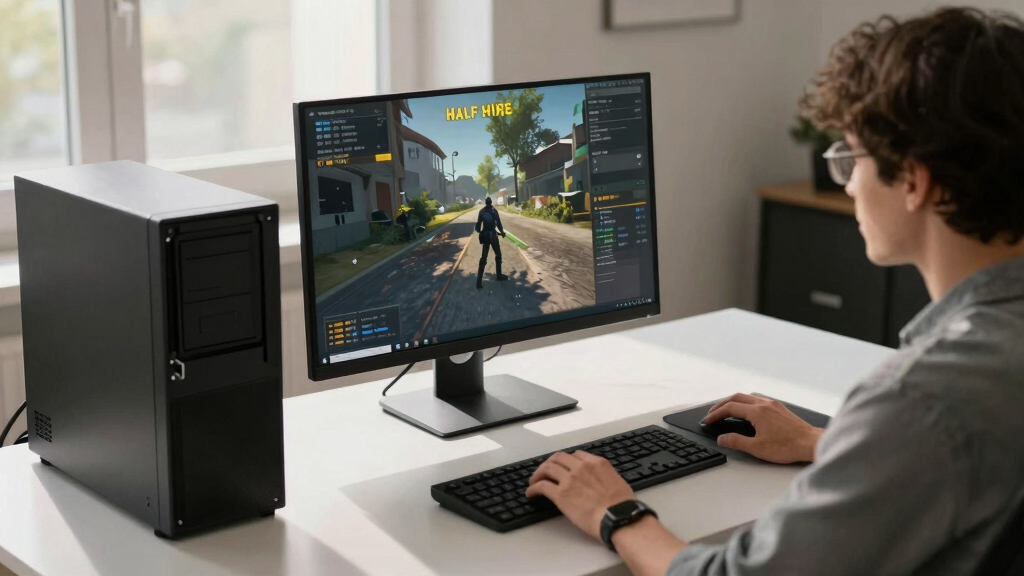
Developers and users of ReactOS, an open-source operating system aiming for binary compatibility with Microsoft Windows, announced that the classic game Half-Life now runs with 3D acceleration on real hardware. This achievement is the first reported instance of the game not only initializing but also running in-game on ReactOS, using a Dell OptiPlex system with a Core i5 2400 processor and NVIDIA GeForce 8400GS graphics.
Reports emerged from a ReactOS user known as “Zombiedeth” who demonstrated the game running successfully, indicating significant progress in the OS’s ability to support Windows drivers and applications at a hardware-accelerated level. While earlier reports suggested Half-Life could at least initialize under ReactOS, this development confirms full in-game functionality with 3D acceleration.
ReactOS has been in development for nearly three decades, with continuous efforts to improve Windows binary compatibility, including drivers and applications, on open-source hardware. This milestone underscores the project’s progress toward that goal.
Impact of Running Half-Life with 3D Acceleration
This development is significant because it demonstrates ReactOS’s growing capability to run complex Windows applications and games with hardware acceleration, a key feature for full Windows compatibility. It showcases progress in the OS’s ability to handle graphics drivers and 3D rendering, essential for gaming and multimedia applications. For users and developers, this indicates that ReactOS could become a more viable alternative for running Windows-specific software without proprietary Microsoft components, especially in scenarios requiring open-source solutions.
Moreover, it highlights the potential for ReactOS to serve as a platform for legacy applications and games, which often depend on specific Windows drivers and APIs. This milestone could accelerate interest and development efforts within the ReactOS community, potentially influencing future compatibility improvements and hardware support.
NVIDIA GeForce 8400GS graphics card
As an affiliate, we earn on qualifying purchases.
As an affiliate, we earn on qualifying purchases.
ReactOS Development and Past Milestones
ReactOS, founded in 1996, has long aimed to replicate the Windows NT architecture to run Windows applications and drivers natively. Over its 28-year history, it has achieved incremental progress, including compatibility with various Windows drivers and applications, but has faced challenges in achieving full hardware acceleration support.
Previous reports indicated that ReactOS could initialize some Windows applications and games, but full in-game functionality, especially with 3D acceleration, remained elusive. The recent demonstration of Half-Life running with hardware acceleration marks a significant step forward, driven by ongoing efforts to improve driver support and graphics subsystem compatibility.
While Linux and other platforms can run Half-Life via Wine or similar compatibility layers, ReactOS’s achievement is notable because it aims for a native Windows compatibility layer, not emulation or translation. This progress aligns with the project’s long-term goal of creating a free, open-source Windows-compatible OS.
“This is a milestone for us. Running Half-Life with 3D acceleration on real hardware shows that our efforts are paying off.”
— an anonymous ReactOS developer
PC gaming graphics card for Windows
As an affiliate, we earn on qualifying purchases.
As an affiliate, we earn on qualifying purchases.
Remaining Challenges for Full Hardware Compatibility
It is still unclear how stable or reliable this setup is across different hardware configurations. The current demonstration involves specific hardware and drivers, and broader hardware support remains uncertain. Additionally, the extent of performance and compatibility with other Windows applications and games is still being evaluated.
Developers have not yet confirmed whether this success is replicable across a wide range of systems or if it is limited to specific configurations. The long-term stability and usability for everyday users are still under assessment.
Open-source Windows compatibility hardware
As an affiliate, we earn on qualifying purchases.
As an affiliate, we earn on qualifying purchases.
Future Development Goals and Community Testing
ReactOS developers are expected to continue refining hardware support, drivers, and stability. Broader testing across diverse hardware setups will be crucial to determine the OS’s readiness for wider use. The community may focus on porting more applications and games, as well as improving driver compatibility.
Further milestones could include achieving full hardware acceleration support for a broader range of graphics cards and systems, as well as enhancing overall stability and usability for daily tasks.
As an affiliate, we earn on qualifying purchases.
Key Questions
How significant is running Half-Life on ReactOS?
It demonstrates progress toward full Windows compatibility, especially with hardware acceleration, which is key for gaming and multimedia applications.
Can ReactOS run other modern Windows applications?
Support for other applications is still evolving. While this milestone is promising, broader compatibility remains a work in progress.
Does this mean ReactOS is ready for everyday use?
Not yet. While significant progress has been made, ReactOS is still in development and not recommended for production or daily use at this stage.
What hardware does ReactOS support now?
Support is limited and varies by device. The recent demonstration involved specific hardware, and broader support is still under development.
When might ReactOS reach full hardware acceleration support?
There is no fixed timeline; ongoing development aims to improve this, but full support may still take years to achieve.
Source: Hacker News
Fall Picks
fall essentials
As an affiliate, we earn on qualifying purchases.