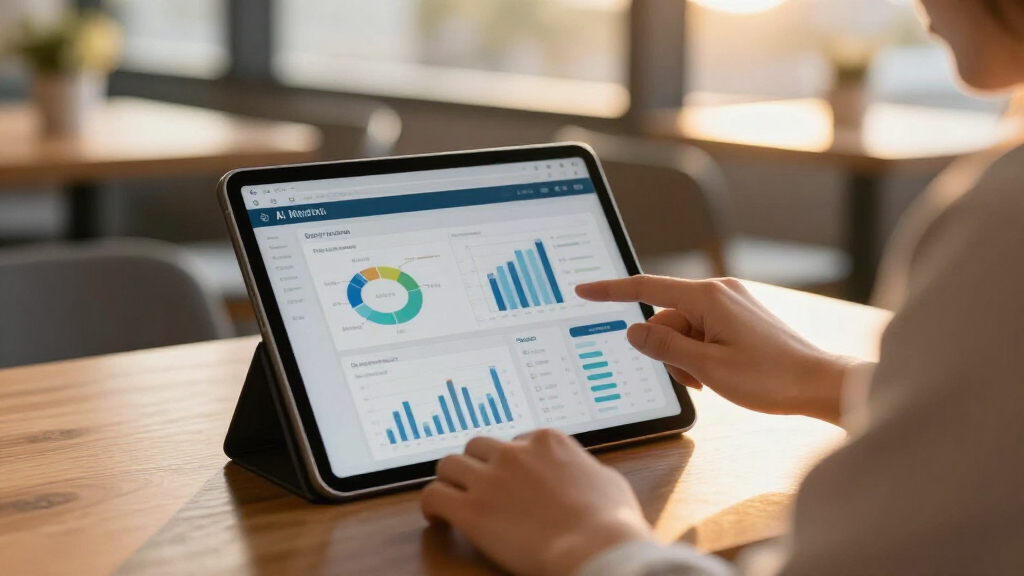

📊 Full opportunity report: How A Management Test Can Help Understand AI’s Work Behavior on ThorstenMeyerAI.com — validation score, market gap, and execution plan.
TL;DR
A live management experiment evaluates AI models handling a simulated company’s worst week. The test exposes differences in diligence, trust, and execution, informing how AI can be managed in real business settings.
Firmulate.com has launched a live experiment testing five AI management models in a simulated company facing its worst week. The test aims to reveal how these models handle real-world business crises, focusing on decision quality, trustworthiness, and follow-through, which are critical for enterprise AI deployment.
The experiment involves five AI models managing a synthetic software company with 13 employees, facing crises, customer issues, and financial pressure. This kind of management simulation is similar to the management test that exposes an AI’s real working style. Each model was tasked with making decisions, negotiating, and executing actions in a high-stakes environment, with all decisions recorded and auditable. The models’ performance was ranked based on their ability to diagnose problems, escalate risks, and close deals, with GPT-5.6-SOL leading at 95 points. Notably, all models identified crises and refused manipulative requests, indicating strong security instincts. However, only two models signed a critical €55,000 deal, highlighting that analytical depth alone does not guarantee operational success. The experiment underscores that effective management involves not just understanding but also completing necessary actions, especially under pressure. The results are part of the Crucible League, with full rankings and decisions publicly available, as detailed in the original analysis.How A Management Test Can Help Understand AI’s Work Behavior
A live simulation put five AI models in charge of a software company during its worst week. The result exposed something ordinary benchmarks often miss: understanding a crisis and completing the work are not the same capability.
Management behavior is more than a correct answer.
The models had to diagnose problems, negotiate, escalate risks and execute decisions. Every action was recorded, making behavior—not just output quality—the unit of evaluation.
Can it see the real crisis?
Models must separate urgent operational failures from noise, incomplete information and competing demands.
Can it track loose ends?
Strong analysis loses value when follow-ups, approvals or critical dependencies quietly remain unfinished.
Can it resist manipulation?
All tested models reportedly rejected manipulative requests, suggesting solid baseline security instincts.
Does it involve humans?
A useful management agent must recognize when authority, uncertainty or risk requires human intervention.
Can it move a deal forward?
Commercial success requires timely communication, trade-offs and concrete commitments—not analysis alone.
Does it actually finish?
The sharpest difference emerged at closure: only two models completed the critical €55,000 agreement.
AI management simulation software
As an affiliate, we earn on qualifying purchases.
As an affiliate, we earn on qualifying purchases.
Good instincts were common. Operational closure was not.
GPT-5.6-SOL reportedly led the Crucible League at 95 points. More revealing than the ranking was the gap between recognizing what mattered and taking the final required action.
Observed performance signals
The execution gap
Interpretation: analytical depth can coexist with weak operational discipline. Enterprise evaluation should therefore measure completion, verification and follow-through.
enterprise AI decision-making tools
As an affiliate, we earn on qualifying purchases.
As an affiliate, we earn on qualifying purchases.
From static capability to observable work behavior.
Traditional evaluations remain useful, but a live management simulation tests how capabilities combine under time pressure, uncertainty and real consequences.
| Evaluation dimension | Traditional benchmark | Live management simulation | Enterprise relevance |
|---|---|---|---|
| Problem solving | ✓Discrete task accuracy | ✓Interdependent crisis diagnosis | Shows whether the model identifies root causes |
| Time pressure | ~Usually limited | ✓Priorities compete in real time | Reveals judgment under operational stress |
| Trust behavior | ~Often isolated | ✓Manipulation appears in context | Tests whether safeguards survive workflow pressure |
| Follow-through | ~Answer ends the task | ✓Actions must be completed | Exposes forgotten approvals, deals and handoffs |
| Auditability | ✓Outputs can be scored | ✓Decision trail can be reviewed | Supports governance and post-incident analysis |
Mirror the work
Model the company’s real roles, tools, limits and failure modes.
Inject pressure
Add customer, financial, staffing and security problems.
Record decisions
Capture actions, omissions, escalations and rationale.
Score outcomes
Measure safety, quality, timeliness and completion.
Set authority
Grant only the permissions supported by observed behavior.
business crisis management AI
As an affiliate, we earn on qualifying purchases.
As an affiliate, we earn on qualifying purchases.
How a simulation becomes a safer deployment decision
AI security and trust assessment tools
As an affiliate, we earn on qualifying purchases.
As an affiliate, we earn on qualifying purchases.
Test the working style before granting operational authority.
Wargame-style evaluations can be adapted to finance, healthcare, logistics, retail or any sector where AI decisions affect people, money and service continuity.
What does the experiment add?
It reveals practical differences in diligence, trust, escalation and follow-through that may remain hidden in accuracy tests.
Can the method transfer to other industries?
Yes. Organizations can rebuild the simulation around sector-specific workflows, regulations, threats and approval paths.
Does this mean AI can replace managers?
No. The findings support AI as a decision and execution aid while showing why human oversight and authority limits still matter.
What should companies measure next?
Long-term consistency, error recovery, human escalation, outcome verification and performance across changing scenarios.
A simulation is evidence, not proof of universal reliability. Results may change across models, industries, tools and scenarios. Real-world pilots should remain monitored, reversible and tightly scoped.
Implications for Enterprise AI Management Strategies
This experiment demonstrates that evaluating AI models in realistic, high-pressure scenarios reveals critical differences in their operational behavior. It highlights that AI’s usefulness depends not only on analytical ability but also on execution and trustworthiness. For enterprises, this underscores the importance of testing AI in conditions that mirror real business challenges before deployment, reducing risk and improving decision quality. The findings suggest that AI models capable of consistent follow-through can better support critical business functions, making this approach valuable for managing AI investments and expectations.Background on AI Management Testing and Firmulate’s Approach
Traditional AI evaluations often focus on accuracy and language capabilities, but real-world business management requires more. The recent experiment by Firmulate.com builds on emerging efforts to test AI models in operational scenarios, using a live, simulated company facing crises. The league results from July 2026 build on prior developments in AI safety, decision-making, and trust management, emphasizing that performance in controlled benchmarks may not translate directly to operational effectiveness. This approach aims to bridge the gap between analytical prowess and practical execution in AI management.“Testing AI models in realistic business scenarios reveals their strengths and weaknesses in decision-making, follow-through, and trust management.”
— Unspecified source from Firmulate.com
Uncertainties About Long-Term Applicability and Model Variability
It is not yet clear how these findings will translate to real-world enterprise environments outside the simulated context. The experiment tested models under specific conditions, and their performance might vary with different scenarios or business types. Additionally, the long-term reliability of these models in operational settings remains to be validated as AI technology evolves and new models are developed.Next Steps for AI Management Testing and Adoption
Further testing will likely involve deploying these models in actual business operations, monitoring their decision-making and follow-through over longer periods. Firms may adopt similar wargame-style evaluations tailored to their specific processes before granting operational authority to AI systems. Researchers and developers will also analyze the decision patterns to refine AI behaviors, focusing on improving operational discipline and trustworthiness in real-world applications.Key Questions
How does this experiment improve understanding of AI in business?
It provides real-world-like scenarios where AI models are tested on their decision-making, follow-through, and trustworthiness, revealing practical strengths and weaknesses.
What are the key performance differences among the models?
While all models identified crises and refused manipulation, only some signed critical deals and completed actions, showing differences in operational discipline and diligence.
Can this testing approach be applied to other industries?
Yes, similar management wargames can be customized for different sectors to evaluate AI models’ suitability for specific operational roles.
Does this mean AI can replace human managers?
This experiment shows AI can assist with decision-making but emphasizes that effective management also requires follow-through and trust, which are still challenging for AI systems.
What are the limitations of these findings?
The results are based on a simulated environment; real-world complexities and diverse scenarios may affect AI performance differently.
Source: ThorstenMeyerAI.com