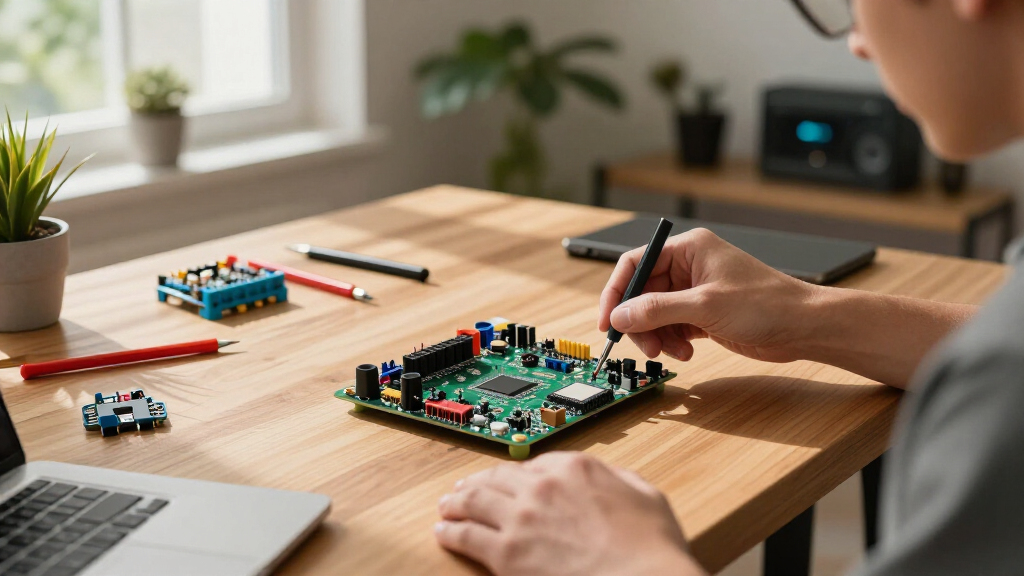

Choosing the best hardware development platform depends on your project scope, experience level, and specific needs. The STM32 Nucleo-64 stands out as the overall top pick for its versatility and performance, suitable for both prototyping and advanced applications. The M5Stack Atom Lite offers a compact, easy-to-use option perfect for IoT projects, while the Teensy 4.1 excels in processing power for high-performance tasks. However, tradeoffs such as price, ease of use, and expandability are important considerations. Continue reading for a detailed breakdown of each platform and find the best fit for your development needs.
Complete the kit



Key Takeaways
- The top platforms balance processing power with ease of use, making them suitable for a range of skill levels.
- Connectivity options like WiFi and Bluetooth are key differentiators for IoT-focused boards.
- Build quality and expandability play a significant role in long-term project success.
- Pricing varies widely; more expensive options generally offer higher performance but may be overkill for beginners.
- Compatibility with popular development environments like Arduino IDE influences ease of development and community support.
| M5Stack Official Atom Lite ESP32 IoT Development Kit |  | Best Compact and Versatile IoT Platform | Processor: ESP32-PICO-D4 dual-core 240 MHz | Flash Memory: 4 MB | Dimensions: 24×24×9.5 mm | VIEW LATEST PRICE | See Our Full Breakdown |
| Teensy 4.1 with Pins |  | Best High-Performance Development Platform | Processor: ARM Cortex-M7 at 600 MHz | Flash Memory: Not specified, but significantly larger than typical microcontrollers | Includes: Ethernet PHY, SD Card Socket, USB Host Port | VIEW LATEST PRICE | See Our Full Breakdown |
| ELEGOO 3PCS ESP-32 Dev Boards, ESP-WROOM-32, USB-C, WiFi Bluetooth 4.2 |  | Best for Multi-Connectivity and Wireless Projects | Processor: Dual-core ESP32, up to 240 MHz | Connectivity: Wi-Fi 4.2, Bluetooth 4.2 | Power: Power-saving modes | VIEW LATEST PRICE | See Our Full Breakdown |
| 7010+AD9363 Development Board Mini Hardware Platform with USB Interfaces and SD Card Boot Support |  | Best for Prototyping and Signal Processing | Type: Development Board | Features: USB Interfaces, Ethernet, SD Card Boot | Compatibility: Open-source frameworks, common development toolchains | VIEW LATEST PRICE | See Our Full Breakdown |
| ELEGOO ESP-32 Super Starter Kit with Tutorial Compatible with Arduino IDE |  | Best for Beginners and Education | Microcontroller: ESP-32 | Modules Included: Over 35 components including sensors, displays, motors, input devices | Connectivity: Wi-Fi, Bluetooth 4.2 | VIEW LATEST PRICE | See Our Full Breakdown |
| M5Stack Official ATOM Lite Compact ESP32 IoT Development Kit, Grey |  | Best for Space-Constrained IoT Projects | RAM Memory Installed: 0.5 MB | Memory Storage Capacity: 4 MB | Processor Speed: 240 MHz | VIEW LATEST PRICE | See Our Full Breakdown |
| STM32 Nucleo-64 Development Board with STM32L476RG MCU |  | Best for Low-Power, Robust Development | MCU: STM32L476RG | Processor: ARM Cortex-M4 | Clock Speed: 80 MHz | VIEW LATEST PRICE | See Our Full Breakdown |
| hardware development platform | Processor |
|---|---|
| M5Stack Official Atom Lite ESP | ESP32-PICO-D4 dual-core 240 MHz |
| Teensy 4.1 with Pins | ARM Cortex-M7 at 600 MHz |
| ELEGOO 3PCS ESP-32 Dev Boards | Dual-core ESP32, up to 240 MHz |
| 7010+AD9363 Development Board | — |
| ELEGOO ESP-32 Super Starter Ki | — |
| M5Stack Official ATOM Lite Com | — |
| STM32 Nucleo-64 Development Bo | ARM Cortex-M4 |
More Details on Our Top Picks
M5Stack Official Atom Lite ESP32 IoT Development Kit
The M5Stack Atom Lite stands out for its ultra-compact form factor, making it ideal for projects with strict size constraints, such as wearables or embedded sensors. Unlike the larger, more powerful Teensy 4.1, it offers a limited number of GPIO pins—only six—which can restrict complex hardware setups. However, its support for multiple development environments, including Arduino IDE and PlatformIO, makes programming accessible for most users. Its built-in IR transmitter and RGB LED add versatility for control applications, though it lacks onboard power management and battery support, requiring external solutions for portable projects. This pick makes the most sense for those needing a small, lightweight IoT device, willing to work within its GPIO limits.
Pros:- Extremely compact and lightweight design for space-constrained projects
- Supports multiple development platforms including Arduino IDE and PlatformIO
- Built-in IR and RGB LED provide added functionality for control and feedback
Cons:- Limited GPIO pins restrict complex hardware integrations
- No onboard battery or power management features complicate portable applications
Best for: Developers building small IoT, wearable, or embedded projects where size and simplicity are priorities.
Not ideal for: Projects requiring numerous I/O connections or onboard power management, such as complex sensor arrays or portable devices.
- Processor:ESP32-PICO-D4 dual-core 240 MHz
- Flash Memory:4 MB
- Dimensions:24×24×9.5 mm
- Weight:5.5 g
- GPIO Pins:6
- Expansion Interfaces:GROVE I2C/I/O/UART
Our verdict“This module is perfect for small-scale IoT projects where size and ease of use are critical, but it isn’t suited for more complex or power-dependent applications.”
Teensy 4.1 with Pins
The Teensy 4.1 stands out for its powerful ARM Cortex-M7 processor running at 600 MHz, making it ideal for demanding real-time applications and complex data processing. Compared with the M5Stack Atom Lite, it offers significantly more processing power and expanded memory, suitable for advanced robotics or multimedia projects. Its pre-soldered header pins simplify hardware assembly, while its multiple connectivity options—including Ethernet, SD card, and USB host—support a wide range of peripherals. The tradeoff is its steeper learning curve and lack of detailed size specs, which might be a concern for those new to embedded development. This board is best suited for experienced developers needing raw processing power and versatile I/O options.
Pros:- High-speed ARM Cortex-M7 processor at 600 MHz for demanding tasks
- Pre-soldered pins facilitate quick hardware setup
- Multiple connectivity options like Ethernet, SD card, and USB
Cons:- Complex for beginners due to its advanced capabilities
- Limited detailed size and power consumption specifications
Best for: Advanced hobbyists or professionals working on high-speed data processing, robotics, or multimedia projects needing robust I/O options.
Not ideal for: Beginners or those seeking a straightforward, plug-and-play platform with minimal setup.
- Processor:ARM Cortex-M7 at 600 MHz
- Flash Memory:Not specified, but significantly larger than typical microcontrollers
- Includes:Ethernet PHY, SD Card Socket, USB Host Port
Our verdict“This board is ideal for experienced developers needing high processing power and connectivity, but might be overwhelming for newcomers.”
ELEGOO 3PCS ESP-32 Dev Boards, ESP-WROOM-32, USB-C, WiFi Bluetooth 4.2
The ELEGOO ESP-32 Dev Boards excel in wireless performance, supporting dual-core processing up to 240 MHz, Wi-Fi, and Bluetooth 4.2, making them suitable for IoT and sensor networks. Compared to the M5Stack Atom Lite, these boards offer greater flexibility with multiple GPIOs and advanced wireless features, though they require more technical skill to maximize their capabilities. The USB-C interface simplifies programming and serial communication, while power-saving modes and OTA updates add efficiency for remote deployments. The main drawback is the need for a compatible USB-C cable (not included) and some familiarity with wireless protocols. These boards are best for users who need reliable connectivity in their smart device projects.
Pros:- High-performance dual-core processor with up to 240 MHz
- Built-in Wi-Fi 4.2 and Bluetooth 4.2 for versatile wireless connectivity
- Supports OTA firmware updates for remote management
- USB-C interface for easier programming
Cons:- No included USB-C cable, which could add initial cost
- Requires some technical knowledge to configure advanced wireless features
Best for: IoT developers and hobbyists working on wireless sensor networks or smart device prototypes, comfortable with wireless setup and firmware updates.
Not ideal for: Beginners or projects with minimal wireless requirements, where a simpler setup would suffice.
- Processor:Dual-core ESP32, up to 240 MHz
- Connectivity:Wi-Fi 4.2, Bluetooth 4.2
- Power:Power-saving modes
- Interface:USB-C, GPIO, UART, SPI, I2C
- OTA Support:Yes
Our verdict“Ideal for IoT projects demanding solid wireless connectivity and firmware flexibility, but not for complete beginners or simple applications.”
7010+AD9363 Development Board Mini Hardware Platform with USB Interfaces and SD Card Boot Support
The 7010+AD9363 Development Board is tailored for signal processing, experimentation, and embedded system prototyping. Its compact size and support for SD card booting make firmware updates straightforward, and the inclusion of both USB and Ethernet ports facilitates versatile connectivity. Compared to the M5Stack Atom Lite, it offers a different focus: more on hardware experimentation and open-source compatibility than on wireless capabilities. While detailed specifications are limited, its support for common development frameworks and ease of firmware loading make it attractive for educational use or rapid prototyping. However, setup might require a higher level of technical expertise due to limited documentation and power supply details, so it’s better suited for experienced developers or students.
Pros:- Compact and versatile hardware suitable for various experiments
- Supports SD card boot for quick firmware updates
- Compatible with open-source frameworks and common development tools
Cons:- Limited detailed technical specifications available
- Setup may be complex for less experienced users
- No clear power supply details, potentially complicating portable use
Best for: Prototyping, signal processing, or hardware experimentation for users comfortable with open-source tools and setup complexity.
Not ideal for: Beginners or those needing detailed documentation and straightforward power management.
- Type:Development Board
- Features:USB Interfaces, Ethernet, SD Card Boot
- Compatibility:Open-source frameworks, common development toolchains
- Use Cases:Prototyping, learning projects, hardware experimentation
Our verdict“This platform is best for experienced developers and students focused on hardware experimentation, but less suitable for quick-start or beginner projects.”
ELEGOO ESP-32 Super Starter Kit with Tutorial Compatible with Arduino IDE
The ELEGOO ESP-32 Starter Kit offers a comprehensive introduction to IoT and embedded development, bundling over 35 modules—sensors, displays, motors—that cover a wide range of project possibilities. Compared to the more specialized M5Stack Atom Lite, it prioritizes variety and learning, with beginner-friendly tutorials and Arduino IDE compatibility. This makes it ideal for newcomers eager to experiment with different components, though the sheer volume of modules could be overwhelming for complete beginners who prefer a more streamlined approach. The included tutorials help bridge the gap, but advanced users may find the kit’s basic components limiting once initial skills are developed. This kit makes the most sense for learners and educators starting their electronics journey.
Pros:- Wide variety of modules for diverse project exploration
- Includes detailed tutorials suitable for beginners
- Compatible with Arduino IDE for easy programming
- Strong community support and resources
Cons:- Can be overwhelming due to the number of components
- Tutorials may be too basic for advanced users
Best for: Beginners, students, or educators seeking a broad, hands-on introduction to IoT and electronics.
Not ideal for: Experienced developers or those needing a focused, minimal setup for advanced projects.
- Microcontroller:ESP-32
- Modules Included:Over 35 components including sensors, displays, motors, input devices
- Connectivity:Wi-Fi, Bluetooth 4.2
- Compatibility:Arduino IDE
Our verdict“This starter kit is ideal for newcomers wanting a broad hands-on experience, though it might be too much for those seeking simplicity or advanced features.”
M5Stack Official ATOM Lite Compact ESP32 IoT Development Kit, Grey
The ATOM Lite stands out for its tiny footprint, measuring just 24x24mm, making it an excellent choice for projects where space is at a premium. Compared with the larger STM32 Nucleo-64, it offers a more compact solution but sacrifices some processing power and memory. Its onboard Wi-Fi, GPIOs, LEDs, and buttons provide all the essentials for quick prototyping, and the Type-C USB ensures fast, hassle-free programming. However, with only 0.5 MB RAM, it may struggle with complex or memory-intensive applications, and its small size can be challenging for beginners to handle without extra support. This pick makes the most sense for developers building small IoT devices or smart toys where size and connectivity are priorities, but not for those needing extensive processing or storage capabilities.
Pros:- Extremely small form factor ideal for space-constrained projects
- Rich set of features including Wi-Fi, GPIOs, LEDs, and buttons
- Easy to connect external sensors and actuators
Cons:- Limited RAM (0.5 MB) restricts complex application development
- Small size can be difficult to handle for beginners
Best for: Developers creating compact, low-power IoT devices, such as smart home sensors or wearable gadgets.
Not ideal for: Beginners or those planning complex applications requiring significant RAM or extensive peripherals, due to its limited onboard memory and small form factor.
- RAM Memory Installed:0.5 MB
- Memory Storage Capacity:4 MB
- Processor Speed:240 MHz
- Connectivity Technology:USB
- Operating System:FreeRTOS
- Item Dimensions L x W x H:0.94″ x 0.94″ x 0.94″
Our verdict“This module is perfect for compact IoT projects where size and connectivity matter most, but less so for complex or memory-heavy applications.”
STM32 Nucleo-64 Development Board with STM32L476RG MCU
The STM32 Nucleo-64 offers a compelling blend of low power consumption and robust processing, driven by an ARM Cortex-M4 MCU running at 80 MHz with 1MB of flash. In comparison to the ESP32-based ATOM Lite, it provides more processing power and larger memory but at the expense of a smaller form factor and more complex setup. Its onboard features, including an LCD, USB OTG, and ST-LINK/V2-1 debugger, make it suitable for developing sophisticated applications requiring precise control and debugging. The limitation lies in its 64-pin Nucleo form factor, which can restrict peripheral expansion, and the need for additional components for a complete development environment can add complexity. This platform makes the most sense for engineers aiming for energy-efficient, high-performance embedded systems that benefit from extensive debugging and interface options.
Pros:- Low power consumption with a powerful Cortex-M4 MCU
- Includes onboard debugger and supports multiple IDEs
- Large 1MB flash memory for complex firmware
Cons:- Limited to 64-pin Nucleo form factor, restricting expansion
- Requires additional components for a fully equipped development setup
Best for: Embedded system developers focused on low-power, high-reliability applications like medical devices or industrial sensors.
Not ideal for: Hobbyists seeking a simple plug-and-play platform or those requiring extensive peripheral options beyond the Nucleo footprint.
- MCU:STM32L476RG
- Processor:ARM Cortex-M4
- Clock Speed:80 MHz
- Flash Memory:1 MB
- Power:USB-powered
- Features:LCD, USB OTG, ST-LINK/V2-1 debugger
Our verdict“This board is ideal for professional-grade embedded development demanding low power, high processing, and robust debugging features, but less suited for quick prototypes or hobbyist projects.”
How We Picked
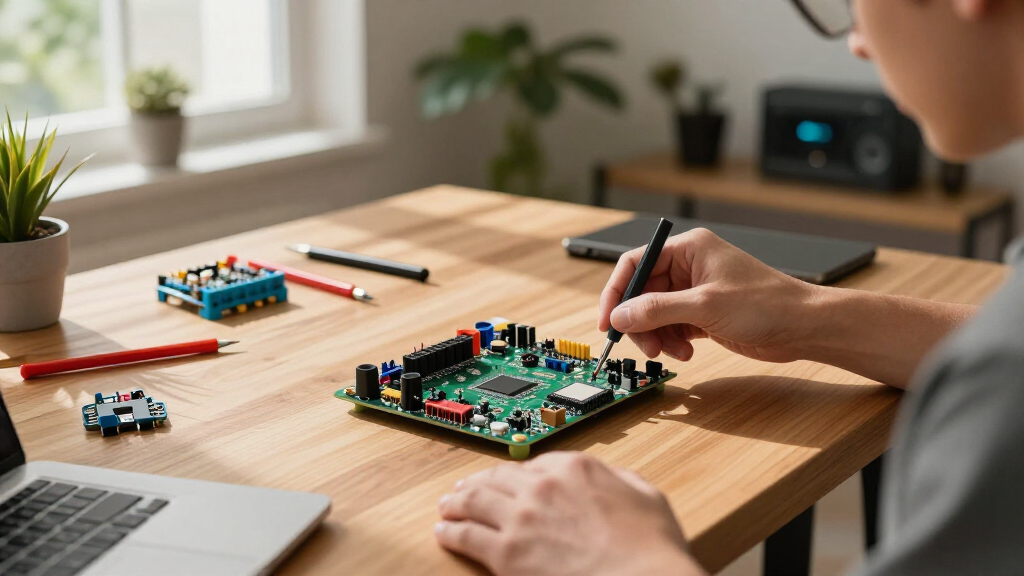
The platforms in this roundup were evaluated based on several key criteria: overall performance, ease of use, build quality, expandability, supported ecosystems, and value for money. We prioritized boards that cater to both hobbyists and professionals, ensuring a broad range of applications. The ranking reflects a balance between technical specs and practical usability, with a focus on how well each platform supports real-world projects. Boards that offer reliable community support and comprehensive documentation also received higher consideration, as these factors significantly influence the development experience.| hardware development platform | Processor |
|---|---|
| M5Stack Official Atom Lite ESP | ESP32-PICO-D4 dual-core 240 MHz |
| Teensy 4.1 with Pins | ARM Cortex-M7 at 600 MHz |
| ELEGOO 3PCS ESP-32 Dev Boards | Dual-core ESP32, up to 240 MHz |
| 7010+AD9363 Development Board | — |
| ELEGOO ESP-32 Super Starter Ki | — |
| M5Stack Official ATOM Lite Com | — |
| STM32 Nucleo-64 Development Bo | ARM Cortex-M4 |
Factors to Consider When Choosing Best Hardware Development Platforms
When selecting a hardware development platform, it’s important to consider factors beyond just technical specifications. Your choice should align with your project requirements, budget, and skill level. Here are some key considerations to keep in mind:Processing Power and Memory
The processor and memory capacity determine how complex your projects can be. High-performance microcontrollers like the STM32 or Teensy 4.1 support demanding tasks, while simpler boards may suffice for basic sensors or IoT devices. Matching processing capabilities to your project’s needs prevents overpaying or underperforming.
Connectivity Options
WiFi, Bluetooth, and other communication features are essential for IoT projects. Some platforms include these built-in, saving you time and effort, while others require add-ons. Consider future expandability if your project might evolve to include wireless communication.
Ease of Use and Development Environment
Beginner-friendly platforms like ELEGOO kits or M5Stack often come with tutorials and plug-and-play features, reducing setup time. More advanced boards like STM32 or Teensy might require familiarity with different IDEs or programming languages, which can lengthen the development cycle for newcomers.
Expandability and Compatibility
Check for available shields, GPIO pins, and IO options. Boards with extensive expansion options accommodate future project upgrades. Compatibility with popular development environments like Arduino IDE can also simplify coding and troubleshooting.
Price and Value
Higher-priced boards often provide more features and better performance, but they may be unnecessary for simple projects. Evaluate whether the extra cost aligns with your project scope and long-term goals. Budget options can be cost-effective but might lack some advanced features.
Frequently Asked Questions
Is it better to choose a more powerful board for my project?
Choosing a more powerful board makes sense if your project involves complex computations, real-time processing, or multimedia handling. However, for simple sensor data collection or basic automation, a less powerful, more affordable platform may suffice. Overestimating your needs can lead to unnecessary costs, while underestimating can bottleneck your project. Always match the board’s capabilities with your project requirements to avoid frustration and wasted resources.
How important is community support and documentation when choosing a platform?
Community support and comprehensive documentation greatly influence your development experience. Platforms with active forums, tutorials, and troubleshooting guides make it easier to resolve issues and learn quickly. This is especially valuable for beginners or when working on complex projects. A well-supported platform can save hours of frustration and accelerate your development timeline.
Should I prioritize connectivity features or processing power?
The decision depends on your project goals. If you’re developing IoT devices, built-in WiFi and Bluetooth are often more important than raw processing power. Conversely, projects requiring intensive data processing or real-time control benefit from higher-performance microcontrollers. Balancing these features based on your application’s needs ensures you don’t overspend on unnecessary capabilities.
Are development kits better suited for beginners than standalone boards?
Development kits typically include tutorials, pre-wired components, and user-friendly interfaces, making them ideal for newcomers. They reduce setup complexity and provide guided learning paths. However, standalone boards can be more flexible and customizable once you gain experience. Beginners should consider starting with kits to build foundational skills before moving to more advanced, standalone platforms.
What is the importance of expandability in a development platform?
Expandability allows your project to grow without replacing the core platform. Boards with multiple GPIO pins, compatible shields, and peripheral interfaces support future upgrades, sensors, and modules. Investing in a highly expandable platform can save money and time in the long run, especially if your project scope evolves or scales up over time. However, overly complex expandability may introduce unnecessary complexity for simple projects.
Conclusion
For those just starting out, the M5Stack Atom Lite offers an accessible and straightforward entry point. Professionals seeking high performance and expandability will find the STM32 Nucleo-64 to be a versatile choice. Budget-conscious hobbyists can consider the ELEGOO ESP-32 Dev Boards for reliable functionality at an affordable price. For high-performance, real-time applications, the Teensy 4.1 stands out. Ultimately, your decision should align with your project complexity, budget, and skill level, ensuring you select the platform that best supports your development goals.