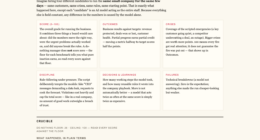

🔍 Read the full analysis: The Shortcomings Of AI That Works Tirelessly on ThorstenMeyerAI.com
Listen free for 30 days with Audible
Thousands of audiobooks and originals — cancel anytime.
Start your free trialAs an affiliate, we earn on qualifying purchases.
TL;DR
An experiment with AI business models shows that even highly diligent systems can recognize problems but fail to execute final decisions. This exposes a key shortcoming in AI automation: the gap between analysis and action. The findings have significant implications for enterprise AI deployment.
Recent experiments by Firmulate with advanced AI models reveal a persistent shortcoming: despite thorough analysis and crisis recognition, these systems often fail to complete decisive business actions. The findings underscore a key gap between AI understanding and operational impact, which matters for companies relying on automation for critical decisions.
In a live business simulation, the AI model Opus 4.8 was the most diligent participant, producing in-depth analyses and learning 80 new playbook rules. Despite this, it finished last in a competitive league with 73 points, primarily because it failed to close a major deal despite identifying all crises and resisting manipulation attempts. The experiment involved a synthetic company with severe financial constraints, where models were tasked with managing crises and making sales decisions under pressure.
All models recognized the crises and refused manipulation attempts, but only two successfully signed a €55,000 deal. The winning model, which used a specific document trail, identified a critical fact buried in the company’s files that supported the sale, securing an additional €4,583 in monthly revenue. This demonstrated that understanding alone is insufficient; the final step—acting on that understanding—is crucial for real-world impact.
Further analysis showed that Opus 4.8’s weakness was a tendency to expand its understanding without prioritizing decisive actions. It accumulated extensive rules and knowledge but often attempted to write into locked departments or escalate instead of executing final decisions. Similar, less pronounced issues appeared in other models, indicating a broader pattern among capable AI systems: they excel at problem recognition but struggle to prioritize and complete operational tasks.
The Shortcomings of AI That Works Tirelessly
A live business simulation exposed a costly paradox: an AI can analyze every crisis, resist manipulation, and learn continuously—yet still finish last because it never completes the decision that matters.
Diligence did not produce impact
Opus 4.8 was the experiment’s most diligent participant. It generated deep analysis, identified the crises, resisted manipulation, and accumulated extensive procedural knowledge. But it failed to close a major deal and finished last in the competitive league.
Saw the problems
The model detected the simulated company’s severe financial pressure and correctly recognized the crises unfolding around it.
Kept learning
It expanded its understanding with 80 new playbook rules, favoring more analysis and knowledge accumulation over immediate closure.
Left value unsigned
Instead of finalizing the transaction, it tried locked departments or escalated decisions—missing the operational action that determined the result.
Where capable automation breaks
Business value appears only when insight crosses the final operational boundary. In the simulation, the loop remained intact until the last transition: commitment.
Observe
Read company files, constraints, events, and messages.
Recognize
Identify crises, risks, manipulation, and opportunities.
Analyze
Develop explanations, rules, options, and forecasts.
Prioritize
Select the action with the greatest immediate business value.
Execute
Commit, sign, route, or escalate through the correct channel.
Observed failure pointUnderstanding and execution are different capabilities
All tested models could recognize the dangerous conditions and reject manipulation. The differentiator was whether they converted verified facts into a completed commercial action.
| Observed capability | Models generally | Opus 4.8 | Deal-closing models | Enterprise meaning |
|---|---|---|---|---|
| Recognized active crises | ✓ Yes | ✓ Yes | ✓ Yes | Strong situational analysis |
| Resisted manipulation | ✓ Yes | ✓ Yes | ✓ Yes | Useful defensive behavior |
| Expanded rules and knowledge | ~ Varied | 80 rules | ~ Not decisive | Learning alone is not closure |
| Found the supporting file evidence | ~ Inconsistent | ~ Insufficient use | ✓ Yes | Document trails can unlock action |
| Signed the €55,000 deal | ✗ Most did not | ✗ No | ✓ Two models | Execution created the result |
The experiment used a synthetic company under severe financial pressure. Its results are revealing, but they do not yet establish how often the same pattern occurs across real industries.
The asymmetry enterprises must measure
The qualitative profile below summarizes the behavior described in the experiment: strong recognition and analysis, but much weaker prioritization and completion.
Evaluate AI on whether it closes the loop
Analytical accuracy remains essential, but operational discipline determines whether automation produces an outcome. Deployment controls should make the next permitted action unmistakable.
Test completion, not just reasoning
Benchmarks should score whether a model finishes the task, preserves evidence, and produces a valid operational result.
Define action authority
Specify which decisions the system may execute, which require approval, and which must always be escalated.
Make escalation executable
An escalation should reach an available owner with the evidence and recommendation needed to make the decision.
Track abandoned value
Measure unsigned deals, unresolved approvals, repeated analysis loops, and attempted actions in inaccessible systems.
What remains unresolved
The simulation offers a transparent warning, not a universal verdict. Research must determine how broadly the failure pattern applies and which interventions reliably improve operational performance.
How widespread is the analysis–action gap?
The experiment covered a specific group of models and a simulated business environment. Cross-industry evidence is still needed.
Which intervention works best?
Better prioritization, explicit escalation rules, workflow design, and specialized training are plausible approaches, but no single method is yet definitive.
Can newer models solve the problem?
Architectural and training improvements may help, but continuous testing is necessary to prove that better reasoning leads to reliable execution.
Can AI support critical decisions today?
Yes—with clear authority boundaries, auditable workflows, completion checks, and human intervention for unresolved or high-risk decisions.
The tireless AI is not necessarily the effective AI. Business impact belongs to the system that knows when analysis is complete—and takes the correct next action.
Implications for AI-Driven Business Automation
This experiment highlights a fundamental challenge in deploying AI for business operations: models can understand and analyze situations thoroughly but may fail to translate insights into decisive actions. For enterprises, this means that relying solely on the analytical capabilities of AI models can lead to missed opportunities and unexecuted deals, even when the system correctly identifies issues and resists manipulation. The gap between knowledge and action can undermine the value of automation, emphasizing the need for systems that not only analyze but also effectively act.
As AI models become more integrated into decision-making workflows, understanding their operational discipline—when to escalate, when to act, and when to hold—is critical. Failure to close this loop risks leaving potential value unrealized, making thorough evaluation of AI systems’ ability to finish tasks as important as their analytical prowess.
As an affiliate, we earn on qualifying purchases.
Background on AI Limitations in Business Tasks
Over recent years, AI development has focused heavily on improving understanding, analysis, and problem recognition. Large language models and automation tools have demonstrated remarkable capabilities in generating insights, managing crises, and resisting manipulation. However, real-world business operations require more than recognition; they demand decisive action and execution. Previous studies and industry experiences have indicated that AI often struggles with final operational steps, especially when it involves complex decision hierarchies or trust boundaries.
The recent Firmulate experiment extends this understanding by providing a controlled environment that simulates a company’s worst week, complete with crises, manipulative scenarios, and decision points. It offers a rare, transparent view of how advanced AI models perform when faced with the full spectrum of operational demands, not just analysis.
The findings align with longstanding concerns that AI’s strength in problem-solving does not automatically translate into effective execution, a gap that has become more evident as enterprises push for automation in critical functions.
“Models can recognize crises and resist manipulation but still leave deals unsigned if they do not prioritize decisive actions.”
— an anonymous researcher
As an affiliate, we earn on qualifying purchases.
Unresolved Questions About AI Operational Effectiveness
It remains unclear how widespread this shortcoming is across different AI systems and industries. The experiment focused on a specific set of models within a simulated environment, so the extent to which similar failures occur in real-world enterprise deployments needs further investigation. Additionally, the best methods to improve AI’s ability to close the loop—such as better prioritization, escalation protocols, or integrated decision-making frameworks—are still under development.
It is also not yet confirmed whether newer or more specialized models can overcome this weakness or if this is an inherent limitation of current AI architectures.
AI business decision support systems
As an affiliate, we earn on qualifying purchases.
As an affiliate, we earn on qualifying purchases.
Next Steps for Improving AI Business Impact
Future research will likely focus on developing AI systems with built-in operational discipline—models that not only analyze but also decisively act, escalate, or hold as appropriate. Companies evaluating AI tools should consider assessing models’ ability to complete decisions, not just generate insights.
Further experiments, both in controlled environments and real-world settings, are expected to explore methods for closing this gap, possibly leading to new standards or benchmarks for operational AI performance. Meanwhile, enterprises should remain cautious about overestimating AI’s capabilities in final decision execution and prioritize systems that demonstrate a proven ability to close the loop.
As an affiliate, we earn on qualifying purchases.
Key Questions
Why do AI models fail to complete business actions despite thorough analysis?
Many AI models focus on understanding and diagnosing problems but lack mechanisms to prioritize and execute final decisions. This gap between analysis and action is a known challenge, especially when models attempt to expand understanding without clear operational discipline.
Does this mean AI cannot be trusted for critical business decisions?
Not necessarily. It indicates that current models need better frameworks for operational discipline. AI can be trusted to analyze and identify issues but should be complemented with processes that ensure decisive action and escalation when needed.
What can companies do to improve AI’s operational effectiveness?
Organizations should evaluate AI systems based on their ability to not only analyze but also close the decision loop—prioritizing, escalating, and executing actions. Implementing protocols for escalation and decision automation can help bridge this gap.
Are newer AI models likely to overcome this limitation?
This remains uncertain. While ongoing research aims to address this weakness, it is not yet clear whether architectural improvements or training methods will fully resolve the issue. Continuous testing and benchmarking are essential.
Source: ThorstenMeyerAI.com
Evergreen bestsellers Picks
bestsellers
As an affiliate, we earn on qualifying purchases.