
TL;DR

Get the latest gadgets delivered free — and shop member deals
- Fast, free delivery on millions of items
- Access to Prime Big Deal Days deals on October 6–7
- Prime Video, Amazon Music and more included
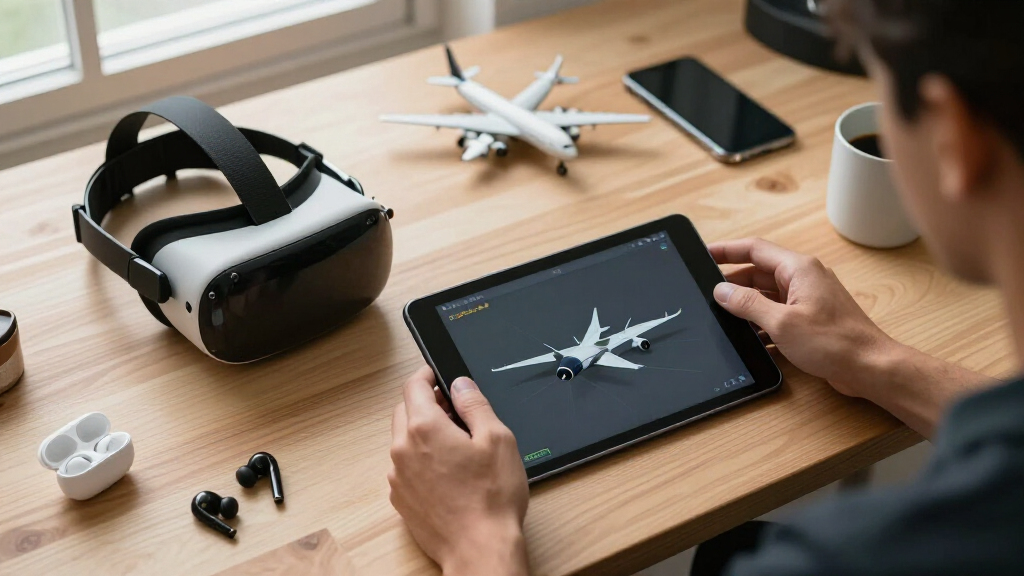
Aerospace companies are integrating virtual reality into aircraft development workflows, enabling more precise design, testing, and collaboration. This shift is confirmed by recent industry reports and pilot programs, highlighting a significant technological advancement.
Multiple aerospace companies are now adopting virtual reality (VR) technology to revolutionize aircraft development, enabling engineers to visualize, test, and modify designs in immersive 3D environments. This development is confirmed by industry reports and pilot projects, signaling a significant shift in how aircraft are designed and tested, with potential impacts on efficiency, accuracy, and collaboration.
Recent industry surveys and pilot programs confirm that aerospace firms are increasingly integrating VR tools into their aircraft development processes. These tools allow engineers to create detailed 3D models that can be experienced in immersive environments, reducing the need for physical prototypes. For example, a major aerospace manufacturer reported that their VR-enabled design reviews cut development time by approximately 20% and improved detection of design flaws early in the process. Experts say that VR enhances collaboration among geographically dispersed teams by providing a shared, interactive space for review and modification, which is especially valuable in complex projects involving multiple stakeholders. Additionally, VR simulations are being used for virtual testing of aerodynamics and ergonomics, offering a safer and more cost-effective alternative to traditional wind tunnel tests and physical mockups.How Virtual Reality Transforms Aircraft Development for Aerospace Professionals
Aerospace companies are integrating VR into aircraft development workflows, enabling engineers to visualize, test, and modify designs in immersive 3D environments — reducing prototype costs, accelerating reviews, and connecting globally dispersed teams.
Where VR Is Reshaping the Engineering Workflow
Immersive Design Reviews
Engineers step inside full-scale 3D aircraft models, spotting design flaws early. One major manufacturer cut development time by roughly 20% in VR-enabled reviews.
Virtual Aerodynamics & Ergonomics
VR simulations offer a safer, more cost-effective alternative to wind tunnel tests and physical mockups for aerodynamic and human-factors evaluation.
Shared Review Spaces
Geographically dispersed teams co-review and modify designs in one interactive space — critical for complex, multi-stakeholder aircraft programs.
From CAD Model to Certified Insight
3D Model Import
CAD design data is converted into an immersive VR environment.
Immersive Review
Teams walk through the virtual aircraft, inspecting systems and ergonomics.
Flaw Detection
Design issues surface early — before costly physical prototypes are built.
Iterate & Validate
Modifications are made in-session; physical testing is reserved for final validation.
Why it matters: VR can significantly reduce development costs and timelines through precise visualization and early flaw detection — while fostering collaboration across locations and enabling more innovative, optimized aircraft designs.
A Decade of Digital Tools in Aerospace Engineering
CAD Foundation
Digital design and simulation platforms become standard across aerospace engineering.
Early VR Trials
First experiments with virtual reality in aerospace design and review contexts.
Adoption Accelerates
Hardware and software advances drive pilot programs at major manufacturers and defense contractors.
Standard Practice
Analysts predict VR becomes a core component of aircraft development workflows.
Promise vs. Proof: The Adoption Reality
Open challenges: hardware durability, software interoperability, training requirements, and initial costs remain barriers — especially for smaller firms. Long-term effects on cost savings, safety, and innovation still require broader deployment and peer-reviewed studies.
What Aerospace Professionals Are Asking
Impacts of VR on Aerospace Design Efficiency
The adoption of virtual reality in aircraft development represents a transformative step for the aerospace industry. By enabling more precise visualization and early detection of design issues, VR can significantly reduce development costs and timelines. It also fosters better collaboration among teams across different locations, potentially leading to more innovative and optimized aircraft designs. As VR technology becomes more accessible and sophisticated, it could reshape industry standards, making virtual prototyping a core part of aerospace engineering. This shift is particularly relevant given the increasing complexity of modern aircraft and the demand for rapid development cycles in a competitive market.
As an affiliate, we earn on qualifying purchases.
Evolution of Digital Tools in Aerospace Engineering
Over the past decade, aerospace engineering has progressively integrated digital tools, from CAD software to simulation platforms. The recent emergence of virtual reality as a practical application builds on this trend, offering immersive experiences that traditional 2D screens cannot provide. Early experiments with VR in aerospace date back to the mid-2010s, but widespread adoption accelerated in 2022 and 2023, driven by advancements in hardware and software. Major aerospace companies and defense contractors have reported pilot programs demonstrating VR’s potential to streamline design reviews, ergonomics testing, and maintenance planning. While still in the early stages compared to established CAD systems, VR’s role is expanding rapidly, with industry analysts predicting it will become a standard component of aircraft development workflows within the next few years.
immersive 3D aircraft modeling software
As an affiliate, we earn on qualifying purchases.
As an affiliate, we earn on qualifying purchases.
Unconfirmed Long-Term Impact and Industry Adoption Rate
While pilot programs and early adoption reports are promising, it is still unclear how quickly VR will become a standard practice across the entire aerospace industry. The long-term effects on cost savings, safety, and design innovation remain to be fully validated through broader deployment and peer-reviewed studies. Additionally, questions about hardware durability, software interoperability, and training requirements are still being addressed. Experts caution that widespread adoption may take several years, and some small firms might face barriers due to costs or technical challenges.
virtual reality tools for aerospace engineering
As an affiliate, we earn on qualifying purchases.
As an affiliate, we earn on qualifying purchases.
Next Steps for Broader VR Integration in Aerospace
Industry leaders are expected to expand pilot programs and invest in VR hardware and software development. Regulatory bodies may begin considering standards for virtual prototyping and testing. Additionally, research institutions are likely to conduct comprehensive studies to quantify the benefits and limitations of VR in aircraft design. Within the next 12 to 24 months, more aerospace firms are anticipated to incorporate VR into their regular workflows, moving towards industry-wide adoption. Ongoing technological improvements and cost reductions will be critical factors influencing this transition.
VR simulation for aerodynamics testing
As an affiliate, we earn on qualifying purchases.
As an affiliate, we earn on qualifying purchases.
Key Questions
How does virtual reality improve aircraft design?
VR enables engineers to immerse themselves in 3D models of aircraft, allowing for better visualization, early detection of design flaws, and enhanced collaboration among teams, which can lead to faster and more accurate development processes.
Are all aerospace companies using VR now?
No, adoption is currently limited to pilot programs and early adopters. Widespread industry use is expected to grow over the next few years as technology matures and costs decrease.
What are the main challenges in adopting VR for aircraft design?
Key challenges include hardware durability, software interoperability, training requirements, and initial investment costs. Addressing these issues is essential for broader adoption.
Will VR replace physical prototypes entirely?
While VR can significantly reduce reliance on physical prototypes, it is unlikely to eliminate them entirely. Physical testing remains important for validation and certification processes, but VR will complement traditional methods.
How soon will VR become standard in aerospace development?
Experts predict that within 2 to 5 years, VR will be a common tool in aerospace engineering, especially for early-stage design, review, and ergonomics testing.
Source: rss
Fall Picks
fall essentials
As an affiliate, we earn on qualifying purchases.