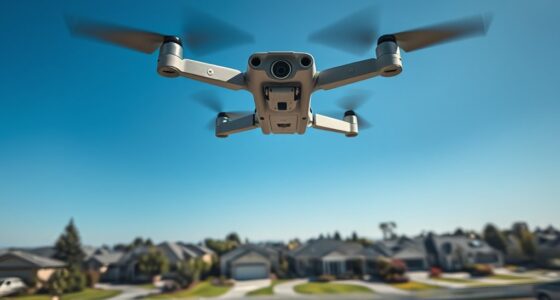

Your camera or phone uses image stabilization technology to prevent blurring caused by hand movements. It combines optical hardware like gyroscopes and lens adjustments with digital software to detect and counteract camera shakes in real-time. Optical image stabilization moves lens elements physically, while digital stabilization crops or adjusts frames to keep images sharp. This hybrid approach guarantees clearer photos and smoother videos, especially in challenging conditions. Keep exploring to discover how these methods work together for stunning results.
Key Takeaways
- Cameras use hardware stabilization like lens shifting (OIS) or sensor movement (Sensor-shift) to counteract shake during capture.
- Digital stabilization employs software algorithms to analyze and correct motion artifacts in real-time or post-processing.
- Gyroscopic sensors detect subtle camera movements and provide data to adjust lens or sensor position for sharper images.
- Proper calibration ensures sensors interpret movements accurately, improving stabilization effectiveness.
- Combining hardware and software techniques, cameras maintain clarity and reduce blurring in various lighting and movement conditions.
The Basics of Image Stabilization Technology

Have you ever wondered how photographers capture sharp images even in shaky conditions? The answer lies in the basics of image stabilization technology. One key factor is managing lens distortion, which can cause blurring if the lens shifts during exposure. To counteract this, cameras and phones adjust their settings, especially shutter speed. A faster shutter speed reduces the chance of motion blur by capturing images quickly. Some devices also incorporate digital or optical stabilization to compensate for tiny movements, ensuring sharpness. Understanding these fundamentals helps you appreciate how your device maintains clarity, even when you’re on the move. Essentially, controlling lens distortion and optimizing shutter speed work together to produce clear, crisp photos despite camera shake. Additionally, many modern devices use reliable backup power systems to ensure consistent performance during extended shooting sessions. These systems help maintain stabilization features even when battery levels are low. Furthermore, incorporating proper airflow around the camera can help prevent overheating that might affect stabilization accuracy. Moreover, advancements in image stabilization technology continue to improve the quality of handheld photography.
Optical Image Stabilization (OIS) Explained

Ever wondered how smartphones and cameras achieve steady shots even when your hands are shaky? Optical Image Stabilization (OIS) uses tiny gyroscopic sensors to detect motion and adjust the lens or sensor in real time. This compensates for camera shake, resulting in sharper images and smoother videos. OIS also helps reduce lens distortion caused by unintended movements, maintaining the integrity of your shots. Additionally, by stabilizing the image, OIS contributes to better color accuracy, as less motion blur allows for more precise color capture. To understand OIS better, consider these key points:
Optical Image Stabilization uses gyroscopic sensors to keep photos and videos sharp and clear.
- Gyroscopic sensors detect subtle camera movements.
- Mechanical adjustments align the lens or sensor instantly.
- The system improves overall image clarity and reduces distortion.
Digital and Electronic Stabilization Methods

Digital and electronic stabilization methods work by processing the captured image or video data to reduce shakiness without relying on physical lens adjustments. They analyze the footage to correct for movement artifacts through sensor calibration, ensuring the camera’s data aligns accurately. These methods also address lens distortion, which can cause warping or blurring, by digitally adjusting the image to maintain clarity. Instead of physical adjustments, algorithms detect and compensate for small movements, shifting pixels or frames to produce smoother results. This approach is particularly useful in smartphones where space limits optical stabilization. Additionally, hardware integration can enhance stabilization performance by combining digital techniques with minimal physical adjustments. sensor calibration is a crucial component that helps the system identify and correct for subtle movements and distortions. Incorporating software algorithms further refines the stabilization process, leading to clearer footage. Some advanced systems also utilize machine learning techniques to improve stabilization accuracy over time. While it may sometimes introduce slight artifacts, digital stabilization effectively stabilizes footage in real-time, making your photos and videos clearer even when your hands are unsteady.
How Gyroscopes and Sensors Detect Movement

Gyroscopes and motion sensors are the key components that detect when a camera shifts or tilts during recording or photography. They constantly monitor orientation and movement, providing real-time data for stabilization. Proper gyroscope calibration guarantees accurate measurements, reducing drift over time. Sensor fusion combines data from gyroscopes, accelerometers, and other sensors, creating a thorough picture of your device’s position. This process filters out noise, improving detection precision. When you move your camera, these sensors detect subtle changes, allowing your stabilization system to respond instantly. The combination of calibration and sensor fusion makes sure that even minor shifts are recognized quickly, enabling effective correction and sharper images. This seamless detection is vital for maintaining clarity in your photos and videos. Accurate measurements are essential for ensuring your camera stays steady, especially during fast or complex movements. Additionally, sensor calibration ensures that the sensors operate correctly over time, maintaining the reliability of the stabilization system. Regular maintenance and calibration procedures can prevent sensor drift, which might otherwise compromise image quality. Properly calibrated sensors also help improve detection accuracy, ensuring your camera responds precisely to movements. Incorporating advanced sensor technology can further enhance stabilization performance in various conditions.
The Role of Software in Image Stabilization

Software plays a vital role in stabilizing images by using motion detection algorithms to identify unwanted movement. It then applies advanced image processing techniques to correct the footage in real time. This combination guarantees smooth, clear videos even when your hands shake or the scene moves unexpectedly. Additionally, modern stabilization methods include Free Floating systems that adapt dynamically to changing conditions to improve image clarity. These systems often utilize real-time feedback to further refine stabilization as the scene changes, incorporating adaptive algorithms that respond to complex motion patterns for enhanced performance.
Motion Detection Algorithms
Motion detection algorithms are the backbone of software-based image stabilization, actively analyzing video footage to identify unwanted camera movements. Your device uses these algorithms to track subtle shifts and vibrations, enabling precise adjustments. To enhance image stabilization accuracy, the algorithms perform several key functions:
- Detect motion vectors by comparing sequential frames, pinpointing movement patterns.
- Filter out background noise to focus on genuine camera shake.
- Calculate necessary corrections to stabilize the footage in real time.
Image Processing Techniques
Image processing techniques are essential tools that software employs to achieve effective stabilization. You use sensor calibration to correct small positional errors and ensure the image data aligns properly. This process helps reduce blurriness caused by camera shake. Additionally, software compensates for lens distortion, which can warp the image edges and introduce unwanted blur. By analyzing the captured footage, algorithms detect slight shifts and distortions, then adjust pixels accordingly. These corrections happen after the image is captured, enhancing sharpness without relying solely on hardware. Precise sensor calibration and lens distortion adjustments work together to produce clearer, more stable photos. This seamless software intervention significantly improves image quality, especially in low-light or handheld situations. Ultimately, these processing techniques are vital for delivering sharp, blur-free photos every time.
Real-Time Stabilization
Since stabilization needs to happen instantly as you record, real-time software processing plays a crucial role in maintaining image clarity. It analyzes sensor data continuously, adjusting for hand movements and vibrations on the fly. This process relies heavily on precise sensor calibration, guaranteeing the software correctly interprets motion signals. The user interface simplifies this complex task, providing intuitive controls and feedback to optimize stabilization settings. Key aspects include:
- Instantaneous correction algorithms that adapt to changing conditions.
- Continuous sensor calibration to maintain accuracy over time.
- Seamless user interface integration, allowing you to fine-tune stabilization without distraction.
Together, these elements ensure your photos stay sharp, even in challenging conditions, by leveraging software that responds instantly and accurately to motion.
Comparing Stabilization Techniques in Cameras and Smartphones

When comparing stabilization techniques in cameras and smartphones, you’ll notice differences like optical versus digital methods. Mechanical stabilization often provides smoother results, while electronic approaches are more flexible but can introduce artifacts. Consider how each performs in low light to choose the best option for your photography needs. Additionally, understanding camera and phone features can help you select the right device with effective stabilization capabilities. Recognizing the importance of sensor technology can also influence how well a device compensates for motion and vibrations during shooting. Being aware of image processing algorithms can further enhance your understanding of how stabilization is achieved, especially as advancements in herbalism techniques have led to more refined remedies for health and wellness.
Optical vs. Digital Stabilization
Optical and digital stabilization techniques each serve to reduce blur and shakiness in photos and videos, but they do so through different methods. Optical stabilization relies on hardware, moving lens elements or sensors to counteract hand movements, which minimizes lens distortion and maintains image quality. Digital stabilization, on the other hand, processes the image after capture, cropping and adjusting frames via software, which can introduce artifacts or reduce resolution. To choose wisely: 1. Optical stabilization offers superior image clarity and less quality loss. 2. Digital stabilization is more flexible and cost-effective but may compromise detail. 3. Sensor calibration is critical for optical systems, ensuring smooth adjustments without distortions. Additionally, understanding how image stabilization interacts with different camera hardware can help optimize your shooting experience. Recognizing the importance of hardware calibration ensures that optical systems function smoothly and accurately, preventing issues like jitter or distortion. Proper maintenance of your camera gear can also contribute to optimal stabilization performance. In the case of body piercings, proper aftercare is essential to maintain healing and prevent infections, similar to how calibration maintains the quality of optical systems. Understanding these differences helps you select the right method for your shooting needs, balancing quality and convenience.
Mechanical vs. Electronic Methods
Mechanical and electronic stabilization methods each have unique advantages and limitations in cameras and smartphones. Mechanical methods, like optical image stabilization (OIS), physically move lens elements or sensors to counteract shake, reducing lens distortion and maintaining image clarity. Electronic stabilization (EIS), on the other hand, shifts or crops the image digitally, which can lead to slight quality loss but requires less space and power. Mechanical systems often offer more precise stabilization, especially with sensor calibration, but add to device complexity and cost. EIS is more flexible and lightweight but may struggle with rapid movements. Here’s a comparison:
| Aspect | Mechanical Stabilization | Electronic Stabilization |
|---|---|---|
| Lens distortion | Reduced through physical movement | Can introduce artifacts |
| Sensor calibration | Essential for accuracy | Less dependent |
| Limitations | Size, cost, complexity | Quality, crop loss |
Additionally, sensor calibration is crucial for achieving optimal stabilization performance.
Performance in Low Light
How well do different stabilization methods perform in low-light conditions? In night photography and handheld shooting, effective stabilization is essential to prevent blurriness. Camera systems with optical image stabilization (OIS) excel here by compensating for small movements, producing sharper images. Conversely, digital or electronic stabilization (EIS) can help but often introduces noise or artifacts, especially in low-light scenes. To compare:
- Optical stabilization offers superior performance, maintaining clarity during long exposures.
- Sensor-shift stabilization enhances handheld shooting by moving the sensor itself.
- Digital stabilization is less effective in low light, often sacrificing image quality for stabilization.
Your choice depends on your device; cameras with advanced OIS are best for night photography, while smartphones often rely on hybrid methods for better handheld results.
Benefits of Using Image Stabilization in Photography

Ever wondered how photographers capture sharp, clear images even in challenging conditions? Image stabilization offers significant benefits by reducing camera shake, allowing you to take steadier shots without a tripod. This improves camera ergonomics, making handheld photography more comfortable and less tiring, especially during long shoots. With stabilized images, your photo composition becomes easier to manage because you don’t have to worry about blurriness caused by slight movements. It also opens up creative opportunities, like shooting in low light or capturing fast-moving subjects without increasing ISO or risking noise. Overall, stabilization helps you produce professional-looking photos with less effort, enhancing your confidence and skill as a photographer. It’s a valuable tool for capturing moments crisply and clearly, regardless of conditions.
Tips for Maximizing Image Sharpness With Stabilization

To maximize image sharpness with stabilization, start by keeping your camera steady and properly aligned. This guarantees your stabilization system functions effectively, resulting in clearer photos. Additionally, pay attention to your lens coatings, which reduce glare and improve contrast, enhancing overall sharpness. To further optimize your images, consider these tips:
Keep your camera steady and aligned to ensure stabilization delivers sharp, clear images.
- Use lenses with high-quality coatings to maintain color accuracy and minimize flare.
- Select stabilization modes suited for your shooting conditions, such as panning or handheld modes.
- Keep your camera or phone steady during shot composition, especially in low-light situations, to prevent blurring and preserve detail.
Implementing these strategies helps you harness stabilization technology fully, ensuring your photos are sharp, vibrant, and true to life.
Frequently Asked Questions
How Does Image Stabilization Affect Low-Light Photography Quality?
Image stabilization markedly improves low-light photography by reducing blur caused by hand movement. When you shoot in low light, sensor shift and optical correction work together to stabilize the image. Sensor shift moves the camera sensor to counteract your hand’s movements, while optical correction adjusts the lens elements. This combined effort allows you to take sharper photos in dim conditions, even with slower shutter speeds, enhancing overall image quality.
Can Stabilization Be Turned off on Cameras or Phones?
While stabilization is often beneficial, you can usually turn it off on your camera or phone if you prefer manual control. Check your device’s stabilization settings to disable or adjust the feature. Keep in mind, turning off stabilization might make capturing sharp images more challenging, especially in low light or when using slow shutter speeds. Experiment with these settings to find what works best for your shooting style.
Are There Differences in Stabilization Effectiveness Between Brands?
Yes, stabilization effectiveness varies between brands due to sensor differences and brand reliability. You’ll find some brands excel with advanced sensor technology that offers smoother, more effective stabilization, especially in low light or fast motion. Other brands may not have as reliable stabilization systems, leading to less sharp images. When choosing, consider brand reputation and how their stabilization features match your photography needs, ensuring you get consistent, clear shots.
How Does Stabilization Impact Video Recording Versus Still Photos?
Stabilization can turn shaky video footage into smooth, cinematic masterpieces or make handheld shots look as stable as mounted on a tripod. Optical stabilization works wonders for both videos and photos, offering real-time correction, while digital stabilization often introduces slight artifacts. When recording videos, stabilization impacts motion quality more noticeably, especially in handheld mode. For still photos, it’s about preventing blur, but for videos, it’s about maintaining cinematic clarity regardless of handheld chaos or tripod steadiness.
What Are the Limitations of Current Image Stabilization Technologies?
You should know that current image stabilization tech faces sensor limitations and mechanical constraints, which can reduce effectiveness in low light or rapid movements. Mechanical parts may wear out over time, and sensors can’t always compensate for extreme shakes or vibrations. As a result, stabilization isn’t perfect—some blurring may still occur during intense activity or when conditions push the limits of the system’s capabilities.
Conclusion
While image stabilization notably reduces blur, some argue it can’t completely eliminate camera shake in every situation. However, modern stabilization tech often proves this theory false—many stunning, sharp photos are now possible even in low light or shaky hands. Embrace these advancements, and you’ll capture clearer images more often. So, trust the technology, practice good technique, and enjoy better photos—because stabilization is truly transforming how you record your world.