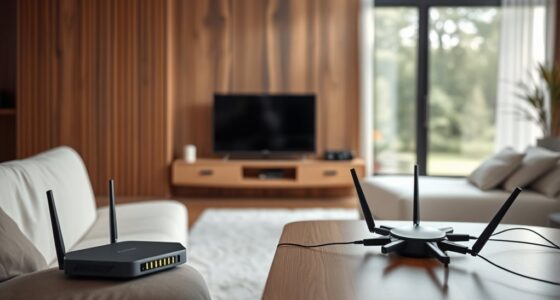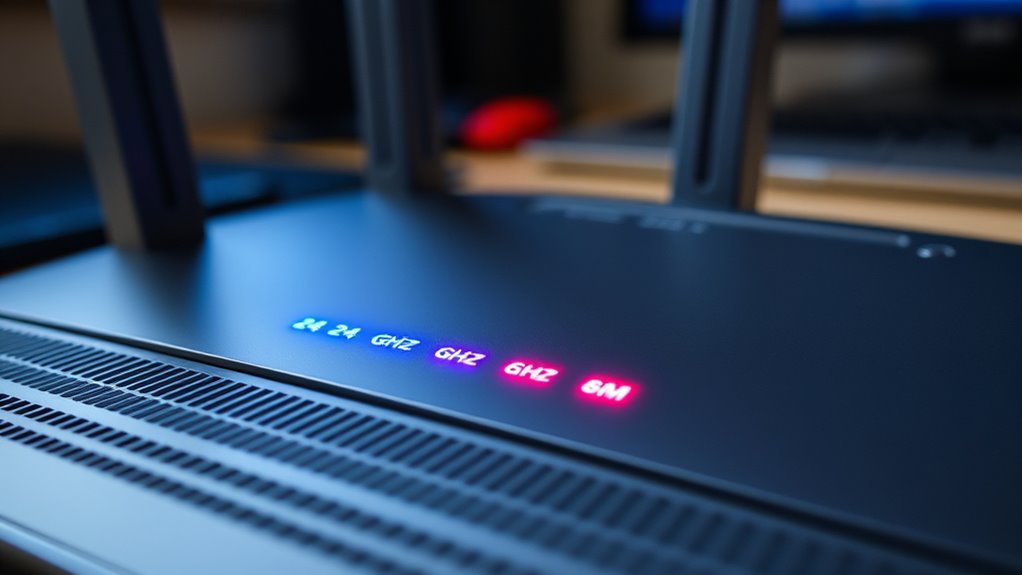

Choosing between 4 GHz, 5 GHz, and 6 GHz bands depends on your device support and environment. Use 4 GHz for broad compatibility and better coverage across your space. Opt for 5 GHz when you want faster speeds and less congestion, ideal for streaming or gaming nearby. Consider 6 GHz if you’re using Wi-Fi 6E devices in a crowded area with maximum performance needs. Continue exploring to find the best fit for your network situation.

Get the latest gadgets delivered free with Prime
- Fast, free delivery on millions of items
- Prime Video, Amazon Music and more included
- Member-only deals all year
Key Takeaways
- Use 4 GHz for broad device compatibility and stable coverage across larger areas.
- Opt for 5 GHz for higher speeds, less congestion, and activities like streaming or gaming.
- Select 6 GHz for ultra-fast performance with Wi-Fi 6E devices in crowded or interference-prone environments.
- Consider device support; older devices may not support 5 GHz or 6 GHz bands.
- Match your environment and performance needs to the appropriate band for optimal network reliability.

Choosing the right Wi-Fi band can substantially impact your network’s performance, especially with the increasing demand for faster speeds and lower latency. As new bands like 4 GHz, 5 GHz, and 6 GHz become available, understanding when and why to use each one is essential. The 4 GHz band, often the most common, offers broad device compatibility and a stable connection, making it suitable for everyday tasks like browsing, streaming, and casual gaming. However, because it’s been around the longest, it tends to experience more channel congestion, especially in densely populated areas where many networks overlap. This congestion can lead to slower speeds and unreliable connections, which might frustrate you during critical online activities.
Switching to the 5 GHz band can alleviate some of these issues. It provides higher speeds and less interference, mainly because it has more channels and experiences less channel congestion compared to 4 GHz. This makes it ideal for high-bandwidth activities such as 4K streaming, online gaming, or large file transfers. Yet, device compatibility can sometimes be a concern. Not all older devices support 5 GHz, so you need to check whether your gadgets can connect to this band. If your devices are compatible, shifting to 5 GHz can markedly improve your network’s performance, especially in environments crowded with other Wi-Fi networks. Keep in mind that 5 GHz signals have a shorter range and are more easily blocked by walls and obstacles, so you might need to be closer to your router for best results.
Switch to 5 GHz for faster speeds and less interference if your devices support it.
The newest addition, the 6 GHz band, offers even more benefits. It provides ultra-high speeds, minimal interference, and an expanded number of channels, which means less channel congestion and better performance in busy areas. If your devices support Wi-Fi 6E, moving to the 6 GHz band can future-proof your network, delivering faster speeds and lower latency. However, device compatibility is a vital factor here; only newer devices support 6 GHz, so if you have older gadgets, they won’t be able to connect. Additionally, 6 GHz signals don’t travel as far and are more susceptible to obstacles, so placement of your router matters even more. Consider wireless technology advancements to understand how these bands can best serve your setup.
Choosing the correct Wi-Fi band depends on your specific needs. If you prioritize device compatibility and stability, sticking with 4 GHz might be best. For higher speeds and less congestion, 5 GHz is generally the ideal choice if your devices support it. And if you want the latest technology with the best performance in crowded environments, 6 GHz is worth considering — provided your devices are compatible. Understanding these factors helps you optimize your network, reduce interference, and enjoy a faster, more reliable internet experience.
As an affiliate, we earn on qualifying purchases.
Frequently Asked Questions
How Does Frequency Impact Wi-Fi Security Vulnerabilities?
Higher frequencies, like 5 GHz and 6 GHz, can reduce wireless encryption vulnerabilities because their signals are harder to intercept over long distances. However, they don’t eliminate risks entirely. You should still be cautious about signal interception, especially in crowded areas. Using strong encryption and updated security protocols helps protect your Wi-Fi, regardless of the frequency band. Frequency impacts vulnerability, but good security practices are essential for keeping your network safe.
Can Devices Automatically Switch Between 4, 5, and 6 GHZ?
It’s no coincidence that many devices now automatically switch between 4, 5, and 6 GHz bands. Your device compatibility often includes band switching, allowing seamless shifts for ideal performance. When your device detects better signal strength or less congestion on a different band, it switches automatically. You don’t need to intervene, making your Wi-Fi experience smoother and more efficient without manual adjustments.
What Are the Environmental Factors Affecting Each Band’s Performance?
Environmental factors like interference sources and signal attenuation affect each band’s performance. Higher bands, such as 5 GHz and 6 GHz, are more sensitive to interference from devices like microwaves and Bluetooth, reducing signal quality. Signal attenuation caused by walls, furniture, and distance also impacts performance, especially at higher frequencies. You need to take these factors into account when choosing the best band to ensure a strong, reliable connection.
How Do Prices Vary for Routers Supporting These Frequency Bands?
Think of buying a router like shopping for a car—prices vary based on features and market availability. Routers supporting 4, 5, and 6 GHz bands show similar price variability, with 6 GHz models often costing more due to newer technology. Market availability influences prices too; high demand can drive prices up. You’ll find entry-level options for each band, but premium models with advanced features tend to be pricier.
Are There Compatibility Issues With Older Devices on Higher Bands?
You might encounter device compatibility issues with older devices on higher bands like 5 GHz and 6 GHz. Many older devices don’t support these frequencies, but firmware updates can sometimes enhance compatibility. Check your device specifications and verify that your router’s firmware is up to date. If your device lacks support, you may need a dual-band or tri-band router that includes legacy support to ensure seamless connectivity.
As an affiliate, we earn on qualifying purchases.
Conclusion
Now that you understand the differences between 4, 5, and 6 GHz bands, it’s clear that choosing the right one depends on your needs. Do you want faster speeds for streaming and gaming or better coverage for multiple devices? Think of it like selecting a road: do you take the busy highway or the scenic route? By matching the band to your usage, you’ll enjoy a smoother, more reliable connection every time.
As an affiliate, we earn on qualifying purchases.
As an affiliate, we earn on qualifying purchases.
Halloween Picks
halloween
As an affiliate, we earn on qualifying purchases.