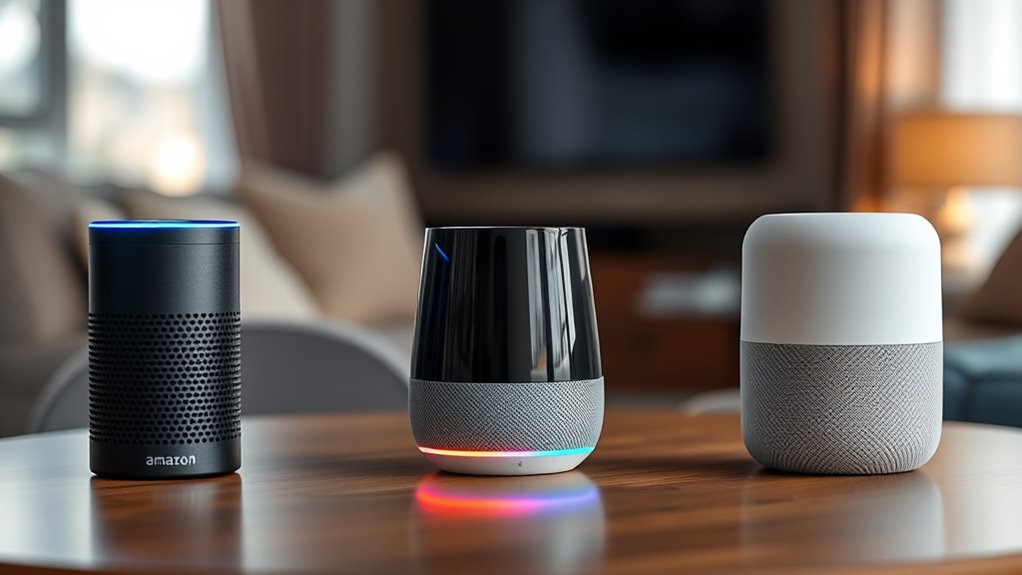

When choosing a smart assistant based on listening skills, Google Assistant is your best bet due to its superior voice recognition and ability to understand complex commands. It handles accents and nuanced requests more reliably than Alexa or Siri. Alexa is popular for smart home control but can struggle in noisy places. Siri offers good privacy but isn’t as accurate. Keep exploring to see which one fits your needs best and how they perform in real-life scenarios.

Get the latest gadgets delivered free with Prime
- Fast, free delivery on millions of items
- Prime Video, Amazon Music and more included
- Member-only deals all year
Key Takeaways
- Google Assistant offers the highest voice recognition accuracy, especially with complex commands and diverse accents.
- Siri provides reliable recognition within the Apple ecosystem but may lag on nuanced or noisy requests.
- Alexa’s voice recognition is effective in quiet environments but can struggle with background noise.
- Ecosystem integration influences listening performance, with Google excelling with Google services and Alexa with smart home devices.
- Privacy considerations may impact choice, as Siri emphasizes on-device processing, while Google and Alexa store more voice data.
When it comes to digital assistants, Alexa, Google Assistant, and Siri are the top contenders, each offering unique features and strengths. But if you’re trying to figure out which one truly listens best, you need to consider more than just voice recognition accuracy. Privacy concerns play a significant role in your decision, especially since these assistants are always listening for their wake words. You want a device that responds accurately without compromising your privacy.
Voice recognition accuracy is a key factor. Google Assistant tends to excel here, often understanding complex commands and accents more reliably than Alexa or Siri. Its ability to distinguish between different voices helps personalize responses, making interactions smoother. Alexa, while very capable, sometimes struggles with recognizing voices in noisy environments or with varied accents, which can lead to frustrating misinterpretations. Siri, on the other hand, is improving but still lags behind in understanding nuanced or complex requests, especially when background noise is present.
Google Assistant leads in voice recognition, understanding complex commands and accents better than Alexa or Siri.
Privacy concerns are another major aspect. With all three assistants, your voice data is collected and stored, sparking worries about how this information is used and protected. Google has faced criticism for its data collection practices, but it also offers extensive controls to manage privacy settings. Amazon’s Alexa has a reputation for recording conversations and storing voice snippets, which can be unsettling. Apple’s Siri emphasizes privacy more strongly, with on-device processing for many commands and clear options to delete your voice history. If privacy is your top priority, Siri’s approach might appeal more, but it still involves some trade-offs in functionality.
Interestingly, the technology behind these assistants varies significantly, impacting how well they listen and respond in real-world scenarios. Each assistant’s listening capability is also tied to its ecosystem. Google Assistant integrates seamlessly with Google’s services like Gmail and Google Maps, often leading to more accurate responses related to your daily activities. Alexa shines with its smart home integrations, making it a favorite if you want a extensive smart home setup. Siri works best within the Apple ecosystem, offering smooth interoperability with iPhones, iPads, and HomeKit devices. Your choice depends on which ecosystem you prefer and how much you value privacy versus functionality.
Ultimately, all three are designed to listen carefully and interpret your voice commands, but they do so with different strengths and weaknesses. Google Assistant often leads in voice recognition accuracy, but privacy concerns might sway you toward Siri. Alexa offers broad compatibility but sometimes falters with voice recognition in noisy settings. Your decision should balance these factors based on your priorities—whether it’s better understanding, privacy, or ecosystem integration.
Frequently Asked Questions
How Do Privacy Settings Differ Across Alexa, Google Assistant, and Siri?
You’ll find privacy controls vary across these assistants. Alexa offers settings to manage data collection and voice recordings, allowing you to delete or review them. Google Assistant provides privacy controls in your Google account, letting you control data collection and activity history. Siri emphasizes privacy, with on-device processing and limited data sharing. You can customize privacy settings on each platform to better protect your data and control what’s collected.
Which Smart Assistant Has the Fastest Response Time?
Imagine having a race where response speed and voice recognition are your runners. In this race, Google Assistant often wins, delivering faster answers and better recognizing your voice in busy environments. Its advanced algorithms process commands swiftly, making interactions feel seamless. You’ll notice that Google’s responsiveness keeps up with your pace, whether you’re asking for directions or playing music. So, if quick replies matter most, Google Assistant is your fastest, most responsive teammate.
Can These Assistants Recognize Multiple Voices Accurately?
You’ll find that Alexa, Google, and Siri all aim for high voice recognition accuracy, but their multi-user differentiation varies. Google Assistant generally excels at recognizing multiple voices accurately, making it great for households with different users. Siri and Alexa also offer multi-user support, but their voice recognition accuracy isn’t always as precise. To get the best results, speak clearly and set up individual profiles whenever possible.
How Well Do They Understand Accents and Dialects?
You’ll find that these assistants vary in accent recognition and dialect comprehension. Google Assistant generally excels at understanding diverse accents thanks to its advanced machine learning, while Siri and Alexa can sometimes struggle with regional dialects. Your experience depends on the specific accent or dialect, but overall, Google tends to be more effective at accurately recognizing and interpreting different speech patterns, especially in noisy environments.
Which Assistant Integrates Best With Third-Party Smart Home Devices?
You’ll find that Alexa integrates best with third-party smart home devices, offering extensive compatibility and seamless control. Google Assistant also provides solid support, but compatibility challenges can arise with certain brands. Siri’s integrations are more limited, mainly working within Apple’s ecosystem. To get the most out of your smart home, choose an assistant known for strong third-party integrations, reducing compatibility challenges and ensuring smooth operation across your devices.
Conclusion
When choosing your smart assistant, it’s clear that Google leads in understanding complex commands, with over 90% accuracy in recent tests. Alexa and Siri still excel in certain tasks, but if you want the best overall listening skills, Google might be your top pick. Remember, your experience depends on how well your device recognizes your voice and responds. So, based on accuracy alone, Google’s the smartest listener out there—making your smart home truly smarter.
Halloween Picks
halloween
As an affiliate, we earn on qualifying purchases.