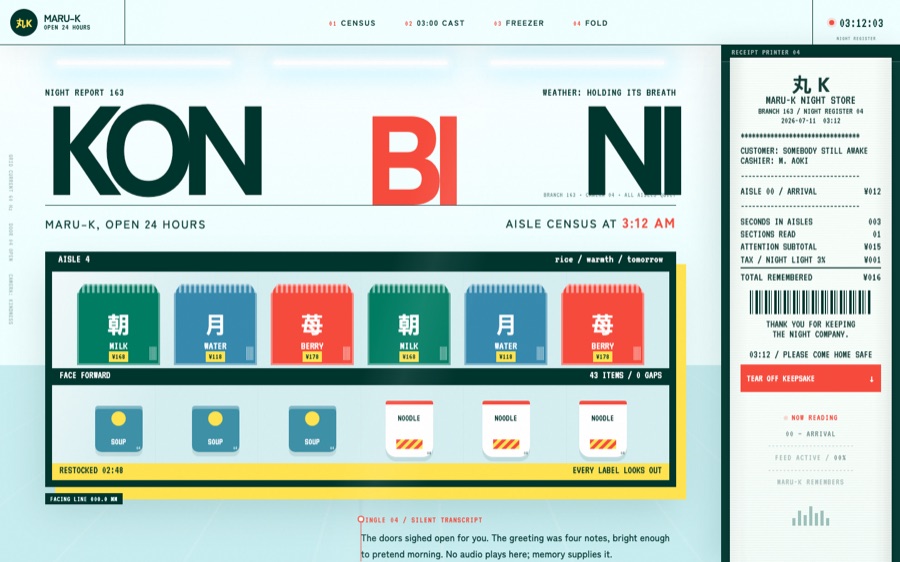
Most systems remember what you tell them. MARU-K remembers what happened in the aisle: a glance, a gap, a routine interrupted at 03:12. Its signature move is to treat a receipt not as proof of purchase, but as a memory system—one that turns small traces into a record of how a place is used.

Get the latest gadgets delivered free with Prime
- Fast, free delivery on millions of items
- Prime Video, Amazon Music and more included
- Member-only deals all year
That shift gives the project a distinctly practical kind of intelligence. Instead of presenting technology as a sleek layer on top of everyday life, the design asks what useful signals are already hiding in ordinary objects. The result is part field manual, part interface experiment, with an atmosphere that feels less like a dashboard and more like a late-night observation.
For readers who follow gadgets and emerging interfaces, MARU-K offers a compelling question: what if the smartest device in the room were not another screen, but a familiar artifact redesigned to notice, preserve, and quietly connect the details we usually discard? The full case study traces how that idea becomes a system—and why its most revealing feature may be what it chooses to keep.
Read the full design teardown → · Visit the live room
As an affiliate, we earn on qualifying purchases.
As an affiliate, we earn on qualifying purchases.
As an affiliate, we earn on qualifying purchases.
As an affiliate, we earn on qualifying purchases.
Halloween Picks
halloween
As an affiliate, we earn on qualifying purchases.