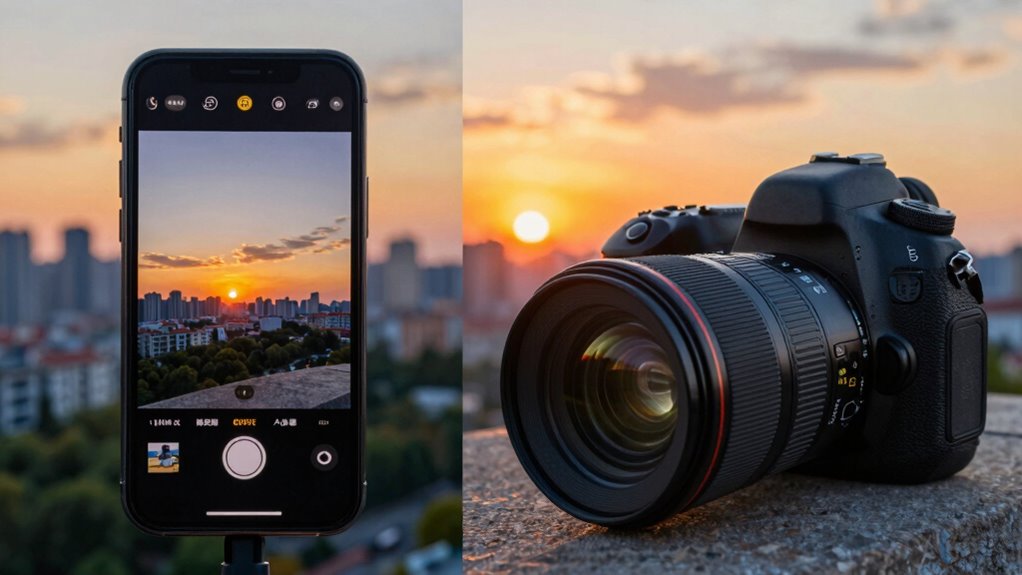

Smartphones have come a long way, offering impressive image quality that can rival entry-level DSLRs and mirrorless cameras in many situations. They excel in convenience, portability, and quick shooting, making them ideal for casual photography. However, professional cameras still outperform smartphones in low-light conditions, with better sensors, lens options, manual controls, and speed. To understand if your phone can truly replace a DSLR or mirrorless, explore how advancements and limitations compare in detail.
Key Takeaways
- Professional cameras have larger sensors, offering superior low-light performance, dynamic range, and image detail compared to smartphones.
- Interchangeable lenses in DSLRs and mirrorless cameras provide greater versatility and creative control over various shooting scenarios.
- Manual settings and advanced autofocus systems in professional cameras enable precise adjustments for high-quality, professional-grade images.
- Smartphones excel in portability, quick responsiveness, and built-in computational photography, making spontaneous shots easier but with some quality compromises.
- While smartphones are increasingly capable for casual photography, professional cameras remain essential for high-end, technical, and large-format imaging needs.
Top picks for "smartphone professional camera"
Open Amazon search results for this keyword.
As an affiliate, we earn on qualifying purchases.
The Evolution of Smartphone Camera Technology
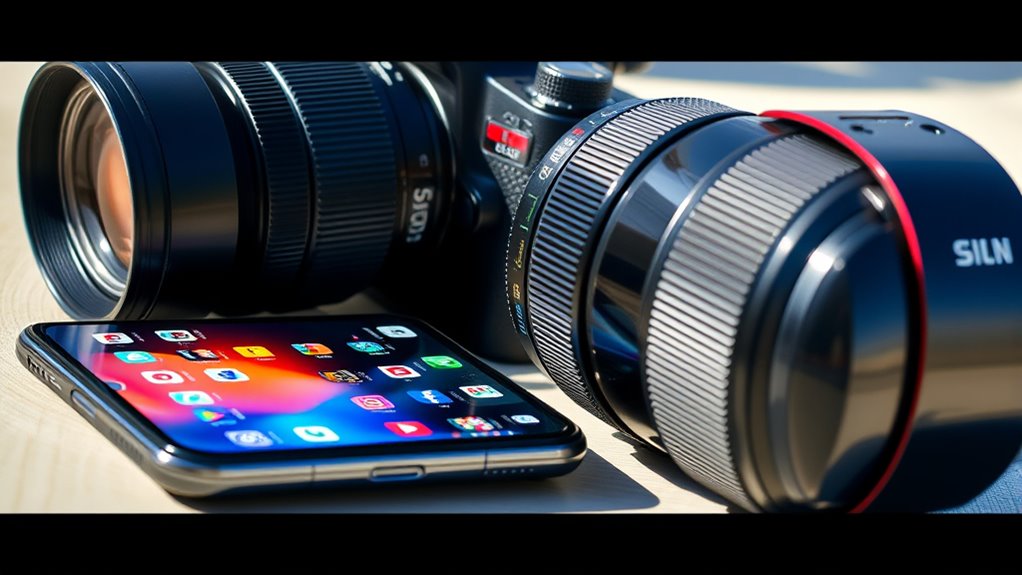
Since smartphones became mainstream, their camera technology has advanced rapidly, transforming them from simple photo tools into powerful imaging devices. Sensor advancements play a vital role in this evolution, allowing phones to capture more light, detail, and color accuracy than ever before. These improvements enable better low-light performance and sharper images. Additionally, computational photography has revolutionized smartphone imaging by processing data intelligently to enhance photo quality. Techniques like HDR, night mode, and portrait effects are now built into smartphones, producing professional-looking shots without extra effort. Sensor technology has been a key driver in bridging the gap between smartphones and dedicated cameras, demonstrating how hardware improvements combined with sophisticated software have pushed smartphones closer to the capabilities traditionally reserved for dedicated cameras. As a result, your phone can now handle a wider range of shooting scenarios with impressive results. Moreover, ongoing innovations in sensor size and design continue to close the performance gap even further.
Image Quality and Resolution Differences
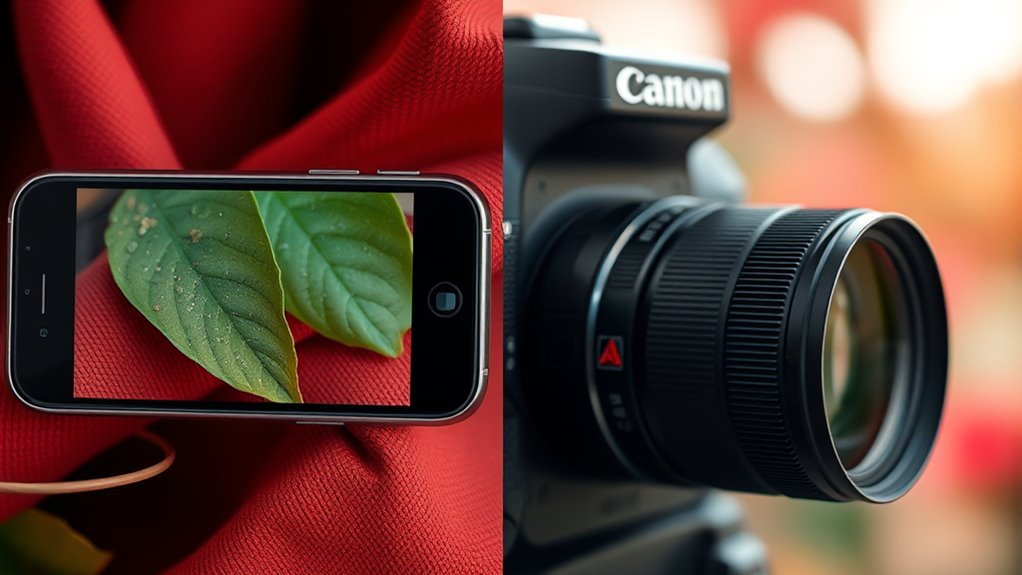
While smartphones have made significant strides in camera technology, there are still notable differences in image quality and resolution compared to professional cameras. One key factor is sensor size; professional cameras typically have larger sensors, allowing more light to enter and producing sharper, more detailed images. This larger sensor size results in better color depth and dynamic range, which smartphones struggle to match despite higher image resolutions. While modern smartphones often boast impressive megapixel counts, their smaller sensors limit the quality and detail captured, especially in complex scenes. As a result, even with high-resolution images, smartphone photos may lack the depth, clarity, and fine detail that a professional camera with a larger sensor can deliver. sensor size plays a crucial role in capturing the nuances of a scene, especially in low-light conditions or high-contrast environments. Additionally, professional cameras often include advanced lens options that contribute significantly to image quality and flexibility in various shooting situations. Furthermore, image processing algorithms in smartphones, although improving, still cannot fully replicate the natural rendering and subtle gradations achieved by larger sensors in professional equipment. A professional-grade lens can also make a noticeable difference in image sharpness and optical performance, further bridging the gap between smartphone and camera quality.
Low-Light Performance Capabilities
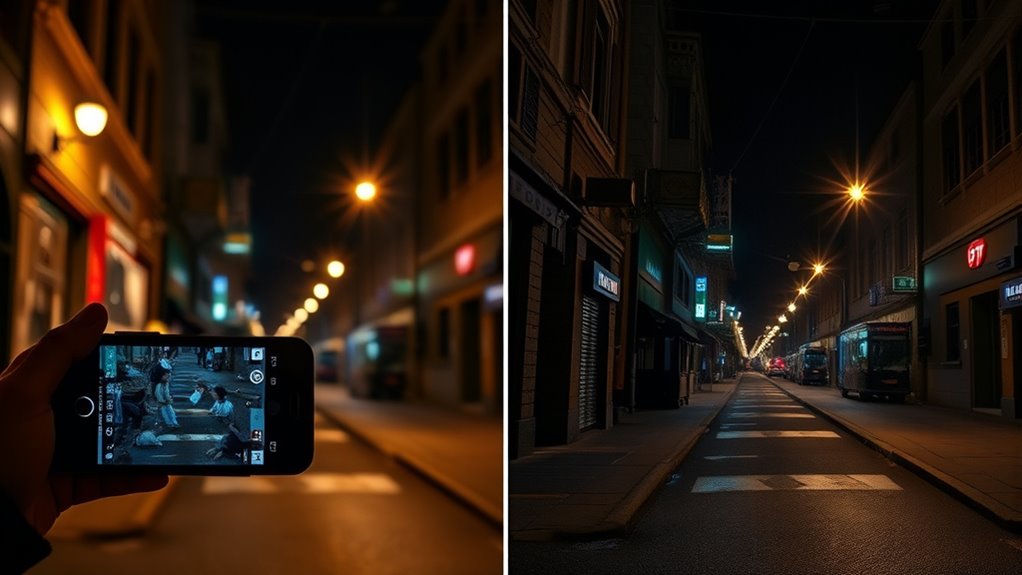
When shooting in low light, you’ll notice how well night modes can brighten your images, but their effectiveness varies. You might also see differences in sensor sensitivity limits, which affect how much light your device can handle without losing detail. Additionally, noise reduction quality plays a big role in maintaining clarity, especially in darker settings.
Night Mode Effectiveness
Night mode capabilities are a key factor in determining a smartphone’s low-light performance, often narrowing the gap between mobile devices and professional cameras. When you activate night mode, your smartphone sensor combines multiple exposures to enhance brightness and reduce noise. This process allows you to capture clearer, more detailed images in dark environments. Additionally, security measures implemented in smartphones can influence the quality of night mode images by protecting user data and ensuring optimal processing. Furthermore, sensor technology advances in smartphones continue to improve low-light image quality, though they still face limitations compared to larger camera sensors. The image processing algorithms used by different smartphone brands can significantly affect night mode effectiveness, emphasizing the importance of software optimization in image quality. However, professional cameras still outperform smartphones in tricky lighting situations because of larger sensors and superior optics. Here’s a comparison:
| Feature | Smartphone Night Mode | Professional Camera Low-Light Capabilities |
|---|---|---|
| Sensor Size | Smaller sensor | Larger sensor |
| Noise Reduction | Software-based | Hardware and software combined |
| Exposure Time | Limited by device | Longer exposures possible |
| Image Detail | Good but limited | Superior detail and depth |
While night mode improves smartphone shots, professional cameras maintain an edge in challenging low-light conditions.
Sensor Sensitivity Limits
Sensor sensitivity plays a pivotal role in a device’s low-light performance, directly influencing how well images turn out in dark environments. Higher sensor sensitivity allows your camera to capture more light, improving overall light capture in dim settings. Professional cameras typically have larger sensors with greater sensitivity ranges, enabling them to perform better in low-light conditions without sacrificing image quality. Smartphones often have smaller sensors, which limit their sensor sensitivity, making it harder to gather enough light for clear shots. As a result, images taken in low light may appear darker, grainier, or less detailed on a phone compared to a professional camera. Your device’s sensor sensitivity ultimately determines how effectively it can handle challenging lighting, impacting the quality of your low-light photography. Additionally, sensor size influences how much light is collected, further affecting low-light performance, and larger sensors tend to excel in low-light environments because they can gather more light efficiently.
Noise Reduction Quality
Noise reduction quality plays a crucial role in determining how well a device handles low-light images. When shooting in dim conditions, effective noise reduction minimizes graininess, delivering clearer photos. Smartphones often rely on advanced algorithms and computational photography to enhance image quality, but their noise reduction isn’t always as refined as professional cameras. Image stabilization also helps reduce blur caused by shaky hands, improving low-light shots. Keep in mind:
- Higher-end devices use sophisticated noise reduction techniques for cleaner images
- Professional cameras often have larger sensors that naturally produce less noise
- Smartphones may struggle with noise reduction at higher ISO settings
- Both device types benefit from good image stabilization to minimize motion blur
Ultimately, while smartphones have improved considerably, professional cameras still hold an edge in handling noise and stabilization in challenging lighting. Additionally, sensor size plays a significant role in noise performance, with larger sensors typically offering better low-light capabilities.
Versatility and Lens Options
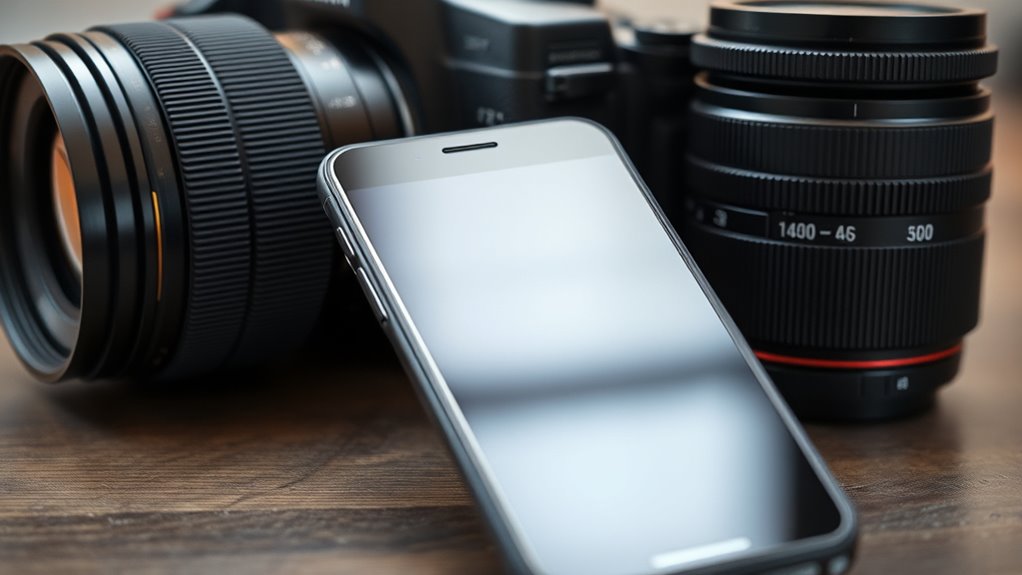
Your smartphone offers a built-in lens range that covers most everyday shots, but a professional camera can expand your creativity with external lens compatibility. With interchangeable lenses, you can switch from wide-angle to macro or telephoto shots quickly, giving you more options. This flexibility allows you to experiment and capture images exactly as you envision them. Additionally, the ability to select specific lenses designed for different scenarios enhances your overall photography versatility. By understanding lens adaptability principles, photographers can also optimize their gear to achieve creative effects and better control over their images. Moreover, mastering camera settings can further improve your ability to tailor shots to various conditions and artistic intentions. A solid grasp of repair fundamentals can also help maintain your equipment’s performance and longevity, ensuring your camera gear remains in top condition.
Built-in Lens Range
While smartphones typically come with a fixed lens, they often feature multiple lenses or digital zoom options that enhance versatility for everyday photography. This built-in lens range allows you to switch between wide-angle, telephoto, or macro shots without extra equipment. However, zoom versatility on smartphones mainly relies on digital zoom, which can compromise optical quality. Some models offer optical zoom, delivering better clarity at various focal lengths. Additionally, advances in sound healing science are inspiring new ways to optimize the calming effects of multimedia content, including smartphone photography. Consider these factors:
- Multiple lenses for different focal lengths
- Digital zoom for extended reach
- Optical zoom for superior image quality
- Compact design for convenience
While smartphones excel in convenience and versatility, their lens options are limited compared to professional cameras. For consistent optical quality across focal lengths, dedicated lenses still hold the advantage.
External Lens Compatibility
External lens compatibility substantially enhances a smartphone’s versatility by allowing you to attach specialized lenses for different shooting scenarios. With the right adapter compatibility, you can easily connect external lenses to your phone, expanding your creative options. Lens mounting options are essential here, as they determine how securely and efficiently lenses attach to your device. Some smartphones support universal mounts, making it simple to swap between macro, wide-angle, or telephoto lenses. However, not all phones are equally compatible, and you may need specific adapters for certain models. This flexibility lets you experiment with various perspectives and achieve professional-looking results, all while maintaining portability. Ultimately, external lens compatibility broadens your photographic potential beyond the limitations of built-in lenses. Additionally, understanding charging safety and proper maintenance can help ensure your equipment stays in optimal condition during use. Moreover, considering lens quality can significantly impact the sharpness and clarity of your images.
Creative Shooting Flexibility
External lens compatibility considerably boosts a smartphone’s creative potential by offering a variety of lens options that suit different shooting scenarios. This flexibility allows you to experiment with creative framing and spontaneous composition, capturing unique perspectives easily. With the right lens, you can achieve macro shots, wide-angle landscapes, or telephoto zooms, expanding your artistic options. This versatility encourages you to think outside the box and adapt quickly to changing scenes. Whether you’re shooting in tight spaces or expansive vistas, the ability to swap lenses on compatible devices enhances your storytelling. It transforms your smartphone from a simple point-and-shoot into a more dynamic tool for creative expression. Embracing this flexibility helps you push your boundaries and access new photographic possibilities.
Control Over Settings and Manual Adjustments
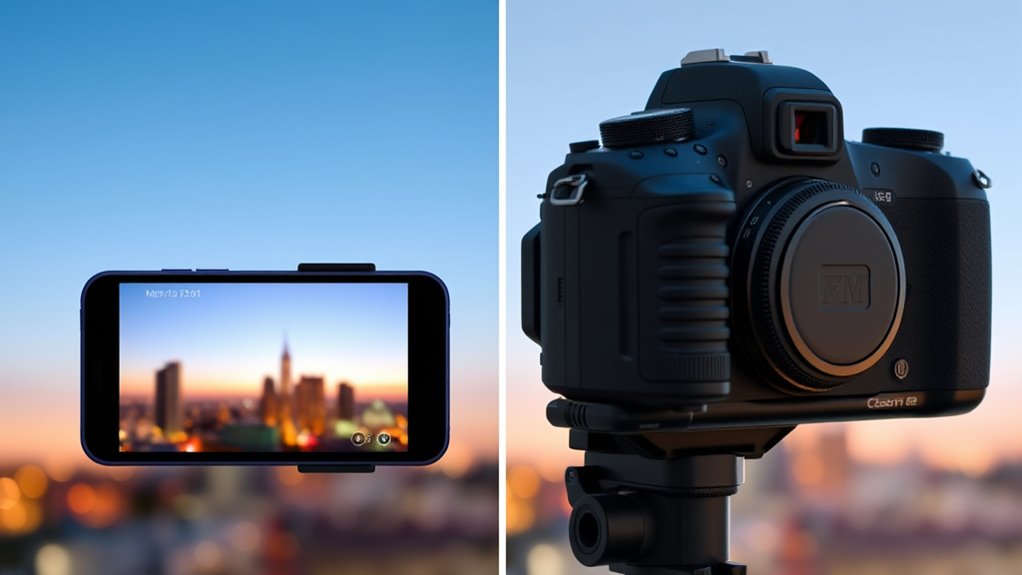
Unlike smartphones, professional cameras give you exceptional control over settings and manual adjustments, allowing you to fine-tune every aspect of your shot. You can precisely set manual exposure to control brightness and shadow detail, rather than relying on automatic modes. Aperture control lets you manage depth of field, making your backgrounds blurry or sharp as needed. With these options, you can adapt quickly to changing lighting conditions and creative intentions. Adjusting shutter speed, ISO, and focus manually gives you full command over each shot, resulting in images that match your vision. This level of control is especially important for challenging or professional work, where automatic settings often fall short. In short, manual adjustments provide the precision needed to optimize your images in diverse scenarios. Additionally, the ability to control camera settings enables photographers to achieve desired artistic effects that automatic modes cannot replicate. Moreover, understanding and utilizing camera controls can significantly enhance your creative possibilities.
Image Processing and Editing Features
While smartphones often come with built-in editing tools, professional cameras typically rely on post-processing software for advanced image correction and enhancement. This gives you greater control over filter effects and color correction, allowing for precise adjustments. With professional software, you can:
- Apply complex filter effects to create specific moods
- Fine-tune color correction for accurate hues
- Remove imperfections or distractions
- Enhance details with sharpening and noise reduction
Smartphones, on the other hand, offer quick, user-friendly edits, but lack the depth of control that professional software provides. This difference impacts the final image quality, especially when aiming for professional-grade results. Your choice depends on whether you prefer instant edits or detailed, high-quality adjustments during post-processing.
Speed and Responsiveness in Shooting

When capturing fast-moving subjects, the autofocus speed of your device makes all the difference. App responsiveness and minimal shot-to-shot delay guarantee you don’t miss vital moments. Understanding how these factors compare between smartphones and professional cameras helps you choose the right tool for quick, accurate shooting.
Autofocus Speed
Autofocus speed is a critical factor that directly impacts your ability to capture sharp, in-the-moment shots. Faster autofocus allows you to lock onto subjects quickly, reducing missed opportunities. When comparing smartphones and professional cameras, autofocus accuracy and autofocus modes play key roles in performance. A DSLR or mirrorless camera often offers more advanced autofocus modes, such as tracking moving subjects or eye detection, ensuring better accuracy. Smartphones have improved autofocus speeds, but they can still lag behind in dynamic scenarios. To maximize your shot potential, consider:
- How quickly your device can lock focus
- The variety of autofocus modes available
- The consistency of autofocus accuracy
- The ability to track moving subjects effectively
App Responsiveness
Have you ever experienced lag or delays when opening your camera app or capturing a shot? That sluggish response can be frustrating, especially when a perfect moment appears unexpectedly. Smartphone apps often rely on a user interface that prioritizes quick access, but they can still stumble under heavy processing loads, causing delays. This responsiveness directly impacts your shooting experience, making it feel less immediate and more frustrating. Additionally, frequent use of camera apps drains your battery faster, which can further slow down app performance over time as power savings modes kick in. A smooth, responsive app assures you can quickly frame and shoot without hesitation, helping you seize fleeting moments. Ultimately, app responsiveness influences how seamlessly your phone operates during photography sessions.
Shot-to-Shot Delay
Shot-to-shot delay refers to the time it takes for your camera to process and prepare for the next shot after capturing an image. With smartphones, this delay is often minimal, thanks to quick image processing, but larger sensor sizes in professional cameras can introduce slight lags. Speed matters when capturing fast-moving subjects or during burst shooting. Features like advanced image stabilization help reduce motion blur but may add to processing time.
Consider these points:
- Larger sensors may increase shot-to-shot delay due to data processing.
- Professional cameras typically have faster autofocus, reducing delays.
- Smartphones excel with rapid shot-to-shot times, especially with electronic stabilization.
- Response speed influences your ability to capture fleeting moments efficiently.
Portability and Convenience Factors
When it comes to portability and convenience, smartphones clearly have the edge. Their compact design fits easily into your pocket or bag, making spontaneous shots simple. Unlike professional cameras, smartphones excel in camera ergonomics, offering intuitive interfaces and quick access to settings, so you don’t waste time fiddling with buttons. Battery life is another advantage; while professional cameras often have larger batteries requiring extra accessories, smartphones are designed for all-day use, and many now feature fast-charging. You can grab your phone anytime without carrying bulky gear or worrying about carrying extra batteries. This convenience means you’re more likely to capture fleeting moments without hassle, making smartphones the go-to choice for casual photography on the move.
Cost and Accessibility Considerations
Smartphones not only excel in portability but also in affordability and accessibility. For many, budget constraints make professional cameras seem out of reach, creating accessibility barriers. With smartphones, you get a capable device without the hefty investment, making photography more accessible to everyone. Plus, they’re easy to find and use, often already integrated into daily life. Consider these points:
- Lower upfront costs compared to professional cameras
- No need for additional lenses or gear initially
- Widely available in retail stores and online
- User-friendly interfaces reduce learning barriers
This accessibility means you can capture moments anytime without worrying about expensive equipment or complex setups. While professional cameras offer advanced features, smartphones provide an affordable, convenient solution for everyday photography needs.
Future Trends in Mobile and Professional Photography
Advancements in technology are rapidly shaping the future of both mobile and professional photography, making high-quality imaging more accessible and innovative than ever before. You can expect smarter cameras with AI-driven features that automatically enhance images, perfect for sharing on social media. App integration will become even more seamless, allowing you to edit, organize, and upload photos directly from your device without switching platforms. Future devices will also focus on real-time processing and augmented reality, transforming how you capture and interact with images. As professional tools become more integrated into mobile apps, you’ll have greater flexibility and creative control, blurring the lines between casual and professional photography. This evolution ensures that whether you’re a hobbyist or a pro, staying ahead will be easier with smarter, more connected gear.
Frequently Asked Questions
Can Smartphones Truly Replace Professional Cameras for Professional Photography?
Smartphones can’t truly replace professional cameras for professional photography. While they excel in video capabilities and are portable, they face storage limitations that can hinder high-resolution work. You might get great shots for social media, but for quality, detail, and flexibility in challenging conditions, a DSLR or mirrorless camera still outperforms. Your phone’s convenience is unmatched, but for professional results, dedicated equipment remains essential.
How Do Smartphone Cameras Handle Dynamic Range Compared to DSLRS?
Smartphone cameras handle dynamic range like a tightrope walker balancing with finesse, but they still have limits. Smaller sensor sizes mean less light capture, while advanced image processing helps brighten shadows and recover highlights. However, DSLRs with larger sensors naturally excel at capturing a broader dynamic range, especially in challenging lighting. So, while smartphones impress, they can’t fully match the wide-range flexibility of professional cameras.
Are There Specific Scenarios Where Smartphones Consistently Underperform?
You’ll find smartphones often underperform in low light scenarios and fast motion capture. In dim settings, their small sensors struggle to gather enough light, resulting in grainy images. When capturing fast-moving subjects, smartphones tend to miss focus or produce blurry shots due to limited shutter speed and processing power. For these situations, a DSLR or mirrorless camera still outshines your phone, offering better clarity, speed, and overall image quality.
What Are the Limitations of Smartphone Sensors in Capturing High-Quality Images?
Imagine holding your phone as the evening sky darkens—you’ll notice sensor noise creeping in, especially in low-light scenes. Smartphone sensors struggle with capturing fine details and often lack advanced image stabilization, making shots blurry or grainy. These limitations hinder your ability to produce high-quality images, especially in challenging conditions. Despite their convenience, sensors on smartphones can’t fully match the dynamic range and clarity of professional cameras.
Will Future Smartphone Advancements Fully Close the Gap With Dedicated Cameras?
Future smartphone advancements will likely narrow the gap with dedicated cameras, but hardware limitations like sensor size and lens quality still pose challenges. You might see better image processing and AI enhancements, yet storage challenges remain as high-resolution images and videos demand more space. While phones will improve, they probably won’t fully replace DSLRs or mirrorless cameras for professional photography, especially in specialized or demanding situations.
Conclusion
Think of your smartphone as a trusty steed—quick, convenient, and always ready to ride into adventure. But a professional camera is like a seasoned knight, equipped with armor and weapons for the fiercest battles. While your phone can handle everyday quests, the DSLR or mirrorless camera is your trusted companion for capturing epic moments. Embrace the journey and choose the tool that best fits your quest for stunning photography.