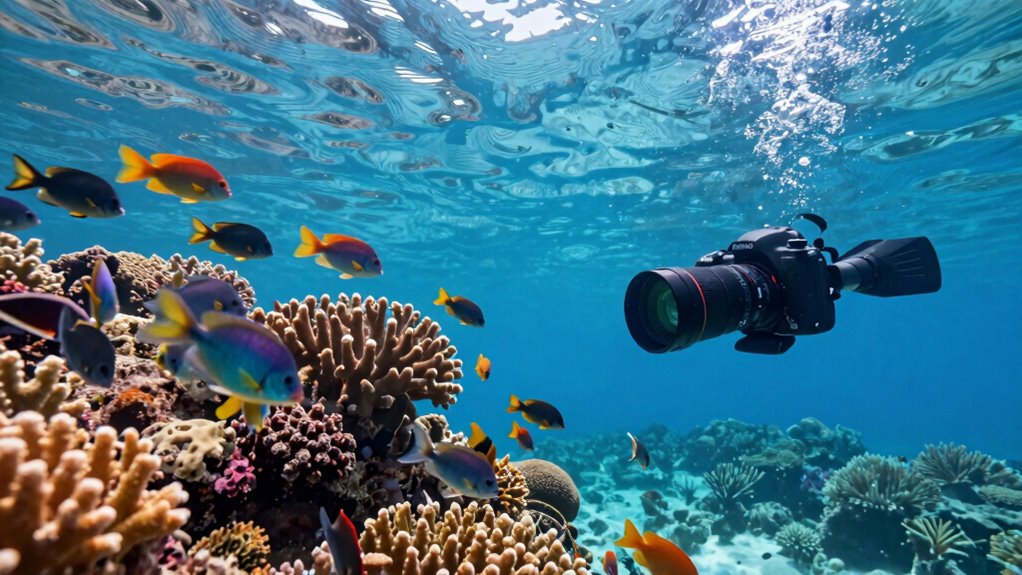

To get great underwater shots, choose a lightweight, waterproof camera with easy-to-access controls. Use natural barriers like overhangs to diffuse sunlight and avoid harsh shadows. Add artificial lighting with strobes to restore colors and highlight details. Master composition by applying the rule of thirds and experimenting with angles. Adjust camera settings like white balance and aperture for clarity. Using accessories such as macro lenses and stabilizers can elevate your photos—continue exploring these tips to improve your skills even more.
Key Takeaways
- Choose waterproof, ergonomic, and lightweight camera equipment with long-lasting batteries for reliable underwater use.
- Control natural light by shooting during midday, using natural barriers, and adjusting angles to reduce shadows and overexposure.
- Use artificial lighting such as strobes, matching their color temperature, to restore color and achieve even illumination.
- Apply proper composition techniques like the rule of thirds, natural framing, and varying perspectives to create engaging images.
- Incorporate accessories like macro lenses, stabilizers, and filters to enhance image quality and capture detailed underwater scenes.
Top picks for "underwater photography basic"
Open Amazon search results for this keyword.
As an affiliate, we earn on qualifying purchases.
Choosing the Right Underwater Camera Equipment
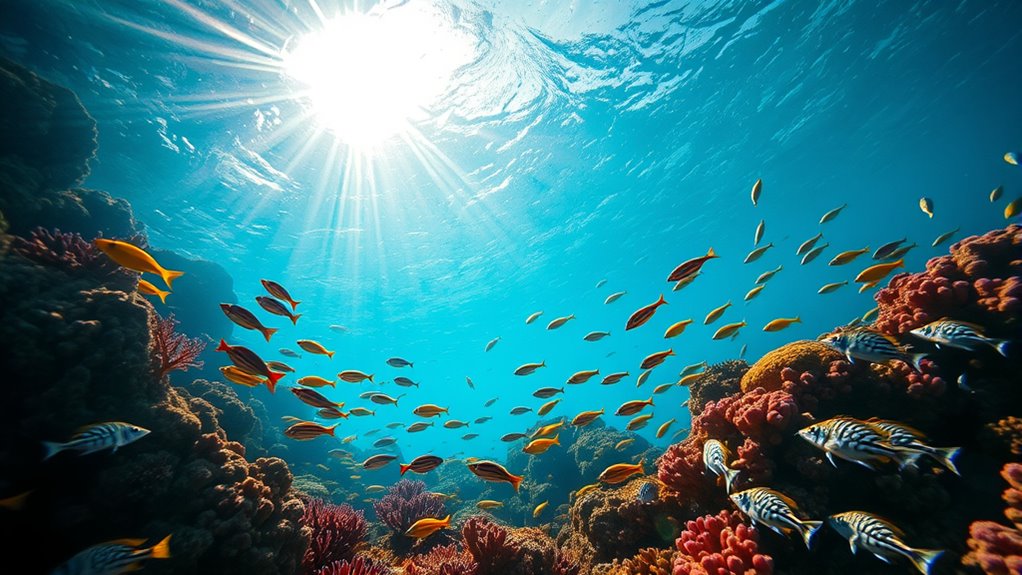
Are you wondering how to select the best underwater camera equipment for your adventures? Start with camera ergonomics—choose a model that feels comfortable in your hands and is easy to operate underwater. A well-designed grip and accessible buttons make a huge difference, especially when you’re capturing fast-moving marine life. Don’t overlook battery life; long-lasting batteries ensure you won’t miss critical shots during extended dives. Opt for cameras with efficient power management and quick recharge options. Lightweight, compact designs also improve handling and reduce fatigue. Remember, the right equipment combines ease of use with durability, so you can focus on your shot without worrying about technical hiccups. Prioritize ergonomic comfort and reliable battery performance to enhance your underwater photography experience. Additionally, simple systems help streamline your setup and make maintenance easier, allowing you to enjoy your dives more confidently. Choosing equipment with reliable battery life ensures your photography sessions are seamless and enjoyable. Incorporating proper lighting is also essential to capture vivid images below the surface, and selecting cameras with waterproof and pressure-resistant features can prevent equipment damage in challenging conditions. Furthermore, integrating connected fitness technology into your gear can help you track your dive stats and improve your underwater photography skills over time.
Understanding Lighting and Color Correction
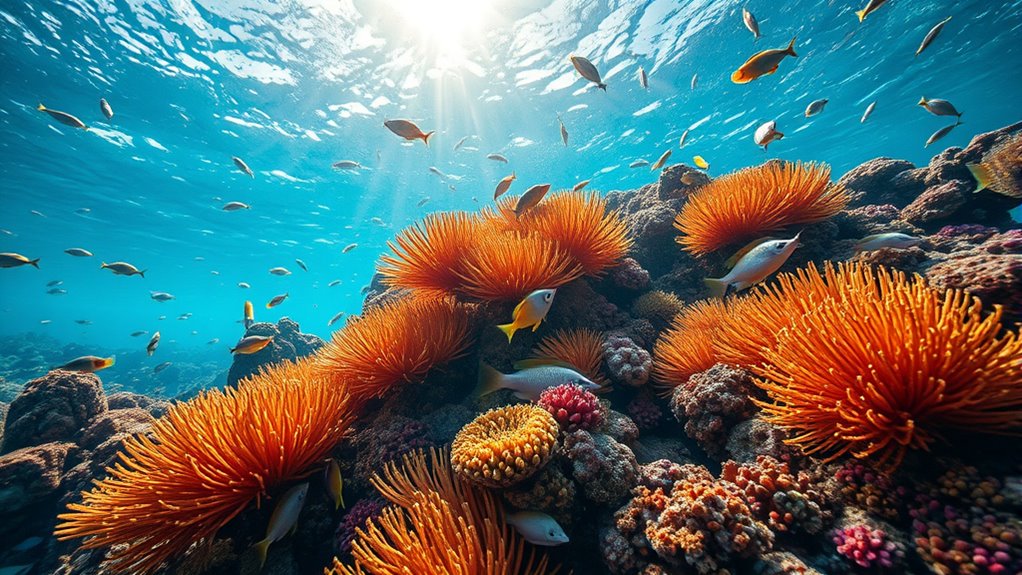
Lighting plays a vital role in capturing vibrant underwater images, so you need to master controlling natural light and using artificial sources effectively. Color shifts caused by water absorption can dull your photos, but with proper correction techniques, you can restore their true hues. Understanding when and how to use artificial lighting helps you achieve balanced exposures and accurate colors in any underwater environment. Additionally, being familiar with smart kitchen tools can inspire innovative approaches to your photography setup, ensuring you optimize lighting conditions for stunning results. Recognizing the impact of contrast ratio can also help you choose equipment that renders deep blacks and bright whites, enhancing the depth and clarity of your images. Properly managing lighting quality is essential for capturing the vivid details that make underwater photography so captivating. Implementing precision lighting control techniques allows for more consistent and high-quality results in varying underwater conditions. Being aware of color correction techniques further enhances your ability to produce natural and vibrant underwater photos.
Controlling Natural Light
Have you ever wondered how to make natural light work for your underwater photos? Controlling natural light involves understanding how light behaves underwater and using techniques like light diffusion to your advantage. To improve your shots, consider these tips:
- Use natural barriers like overhangs or kelp to diffuse sunlight and soften shadows.
- Shoot during midday when sunlight penetrates more evenly, reducing harsh contrasts.
- Adjust your angle to minimize direct sunlight and avoid overexposed areas.
- Incorporate water movement or particles to naturally scatter light, creating a more balanced exposure.
- Understanding lighting and color correction can help you adjust your camera settings or post-process to achieve more accurate colors and brightness.
- Learning about light reflection can further enhance your ability to manipulate natural light for better underwater images.
- Familiarizing yourself with light attenuation can help you predict how light diminishes at different depths, improving your shot planning.
- Recognizing how light absorption affects color visibility at various depths can help you plan your shots more effectively.
- Additionally, understanding underwater light scattering can give you insights into how light diffuses at different depths, optimizing your composition.
Correcting Color Shifts
When you plunge into underwater photography, you’ll quickly notice that colors often appear shifted or muted. This happens because water absorbs and scatters light, causing reds, oranges, and yellows to fade at depth. To fix this, you need effective color correction, starting with proper white balance adjustments. Setting the correct white balance ensures that your camera compensates for color loss, making your images appear more natural. Many cameras have underwater modes or custom white balance settings—use them to match your environment. Post-processing can also help fine-tune colors further. Remember, understanding how lighting affects colors underwater is vital for achieving vibrant, true-to-life shots. Correcting color shifts ensures your photos accurately reflect the beauty of the underwater world. Understanding lighting effects is essential for mastering color correction in underwater photography. Additionally, being aware of vetted information helps you make informed decisions about your equipment and techniques to improve your results. In particular, familiarizing yourself with color correction techniques can significantly enhance the vibrancy and accuracy of your underwater images.
Using Artificial Lighting
Artificial lighting plays a crucial role in underwater photography because natural light diminishes quickly with depth and water clarity. When using artificial light, consider strobe positioning to minimize backscatter and guarantee even illumination. Adjusting your strobe angle helps bring out vibrant colors and detail, especially in low-light conditions. Pay attention to color temperature; matching your light source to ambient conditions prevents color casts that can ruin shots. To improve results:
- Position strobes slightly above and to the sides of your lens
- Use diffusers to soften harsh light
- Experiment with different strobe angles for ideal coverage
- Correct color temperature with filters or post-processing
Mastering strobe positioning and color temperature control is key to capturing sharp, colorful images beneath the surface. Additionally, understanding lighting diagrams can help you optimize your strobe placement for even coverage and minimal backscatter. Incorporating smart lighting controls can further enhance your ability to fine-tune lighting conditions in real time, especially when working in variable underwater environments. Using light diffusion techniques can greatly improve the softness and quality of your lighting, resulting in more natural-looking images. Employing color correction methods ensures accurate color reproduction across different water conditions, making your photos more vibrant and true to life.
Mastering Composition and Framing Techniques

To create striking underwater images, you need to master composition and framing techniques. Using the rule of thirds helps you position your subject for maximum impact, while framing adds focus and context. Experimenting with depth and perspective can make your photos more dynamic and engaging. Additionally, understanding effective lighting underwater can significantly enhance image clarity and color accuracy. Developing attention to detail during composition ensures you capture all critical elements of the scene. Incorporating basic camera settings knowledge allows you to optimize your shots in various underwater conditions. Recognizing individual skill development can lead to continuous improvement in your underwater photography. Paying attention to vetted products and safety equipment can also ensure successful and safe shoots beneath the surface.
Rule of Thirds
The Rule of Thirds is a fundamental principle that can dramatically improve your underwater photographs by creating balanced and engaging compositions. By imagining your frame divided into nine equal parts, you position key elements along these lines or at their intersections. This technique guides your eye to focal points naturally, enhancing visual balance and interest. When applying this rule, consider these points:
- Place your main subject off-center to avoid static shots
- Use intersections to highlight focal points for emphasis
- Balance elements within the frame to prevent clutter
- Lead viewers’ eyes through the scene smoothly
Framing for Impact
Have you ever wondered how to make your underwater photos truly stand out? Framing for impact is key to creating striking images. Focus on strong visual storytelling by guiding the viewer’s eye to your main subject. Use framing techniques like leading lines or natural elements—coral, rocks, or even light rays—to direct attention and add depth. Emphasize your focal point by positioning it off-center or through close-up shots, ensuring it pops against the background. Remember, effective framing not only highlights your subject but also conveys a story or mood. Keep your composition simple and intentional, avoiding clutter that distracts from your focal point. Mastering these framing techniques will help you craft compelling underwater images that draw viewers in and leave a lasting impression.
Depth and Perspective
Ever wonder how to give your underwater photos a sense of depth and dimension? It’s all about mastering perspective. To add depth, include foreground elements like vibrant marine life or coral formations, leading the viewer’s eye into the scene. Use lines and shapes within underwater landscapes to create a sense of distance, making your shot feel three-dimensional. Play with angles—shoot slightly upward or downward—to emphasize scale and spatial relationships. Remember, layering different elements enhances realism and immersion. Consider these tips:
- Incorporate foreground, middle ground, and background
- Use wide-angle lenses for expansive landscapes
- Capture marine life interacting with their environment
- Experiment with different angles to highlight depth
These techniques help your images come alive, making viewers feel as if they’re exploring beneath the waves.
Adjusting Camera Settings for Underwater Conditions

Adjusting your camera settings is essential to capture clear and vibrant underwater images. Start by setting the white balance to match your environment; underwater modes or custom settings help correct color shifts caused by water absorption. Proper white balance prevents images from looking too blue or green. Next, tweak the aperture settings to control depth of field and light intake. A wider aperture (lower f-number) lets in more light for low-light conditions, while a narrower aperture (higher f-number) guarantees sharper focus across the scene. Remember, water reduces contrast and sharpness, so adjusting these settings helps compensate for these challenges. Always review your shots and adjust accordingly to ensure your images are bright, colorful, and well-focused under the sea.
Using Accessories to Enhance Your Shots
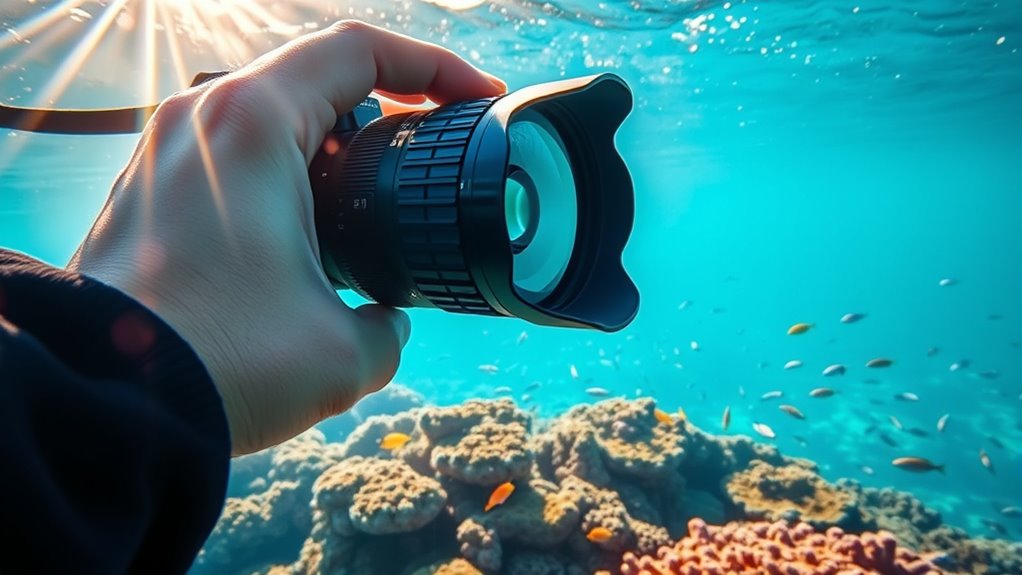
Using accessories can substantially improve your underwater photography by helping you overcome common challenges like limited lighting, color loss, and stability issues. With the right underwater accessories, you can capture stunning shots of marine life and bring out vibrant colors lost at depth. Consider using a strobe or external flash to illuminate subjects and restore natural hues. A macro lens attachment allows you to focus on tiny marine creatures with sharp detail. A stabilizing tray or arm helps reduce camera shake in currents, ensuring clear images. Additionally, color correction filters can balance out blue and green tones, making your photos more true to life. These accessories not only enhance image quality but also expand your creative possibilities beneath the sea.
Practice Tips for Stable and Clear Images
Achieving stable and clear underwater images requires proper technique and equipment handling. To improve stability, practice stability techniques like maintaining a steady buoyancy and using your fins to stay balanced. Keep your body relaxed to minimize movement that can blur your shots. Focusing exercises are also essential; practice gently adjusting your focus before taking the shot to ensure sharpness. Use your camera’s focus lock feature if available, and learn to anticipate subjects’ movements. Holding your breath and controlling your breathing can help reduce shake. Additionally, stabilize your body by anchoring yourself to a steady object or maintaining a neutral buoyancy position. With consistent practice of these stability techniques and focusing exercises, you’ll capture sharper, more professional-looking underwater images.
Safety and Environmental Considerations While Shooting
While capturing stunning underwater images, prioritizing safety and respecting the environment is essential to protect yourself and marine life. Adhering to diver safety protocols prevents accidents, while supporting marine conservation helps preserve fragile ecosystems. Keep these considerations in mind:
- Avoid touching or disturbing marine creatures to prevent stress or injury.
- Follow established dive guidelines to maintain safety and prevent accidents.
- Use eco-friendly equipment that minimizes environmental impact.
- Respect protected areas and avoid damaging coral reefs or seabed habitats.
Tips for Post-Processing Underwater Photos
Post-processing is a crucial step in transforming your underwater shots into stunning images. Once you’ve captured your photos, use underwater editing techniques to correct color loss and enhance details. Start by adjusting white balance to restore natural hues affected by water’s filtering effect. Next, tweak contrast and brightness to make your subjects pop. Using reliable post processing software, you can selectively sharpen details and eliminate backscatter or haze. Be cautious not to overdo it; subtle edits often produce the best results. Consider cropping or straightening to improve composition. Remember, each image is unique, so experiment with different settings to find what enhances your shot best. With effective underwater editing, your underwater photography will truly stand out.
Frequently Asked Questions
How Do I Choose an Underwater Camera for Beginners?
To choose an underwater camera for beginners, focus on essential features like waterproof depth, ease of use, and image quality. Look for models with automatic modes and simple controls to ease your learning curve. Beginner camera tips include checking for good battery life and durability. Prioritize affordability and compact size, so you’re comfortable exploring underwater photography without feeling overwhelmed. This approach guarantees you get a reliable, user-friendly camera that helps you capture stunning underwater images.
What Are Common Mistakes to Avoid While Underwater Shooting?
Think of underwater shooting like steering a maze—you might get lost without proper guidance. Avoid common mistakes like neglecting depth perception; objects appear closer or farther than they are, so adjust your positioning. Don’t forget color correction; water filters out certain wavelengths, dulling your shots. Keep your buoyancy steady, use the right lighting, and stay aware of your surroundings. These tips help you capture sharp, vibrant images beneath the waves.
How Can I Protect My Equipment From Water Damage?
To protect your equipment from water damage, always store your gear in dry storage when not in use. Before diving, make certain your camera is sealed inside a waterproof casing, which provides an extra layer of security against water ingress. Check the seals and clasps regularly for any signs of wear. Using these precautions, you’ll keep your equipment safe and avoid costly repairs, so you can focus on capturing stunning underwater shots.
What Are the Best Practices for Underwater Wildlife Photography?
Immerse yourself in the vibrant world of marine life with respect and patience. Capture their essence by approaching slowly, avoiding sudden movements that could scare them away. Use a macro lens for intimate shots and focus on their eyes for emotional impact. Practice ethical photography by respecting their habitat and avoiding disturbance. Remember, the goal is to preserve their natural behavior while sharing their beauty with others.
How Do I Improve My Underwater Shots in Low-Light Conditions?
To improve your underwater shots in low-light conditions, focus on adjusting your camera settings first. Increase the ISO to enhance light sensitivity, but watch for noise. Use a wider aperture to let in more light and slow down your shutter speed to prevent blur. Employ lighting techniques like using an underwater strobe or flashlight to illuminate your subject. Practice these adjustments consistently, and you’ll see sharper, brighter images even in poor visibility.
Conclusion
With the right gear, keen eye, and mindful practice, you’re well on your way to capturing stunning underwater scenes. Think of each shot as a window into a hidden world waiting to be discovered—your ability to adapt and learn transforms mere moments into breathtaking memories. So plunge in with confidence, embrace the challenges, and let your passion for underwater photography turn every dive into a masterpiece waiting to be revealed.