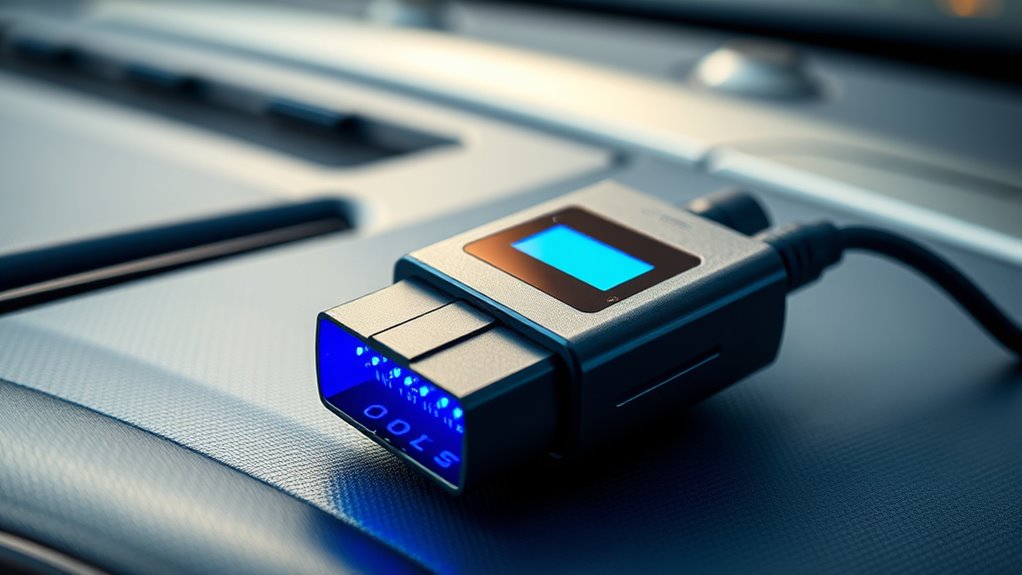

An OBD-II reader connects to your car’s diagnostic port to instantly provide insights into your vehicle’s health. It interprets data from sensors, shows trouble codes, and tracks engine performance in real time. If your check engine light turns on or you notice strange noises, this device helps you understand what’s wrong and can save you money on repairs. Keep exploring to discover how to get the most out of your OBD-II scanner.
Key Takeaways
- OBD-II readers connect to your vehicle’s diagnostic port to access real-time engine data and trouble codes.
- They identify issues like check engine lights, misfires, or emission problems early before costly repairs.
- OBD-II devices interpret diagnostic trouble codes to pinpoint specific problems with spark plugs, sensors, or fuel systems.
- They help monitor vehicle health, emission compliance, and engine performance, promoting proactive maintenance.
- Using an OBD-II scanner is simple, providing clear codes and live data to understand what your car is communicating.

Have you ever wondered how to quickly diagnose your vehicle’s issues without visiting a mechanic? Luckily, an OBD-II reader makes that possible. These handy devices plug into your car’s diagnostic port and give you instant access to important data about your vehicle’s health. When you connect an OBD-II scanner, you’ll see real-time information that can help you identify problems early, saving you time and money. Whether it’s a check engine light or a strange noise, the right tool can tell you what’s going on under the hood.
One common reason to use an OBD-II reader is to diagnose issues like cylinder misfires. If your engine isn’t running smoothly, a misfire can cause rough idling, poor acceleration, or decreased fuel efficiency. By scanning your vehicle, you can find specific trouble codes related to misfiring cylinders. These codes reveal whether a particular spark plug, ignition coil, or fuel injector is malfunctioning. Catching misfires early helps prevent more serious damage, such as damaged pistons or catalytic converters. Plus, understanding which cylinder is misfiring allows you to focus repairs, whether you’re fixing it yourself or heading to a mechanic.
Using an OBD-II scanner helps identify misfiring cylinders and prevent costly engine damage early.
Another critical aspect of using an OBD-II scanner is emission diagnostics. Emissions-related trouble codes alert you when your vehicle isn’t meeting environmental standards. This could be due to faulty oxygen sensors, a malfunctioning catalytic converter, or issues with your fuel system. If these problems go unnoticed, your car might fail an emissions test or produce excessive pollutants. By reading the codes, you can pinpoint the root cause of emission issues and address them proactively. Fixing emission problems not only keeps your car running smoothly but also helps you stay compliant with local regulations and reduces your environmental impact.
Using an OBD-II scanner is straightforward. You plug it into the diagnostic port, turn on your vehicle, and wait for the scanner to retrieve data. Many devices come with a user-friendly interface that displays codes and descriptions, making it easy for you to interpret the results. Some advanced models even provide live data streams, helping you monitor your engine’s performance in real time. With this knowledge, you can make informed decisions—whether it’s tightening a loose gas cap, replacing a sensor, or scheduling professional repairs. Additionally, understanding the contrast ratio of your vehicle’s engine performance can help you better interpret how well your vehicle handles different driving conditions, similar to how contrast ratios affect image quality in projectors.
In essence, an OBD-II scanner empowers you to understand what your car is telling you. It’s a cost-effective way to troubleshoot issues like cylinder misfires and emission diagnostics early on. By regularly checking your vehicle’s codes, you can keep your car running efficiently, avoid costly repairs, and ensure it stays compliant with emission standards. It’s a small investment for peace of mind and a more reliable driving experience.

ANCEL AD310 Classic Enhanced Universal OBD II Scanner Car Engine Fault Code Reader CAN Diagnostic Scan Tool, Read and Clear Error Codes for 1996 or Newer OBD2 Protocol Vehicle (Black)
CEL Doctor: The ANCEL AD310 is one of the best-selling OBD II scanners on the market and is…
As an affiliate, we earn on qualifying purchases.
As an affiliate, we earn on qualifying purchases.
Frequently Asked Questions
Can OBD-II Readers Diagnose All Car Issues?
No, OBD-II readers can’t diagnose all car issues because of their diagnostic limitations. They primarily identify problems related to the engine and emissions systems, but some issues like minor mechanical faults or electrical glitches might go undetected. Additionally, false alarms can occur, leading you to believe there’s a problem when there isn’t. For extensive diagnostics, it’s best to consult a mechanic who can perform detailed inspections beyond the OBD-II scan.
Are There Affordable OBD-II Readers for Beginners?
Yes, you can find budget options for beginner-friendly tools that are easy to use and affordable. Look for popular brands like Autel, BlueDriver, or Innova, which offer reliable features at lower prices. These tools typically have simple interfaces and clear instructions, making them perfect for beginners. With a little research, you’ll find an OBD-II reader that fits your budget and helps you understand your car’s diagnostics without breaking the bank.
How Often Should I Use an OBD-II Scanner?
You should use an OBD-II scanner regularly, like a guardian angel watching over your car, to catch issues early. Incorporate it into your maintenance routines at least once a month or whenever you notice a warning light. This keeps troubleshooting tips at your fingertips, preventing small problems from snowballing into costly repairs. Frequent checks guarantee your vehicle stays in top shape, saving you time, money, and stress long-term.
Do OBD-II Readers Work on Electric Vehicles?
Yes, OBD-II readers can work on electric vehicles, but for accurate electric vehicle diagnostics, you’ll need EV-specific tools. Standard OBD-II scanners may read some data like battery status or error codes, but they often lack the advanced features needed for EV systems. To get detailed insights into your electric vehicle’s health, invest in specialized EV diagnostic tools designed to interpret the unique data from EV components.
Can OBD-II Scanners Improve My Car’s Fuel Efficiency?
Yes, an OBD-II scanner can help improve your car’s fuel efficiency. By monitoring real-time data, you can identify issues like misfires or sensor problems that waste fuel. Look for scanner features such as live data readouts, fuel efficiency metrics, and error code explanations. Regularly checking these details allows you to make adjustments or schedule repairs, ultimately saving you money on fuel and maintenance costs.
ANCEL AD310 Classic Enhanced Universal OBD II Scanner Car Engine Fault Code Reader CAN Diagnostic Scan Tool, Read and Clear Error Codes for 1996 or Newer OBD2 Protocol Vehicle (Black)
CEL Doctor: The ANCEL AD310 is one of the best-selling OBD II scanners on the market and is…
As an affiliate, we earn on qualifying purchases.
As an affiliate, we earn on qualifying purchases.
Conclusion
Using an OBD-II reader empowers you to understand your car’s health better. Did you know that over 80% of vehicle issues can be diagnosed early with these devices? By regularly checking your car’s data, you can prevent costly repairs and keep your ride running smoothly. It’s a simple tool that puts you in control, saving you time and money. Stay proactive, and let your car tell you what’s really going on beneath the hood.
ANCEL AD310 Classic Enhanced Universal OBD II Scanner Car Engine Fault Code Reader CAN Diagnostic Scan Tool, Read and Clear Error Codes for 1996 or Newer OBD2 Protocol Vehicle (Black)
CEL Doctor: The ANCEL AD310 is one of the best-selling OBD II scanners on the market and is…
As an affiliate, we earn on qualifying purchases.
As an affiliate, we earn on qualifying purchases.

UMEIJA OBD2 Scanner with Upgrade Battery Tester – Diagnostic Tool for Cars That Check Engine Light & Emissions Readiness Read and Clears Vehicle Error Codes for All OBD II Protocol Vehicles Since 1996
Multi-Function: This code reader for cars and trucks is like a micro mechanic, which can quickly read and…
As an affiliate, we earn on qualifying purchases.
As an affiliate, we earn on qualifying purchases.