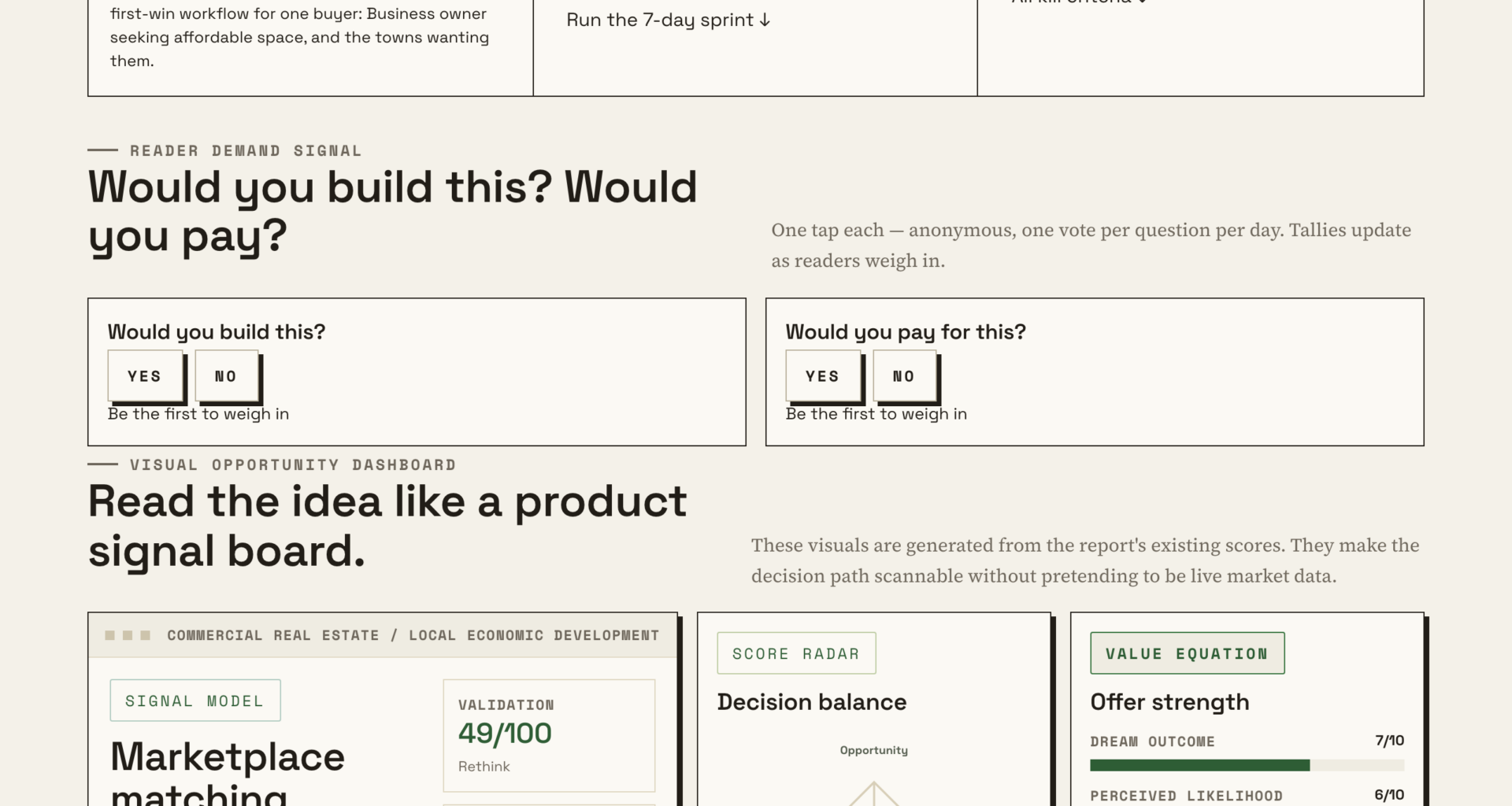

📊 Full opportunity report: A Digital Path From Vacant Storefront To Local Business on IdeaNavigator AI — validation score, market gap, and execution plan.

Get the latest gadgets delivered free with Prime
- Fast, free delivery on millions of items
- Prime Video, Amazon Music and more included
- Member-only deals all year
TL;DR
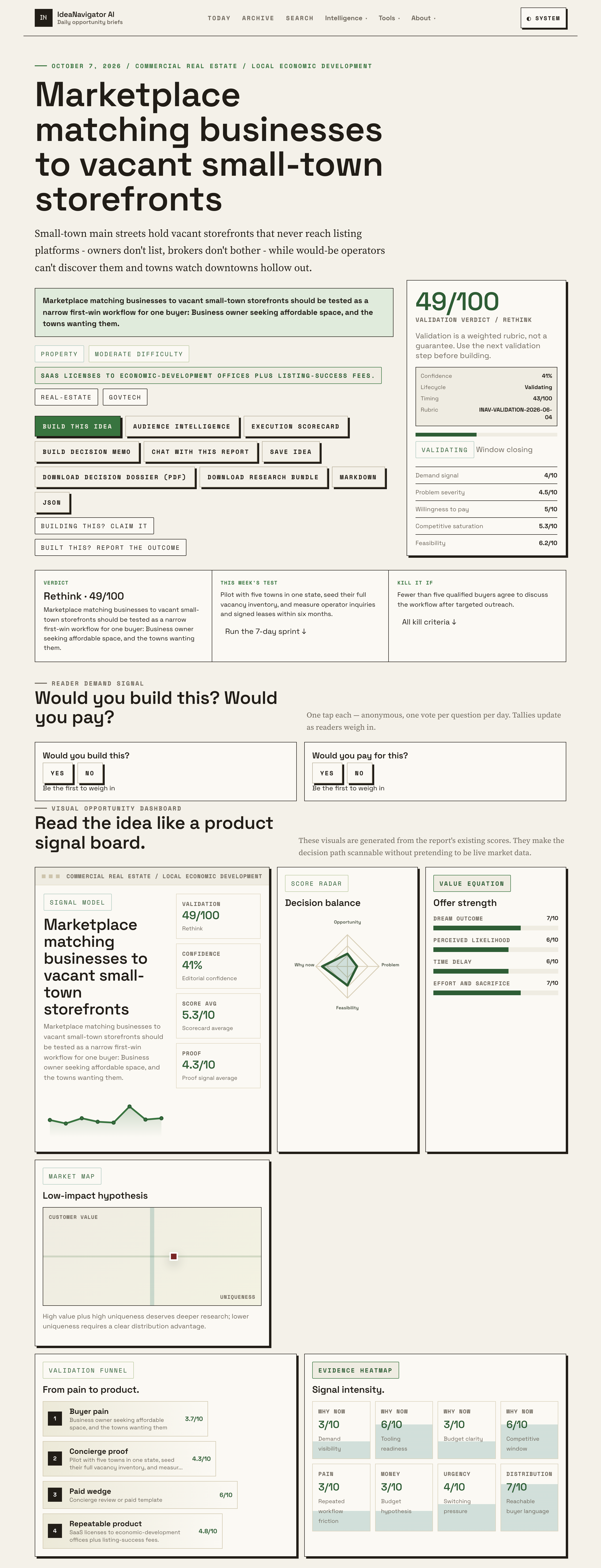
IdeaNavigator AI has outlined a marketplace concept to match vacant small-town storefronts with business operators and route prospects to local economic-development offices. The proposal calls for a five-town pilot, but no launch, participating towns, funding, or results are confirmed.
IdeaNavigator AI has proposed a digital marketplace to connect businesses seeking affordable space with owners of vacant small-town storefronts, routing potential matches to local economic-development offices. The concept outlines a possible five-town pilot, but no participating communities, launch date, or operating results have been announced.
The proposed service would let towns and property owners post storefront listings with photographs, size, rent, and information about available incentives. Prospective operators would be able to browse locations using town profiles and foot-traffic data, according to the concept. When a business shows interest, the marketplace would direct the match to the local development office and attach information about grants that may be available.
The stated users are business owners seeking affordable premises and towns looking to attract them. The proposal describes a potential revenue model based on software subscriptions, or SaaS licenses, sold to economic-development offices, alongside fees tied to successful listings. It does not provide prices, projected revenue, or details on how a success fee would be calculated.
For an initial test, the proposal recommends working with five towns in one state, entering their full inventory of vacant storefronts, and tracking operator inquiries and signed leases over six months. Those are suggested pilot parameters, not evidence that a pilot has been organized or completed.
A Match Could Support Main Streets
The idea addresses a visibility problem: storefronts can remain empty even when operators are looking for space, if owners do not advertise vacancies and brokers do not list them. A shared inventory could make those properties easier to discover and give local officials a route to connect interested businesses with available support.
For towns, the proposed system could bring listings, inquiries, and incentive information into one workflow. For operators, it could reduce the effort involved in finding affordable premises and understanding local programs. Whether those benefits lead to more signed leases is the key test; a listing or inquiry alone would not show that a business has opened or that a vacancy has been filled.
Products Worth Considering

Amazon Kindle Paperwhite (12th Generation, 2024), 16 GB, 7-inch Display, Jade

Bose QuietComfort Wireless Bluetooth Headphones with Active Noise Cancellation, Mic, USB‑C Charging, Deep Bass, 24‑Hour Battery – White Smok

Amazon Kindle Paperwhite Signature Edition (12th Generation, 2024), 32 GB, Metallic Black
As an affiliate, we earn on qualifying purchases.
How the Proposed Pilot Would Work
The proposal identifies a gap between unlisted commercial vacancies and potential tenants who have no straightforward way to find them. It also points to renewed interest in small-town commercial property associated with remote-work migration, and says economic-development offices have grant money aimed at matching businesses with space. No data, named grant programs, or examples of participating offices are supplied to quantify those claims.
The suggested pilot is designed to test the workflow at a limited scale before a broader rollout: collect vacancies across five towns, make details searchable, connect interested operators to local development staff, and monitor activity for six months. The proposal does not specify how towns would verify listing accuracy, update rents and availability, or provide foot-traffic data.
Pilot Details Remain Unconfirmed
No launch or participating towns are identified, and there is no evidence yet of listings, business inquiries, leases, or grant awards through the proposed service. It is also unclear who would build and operate the marketplace, how it would obtain complete vacancy inventories, and whether property owners and development offices have agreed to take part.
The proposal does not define its foot-traffic measures, grant eligibility process, listing-success fee, or subscription pricing. Its reference to remote-work migration and grant availability is presented without figures or specific programs, so the scale of demand and the amount of support potentially available remain unknown.
A Five-Town Test Is Proposed
The next step described is a pilot across five towns in one state, with vacant storefronts entered into the marketplace and performance tracked for six months. The proposed measures are operator inquiries and signed leases. No timetable or organizer for that work has been announced.
If a pilot is launched, its results could show whether towns can assemble and maintain reliable listings, whether operators use the service, and whether inquiries progress to leases. Until those details and outcomes are available, the marketplace remains a proposal rather than a demonstrated solution.
Source: IdeaNavigator AI
Key Questions
Is the storefront marketplace already operating?
No operating service is confirmed. The material describes a marketplace concept and a proposed pilot, but gives no launch date or active locations.
Who would use the marketplace?
The proposed users are business operators looking for affordable space, storefront owners with vacancies, and local economic-development offices involved in matching and incentives.
What would storefront listings include?
The proposed listing details include photos, size, rent, and incentive programs. Operators could also browse using town profiles and foot-traffic data.
How would the pilot measure success?
The suggested test would cover five towns over six months and track operator inquiries and signed leases. No pilot results are available.
How might the service make money?
The concept proposes software subscriptions for economic-development offices and fees tied to successful listings. Pricing and fee terms have not been specified.
Source: IdeaNavigator AI