
TL;DR
Google opened Gemini 4 Carbon to paying users on November 10 and released a model card. On the new MKA benchmark, Carbon placed second at 54.3%, close to the leading models, while Google DeepMind reported a $5.63 cost per task compared with $35.28 for Claude Fable 5.2.
Google opened Gemini 4 Carbon to paying developers, businesses and Google AI Ultra subscribers on November 10, the same day Google DeepMind and Artificial Analysis introduced a benchmark for AI agents working with visual documents. Carbon scored 54.3% on MKA, placing second behind Anthropic’s Claude Fable 5.2, while Google DeepMind reported a much lower per-task cost for Carbon on that test.

Get the latest gadgets delivered free with Prime
- Fast, free delivery on millions of items
- Prime Video, Amazon Music and more included
- Member-only deals all year
MKA, short for Multimodal Knowledge Agent, contains 200 expert-built tasks across 10 sectors. The tasks ask models to work with material such as blueprints, scans and charts rather than relying only on plain text. Claude Fable 5.2 scored 56.6%, Gemini 4 Carbon scored 54.3%, and Claude Opus 5.5 scored 53.0%. The report says the top three results fall within the benchmark’s margin of error, so the ranking does not establish a clear performance gap among them.
Google DeepMind’s report puts Carbon’s cost at $5.63 per MKA task, compared with $35.28 for Fable 5.2. That is a comparison of costs on this benchmark, not a general measure of the models’ costs for every kind of work. MKA was developed by Google DeepMind and Artificial Analysis, and Google’s involvement is relevant when evaluating results that include its own model.
Carbon is available through the paid Gemini API and Google AI Studio, as well as Gemini for business. In the Gemini app and AI Mode in Search, access is limited to Google AI Ultra subscribers. The listed API price is $2 per million input tokens and $10 per million output tokens through November 30; from December 1, those rates rise to $4 and $20, respectively.
A Close Score at a Lower Reported Cost
For companies considering models for document-heavy tasks, MKA offers an early comparison that puts accuracy and reported cost side by side. Carbon’s result is close to the two leading Anthropic models, and its reported per-task cost is lower on this test. That could make it worth evaluating for workflows involving visual records or technical documents, but a benchmark score alone does not show how a model will perform on a particular company’s files, tools or quality requirements.
Access and price also shape the practical choice. Carbon requires a paid Google product, and its discounted API rates expire at the end of November. Google describes it as a model for difficult, multi-step work that uses more reasoning tokens; the company says Gemini 4 Argon remains a better fit for most software engineering and knowledge work. Carbon’s higher token use and possible slowdowns may affect total cost and response time outside the MKA test.
Products Worth Considering

Samsung Odyssey OLED G5 27-Inch QHD Gaming Monitor

Apple AirPods Pro 3 Wireless Earbuds with Active Noise Cancellation

LG UltraGear 34G600A-B 34-Inch Curved WQHD Gaming Monitor, 160Hz
As an affiliate, we earn on qualifying purchases.
Carbon’s Release and Earlier Rankings
Carbon was first released to a small group of cyber defenders through Google’s Fairwind Program about two weeks before its wider paid launch. Artificial Analysis lists its release date as October 28. Google says Carbon is built on Gemini 4 Argon and is intended for demanding coding, debugging and research tasks. Its model card lists support for text, images, audio and video as input, text output, and a context window of up to one million tokens. Google also lists hallucinations, occasional slowness or timeouts, and higher token use as limitations.
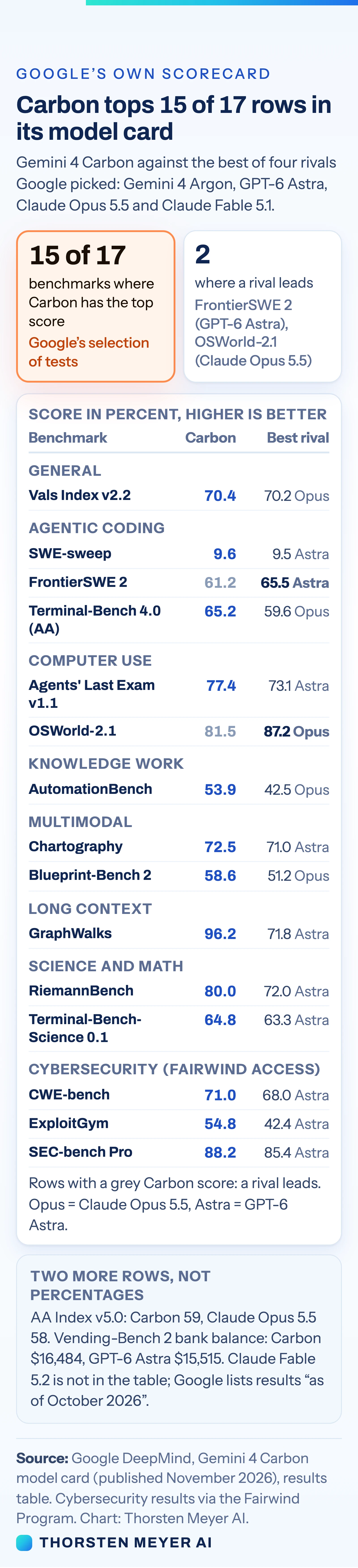
The MKA result is not the only available comparison. On Artificial Analysis’s Intelligence Index v5.0.1, Carbon at high reasoning scored 60 points; Claude Fable 5.2 scored 62 at high and 65 at its maximum setting. Those figures come from a separate index and should not be conflated with MKA percentages. Google’s model card, meanwhile, says Carbon led on 15 of 17 benchmarks selected by Google, with results dated as of October 2026. That comparison does not include Fable 5.2, which was released November 9.
““tasks that test the limits of a model’s intelligence””
— Google DeepMind, Gemini 4 Carbon model card
Limits of the MKA Comparison
MKA’s tasks are kept private, so outside researchers cannot inspect them or independently reproduce the results from the task set. Google DeepMind co-developed the benchmark, and the published report includes Google’s model. Those facts do not invalidate the scores, but they limit how fully outsiders can assess the test design and its relevance to other work.
The report says the leading three models are within the margin of error; it does not establish that Fable 5.2 is reliably better than Carbon. It is also unclear from these results how scores translate to performance on a specific business’s documents, or whether the reported cost advantage will hold for other workloads and settings. The MKA cost figures describe the benchmark tasks and should not be treated as a universal price comparison.
API Pricing Changes in December
Developers can access Carbon through Google’s paid API and AI Studio, subject to Google’s terms and pricing. The temporary rates of $2 per million input tokens and $10 per million output tokens run through November 30, with listed rates rising to $4 and $20 on December 1. Businesses evaluating the model will need to compare its performance and full usage costs on their own tasks; the published MKA result provides one benchmark, not that assessment.
Key Questions
What was Gemini 4 Carbon’s MKA score?
Carbon scored 54.3% on MKA, behind Claude Fable 5.2 at 56.6% and ahead of Claude Opus 5.5 at 53.0%. The report says the top three are within the margin of error.
How much did Carbon cost per MKA task?
Google DeepMind reported $5.63 per task for Carbon, compared with $35.28 for Claude Fable 5.2. These are benchmark-specific figures, not general costs for every use.
Who can use Gemini 4 Carbon?
It is available to paying developers through the Gemini API and Google AI Studio, and to businesses using Gemini for business. In the Gemini app and AI Mode in Search, it is limited to Google AI Ultra subscribers.
When does Carbon’s API price change?
The listed price is $2 per million input tokens and $10 per million output tokens through November 30, 2026. From December 1, the rates become $4 and $20 per million, respectively.
Source: Thorsten Meyer AI