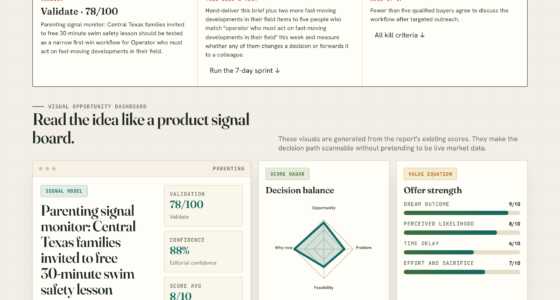

📊 Full opportunity report: The Role Of Family Trends In Student Discipline Incidents on IdeaNavigator AI — validation score, market gap, and execution plan.

Get the latest gadgets delivered free with Prime
- Fast, free delivery on millions of items
- Prime Video, Amazon Music and more included
- Member-only deals all year
TL;DR
Recent analysis shows that family and parenting trends significantly impact student discipline incidents. Schools and parents are noticing these patterns, prompting calls for better early detection. The connection is confirmed, but the full scope remains under investigation.
Recent observations and emerging data suggest that family and parenting trends are increasingly influencing student discipline incidents across schools nationwide. Experts and educators note a rising correlation between family behaviors and student conduct, prompting calls for more targeted monitoring. This development matters because understanding these links can help improve disciplinary policies and family engagement strategies, potentially reducing incidents and fostering healthier school environments.
Multiple sources, including educators and child development specialists, have reported a noticeable rise in student discipline cases that appear linked to family dynamics. For example, a recent case involved a student suspended for bringing coffee to school, which sparked discussions about how family routines and behaviors influence student actions. According to an anonymous educator, ‘We are seeing more incidents where family habits and attitudes are reflected in student behavior, indicating a deeper connection than previously recognized.’
Researchers point out that family trends—such as parenting styles, household routines, and parental responses to stress—can shape student conduct. A preliminary analysis suggests that students from households with inconsistent discipline or high parental stress levels are more prone to disciplinary issues. However, experts caution that these are correlations, and causation remains under study.
Schools and policymakers are beginning to explore early warning systems that monitor family-related signals—such as social media trends, safety notices, and family behavior reports—to identify at-risk students before incidents escalate. Such efforts aim to create a proactive approach rather than reactive discipline, emphasizing family engagement and support.
Implications for School Discipline Policies
The connection between family trends and student discipline underscores the importance of integrating family dynamics into school discipline policies. Recognizing these influences can lead to more effective interventions, reduce repeat offenses, and foster better communication between schools and families. For parents, understanding how their behaviors impact student conduct can encourage more mindful parenting, ultimately supporting healthier student development and school climate.
As an affiliate, we earn on qualifying purchases.
Over the past year, educators and child psychologists have observed an uptick in discipline incidents linked to family behaviors. This trend coincides with increased stresses on families due to economic, social, and mental health challenges, which can manifest in student behavior. Prior to this, discipline issues were often viewed as individual student problems; now, the family environment is gaining recognition as a key factor. Some districts have begun collecting data on family-related signals, such as household routines or parental responses, to better understand these patterns.
Historically, school discipline has focused on individual student actions, but recent studies suggest that family context plays a significant role. For example, a 2022 survey indicated that students with inconsistent parental supervision or high household conflict are more likely to face suspensions or behavioral interventions. This evolving understanding is prompting a shift toward more holistic disciplinary approaches.
As an affiliate, we earn on qualifying purchases.
Scope and Causality of Family Influence on Discipline
While correlations between family trends and discipline incidents are increasingly documented, establishing direct causality remains challenging. It is unclear how much specific family behaviors directly cause disciplinary issues versus being associated factors. Additionally, the variability across different communities and socioeconomic contexts complicates broad generalizations. Researchers emphasize the need for further longitudinal studies to clarify these relationships and determine effective intervention points.
early warning student discipline system
As an affiliate, we earn on qualifying purchases.
As an affiliate, we earn on qualifying purchases.
Monitoring Systems and Policy Adjustments Underway
Educational institutions and child development experts are developing early warning systems that incorporate family-related signals, such as social media activity and household reports, to identify at-risk students proactively. Policymakers are considering integrating family engagement strategies into disciplinary frameworks. Expect pilot programs to launch over the next year, aiming to test the effectiveness of these approaches in reducing discipline incidents linked to family trends.
family engagement educational resources
As an affiliate, we earn on qualifying purchases.
As an affiliate, we earn on qualifying purchases.
Key Questions
How do family trends influence student discipline?
Emerging evidence suggests that family behaviors, routines, and stress levels can impact student conduct, leading to more disciplinary incidents in some cases.
Are all discipline issues connected to family dynamics?
No, not all issues are linked; current research indicates a correlation, but causality varies by individual circumstances and community factors.
What can schools do to address this trend?
Schools are exploring early warning systems and enhanced family engagement strategies to better identify and support at-risk students before discipline problems escalate.
What remains uncertain about this connection?
The exact causal pathways and how to best intervene are still under study, with ongoing research needed to develop effective policies.
Will this lead to changes in disciplinary policies?
Potentially, as understanding deepens, policies may evolve to incorporate family context as a factor in disciplinary decisions and interventions.
Source: IdeaNavigator AI
Halloween Picks
halloween
As an affiliate, we earn on qualifying purchases.