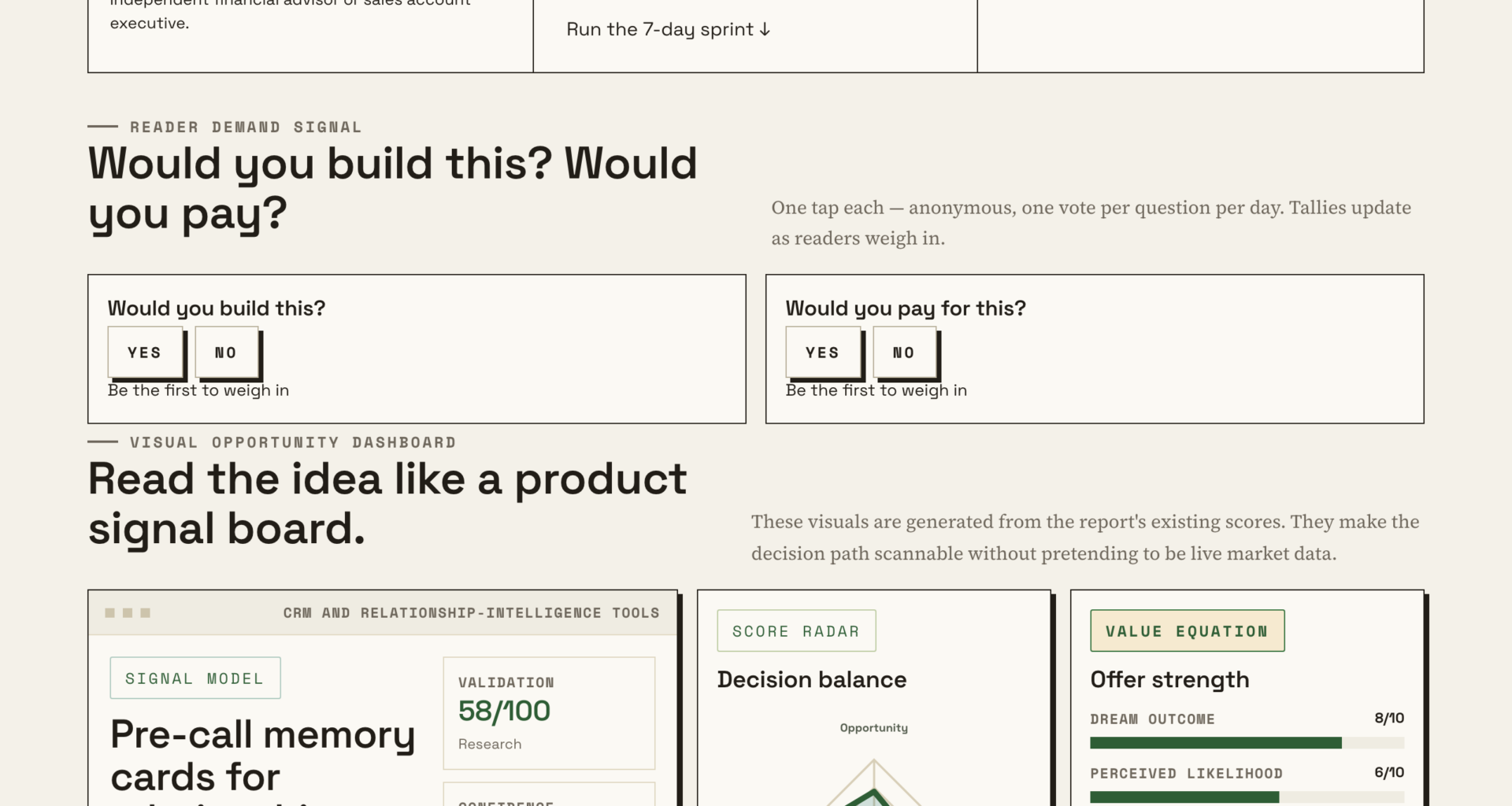

📊 Full opportunity report: Build Better Customer Relationships With Strategic Pre-Call Memory Cards on IdeaNavigator AI — validation score, market gap, and execution plan.

Get the latest gadgets delivered free with Prime
- Fast, free delivery on millions of items
- Prime Video, Amazon Music and more included
- Member-only deals all year
TL;DR
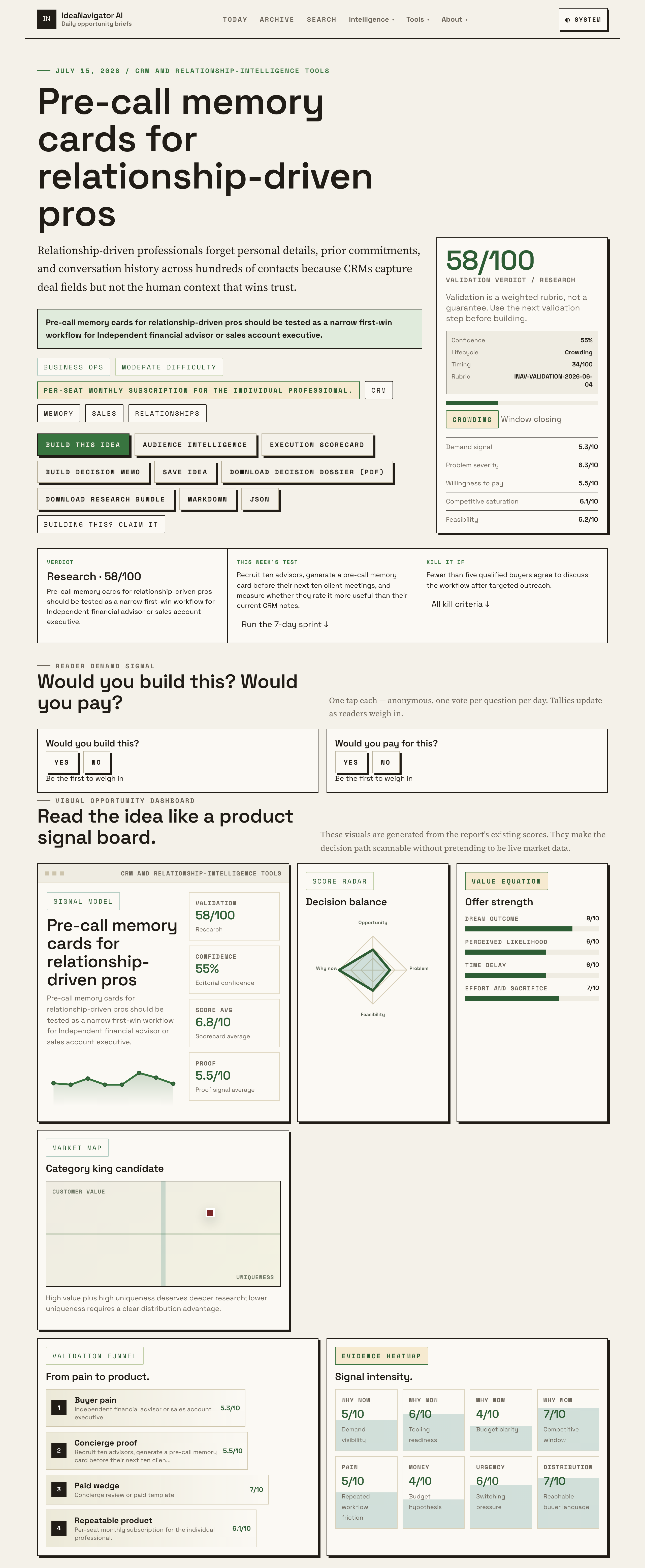
A new tool concept for independent financial advisors and sales professionals uses AI to create pre-call memory cards. These cards summarize past interactions, helping build stronger client relationships. The approach is being tested as a way to address gaps in current CRM systems.
Independent financial advisors and sales account executives are being tested on a new tool: pre-call memory cards designed to enhance client relationships by summarizing past interactions using AI. This development aims to address a common challenge: professionals often forget personal details and prior commitments due to limitations in current CRM systems, which focus on deal data rather than human context.
The concept involves connecting a contact’s previous emails, notes, and interaction history to generate a one-page pre-call brief. This brief highlights who the client is, what was last promised, and any open threads, making it easier for professionals to personalize conversations. The tool leverages large-language-model summarization technology, which has become more affordable and effective, to produce these memory cards in real time.
According to sources close to the project, the initial MVP (minimum viable product) will allow users to generate a pre-call summary by linking their existing CRM data. The goal is to test whether these memory cards improve the quality of client interactions, as rated by the professionals themselves. The model is designed for per-seat monthly subscriptions targeting the CRM and relationship-intelligence market.
Validation will occur by recruiting ten advisors, who will generate memory cards before their next ten client meetings and provide feedback on usefulness compared to their current notes. Early indications suggest that this approach could fill a gap left by traditional CRM systems, which often lack the human context necessary to foster trust and rapport.
Potential Impact on Client Relationship Management
This initiative could significantly improve how relationship-driven professionals manage client interactions by providing them with concise, relevant context before each call. By capturing and surfacing personal details and previous commitments, the memory cards may help professionals build trust faster and deepen relationships. If successful, this approach could become a standard feature in CRM tools, shifting focus from deal data to human connection, which is crucial for long-term client retention and satisfaction.
Products Worth Considering

Bose QuietComfort Wireless Noise-Cancelling Headphones, White Smoke

Samsung Odyssey G3 G30D 27-Inch FHD Gaming Monitor

Kindle Paperwhite Signature Edition 32GB E-Reader, 7-Inch Display, Seaglass Green
As an affiliate, we earn on qualifying purchases.
Limitations of Current CRM Systems for Relationship Professionals
Many independent financial advisors and sales professionals report that traditional CRM systems fail to capture the nuanced human context needed for relationship building. While CRMs record transaction history and deal-specific data, they often overlook personal details, prior promises, and conversation subtleties that foster trust. This gap has prompted interest in AI-powered solutions that can synthesize and surface relevant information quickly, supporting more personalized client interactions.
The idea of pre-call memory cards is emerging as a targeted solution, leveraging recent advances in large-language models that can summarize long conversation histories into compact, searchable formats. This approach is seen as a practical way to enhance existing workflows without overhauling entire CRM platforms.
“The ability to quickly access a client’s recent history and commitments can transform the quality of interactions and trust-building.”
— an anonymous researcher
Unanswered Questions About Implementation and Effectiveness
It is not yet clear how well the memory cards will perform in real-world settings or how much they will improve client relationships compared to current practices. The testing phase is still in early stages, and user feedback will be critical to determine whether the concept delivers measurable benefits. Additionally, questions remain about integration with existing CRMs, the cost for individual professionals, and how users will adopt the new workflow.
Next Steps in Testing and Validation
The project plans to recruit ten advisors for initial testing, generating memory cards before ten client meetings and gathering feedback on usefulness. Results from this pilot will inform further development, including potential integration features and user experience improvements. Broader deployment and commercial rollout are expected if early feedback indicates significant value. Ongoing monitoring will assess whether the tool effectively enhances relationship-building over time.
Key Questions
How does the pre-call memory card differ from existing CRM notes?
The memory card condenses past interactions, promises, and personal details into a single, easy-to-review page, whereas CRM notes are often dispersed and less focused on human context.
What technology powers the memory card generation?
Large-language-model summarization technology, which analyzes linked emails and notes to produce a concise overview, is used to generate the memory cards.
Will this tool be available for all types of relationship professionals?
Initially, the focus is on independent financial advisors and sales account executives, but the concept could be adapted for other relationship-driven roles if successful.
How will user privacy and data security be handled?
Details are still emerging, but privacy considerations will be integral to development, especially since the tool processes sensitive client information.
When can professionals expect to start using this tool widely?
A broader rollout depends on pilot results; if positive, commercial availability could follow within the next year.
Source: IdeaNavigator AI