
🔍 Read the full analysis: ModRetro’s $200 Handheld Makes Cartridges From OpenAI Prompts on ThorstenMeyerAI.com

Get the latest gadgets delivered free with Prime
- Fast, free delivery on millions of items
- Prime Video, Amazon Music and more included
- Member-only deals all year
TL;DR
OpenAI’s Supply Co. began selling a $200 ModRetro Chromatic: Codex Edition on November 9, 2026. Its included programmable cartridge can hold games made with Codex and refined in GB Studio, but the product page showed “Restock soon” the next day, with November 19 listed as the expected restock date.
OpenAI’s Supply Co. began selling the $200 ModRetro Chromatic: Codex Edition on November 9, pairing a retro handheld with a programmable cartridge for games created using the company’s Codex coding agent. The product page showed “Restock soon” on November 10 and listed an expected restock date of November 19, making availability uncertain for buyers seeking the device now.
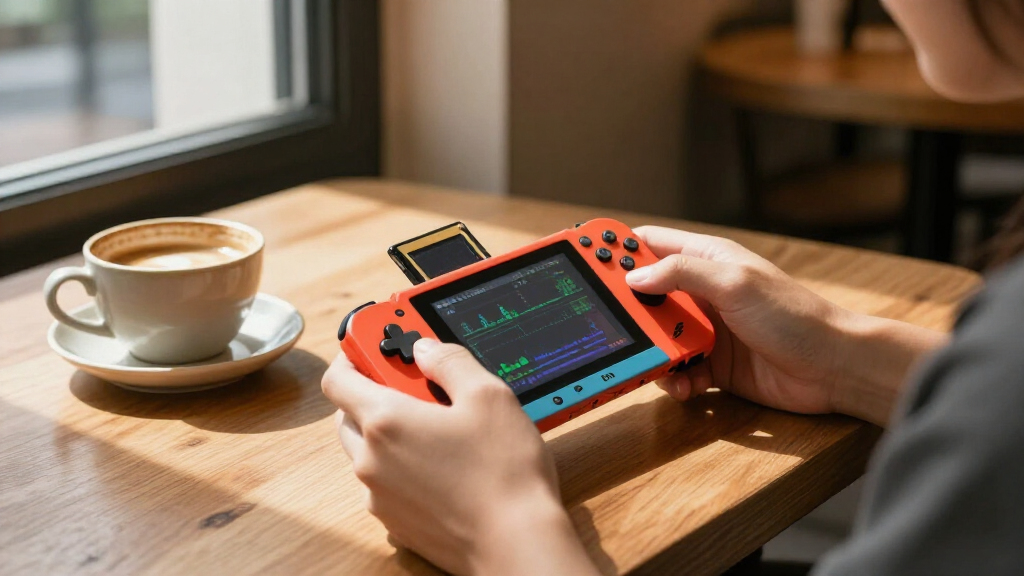
The bundle includes a ModRetro Chromatic handheld, one programmable Codex Cartridge and three AA batteries. The device has a 2.56-inch, 160-by-144-pixel backlit display and plays Game Boy and Game Boy Color cartridges as well as Chromatic cartridges. OpenAI’s shop lists the shell as transparent plastic and the buttons as PBT; the handheld can also use ModRetro’s separately sold Rechargeable Power Core.
OpenAI presents the cartridge as part of a creation workflow rather than a preloaded collection of games. Users describe a game idea, use the ModRetro Chromatic plugin in Codex to generate and revise it, and work with the game in GB Studio, a visual editor for Game Boy games. They can build a ROM, then test it in a browser emulator, stream it from a computer to the handheld, or write it to the cartridge for play without a computer.
Getting started requires updating the handheld’s firmware, entering an activation code to unlock Developer-Mode, installing the Codex app and adding the plugin. OpenAI’s developer guide warns that writing a new ROM erases the existing game on the cartridge and can also erase saved games; the installer does not back up the cartridge. OpenAI’s shop lists a Codex Edition carrying case for $35 and an additional cartridge for $50, sold separately.
ModRetro’s $200 Handheld Turns Prompts Into Cartridges
OpenAI’s Supply Co. pairs a retro handheld with a programmable cartridge for games made using Codex. Buyers face uncertain availability and a setup process that can erase cartridge data.
From prompt to handheld game
The cartridge makes Codex-created games playable on dedicated hardware.
Use Codex with the Chromatic plugin to generate and revise a game.
Work in GB Studio, then build a ROM to test or load onto the cartridge.
Write the ROM to the programmable cartridge for play without a computer.
What buyers get
The bundle combines familiar cartridge play with tools for making games.
Retro handheld
Includes a Chromatic, one programmable Codex Cartridge and three AA batteries.
Compact screen
A backlit 2.56-inch display supports Game Boy, Game Boy Color and Chromatic cartridges.
Make your own games
The workflow connects Codex, its Chromatic plugin and GB Studio.
A different bundle trade-off
The Codex Edition is priced above a standard Chromatic bundle listed by ModRetro.
| Option | Listed price | Included game or cartridge |
|---|---|---|
| Codex Edition | $200 | Programmable Codex Cartridge |
| Transparent Chromatic bundle | $149.99 | Tetris cartridge |
Availability and setup
The product page showed “Restock soon” on November 10, with November 19 listed as an expected date.
- OpenAI says restock dates may change; unit counts and future stocking plans are not public.
- Setup requires a firmware update, Developer-Mode activation, the Codex app and the Chromatic plugin.
- Back up anything you want to keep: writing a ROM can erase the existing game and saved games, and the installer does not back up the cartridge.
- ModRetro handles warranty and support; non-defective items cannot be returned through OpenAI’s shop.
A Cartridge-Based Codex Demo
The sale turns an AI coding tool into a physical, playable output: a game made with Codex can be transferred from a computer onto a cartridge and used on dedicated hardware. That gives buyers a tangible way to experiment with AI-assisted game development, rather than limiting the result to code on a screen or a browser demo.
It also functions as a product demonstration for Codex. The handheld’s defining feature in OpenAI’s pitch is not a new display or a different way to play existing games, but a path from a natural-language prompt to a ROM. Buyers who want to make their own cartridge games need to use Codex, the plugin and GB Studio, linking the hardware purchase to OpenAI’s software ecosystem.
The $200 price sits above the $149.99 price listed on ModRetro’s store on November 10 for a transparent Chromatic bundled with a Tetris cartridge. The comparison is not identical: the Codex Edition includes a programmable cartridge, while the standard bundle includes Tetris. OpenAI’s product listing does not mention Tetris in its box contents. The difference gives prospective buyers a concrete trade-off between a ready-to-play game bundle and a cartridge designed for creating and loading games.
Products Worth Considering

LG UltraGear 25G590B-B 25-Inch Full HD 1000Hz Gaming Monitor

EcoFlow Delta 3 Max Portable Power Station with 220W Solar Panel, 2048Wh

LG UltraGear 32GX850A-B 32-inch 4K UHD OLED Gaming Monitor
As an affiliate, we earn on qualifying purchases.
From DevDay to Retail
OpenAI says the Codex Edition was first introduced as a DevDay exclusive and describes the retail version as returning with a new look. The source article reports that ModRetro announced the collaboration on X on September 29, 2026, the day of OpenAI’s developer conference. An OpenAI developer-forum post introduced the later sale with the phrase “By popular demand.”
Supply Co. began as a shop for employee merchandise. OpenAI has described its next phase as involving collaborations, experiments and physical products connected to its research. The Chromatic sale fits that stated direction, though the company’s promotional framing is not evidence of how many customers will use the device to create games.
OpenAI’s developer blog gives an example prompt about a beaver that cuts down trees to build a lodge, and describes Codex helping with sprite sheets, collision maps and running a ROM in an emulator. OpenAI has also published 13 Codex-made Chromatic games as browser-playable titles or downloadable ROMs, with the product page highlighting a tile-matching puzzle, a dungeon crawler and a rhythm game.
Stock, Sales and Support
OpenAI has not disclosed how many Codex Edition units were made, how many sold, or how many remain available. The November 19 restock date was presented as expected, and OpenAI says restock dates may change. It is not clear whether the product will be regularly stocked after that date or offered in limited batches.
The product is listed for shipping to the United States, Canada, Australia, New Zealand, Japan, the United Kingdom and the European Union. The source material does not give shipping costs or delivery estimates. OpenAI’s shop says non-defective items cannot be returned, while warranty and support are handled by ModRetro, not OpenAI. The source does not specify the warranty duration or explain how support will handle Codex software issues.
OpenAI and ModRetro have not provided independent performance testing of the game-generation workflow. OpenAI describes Codex’s capabilities and publishes sample games, but the source material does not establish how reliably the tools produce games from a range of prompts or how much editing most users will need.
Watch the November Restock
The next stated availability milestone is the expected November 19 restock on Supply Co. OpenAI cautions that the date may change, so buyers will need to check the product page for an update. The source material does not identify a separate sales announcement or a schedule for additional production.
For owners, the immediate next step is setting up the handheld and Codex workflow: update the firmware, activate Developer-Mode, install Codex and add the Chromatic plugin. Users should back up anything they want to keep before writing a new ROM, since the cartridge can lose its current game and saves during that process. OpenAI’s published games and the included example project offer starting points, but the company has not stated whether it plans to release further titles or updates.
Key Questions
What is the ModRetro Chromatic: Codex Edition?
It is a $200 ModRetro Chromatic handheld sold through OpenAI’s Supply Co. shop. The box includes one programmable Codex Cartridge and three AA batteries.
How does Codex work with the cartridge?
Users describe a game, use Codex and the Chromatic plugin to create or revise it in GB Studio, then build a ROM. The ROM can be tested in an emulator or written to the cartridge for play on the handheld.
When will the handheld be available again?
On November 10, 2026, the product page said “Restock soon” and listed November 19 as the expected restock date. OpenAI says dates may change, and the number of units available is not public.
Does writing a game erase the cartridge?
It can. OpenAI warns that writing a new ROM erases the game already on the cartridge and may erase its saved games. The installer does not back up cartridge contents.
Where does the Chromatic: Codex Edition ship?
OpenAI lists shipping to the United States, Canada, Australia, New Zealand, Japan, the United Kingdom and the European Union. Its shop says non-defective items cannot be returned; ModRetro handles warranty and support.
Source: ThorstenMeyerAI.com