
TL;DR

Get the latest gadgets delivered free with Prime
- Fast, free delivery on millions of items
- Prime Video, Amazon Music and more included
- Member-only deals all year
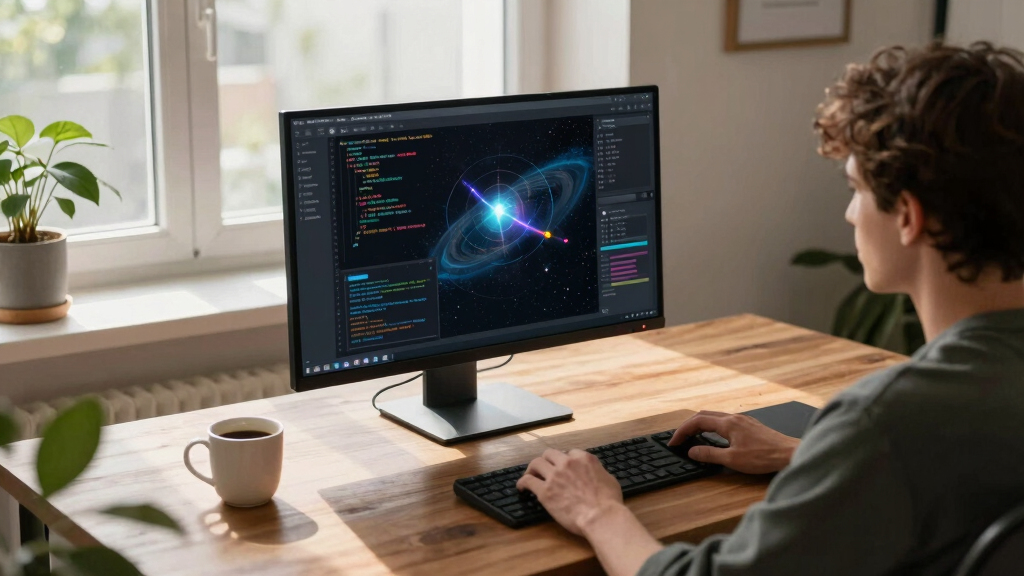
A developer has built a space economy simulation that runs autonomously, using Rust and Bevy. It features hundreds of ships operating without scripting, demonstrating a new approach to simulation design.
A developer has introduced a self-running space economy simulation built with Rust and Bevy. This simulation features hundreds of autonomous ships operating without scripted behaviors, highlighting a novel approach to creating persistent, dynamic virtual economies.
The project was shared on Show HN by the creator, who explained that the simulation is designed to run entirely autonomously, with each ship managing its own behaviors and interactions. The developer, who collaborated with Claude, expressed a personal interest in tinkering with economic models and space themes, leading to the creation of this simulation.
The simulation employs Rust, a systems programming language known for safety and performance, alongside Bevy, an open-source game engine built in Rust. The setup allows for complex interactions among hundreds of ships, which operate without pre-scripted commands, instead relying on emergent behaviors driven by underlying rules and AI-like decision-making processes.
While the project is still in development, the creator emphasized its potential as a sandbox for experimenting with autonomous systems and economic dynamics in a space setting. The simulation is designed to be extensible, with plans to add more features such as resource management, trading, and environmental factors.
Implications for Autonomous Simulation and Space Modeling
This project demonstrates a new approach to creating self-sustaining virtual economies using autonomous agents, which could influence future simulation and game development. It showcases how modern programming tools like Rust and Bevy can support complex, persistent systems without relying on scripted behaviors, potentially reducing development overhead and increasing realism.
For the broader tech and gaming communities, this approach offers a pathway toward more dynamic, emergent systems in virtual environments, with applications ranging from gaming to research in economics and AI.
As an affiliate, we earn on qualifying purchases.
Background on Autonomous Simulations and Rust-Based Development
Recent years have seen increased interest in autonomous systems within simulation and gaming, driven by advancements in AI and system design. Rust has gained popularity for its safety and performance, making it suitable for complex simulations. Bevy, as an open-source game engine, provides a flexible platform for building such systems in Rust.
This project builds on these trends, combining Rust and Bevy to develop a simulation that operates without scripting, relying instead on emergent behaviors of autonomous agents. Previously, most space or economic sims depended heavily on scripting or predefined scenarios, making this project a notable departure.
“I built this with Claude because I always wanted to tinker with a simulation economy and I love space themes.”
— the developer
As an affiliate, we earn on qualifying purchases.
Unconfirmed Aspects of the Simulation’s Capabilities
It is not yet clear how the simulation handles complex scenarios such as resource scarcity, trading dynamics, or environmental changes. The developer has not disclosed detailed technical specifications or the full scope of features planned for future updates.
Additionally, the performance and scalability of the simulation under larger numbers of agents remain untested publicly, and whether it can support extended, long-term runs is still uncertain.
As an affiliate, we earn on qualifying purchases.
Upcoming Developments and Potential Features
The developer plans to expand the simulation by adding features such as resource management, trading systems, and environmental factors. Further testing will determine how well the autonomous behaviors scale and how realistic the emergent economic dynamics become.
Future milestones include releasing a more polished version, possibly with user controls or visualization tools, and exploring applications in research or educational contexts.
As an affiliate, we earn on qualifying purchases.
Key Questions
What programming languages and tools are used in this simulation?
The simulation is built using Rust for its core logic and Bevy as the game engine framework, both of which support high performance and safety.
Can this simulation be used for real-world economic modeling?
Currently, it is a prototype primarily for experimentation and demonstration. Its applicability to real-world economics would require further development and validation.
Is the simulation open source or available for public use?
The project was shared on Show HN, indicating it is likely accessible for review or contribution, but specific licensing or access details have not been confirmed.
What are the main technical challenges faced in creating autonomous agents in this context?
Designing agents that can operate independently, make decisions, and interact realistically without scripting is complex, especially ensuring performance and emergent behavior consistency.
Source: hn
Evergreen bestsellers Picks
bestsellers
As an affiliate, we earn on qualifying purchases.