
If you’re gaming on a 60Hz monitor, upgrading to 144Hz can noticeably improve your experience with smoother motion and better responsiveness, especially in fast-paced titles. Your eyes might detect the difference during quick actions or high-speed scenes, but perception varies based on lighting, game type, and personal sensitivity. While some may feel an immediate benefit, others might need more technical context to understand why it matters—if you’re curious, you’ll find out more below.
Key Takeaways
- Higher refresh rates like 144Hz produce smoother motion, especially noticeable during fast-paced gaming scenes.
- Visual perception of differences depends on individual sensitivity, gaming speed, and environmental conditions.
- Many players notice improved responsiveness and reduced motion blur with 144Hz compared to 60Hz.
- Under optimal conditions, the human eye can distinguish some improvements, but perception varies among individuals.
- Factors such as display quality, game type, and lighting influence how clearly you can perceive the difference.
Top picks for "144hz 60hz monitor"
Open Amazon search results for this keyword.
As an affiliate, we earn on qualifying purchases.
Understanding Refresh Rates and How They Work

Understanding refresh rates is key to grasping how monitors display motion. Your monitor’s refresh rate determines how many times per second it updates with new information, directly impacting smoothness. At higher refresh rates like 144Hz, you’ll notice more fluid motion compared to 60Hz, which can make gaming feel more responsive. However, other factors also matter, such as color accuracy and screen resolution. A higher screen resolution enhances detail, but it can put more strain on your GPU to maintain high refresh rates. Good color accuracy guarantees your images look vibrant and true to life, regardless of refresh rate. Additionally, understanding refresh rate compatibility can help you optimize your gaming setup for the best performance. Furthermore, selecting a monitor with appropriate contrast ratio can greatly improve the perceived sharpness and clarity during intense gaming moments. Being aware of adaptive sync technology can also help reduce screen tearing and provide a smoother gaming experience.
The Visual Experience: Comparing 60Hz and 144Hz Displays
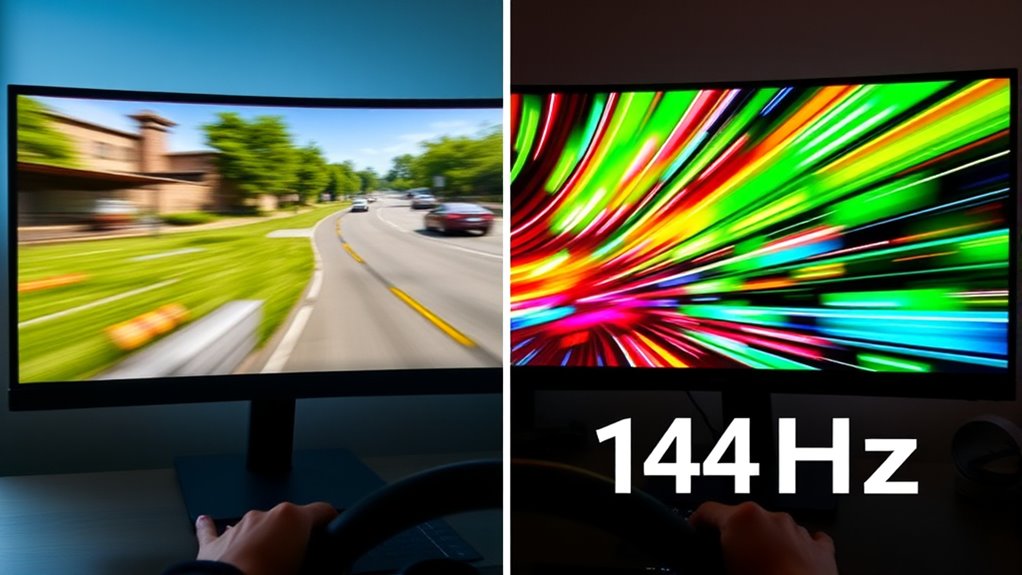
The visual clarity also improves, making details sharper and more defined. Additionally, a higher refresh rate can reduce eye strain, helping you stay comfortable during extended use. Proper monitor setup can further enhance your gaming experience and minimize fatigue, especially when considering factors like brightness, contrast, and ergonomic positioning. Ensuring your monitor has the right refresh rate settings can optimize these benefits and provide a smoother visual experience. Incorporating sound therapy elements into your environment may also contribute to overall comfort and focus during gaming sessions. Being mindful of visual ergonomics can further support eye health and prolonged comfort.
Motion Smoothness Enhancement
Higher refresh rates substantially enhance motion smoothness, making fast-paced scenes appear more fluid and realistic. With a 144Hz monitor, you’ll notice less motion blur and smoother shifts, reducing flicker perception that can cause eye strain. This improvement allows your eyes to track moving objects more comfortably. Here’s how it helps:
- Reduced motion blur, resulting in clearer fast movements.
- Smoother gameplay with less stuttering.
- Minimized flicker perception, easing eye fatigue.
- Faster response time, making quick reactions more precise.
- Display technology advancements contribute to smoother visuals and can impact overall viewing comfort. Additionally, higher refresh rates can better accommodate adaptive sync technologies like G-Sync and FreeSync, which further improve motion clarity and reduce tearing. These technologies leverage refresh rate synchronization to align the monitor’s refresh rate with the GPU output, providing even more seamless motion. Furthermore, the evolution of monitor panel types plays a role in achieving these smoother visuals.
Visual Clarity Differences
While a higher refresh rate like 144Hz doesn’t automatically guarantee sharper images, it considerably enhances visual clarity during fast movements. The increased refresh rate reduces motion blur, making fast-paced scenes appear crisper and more detailed. Although resolution and pixel quality primarily influence sharpness, the display’s color accuracy and contrast ratios also play crucial roles in overall clarity. A monitor with better color accuracy reproduces images more vividly and true to life, while higher contrast ratios improve the differentiation between light and dark areas. With a 144Hz display, you’ll notice smoother visual shifts and more precise details, especially in rapid motion scenes. This improved clarity can help you pick out subtle elements, giving you a clearer, more immersive gaming experience. Additionally, understanding how visual clarity impacts your overall experience is essential for maximizing your gaming setup. For example, motion handling is a key factor that influences how smooth and natural fast movements appear on the screen. Improving display technology can further enhance the sharpness and clarity of fast-paced scenes, making gameplay more enjoyable.
Eye Strain Impact
Enhanced visual clarity at 144Hz can make fast-moving images appear smoother, but it also impacts how your eyes experience prolonged screen time. Higher refresh rates reduce flickering and motion blur, which can lessen eye strain. However, if the monitor’s color accuracy isn’t optimized or the ergonomic design isn’t comfortable, you may still experience fatigue. To minimize eye strain, consider these factors:
- Use a monitor with good color accuracy to reduce eye fatigue during long sessions.
- Adjust the refresh rate to match your activity for comfort.
- Incorporate ergonomic design features like adjustable height and anti-glare screens.
- Take regular breaks to prevent strain from continuous screen exposure.
Both refresh rate and monitor quality influence your visual comfort, making mindful choices essential.
How Refresh Rate Impacts Gaming Performance
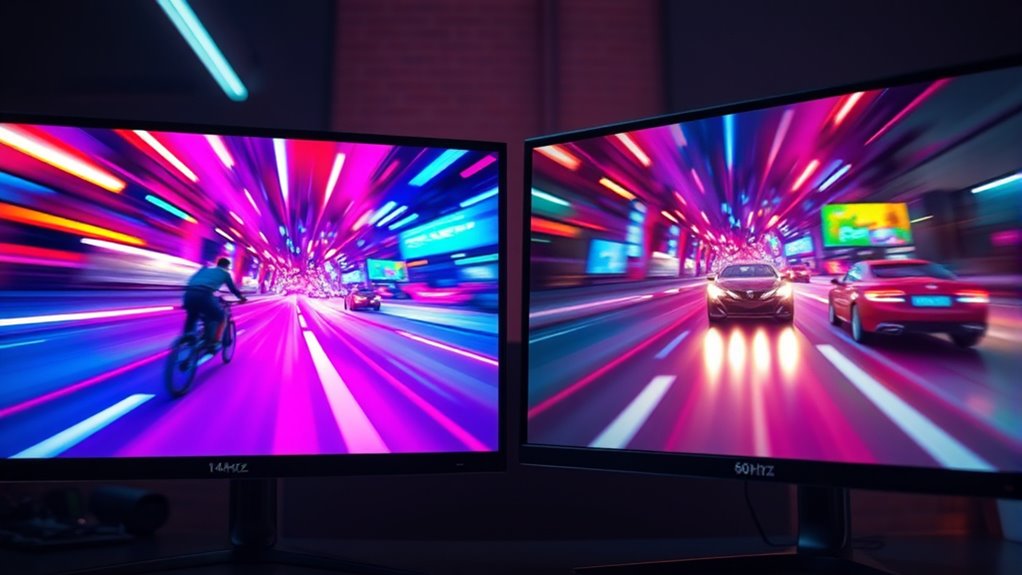
The refresh rate of your monitor directly affects how smoothly your game feels and how well you can react to in-game actions. Higher refresh rates, like 144Hz, use advanced refresh rate technology to deliver more frames per second, resulting in smoother motion and quicker response times. This advanced technology can give you a competitive edge, especially in fast-paced games, by reducing motion blur and input lag. Additionally, a higher refresh rate can improve color accuracy in motion, making visuals more vibrant and precise during gameplay. Moreover, the increased frames per second provided by higher refresh rates can reduce eye strain during extended gaming sessions. The refresh rate also influences the visual clarity of fast-moving objects, enabling players to see more detail during rapid movements. Conversely, a lower refresh rate like 60Hz may produce choppier visuals, making fast movements harder to follow. Overall, refresh rate impacts your gaming performance by enhancing fluidity, responsiveness, and visual clarity, helping you perform better and enjoy a more immersive experience.
Can the Human Eye Detect the Difference?
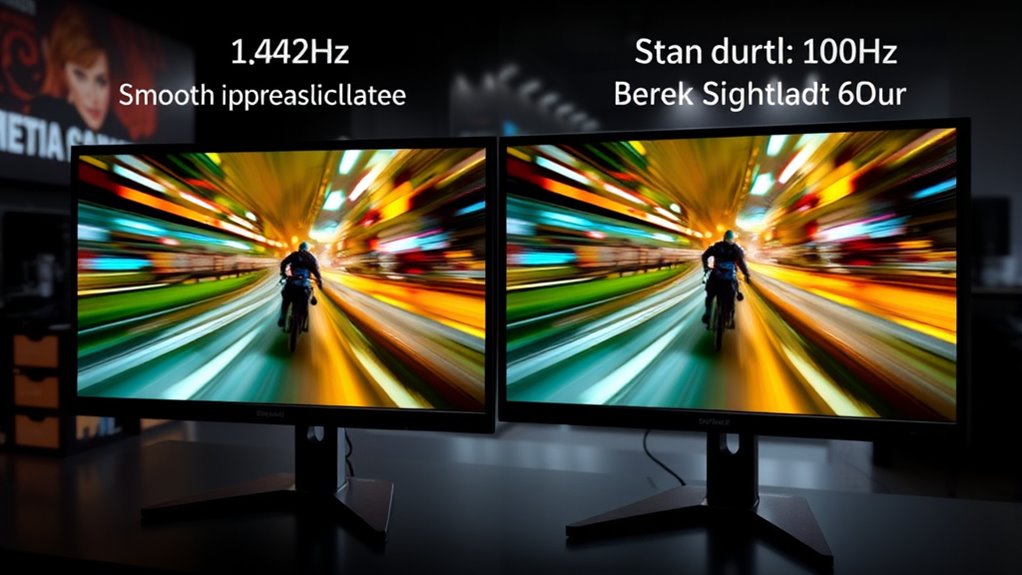
You might wonder if your eyes can really notice the difference between 144Hz and 60Hz screens. Your visual resolution and how you perceive motion play big roles in this. Keep in mind, there are limits to what the human eye can detect, affecting how much of a difference you actually see. Additionally, factors like refresh rate perception can be influenced by the type of content and the viewer’s sensitivity to motion. The ability to discern these differences can also be affected by visual acuity and the specific conditions under which you are viewing the monitor. Moreover, understanding how peripheral vision processes rapid movements can help explain why some users perceive a difference in refresh rates more readily than others. Recognizing the role of perception thresholds can further clarify how subtle changes in refresh rates may or may not be perceived by individuals. Research into visual processing indicates that individual differences can significantly impact the detection of these visual changes.
Eye’s Visual Resolution
While the human eye has remarkable capabilities, it doesn’t perceive every detail in high-refresh-rate displays equally. Your visual acuity limits how much detail you can discern, especially at higher resolutions. This impacts how you experience different monitor refresh rates. Specifically:
- Your eye’s ability to detect fine details diminishes with distance and lighting.
- High refresh rates can reduce eye fatigue by providing smoother motion.
- Visual resolution depends on both the display’s pixels and your eye’s acuity.
- Beyond a certain point, increasing refresh rates offers diminishing perceptible benefits.
- Understanding how visual perception functions helps clarify why higher refresh rates may not always seem necessary.
In essence, your eye’s resolution is finite, and while higher refresh rates improve smoothness, they don’t necessarily translate to perceiving more detail. This balance influences how you perceive differences between 60Hz and 144Hz monitors.
Perception of Motion
Can the human eye truly distinguish the rapid motion displayed on high-refresh-rate monitors? Your perception of motion depends on eye movement sensitivity and how smoothly your brain interprets rapid changes. With higher refresh rates, like 144Hz, motion appears more fluid and less blurry, reducing motion blur that can hinder fast-paced gameplay. While your eyes continually move and scan, they may not always notice the difference in speed at a casual glance. However, in quick, precise movements, the improved perception of motion becomes noticeable, especially during fast actions or rapid camera shifts. Your eyes are more sensitive to motion than static images, but whether you consciously detect the difference depends on your focus, response time, and the intensity of the scene.
Limitations in Detection
Although higher refresh rates like 144Hz produce smoother motion, the human eye has limitations in detecting these subtle differences. Your ability to perceive improvements depends on factors like color accuracy and screen brightness. For example:
- Your eyes may struggle to notice differences in refresh rates under poor lighting conditions.
- Variations in color accuracy can mask the perceived smoothness or sharpness of motion.
- Screen brightness levels influence how well you can discern fast movements.
- Fatigue and individual eyesight quality can further limit your detection capabilities.
- The refresh rate itself is a technical specification that may not be fully perceivable without ideal viewing conditions.
These factors mean that even with advanced monitors, your visual perception might not fully capture all technical enhancements, especially if environmental conditions aren’t ideal.
The Role of Frame Rate in Perceived Smoothness
Frame rate plays a crucial role in how smooth your gaming experience feels. Higher frame rates, like 144Hz, deliver more images per second, making motion appear fluid and reducing motion blur. This increased smoothness helps you track fast-moving objects more accurately, giving you a competitive edge. While frame rate primarily affects perceived smoothness, it can also influence color accuracy, as modern high-refresh-rate monitors often support better display technologies. However, higher frame rates typically increase power consumption, which can impact your device’s efficiency and longevity. Conversely, 60Hz monitors may not provide the same level of fluidity but consume less power. Ultimately, a higher frame rate enhances your gaming experience by making motion feel seamless and responsive.
Situations Where Higher Refresh Rates Make a Difference
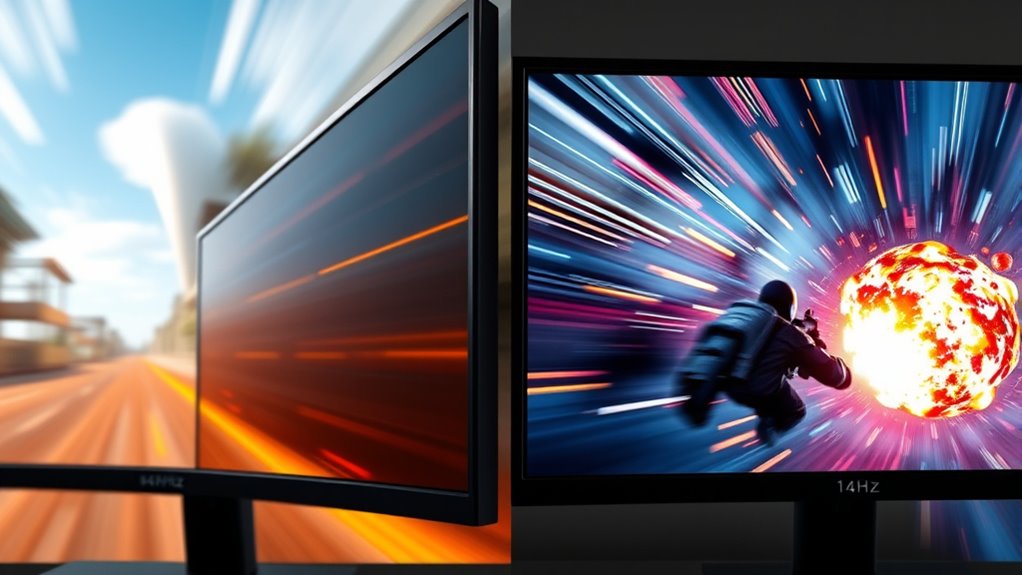
Higher refresh rates make a significant difference in fast-paced gaming scenarios where quick reactions are essential. When your visual acuity is tested in rapid movements, a 144Hz monitor provides smoother motion, reducing motion blur. This helps you track fast-moving objects more accurately, giving you a competitive edge. Additionally, higher refresh rates can enhance color accuracy during quick scenes, making visuals appear more fluid and detailed. Consider these situations:
- Fast reflex shooter games where split-second decisions matter.
- Racing games involving rapid camera changes.
- Action-packed eSports tournaments demanding precision.
- Competitive multiplayer matches where every millisecond counts.
In these cases, a higher refresh rate improves your overall perception, making quick, accurate responses easier and more natural, especially in scenarios relying on visual acuity and color accuracy. Understanding your monitor’s refresh rate capabilities can help you optimize your gaming setup for these demanding scenarios.
Limitations of Human Vision in Differentiating Frame Rates
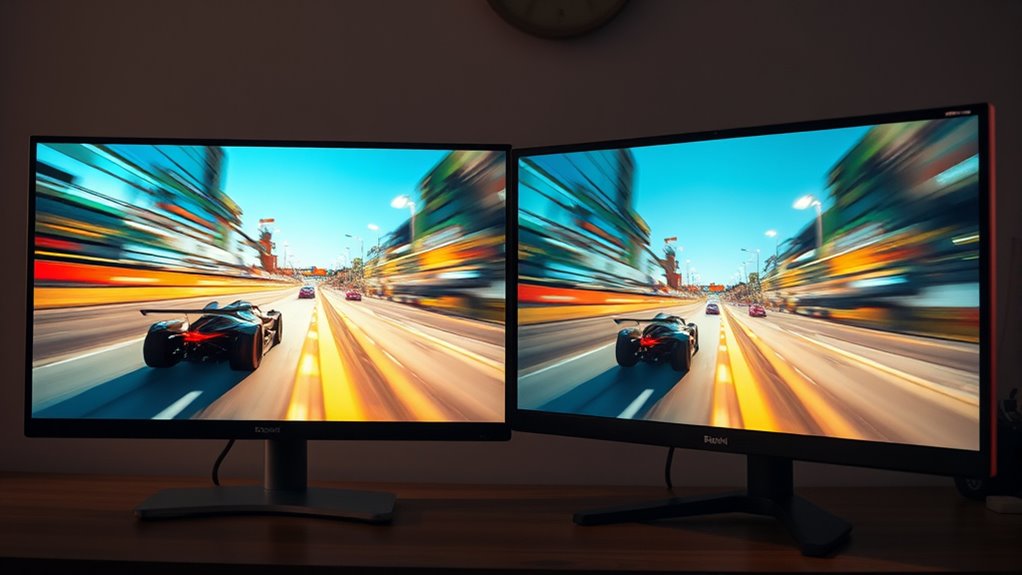
While higher refresh rates can deliver smoother visuals, human eyes have inherent limits in perceiving these differences. Your vision processes images based on factors like color accuracy and contrast ratio, which influence how clearly you see motion. Even with a 144Hz monitor, your eyes may struggle to distinguish all the subtle frame shifts, especially if lighting conditions or display quality are poor. Additionally, the brain filters visual information, making it difficult to notice small improvements in refresh rate beyond a certain point. As a result, your ability to perceive enhanced smoothness diminishes, and other display qualities like color accuracy and contrast ratio become more noticeable. This means that, despite technological advancements, human vision can only perceive a certain level of difference in frame rates.
Hardware and Software Factors Affecting Perception
Your perception of smoothness depends not just on the monitor’s refresh rate but also on hardware and software factors. Frame rate synchronization and display refresh rates directly influence how seamless your visual experience feels. Additionally, your brain’s visual processing limits can affect how well you notice differences in frame rates.
Display Refresh Rate Impact
The way your eyes perceive motion on a monitor is considerably influenced by both hardware and software factors that affect the display’s refresh rate. Higher refresh rates, like 144Hz, deliver smoother motion, reducing flicker and motion blur, which enhances the perception of fluid gameplay. Additionally, display quality impacts this perception:
- Color accuracy – Better color reproduction makes fast-moving scenes more distinct.
- Contrast ratio – Higher contrast enhances clarity, especially during rapid action.
- Response time – Faster response times minimize ghosting, sharpening moving objects.
- Image processing – Advanced software optimizations improve perceived smoothness and detail.
All these factors together determine how well your monitor conveys motion, making refresh rate a crucial element in visual clarity and gaming experience.
Frame Rate Synchronization
Frame rate synchronization plays a pivotal role in how smooth and responsive your visuals appear, directly impacting your gaming and viewing experience. When hardware and software work together to sync frame rates, motion feels more natural, and input lag reduces. Misalignment can cause tearing, stuttering, or ghosting, diminishing image quality and color accuracy. To visualize this, consider the following:
| Frame Rate | Sync Method | Experience |
|---|---|---|
| Inconsistent | V-Sync Off | Choppy, tearing |
| Matched | Adaptive Sync | Seamless, smooth |
| Overmatched | G-Sync/FreeSync | Fluid, precise |
An ergonomic design complements synchronization by reducing eye strain, while high refresh rates maximize clarity. Together, these factors craft a more immersive, comfortable gaming environment.
Visual Processing Limitations
While higher refresh rates can deliver smoother visuals, hardware and software limitations often influence how well your brain perceives these enhancements. Your visual acuity and color perception play vital roles in this process. Factors affecting perception include:
- Display quality: Poor resolution or color accuracy can mask smoothness benefits.
- Graphics processing: Limited GPU power may cause input lag or frame drops, reducing perceived fluidity.
- Software optimization: Games that aren’t optimized for high refresh rates can hinder your ability to notice differences.
- Neural processing: Your brain’s ability to process rapid visual changes varies, affecting how much you perceive improvements in refresh rate.
These limitations mean that even if your monitor offers higher refresh rates, your perception depends on hardware, software, and your own visual processing capabilities.
Cost vs. Benefit: Is Upgrading to 144Hz Worth It?
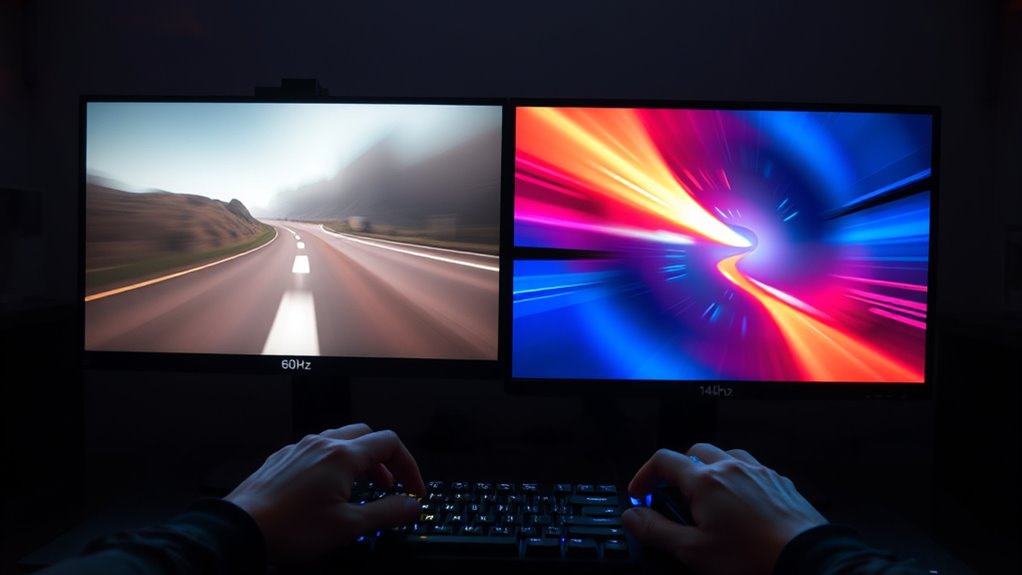
Upgrading to a 144Hz monitor involves a financial investment, but it can also deliver noticeable benefits in your gaming and daily tasks. The higher refresh rate reduces visual fatigue by providing smoother motion, which minimizes eye strain during long gaming sessions. It also enhances gaming immersion, making fast-paced action feel more fluid and responsive. If you’re serious about competitive gaming or want a more engaging experience, the upgrade can be well worth the cost. However, consider whether your hardware can support 144Hz effectively, and if your typical use justifies the expense. For casual gamers, the difference might not be as impactful, but for those seeking sharper visuals and less eye discomfort, the benefit often outweighs the price.
Tips for Choosing the Right Monitor Based on Your Gaming Needs
Choosing the right monitor depends heavily on your specific gaming needs and preferences. To find the best fit, consider these key factors:
- Color accuracy: If you prioritize immersive visuals or editing, opt for a monitor with high color accuracy.
- Refresh rate: Gamers seeking smooth gameplay should consider higher refresh rates like 144Hz.
- Ergonomic design: Comfort matters; choose a monitor with adjustable height, tilt, and swivel features.
- Screen size and resolution: Match these to your gaming space and the types of games you play for ideal experience.
Frequently Asked Questions
Do Esports Professionals Prefer 144HZ Over 60HZ Monitors?
Yes, esports professionals prefer 144Hz monitors over 60Hz because they benefit from better monitor technology, which provides smoother gameplay and quicker reactions. As a competitive gamer, you’ll notice the difference in responsiveness, especially during fast-paced matches. Higher refresh rates give you a competitive edge, making 144Hz monitors the standard in professional gaming. This preference highlights how monitor technology plays an essential role in optimizing your gaming performance.
How Does Motion Blur Differ Between 60HZ and 144HZ Screens?
Imagine you’re playing a fast-paced shooter, and at 60Hz, you notice ghosting effects, where motion appears blurry or trails behind. Switching to a 144Hz monitor considerably improves motion clarity, reducing ghosting effects and making fast movements smoother. This higher refresh rate minimizes motion blur, so your eyes can track moving objects more easily, giving you a competitive edge and a more immersive gaming experience.
Can a Higher Refresh Rate Reduce Eye Strain During Long Gaming Sessions?
A higher refresh rate can help reduce eye strain during long gaming sessions by providing smoother motion, which lessens eye fatigue. Additionally, many high-refresh-rate monitors come with blue light filters, further easing your eyes. By minimizing flicker and sharp motion changes, a 144Hz monitor makes gaming more comfortable, especially over extended periods. This combination helps protect your eyes from fatigue and discomfort, keeping you focused longer.
Are There Specific Game Genres That Benefit More From Higher Refresh Rates?
If you’re into fast-paced genres like first-person shooters, racing, or fighting games, you’ll notice a significant boost in refresh rate perception, which enhances your gaming experience. Higher refresh rates make movements smoother and reactions quicker, giving you an edge. For slower-paced or turn-based games, the difference isn’t as noticeable. So, choose a higher refresh rate monitor if you want sharper visuals and a more immersive, responsive gaming experience.
Does Screen Size Influence the Perceptibility of Refresh Rate Differences?
Think of screen size like a window; the bigger it is, the more you notice differences. Larger screens enhance your visual perception, making refresh rate differences more noticeable and improving screen clarity. On smaller screens, the impact is subtler, and you might not perceive the refresh rate change as easily. So, if you want sharper, smoother visuals, bigger monitors let you see the benefits more clearly.
Conclusion
If you’re wondering whether upgrading to a 144Hz monitor is worth it, consider this: gamers report a 37% improvement in perceived smoothness with higher refresh rates. While your eyes might not notice every detail, faster screens can give you a competitive edge and a more immersive experience. So, if gaming is your passion, investing in a 144Hz display could make a real difference—you’re more likely to see and feel the difference than you might think.