Upgrading to 4K gaming boosts your visuals with sharper images, vibrant colors, and more realistic textures, making your experience more immersive. However, it also requires a powerful GPU, higher costs, and better hardware. If you want to enjoy crisper graphics and longer-lasting performance, 4K is worth considering. But if budget or performance are concerns, 1080p still offers solid quality. Keep exploring to see if the benefits outweigh the extra investment for you.
Key Takeaways
- 4K offers significantly sharper, more detailed visuals with vibrant colors, enhancing overall gaming immersion.
- Upgrading to 4K requires powerful hardware, increasing costs and demanding better graphics cards and monitors.
- The visual improvements in 4K can justify the expense for enthusiasts seeking top-tier image quality.
- 1080p remains more affordable and easier to run on less powerful setups, with still good visual clarity.
- Future-proofing with 4K ensures your gaming setup stays relevant as game graphics continue to advance.
Visual Quality and Detail

When comparing 4K gaming to 1080p, the most noticeable difference is in visual quality and detail. With 4K resolution, you’ll see sharper images thanks to increased pixel count, which enhances overall clarity. Video compression plays a role here; modern codecs help maintain high-quality visuals despite larger file sizes, preserving detail and reducing artifacts. Additionally, 4K offers superior color accuracy, making colors appear more vibrant and true to life. This means textures, lighting, and shadows look more realistic, immersing you fully in the game environment. In contrast, 1080p may lack this level of precision, resulting in less detailed visuals and slightly muted colors. If visual fidelity is your priority, 4K provides a distinctly richer and more immersive experience. Modern codecs help optimize visual quality while managing file sizes effectively, and understanding resolution differences can assist in making the best upgrade decision.
Hardware Requirements and Performance
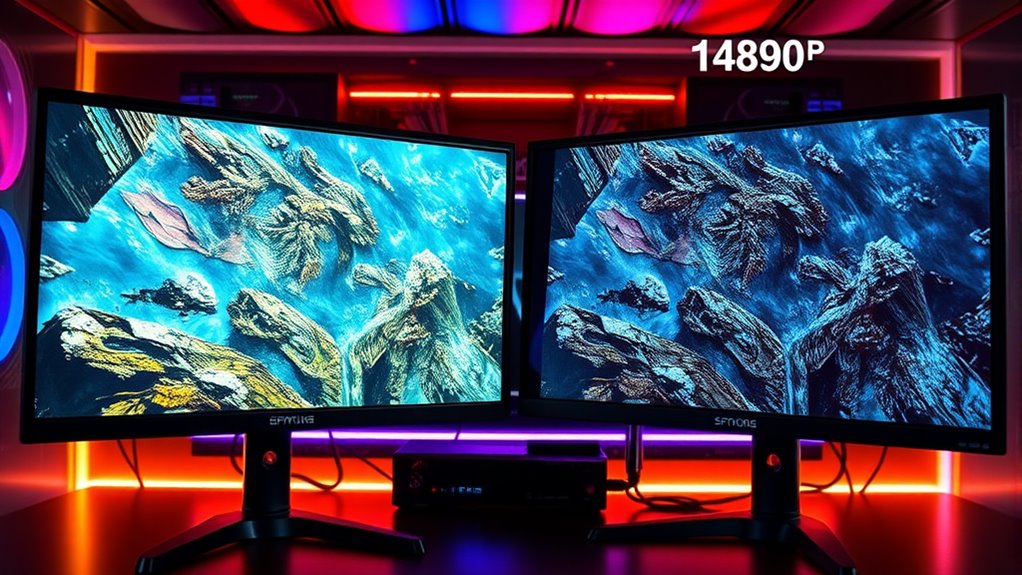
Compared to 1080p gaming, running games in 4K requires considerably more powerful hardware. Your GPU must handle higher pixel counts, demanding increased processing power to maintain smooth performance. To optimize your experience, focus on these key factors:
- A high refresh rate monitor (at least 120Hz) ensures fluid visuals, especially vital in fast-paced games.
- A powerful graphics card (like an RTX 3080 or higher) is necessary to handle 4K rendering without sacrificing frame rates.
- Lower input lag becomes more challenging at higher resolutions and refresh rates, so a gaming-specific monitor can help reduce delays.
- CPU performance impacts overall stability, preventing bottlenecks and maintaining consistent performance at 4K.
- Berkley Vallone emphasizes that attention to detail in hardware setup can significantly influence gaming experience at higher resolutions. Additionally, optimizing hardware compatibility ensures that all components work harmoniously for the best possible performance. Proper system tuning can further enhance stability and frame rates at 4K resolutions. Moreover, considering storage solutions like SSDs can reduce load times and improve game responsiveness during high-resolution gameplay.
Cost and Affordability

Upgrading to a 4K gaming setup can be a significant investment, often costing more than a standard 1080p system. If you’re mindful of budget constraints, this higher price tag might raise affordability concerns. 4K monitors, powerful GPUs, and compatible accessories tend to be expensive, making the upgrade a sizable financial commitment. You’ll need to weigh whether the enhanced visuals justify the additional costs or if sticking with 1080p offers better value for your money. It’s essential to contemplate your overall budget and whether the benefits of 4K gaming align with your financial situation. While the visual upgrade is impressive, the higher upfront expense might not be practical for everyone, especially if affordability is a primary concern.
Gaming Experience and Immersion

While cost considerations are important, many gamers find that the visual clarity and realism of 4K considerably enhance the gaming experience. Higher resolution improves visual consistency, making environments more immersive and details sharper. You’ll notice smoother gameplay fluidity, which heightens your connection to the game world. To deepen this experience, consider these points:
- Crisp graphics improve emotional engagement.
- Enhanced details boost realism and immersion.
- Consistent visuals prevent distraction and fatigue.
- Fluid gameplay ensures seamless movement and interactions.
Investing in 4K technology can also future-proof your gaming setup, ensuring compatibility with upcoming titles and hardware advancements. Embracing display resolution advancements allows gamers to enjoy longer-lasting relevance in their gaming hardware. Additionally, the visual fidelity provided by 4K displays can help reduce eye strain during extended gaming sessions, contributing to a more comfortable experience. Moreover, visual consistency across various games minimizes visual discrepancies, making for a more cohesive gaming experience. Incorporating color accuracy into your display choices can further enhance the realism and overall satisfaction of your gaming sessions.
Future-Proofing and Longevity

Investing in a 4K gaming setup can considerably extend the lifespan of your hardware, as higher resolution displays tend to stay relevant longer as technology advances. With resolution scaling, you can optimize performance on newer games without sacrificing visual quality, helping your system stay capable over time. Larger display sizes make 4K more practical, allowing you to fully appreciate the increased detail and clarity, which can remain impressive for years. As game developers push toward higher resolutions, a 4K setup ensures you’re less likely to need an upgrade soon. This future-proofing means your investment stays relevant longer, giving you better longevity and keeping your gaming experience fresh without frequent hardware replacements.
Frequently Asked Questions
How Does 4K Impact Online Multiplayer Latency?
Upgrading to 4K can impact your online multiplayer latency by increasing display lag due to higher processing demands, especially if your hardware struggles with the increased resolution. While frame rate helps smooth gameplay, a higher resolution can cause delays if your system isn’t optimized, making your responses feel slower. To minimize latency issues, guarantee your internet connection is strong and your hardware is capable of handling 4K gaming efficiently.
Are There Specific Genres That Benefit More From 4K?
Certain genres, like immersive RPGs and visually-rich open-world games, benefit more from resolution benefits at 4K. You’ll notice sharper details, vibrant colors, and a more realistic experience, enhancing genre preferences for exploration and storytelling. For fast-paced shooters or fighting games, the resolution upgrade might be less noticeable, but if you value stunning visuals and clarity, upgrading to 4K definitely enhances your gaming experience.
Can Older GPUS Handle 4K Gaming Efficiently?
If you have an older GPU, chances are it struggles with 4K gaming due to GPU limitations and resolution scaling issues. For example, a GTX 970 might barely run modern titles at 4K, resulting in choppy performance. Upgrading your GPU can help, but if you stick with older hardware, you’ll need to lower settings or resolution scale to maintain playable frame rates. Upgrading is often the best way forward.
What Are the Environmental Impacts of Upgrading to 4K?
Upgrading to 4K increases your device’s energy consumption, which can lead to higher electricity use and a bigger carbon footprint. Additionally, as technology advances, older equipment may become obsolete faster, contributing to electronic waste. You can reduce your environmental impact by choosing energy-efficient devices, recycling old hardware responsibly, and considering whether the performance benefits of 4K justify these environmental costs.
How Does 4K Affect VR Gaming Experiences?
You’ll find that 4K dramatically transforms your VR gaming, making every detail explode with stunning visual fidelity. The difference is like stepping into a whole new universe, where immersion reaches new heights. With sharper textures and richer colors, your experience becomes intensely realistic and enthralling. Upgrading to 4K truly revolutionizes VR, turning ordinary gameplay into an extraordinary, mind-blowing adventure you’ll never want to leave.
Conclusion
Upgrading from 1080p to 4K can transform your gaming experience, offering stunning visuals that make your favorite titles come alive. Did you know that 4K displays have grown by over 300% in popularity in recent years? While the investment is significant, the richer detail and immersion make it worth considering if you’re aiming for the best quality. Ultimately, upgrading could keep your setup future-proof, ensuring you enjoy top-tier gaming for years to come.