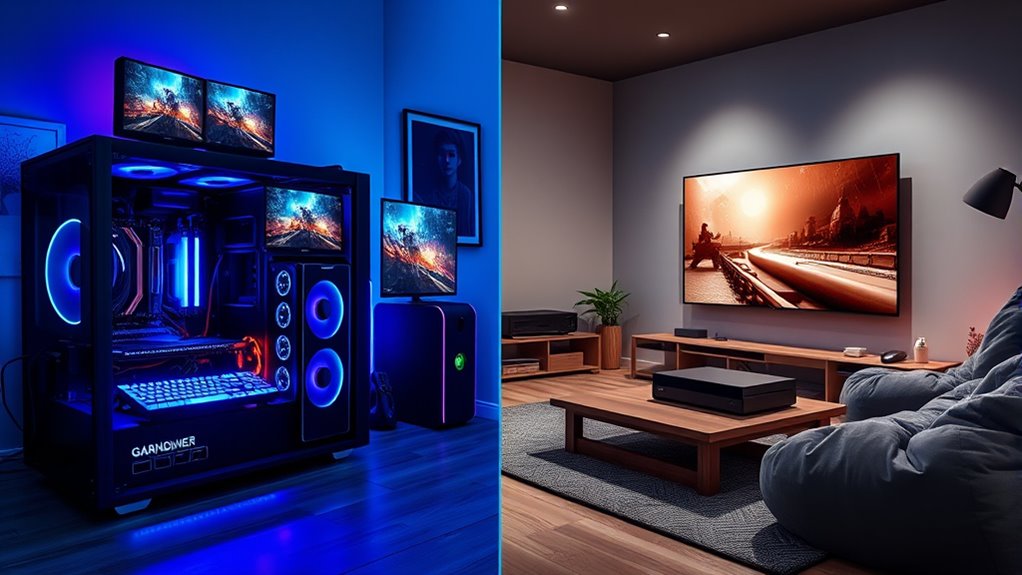

You’ll find that PC gaming offers flexibility through custom hardware, better graphics, and upgrades to extend your setup’s lifespan, but it can be complex and costly to maintain. Consoles, on the other hand, are easier to use, provide stable performance, and have exclusive titles, but your options for upgrades are limited. Both have their benefits and drawbacks—continue exploring to discover which suits your gaming style best.
Key Takeaways
- PC gaming offers extensive customization, higher graphics quality, and upgrade flexibility, but requires technical knowledge and maintenance.
- Console gaming provides a user-friendly experience with stable performance and exclusive titles, but limits hardware upgrades and personalization.
- Upgrading PC components extends system lifespan and improves performance, whereas consoles have fixed hardware capabilities.
- PC setups can be costly and complex to maintain, while consoles are more straightforward with minimal setup.
- Both platforms have unique benefits: PCs excel in performance and customization, while consoles prioritize simplicity and exclusive content.
Advantages and Disadvantages of PC Gaming
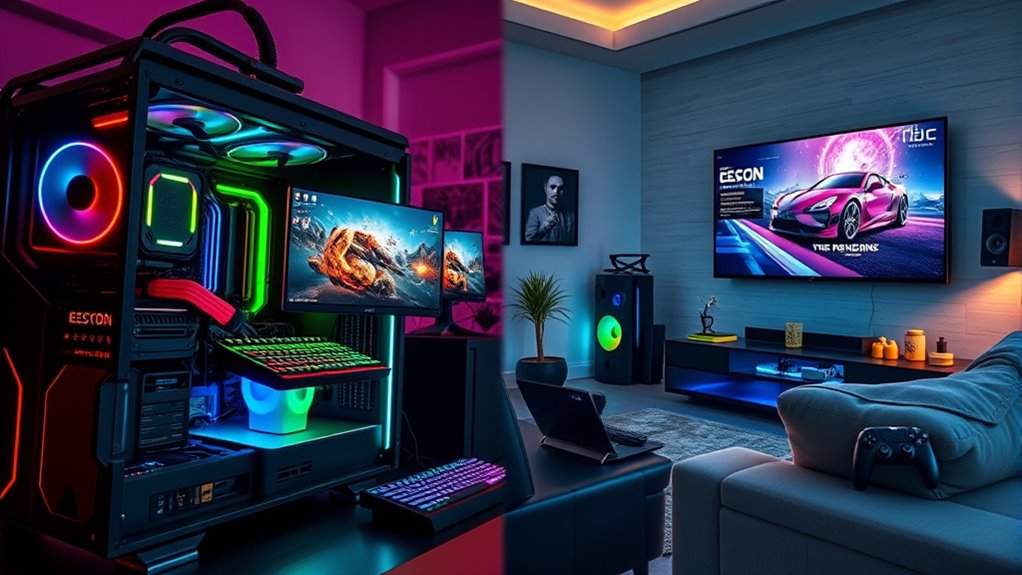
PC gaming offers significant advantages, such as customizable hardware that allows you to upgrade components for better performance and graphics. This upgrade flexibility implies you can enhance your system over time, keeping up with new game demands and improving visuals without buying a new rig. As a result, your games will look sharper, with higher graphics quality and smoother gameplay. You can choose specific parts like graphics cards, processors, or memory to tailor your setup to your preferences and budget. This adaptability ensures your gaming experience remains top-tier for years. Additionally, high refresh rates in PC monitors and projectors contribute to smoother gameplay, reducing motion blur and latency. Maintaining a well-functioning system requires some effort and knowledge, but it allows you to keep your hardware optimized for the best gaming experience, which might be a drawback if you prefer a more straightforward gaming solution. Furthermore, customizable hardware plays a crucial role in optimizing your gaming setup to meet evolving performance standards and personal preferences.
Benefits and Drawbacks of Console Gaming

Console gaming offers a straightforward and user-friendly experience, making it easy for you to jump right into your favorite games without worrying about hardware specs or complicated setups. One major benefit is access to exclusive titles you can’t find elsewhere, adding unique value to console platforms. Additionally, the controller comfort enhances your gaming sessions, reducing fatigue during long playtimes. Moreover, hardware limitations often mean that consoles are designed to prioritize performance stability over constant upgrades, which can be advantageous for consistent gameplay quality. However, there are some drawbacks:
- Limited hardware upgrades restrict future performance improvements.
- Games are often locked to specific consoles, reducing flexibility.
- The need for physical discs or downloads can take up storage space.
- Some players find the graphics less customizable than PC options.
- Safe and reliable power supply considerations are less of a concern with consoles designed for consistent performance.
Despite these drawbacks, the simplicity and dedicated features make console gaming appealing for many.
Frequently Asked Questions
How Do Upgrade Options Differ Between PC and Console Gaming?
You can customize hardware and upgrade more easily on a PC, allowing you to swap out components like graphics cards or RAM as needed. This means you’ll have a higher upgrade frequency, keeping your system current with new technology. Consoles, on the other hand, have fixed hardware, so upgrades are limited to software updates and occasional new models, offering less flexibility but potentially more straightforward maintenance.
Which Platform Offers Better Multiplayer Experiences?
You’ll find that consoles often provide better multiplayer experiences due to lower latency and more consistent performance, especially with exclusive servers. Cross-platform play enhances this, letting you join friends across systems. PCs can also offer excellent multiplayer experiences, but they might involve higher latency and more variability depending on your hardware and internet connection. Overall, consoles tend to deliver smoother, more reliable multiplayer sessions, especially with cross-platform options in popular games.
What Are the Typical Costs Associated With Each Gaming System?
You’ll find that the cost comparison varies considerably between PC and console gaming. With consoles, you usually pay a one-time purchase price, but maintenance expenses like repairs or upgrades are minimal. PC gaming often involves higher initial costs for a powerful setup, plus ongoing expenses for hardware upgrades and maintenance. Overall, consoles tend to be more budget-friendly upfront, while PCs might cost more long-term due to maintenance and upgrades.
How Do Game Libraries Compare Between PC and Consoles?
Imagine stepping into a vast, colorful jungle of games—you’ll find that PC game libraries boast incredible diversity, offering everything from indie gems to AAA titles. Consoles, on the other hand, shine with exclusive titles you can’t find anywhere else, like iconic franchises. You get a mix of both worlds: a rich variety on PC and unique exclusives on consoles, making your gaming adventure truly personalized.
Which Platform Offers More Future-Proof Gaming Experiences?
You’ll find that PCs generally offer more future-proof gaming experiences because of better hardware longevity and ongoing software updates. PCs can be upgraded over time, allowing you to keep up with new game demands, while consoles tend to have fixed hardware that becomes outdated quickly. With regular software updates, PCs can stay compatible with the latest games longer, giving you a more enduring gaming setup.
Conclusion
Ultimately, whether you choose PC or console gaming depends on your preferences and priorities. Both have their own pros and cons, so consider what matters most—be it graphics, affordability, or convenience. Remember, “The grass is always greener on the other side,” so weigh your options carefully. Whichever you pick, the key is to enjoy the game and make the most of your gaming experience. Happy gaming!