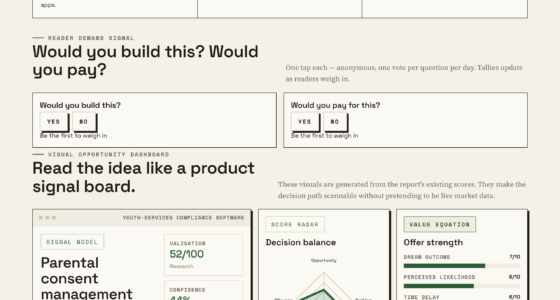

📊 Full opportunity report: The cleaner cap table. Why Anthropic’s public-benefit structure dodges OpenAI’s charitable-trust problem — and trades it for a governance question of its own. on ThorstenMeyerAI.com — validation score, market gap, and execution plan.

Get the latest gadgets delivered free with Prime
- Fast, free delivery on millions of items
- Prime Video, Amazon Music and more included
- Member-only deals all year
TL;DR
Anthropic’s structure, built as a Public Benefit Corporation with a Long-Term Benefit Trust, sidesteps OpenAI’s legal challenges over charitable trust conversion. However, it introduces different governance concerns that could impact its public market valuation. Both companies face unique governance-discount issues entering the IPO phase.
Anthropic’s corporate structure, designed from the outset as a Public Benefit Corporation with a Long-Term Benefit Trust, allows it to avoid the legal and regulatory issues faced by OpenAI regarding charitable trust conversion. This structural choice makes Anthropic a potentially cleaner candidate for public markets, but it introduces new governance challenges that could influence its valuation and investor perception.
Founded in April 2021 by former OpenAI researchers Dario and Daniela Amodei, Anthropic’s structure places a five-member, disinterested Trust at the core of its governance, with the authority to influence the company’s board and mandate a focus on safety and public benefit over shareholder returns. Unlike OpenAI, which converted a charitable trust into a for-profit entity, Anthropic was built from the start as a for-profit with a mission-oriented governance layer.
This layered governance design means Anthropic did not face the legal and regulatory scrutiny associated with trust-to-for-profit conversions, which was a central issue in OpenAI’s recent legal challenges. Instead, the key question for investors will be whether the mission trust could subordinate shareholder interests, potentially impacting valuation and market perception. The Trust’s independence and mandate to prioritize safety over profit create a governance discount, similar to the one that OpenAI’s conversion overhang imposes.
Market analysts note that while Anthropic’s structure avoids the conversion overhang, it introduces a different kind of governance discount. Investors will scrutinize whether the mission trust’s control could limit shareholder value, especially given the company’s significant funding from major investors like Google, Amazon, and a consortium led by Coatue and GIC.
The cleaner cap table.
Why Anthropic’s public-benefit
structure dodges OpenAI’s
charitable-trust problem —
and trades it for a governance
question of its own.
to convert · no charitable trust
board majority within ~4 years
$30B raise · GIC + Coatue led
breakeven 2027-28 vs 2030s
- Conversion history · nonprofit → capped-profit → PBC · $130B Foundation equity + control
- The litigation · Musk case dismissed on timing, on appeal · underlying theory unreached
- Regulatory overhang · AG settlement + oversight · IRS conversion review · future plaintiffs
- Microsoft entanglement · AGI clause · $38B revenue-share cap · 27% equity · access through 2032
- The Long-Term Benefit Trust · Class T voting · escalating board control · mission-balancing mandate
- Hyperscaler concentration · Google ~14% / $40B · Amazon $25B · much in credits · antitrust at IPO
- Compute dependency · AWS / GCP reliance · SpaceX 300MW / 220,000 GPUs · unit-economics proof
- Mission-vs-margin tension · ad-free pledge · Pentagon dispute cost a contract OpenAI won
The cleaner cap table is not the cleaner valuation. Anthropic dodged the exact problem that consumed three weeks of OpenAI’s litigation — by adopting a structure that introduces a governance question public markets have never priced at this scale. It is a different discount, not no discount.Thorsten Meyer · The Cleaner Cap Table · AI Governance 02
Implications of Mission-Driven Corporate Structures in AI IPOs
Anthropic’s structural design exemplifies a new approach to aligning AI safety and public benefit with corporate governance, potentially influencing how future AI companies structure their IPOs. While it avoids the legal pitfalls of trust conversions, the governance model raises questions about how mission-oriented control affects investor confidence, valuation, and regulatory treatment. The outcome of Anthropic’s IPO could set a precedent for mission-focused AI companies seeking public funding without sacrificing their core values.
As an affiliate, we earn on qualifying purchases.
Comparison of Governance Structures in Leading AI Labs
OpenAI’s legal challenge stemmed from its conversion of a charitable trust into a for-profit, raising questions about the legality and durability of such conversions under U.S. law. This legal uncertainty has cast a shadow over its upcoming IPO, with investors wary of potential regulatory or litigation risks. In contrast, Anthropic’s founding documents explicitly established a mission-focused governance structure from the beginning, avoiding the trust conversion issue altogether. However, this design introduces its own governance risks, particularly around the influence of the mission trust and its potential to subordinate shareholder interests.
Both companies are entering the public markets with governance models that depart from conventional profit-maximizing structures. This divergence reflects broader trends in AI development, emphasizing safety and mission alignment, but also complicates investor valuation and market acceptance.
“Anthropic’s layered governance structure offers a cleaner legal profile than OpenAI’s trust conversion, but it shifts the governance risk to the mission trust’s influence over shareholder value.”
— Thorsten Meyer
As an affiliate, we earn on qualifying purchases.
Unresolved Questions About Mission Trust Impact
It remains unclear how public investors will perceive Anthropic’s mission trust and whether its governance model will significantly impact its valuation compared to more conventional profit-driven companies. The long-term stability of the trust’s control and its influence on shareholder returns are still to be tested in the market environment.
As an affiliate, we earn on qualifying purchases.
Next Steps for Anthropic’s IPO and Market Evaluation
Anthropic is expected to file its S-1 in the coming months, after which underwriters and investors will scrutinize its governance structure and valuation prospects. The company’s ability to convince the market that its mission-oriented governance will not impair shareholder value will be critical. The outcome could influence how other mission-driven AI companies approach public offerings in the future.
As an affiliate, we earn on qualifying purchases.
Key Questions
How does Anthropic’s structure differ from OpenAI’s?
Anthropic was founded as a Public Benefit Corporation with a Long-Term Benefit Trust from the start, avoiding the trust-to-for-profit conversion that OpenAI undertook. Its governance centers on a disinterested Trust that influences board decisions to prioritize safety and public benefit.
Why does the mission trust matter for investors?
The mission trust’s control could subordinate shareholder interests, creating a governance discount. Investors will assess whether this structure limits potential returns or introduces risks that could affect valuation.
Will Anthropic’s structure lead to higher or lower valuation than OpenAI?
It is uncertain. While Anthropic’s structure avoids legal risks associated with trust conversions, its governance model might result in a valuation discount similar to or greater than OpenAI’s, depending on investor perception of mission control.
What are the regulatory implications of these structures?
Anthropic’s design may face less legal scrutiny than OpenAI’s trust conversion, but regulators and investors will still evaluate whether its governance adequately protects shareholder interests and aligns with public benefit goals.
Source: ThorstenMeyerAI.com
Halloween Picks
halloween
As an affiliate, we earn on qualifying purchases.