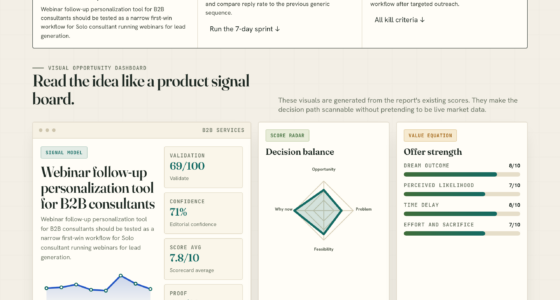
📊 Full opportunity report: Make Social Media Collaboration Easier With Task-Based Management on IdeaNavigator AI — validation score, market gap, and execution plan.

Get the latest gadgets delivered free with Prime
- Fast, free delivery on millions of items
- Prime Video, Amazon Music and more included
- Member-only deals all year
TL;DR

IdeaNavigator AI has outlined a product opportunity for a task-based social media workspace aimed at creator teams and small agencies coordinating work across clients. The proposal describes an unbuilt minimum viable product and recommends testing it with 10 agencies; no product launch or validation results are reported.
IdeaNavigator AI has proposed a task-based social media workspace for creator teams and small social agencies, outlining a product concept and a plan to test it with 10 agencies. The proposal is not an announcement of a launched service: it describes a potential workflow tool intended to bring post production, approvals and scheduling into one place.
The concept targets teams coordinating social content for multiple clients. IdeaNavigator AI says this work is naturally organized around tasks—such as shooting, editing, getting approval and scheduling—while social media tools tend to center on calendars and individual posts. Teams may then use a separate project-management tool alongside a scheduler, creating handoffs between systems.
The proposed minimum viable product would treat each post as a task moving through stages: brief, asset, edit, approval and scheduled. It would include client-facing approval links, asset versioning and scheduling that follows approval, creating a single pipeline from idea to publication. These are proposed features, not confirmed capabilities of an available product.
The suggested business model is a per-seat subscription, with pricing for client seats aimed at agencies. To test demand and performance, the proposal calls for migrating 10 agencies from their existing two-tool setups, then comparing missed publishing windows and approval turnaround with each agency’s baseline. No participating agencies, baseline figures or test outcomes are identified.
A Test for Agency Workflow Gaps
The proposal focuses on an operational problem rather than simply adding another content calendar: work can stall when briefs, assets, edits, approvals and scheduling are spread across tools. For a small agency handling several clients, a missed approval or unclear file version can disrupt a publishing plan. A shared post-level workflow could make responsibility and status easier to track if teams adopt it.
The suggested trial also gives the idea a measurable test. Comparing missed-window rates and approval turnaround before and after migration could show whether consolidating work improves coordination. However, the proposal reports no measurements, and a trial with 10 agencies would not by itself establish how well the approach works across the broader social media management market.
Products Worth Considering

Bose TV Speaker (2nd Gen) Compact Soundbar with Bluetooth and HDMI Connectivity

Logitech MX Keys S Wireless Keyboard, Graphite

Jackery Solar Generator 1000 V2 with 200W Solar Panel
As an affiliate, we earn on qualifying purchases.
Why Teams Use Separate Tools
Social media management products commonly support planning and scheduling posts, while general project-management tools handle assignments and collaboration. The proposal argues that teams often combine the two because the scheduling layer does not cover the full production process. That characterization is the rationale for the product concept, not an independent survey of the market.
IdeaNavigator AI frames the opportunity around rising content-velocity expectations and the needs of creators and small agencies managing work across clients. Its suggested response is to connect post production directly to publishing, rather than asking teams to maintain separate task and scheduling workflows. The proposal does not name a product, company, developer or release timeline.
Product Status and Test Results
No launch, pricing or customer results are provided. It is unclear whether a team is building the workspace, when a pilot might begin, or which agencies would take part. The proposed subscription and client-seat pricing are a business-model suggestion rather than announced rates.
The proposal also gives no baseline values for missed publishing windows or approval times, and it does not define how those measures would be calculated or over what period. Until a test is conducted and results are shared, the claim that a unified workflow could improve coordination remains an idea to validate.
The Proposed Agency Pilot
The next step set out in the proposal is to recruit 10 agencies, move them from their current two-tool workflows and compare operational measures with baseline performance. A useful account of that test would identify the participating teams, the duration, how missed windows and approval turnaround are measured, and whether results differ by agency.
IdeaNavigator AI has not announced a pilot schedule or confirmed that development is underway. The concept’s status, implementation and any later evidence of customer demand remain open.
Source: IdeaNavigator AI
Key Questions
Is the task-based social media workspace available now?
No availability is reported. IdeaNavigator AI describes a product concept and proposed minimum viable product, not a launched service.
Who is the proposed workspace for?
It is aimed at creator teams and small social agencies coordinating content across multiple clients.
What features would the minimum viable product include?
The proposal lists post tasks with brief, asset, edit, approval and scheduled stages, plus client-facing approval links, asset versioning and scheduling after approval.
How would the idea be tested?
The proposed test would migrate 10 agencies from two-tool setups and compare missed-window rates and approval turnaround against each agency’s baseline. No test results are available.
Has pricing been announced?
No. A per-seat subscription with client-seat pricing is suggested as a possible model, but no actual prices or commercial terms are provided.
Source: IdeaNavigator AI