

📊 Full opportunity report: Food Import Regulation Compliance: Focus On Pesticide Residues on IdeaNavigator AI — validation score, market gap, and execution plan.

Get the latest gadgets delivered free with Prime
- Fast, free delivery on millions of items
- Prime Video, Amazon Music and more included
- Member-only deals all year
TL;DR
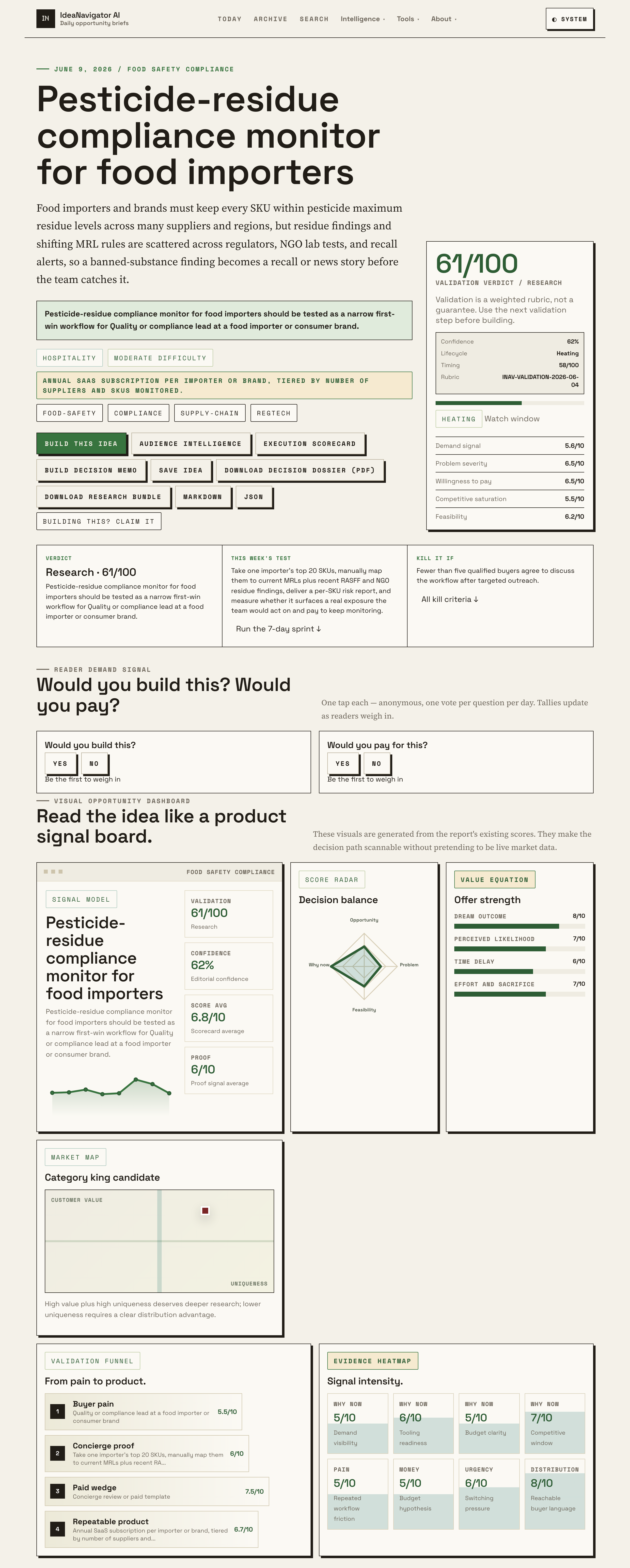
A new pesticide-residue compliance monitoring tool is being developed for food importers to better track pesticide levels in imported goods. It maps suppliers and SKUs to current MRLs and residue findings, aiming to prevent recalls and meet stricter regulations. This development addresses rising concerns over pesticide residues in staples like rice, tea, and spices.
A new compliance monitoring tool is being developed to help food importers track pesticide residues across their supply chains, aiming to reduce recalls and meet tightening regulatory standards. This solution addresses increasing pressure from regulators, NGOs, and retailers demanding documented residue compliance, especially in staples like rice, tea, and spices.
The proposed pesticide-residue compliance monitor will map a brand’s suppliers and SKUs against current EU and regional maximum residue levels (MRLs) and public residue findings, including RASFF alerts and NGO tests. It will flag products at risk of exceeding permissible limits and generate audit-ready reports for each SKU.
This tool is designed as an initial workflow for quality or compliance leads at food importing companies or consumer brands, aiming to streamline the identification of potential pesticide violations before they lead to recalls or negative publicity. The MVP involves manually mapping a sample of top SKUs to current MRLs and recent residue findings, then assessing whether the system can effectively surface real risks that warrant further action.
Why Pesticide Residue Monitoring Is Critical Now
As global markets tighten pesticide residue standards and NGOs increasingly test for banned substances, food importers face growing compliance challenges. Failure to monitor residues accurately can lead to costly recalls, brand damage, and loss of market access, especially in regions with strict regulations like the EU. Implementing a dedicated monitor can help companies proactively manage risks and demonstrate compliance, which is vital in maintaining consumer trust and regulatory approval.
As an affiliate, we earn on qualifying purchases.
Rising Regulatory and Market Pressures on Food Imports
Recent years have seen increased detection of EU-banned pesticides in staple foods such as rice, tea, and spices, prompting regulators and NGOs to intensify testing and enforcement. Retailers now demand detailed residue compliance documentation, and MRL rules are continually tightening across various markets. Currently, food importers rely on scattered sources—regulator alerts, NGO reports, and internal testing—to monitor pesticide levels, which can be inefficient and reactive rather than proactive.
This environment underscores the need for tools that can aggregate and analyze residue data across supply chains, enabling importers to identify risks early and avoid costly disruptions. The proposed compliance monitor aims to fill this gap by providing a centralized, real-time overview of pesticide residue risks per SKU.
“The development of a dedicated pesticide-residue monitor could significantly enhance importers’ ability to manage compliance proactively.”
— an anonymous researcher
food import pesticide residue monitor
As an affiliate, we earn on qualifying purchases.
As an affiliate, we earn on qualifying purchases.
Uncertainties About Implementation and Effectiveness
It is not yet clear how accurately the monitor will identify true residue risks or how easily it can be integrated into existing supply chain management systems. The effectiveness of the MVP will depend on the quality and timeliness of data mapping and the system’s ability to adapt to evolving MRL rules and residue findings. Further testing and validation are needed to confirm its practical benefits.
MRL compliance software for food importers
As an affiliate, we earn on qualifying purchases.
As an affiliate, we earn on qualifying purchases.
Next Steps for Development and Validation
The next phase involves testing the monitor with a sample of top SKUs from one or more importers, manually mapping them to current MRLs and recent residue alerts. Success will be measured by the system’s ability to surface genuine risks that require action. Based on initial results, developers will refine the tool and prepare for broader deployment, with potential subscription models targeting food importers and brands.
residue analysis laboratory testing
As an affiliate, we earn on qualifying purchases.
As an affiliate, we earn on qualifying purchases.
Key Questions
How will the compliance monitor improve food safety?
The monitor will help importers identify potential pesticide violations early, reducing the risk of recalls and ensuring products meet regulatory standards across markets.
What data sources will the monitor use?
It will incorporate EU and regional MRL databases, RASFF alerts, NGO residue testing reports, and internal supplier data to provide a comprehensive risk overview.
Will this system replace manual testing?
No, it is intended as a proactive risk management tool to complement existing testing regimes, not replace laboratory analysis.
When will the product be commercially available?
The development is ongoing, with initial testing expected to conclude within the next few months. Broader rollout could follow shortly after successful validation.
Who will benefit most from this compliance tool?
Quality and compliance leads at food importing companies and consumer brands seeking to streamline residue risk management and ensure regulatory adherence.
Source: IdeaNavigator AI
Fall Picks
fall essentials
As an affiliate, we earn on qualifying purchases.