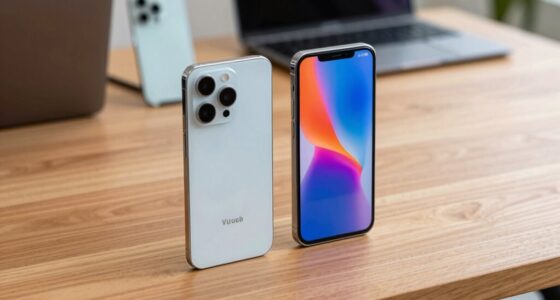
Your phone has multiple cameras to improve your photography experience. The main wide-angle lens captures sharp, vibrant images, while the ultra-wide lets you fit more into shot. The telephoto zooms in on distant objects, and the macro lens reveals tiny details up close. Night mode enhances low-light shots, and additional sensors improve depth and focus. Together, these lenses work seamlessly to give you professional-quality photos in any situation—if you want to explore each role further, keep going.
Key Takeaways
- Multiple lenses provide varied perspectives, such as wide, ultra-wide, and telephoto, enhancing overall image versatility.
- Each lens specializes in functions like macro for close-ups and night mode for low-light photography.
- Combining lenses allows for advanced features like zoom, depth sensing, and professional-quality portraits.
- Specialized lenses improve image quality by reducing distortions, glare, and aberrations during capture.
- Multiple cameras work together through calibration and software to deliver sharper, more detailed, and dynamic photos.
Top picks for "phone multiple camera"
Open Amazon search results for this keyword.
As an affiliate, we earn on qualifying purchases.
The Main Wide-Angle Lens
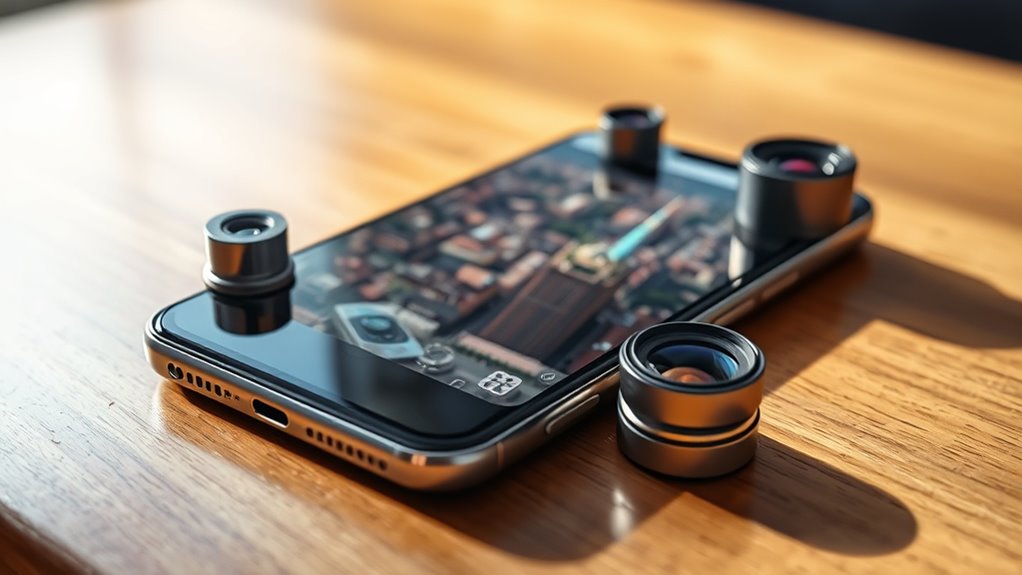
The main wide-angle lens is the most versatile and commonly used camera on your phone. Its lens durability is essential because it withstands daily wear and tear, guaranteeing consistent performance over time. This durability depends on the manufacturing complexity, which involves precise engineering to create a robust, high-quality lens that resists scratches and impacts. Manufacturers prioritize balancing durability with optical clarity, making sure the lens captures sharp images while remaining resilient. The manufacturing process for this lens is intricate, involving multiple steps to guarantee it meets both durability and optical standards. Because it handles most of your everyday photos, its reliability and build quality are critical for delivering clear, vibrant images without compromise. Additionally, incorporating sustainable manufacturing practices can reduce environmental impact while maintaining high-quality standards. Furthermore, advancements in lens coating technology help improve durability and reduce reflections, enhancing overall image quality. Incorporating innovative material engineering techniques can further enhance the longevity and performance of the lens under various environmental conditions.
The Ultra-Wide Camera
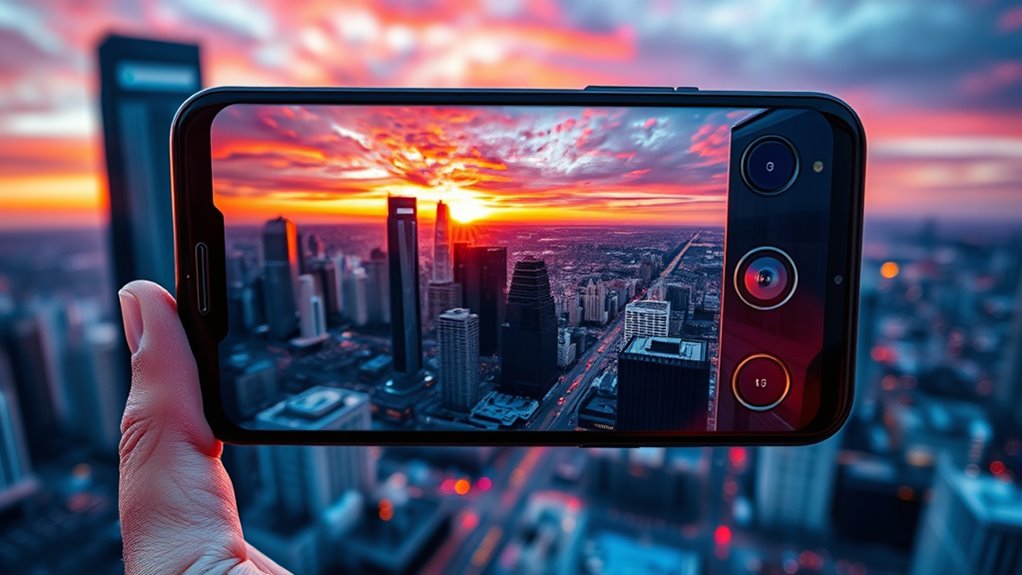
Building on the reliability of your main wide-angle lens, the ultra-wide camera expands your photography capabilities by capturing a broader view. It’s perfect for panoramic shots, allowing you to fit more of the scene into a single frame. Unlike a traditional fisheye lens, which creates a dramatic, curved effect, the ultra-wide lens provides a natural, expansive perspective. This lens is ideal for landscape photography, crowded events, or tight spaces where you want to include everything. Its wider field of view makes your photos more immersive, giving viewers a sense of being right there with you. Whether you’re capturing cityscapes or scenic vistas, the ultra-wide camera helps you tell a richer, more detailed story without sacrificing image quality. Incorporating professional equipment can further enhance your results and ensure high-quality captures in various conditions. Additionally, understanding the field-of-view helps you compose shots more effectively and maximize the potential of each lens. Recognizing the diversity of lenses available allows you to choose the right tool for any creative scenario. Knowing how advanced technology improves camera performance enables you to make more informed photography decisions.
The Telephoto Lens
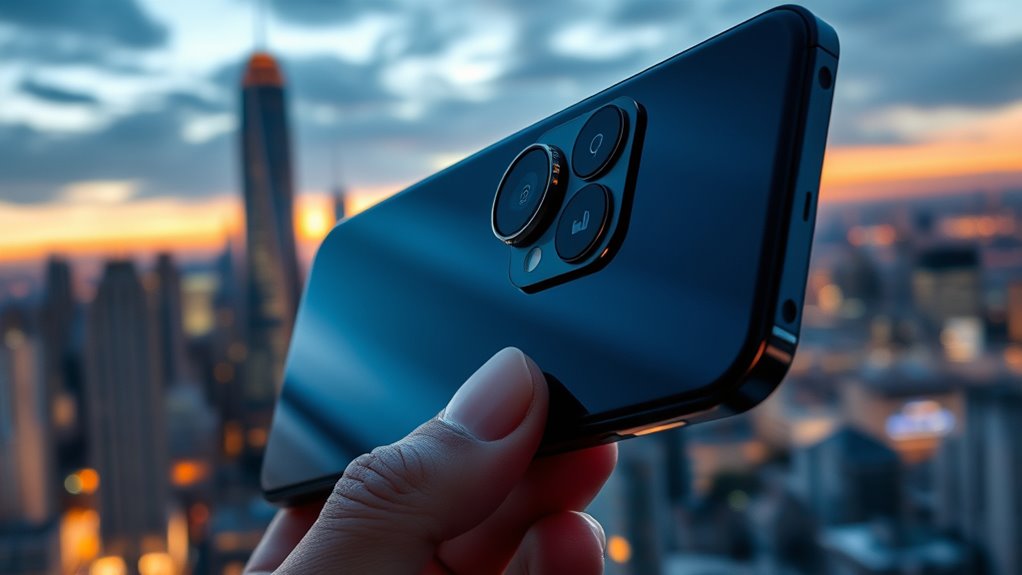
The telephoto lens lets you zoom in closer without losing image quality, making distant subjects appear sharper. It also enhances portrait mode by creating a natural background blur that makes your subjects stand out. With these capabilities, your photos look more professional and detailed. Additionally, understanding the camera lens functions can help you optimize your device for better photography results. For instance, knowing how different lenses affect image clarity can assist you in capturing the best shots in various situations. Recognizing the knowledge about different lens types can further improve your understanding of your phone’s camera system. Moreover, learning about Free Floating can provide insights into how certain camera technologies maintain stability for clearer images. Being aware of lens-specific features can help you make the most of your phone’s multiple lenses in diverse shooting scenarios.
Zoom Capabilities Enhanced
When you want to capture distant subjects clearly, the telephoto lens’s zoom capabilities come into play. With optical zoom, you can get closer without losing image quality, ensuring sharp, detailed photos. Unlike digital zoom, which enlarges pixels and reduces clarity, optical zoom uses the lens’s optics to magnify the scene naturally. This technology preserves image quality even at higher magnifications. The telephoto lens allows you to frame distant objects precisely, whether you’re photographing wildlife, sports, or architecture. By enhancing zoom capabilities, it helps you achieve professional-looking shots without needing extra equipment. So, next time you’re far from your subject, rely on the telephoto lens to bring it into perfect focus with crisp, clear images. Additionally, optical zoom provides a more authentic and natural magnification compared to digital methods. Understanding lens optics can help you make the most of your phone’s camera system, especially when it comes to maximizing camera versatility for various shooting scenarios.
Portrait Mode Benefits
Using the telephoto lens in portrait mode allows you to capture stunning, professional-looking photos with flattering depth and focus. It creates a natural background blur, making your subject stand out sharply against a softened backdrop. This artistic effect emphasizes your subject’s features and adds a sense of dimension to your photos. The telephoto lens compresses perspective, giving a more refined and elegant look that mimics traditional portrait photography. With this lens, you can achieve beautiful bokeh and smooth background separation, even in busy environments. Whether you’re taking a close-up of a loved one or shooting an artistic portrait, the telephoto lens enhances your image quality, providing a polished, creative touch that elevates your photos beyond everyday snapshots. Proper lens selection plays a crucial role in achieving the desired artistic effect and overall image quality. Additionally, understanding how different camera lenses function can help you make better choices for various photographic scenarios.
The Depth Sensor
Depth sensors play a crucial role in enhancing your smartphone’s camera capabilities by accurately measuring distances between objects and the camera itself. This improved depth perception allows your device to distinguish foreground from background more effectively. As a result, you get sharper subject focus and natural background blurring, creating a more professional look. The depth sensor works behind the scenes, providing essential data for various features. It also helps improve augmented reality experiences and enhances low-light performance. By capturing precise spatial information, it ensures your photos are well-balanced and visually appealing. Accurate spatial data enables more realistic and immersive visuals across multiple applications. Additionally, this technology supports essential oil applications by allowing for more detailed and true-to-life visual representations of scenes and objects. Moreover, multilayer sensor technology contributes to the overall versatility and accuracy of your smartphone camera system. Incorporating AI-driven processing further refines depth data, optimizing image quality and AR interactions. Implementing automated calibration techniques also helps maintain sensor accuracy over time, ensuring consistently high-quality results.
The Macro Lens
The macro lens allows you to capture stunning close-up shots by focusing on tiny details that are often missed by regular lenses. With macro photography, you can explore intricate textures, patterns, and tiny objects up close. This lens is perfect for photographing things like insects, flowers, or even everyday objects with remarkable detail. When using the macro lens, you’ll notice that your photos reveal textures and features that are invisible to the naked eye. It helps you highlight the minute aspects of your subject, turning simple scenes into mesmerizing images. Whether you’re a hobbyist or just want to experiment with creative shots, the macro lens discloses a new world of close-up details that can make your photos more engaging and visually striking. Understanding how lenses work can enhance your ability to choose the right lens for capturing specific details, especially when considering the purpose of each lens. Recognizing the weight and design of the lens can also influence your overall photography experience, especially if you plan to shoot handheld for extended periods. Additionally, knowing about lens compatibility ensures you select the correct equipment for your device, maximizing image quality and ease of use.
The Night Mode Camera
When the lights dim, your phone’s Night Mode camera steps in to capture clearer, brighter photos in low-light conditions. This lens is essential for night photography, providing low light enhancement that dramatically improves your images without a flash. It uses advanced algorithms and longer exposure times to gather more light, resulting in sharp, detailed shots even in darkness. Night Mode adjusts automatically or can be manually activated, helping you preserve memories in challenging lighting. Its technology minimizes noise and enhances colors, making nighttime scenes more vivid. This lens is perfect for capturing cityscapes, starry skies, or intimate indoor moments without additional equipment. With Night Mode, you can confidently take stunning photos anytime, anywhere, regardless of the lighting environment.
- Utilizes long exposure for maximum light capture
- Reduces noise through sophisticated processing
- Enhances color accuracy in low light
- Automatically activates in dim environments
- Perfect for night photography and low light enhancement
The Periscope Lens
The periscope lens gives you an extended zoom range, letting you capture distant details without sacrificing image quality. It also features enhanced image stabilization to keep your shots clear and steady. Its unique optical design allows for these improvements while fitting seamlessly into your phone’s slim profile.
Extended Zoom Range
Extended zoom range is achieved through the periscope lens, a clever design that allows your phone to zoom in on distant objects without sacrificing image quality. This lens uses a folded optical path, enabling high magnification within a slim profile. To guarantee sharp images, manufacturers perform precise sensor calibration, aligning the sensor with the lens system. Lens coatings reduce reflections and glare, improving clarity and contrast during zoomed shots. The periscope lens often incorporates specialized glass and multi-layer coatings to enhance light transmission. Additionally, the design minimizes chromatic aberrations, maintaining color accuracy even at high zoom levels. This combination of optical engineering and calibration makes your phone capable of capturing detailed images from afar, all while preserving the quality you expect from modern smartphone photography.
- Advanced sensor calibration techniques for accuracy
- Multi-layer lens coatings for clarity
- Folded optical design for slimness
- Reduced chromatic aberrations
- Enhanced light transmission for better detail
Enhanced Image Stabilization
Enhanced image stabilization in the periscope lens actively compensates for hand movements and vibrations, ensuring your zoomed-in shots remain sharp and steady. This technology relies on precise sensor calibration to detect tiny movements and adjust accordingly in real-time. Additionally, advanced lens coatings reduce glare and reflections, improving overall image clarity during stabilization. This combination allows you to capture clear, blur-free images even at extreme zoom levels. To understand its effectiveness, consider how sensor calibration fine-tunes the lens’s responsiveness, while coatings maintain image integrity against environmental factors.
| Feature | Benefit |
|---|---|
| Sensor Calibration | Precise movement detection and correction |
| Lens Coatings | Minimize reflections, improve clarity |
| Stabilization Algorithms | Smooth out vibrations for sharp images |
| Mechanical Stabilization | Physical adjustments to keep camera steady |
Unique Optical Design
Have you ever wondered how smartphones achieve such impressive zoom capabilities without sacrificing image quality? The key lies in the unique optical design of the periscope lens. Unlike traditional lenses, it uses a prism to bend light, allowing a longer zoom path within a slim phone body. Precise sensor calibration ensures each component aligns perfectly, maintaining sharpness and clarity. Proper optical alignment minimizes distortions, so your images stay true to life even at high magnification. This innovative design enables high-quality optical zoom without bulky hardware. To achieve this, manufacturers focus on:
- Advanced prism arrangements
- Precise sensor calibration
- Rigorous optical alignment
- High-quality lens materials
- Compact, efficient layout
This sophisticated approach makes zooming seamless and sharp, fitting powerful optics into a sleek device.
The ToF (Time of Flight) Sensor
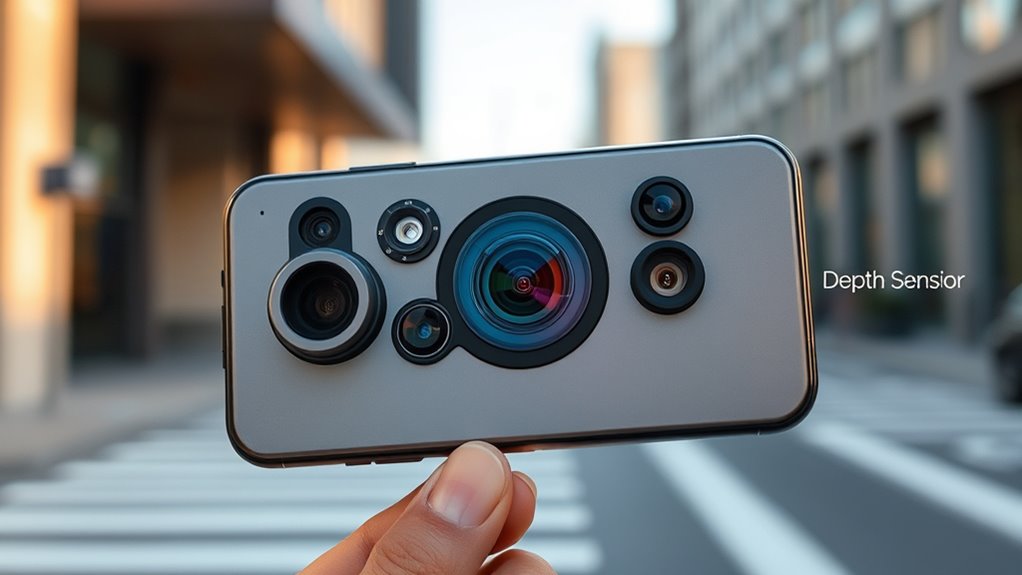
The ToF (Time of Flight) sensor plays a crucial role in improving your smartphone’s depth sensing capabilities by measuring the distance between the camera and objects in the scene. It emits infrared light pulses that bounce back from surfaces, allowing the sensor to calculate how far away objects are. This precise depth information enhances features like portrait mode, where accurate background blur matters. Additionally, the ToF sensor improves motion tracking by quickly detecting how objects move within a scene. This makes your phone better at capturing smooth videos and interactive AR experiences. Unlike traditional lenses, the ToF sensor provides real-time, detailed depth data, which helps your device create more realistic images and immersive digital interactions, all while maintaining fast, reliable performance.
How Multiple Lenses Work Together
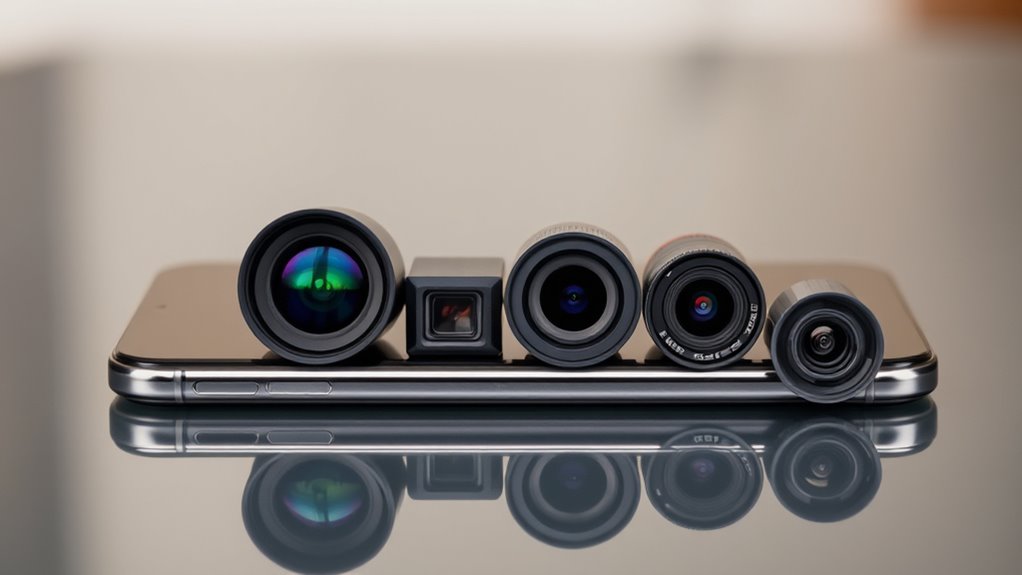
Multiple lenses on your phone work together seamlessly to capture a variety of images and improve overall photo quality. This process relies on advanced multi lens integration, where data from each lens is combined to create a unified image. Sensor calibration guarantees that each lens’s input aligns perfectly, reducing distortions and color inconsistencies. During multi lens integration, your device analyzes depth, color, and detail from different sensors to produce sharper, more vibrant photos. This coordination allows features like optical zoom, portrait mode, and HDR to function smoothly, enhancing your photography experience. Proper sensor calibration is essential for accurate image stitching, and real-time processing ensures you get high-quality results instantly. Ultimately, the teamwork of multiple lenses delivers richer, more detailed images with minimal effort on your part.
Frequently Asked Questions
How Do Multiple Lenses Impact Overall Smartphone Camera Quality?
Multiple lenses improve your smartphone camera quality by offering lens diversity, which allows you to capture different types of photos, like wide-angle or zoom shots. This enhances image clarity across various scenarios, making your photos sharper and more detailed. With the right combination of lenses, you get versatile performance, better low-light photos, and less distortion, ensuring your images look professional regardless of the situation.
Can You Upgrade or Replace Individual Lenses on Your Phone?
You can’t typically upgrade or replace individual lenses on your phone easily. While a lens upgrade sounds appealing, hardware replacement usually involves professional repair services and can be costly, risking damage to delicate components. Imagine improving your camera quality by upgrading a single lens—it’s tempting, but most smartphones are sealed units. For better results, consider buying a new phone with upgraded camera hardware rather than attempting hardware replacement yourself.
Are Multi-Lens Cameras More Prone to Malfunctions or Damage?
Multi-lens cameras can be more prone to malfunctions or damage because their hardware complexity increases repair challenges. If one lens or sensor fails, it might affect the entire camera system, making repairs more costly and intricate. You should handle your phone carefully and consider professional repairs if issues arise, as dealing with multiple delicate components requires specialized skills to avoid further damage.
Do Different Brands Use the Same Types of Lenses in Their Phones?
You’ll notice different brands often use varied lens types, reflecting lens diversity and brand consistency. While some manufacturers prefer similar lenses like wide-angle or telephoto, others tailor their setups for unique features or image quality. This variation means your phone’s camera system isn’t standardized across brands, so understanding each brand’s lens choices helps you appreciate why your device looks and performs differently from others.
How Do Software Updates Improve Multi-Lens Camera Performance?
Software updates improve your multi-lens camera performance by enhancing software compatibility and optimizing processing algorithms. When you install updates regularly, your phone can better coordinate between lenses, improve image quality, and enable new features. Updates also fix bugs and boost overall stability, ensuring your camera functions smoothly across different scenarios. So, keeping up with update frequency helps your multi-lens system work efficiently, giving you better photos and more reliable performance.
Conclusion
By understanding each lens’s purpose, you can better appreciate your phone’s versatility. For example, when capturing a landscape at sunset, the ultra-wide lens captures the expansive scene, while the Night Mode camera enhances low-light details. Combining these lenses lets you take stunning photos in any situation. So, next time you snap a picture, remember how each lens works together to create a professional-looking shot — all in the palm of your hand.