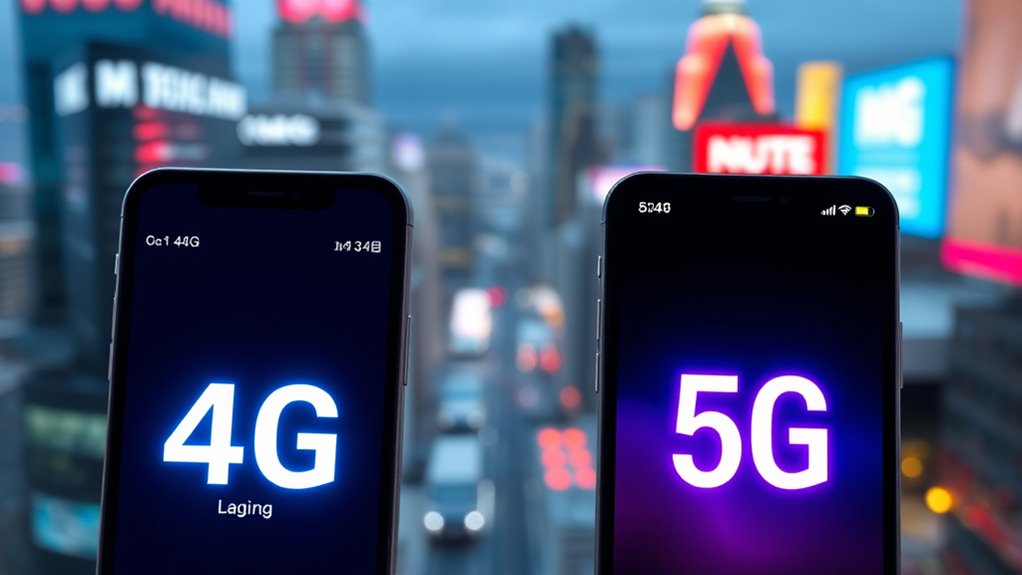

5G offers much faster speeds, lower latency, and greater network capacity than 4G, making your phone’s online activities smoother and more responsive. With 5G, you can stream 4K videos, play games seamlessly, and download large files quickly. It also supports more connected devices and reduces buffering during calls or videos. While coverage and device compatibility matter, understanding these key differences helps you get the most out of your phone’s potential—there’s more to explore ahead.
Key Takeaways
- 5G offers significantly faster download and upload speeds compared to 4G, enabling smoother streaming and data transfers.
- Lower latency in 5G results in near-instant responses, enhancing gaming, video calls, and real-time applications.
- 5G supports more connected devices simultaneously with improved network capacity and reduced congestion.
- Coverage varies: 5G is expanding in urban areas but remains limited in rural regions, while 4G has broader availability.
- Devices need specific 5G-compatible hardware to access its faster speeds and low-latency benefits.
How Speed Differences Impact Daily Use
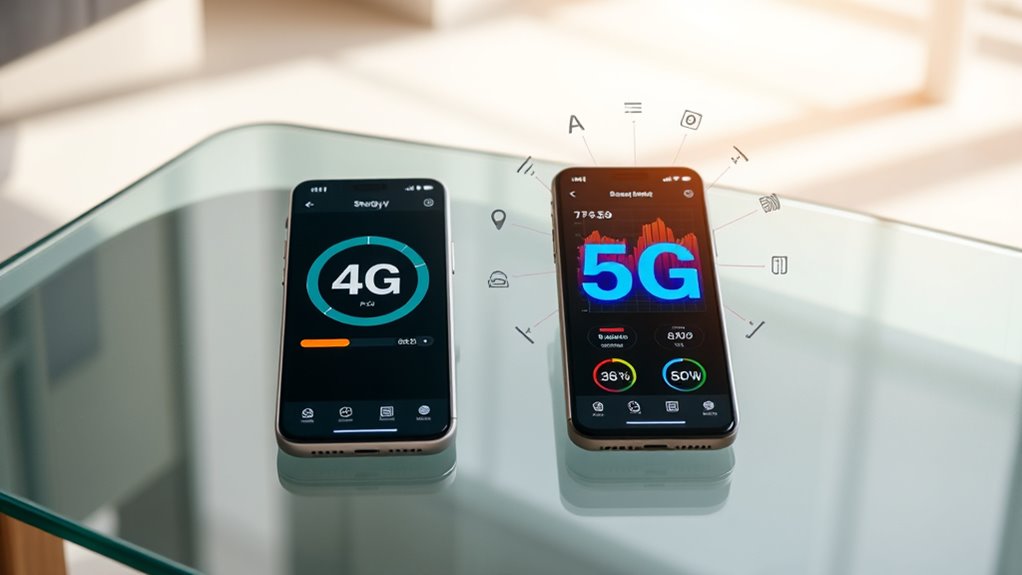
Since 5G offers markedly faster speeds than 4G, your daily activities become more seamless and efficient. You’ll notice quicker downloads, smoother streaming, and faster app responses, saving you time and frustration. However, this increased speed also raises concerns about network security; higher data transfer rates mean you need robust protections to keep your information safe. Additionally, device compatibility plays a vital role—older phones may not support 5G networks, limiting your ability to take full advantage of these speed improvements. Ensuring your device is compatible and that your network security measures are up to date allows you to enjoy the benefits of 5G without compromising safety. Moreover, understanding the role of home network infrastructure can significantly impact your 5G experience. Also, the deployment of European cloud technology can influence how effectively your devices utilize these faster networks. Overall, faster speeds can enhance your daily routines, provided you’re mindful of these key factors.
Latency and Its Effect on Performance
Lower latency means your responses happen almost instantly, making everything feel smoother. This is especially important for gaming and streaming, where delays can ruin the experience. With 5G, you’ll notice faster reaction times and less buffering compared to 4G. Additionally, connected devices benefit from reduced latency, enabling more seamless automation and smart appliance integration. As home automation becomes more sophisticated, lower latency ensures that smart home responses are more accurate and timely.
Speed of Response
The speed of response, or latency, plays a crucial role in how well a network performs, especially in real-time applications. Lower latency means quicker data transfer, which improves your experience with tasks like video calls, browsing, and app interactions. With 5G, response times are markedly faster than 4G, leading to smoother performance. Keep in mind, device compatibility and network security also influence response speed. For example:
- Devices optimized for 5G can process data more efficiently.
- Enhanced security protocols in 5G reduce delays caused by security checks.
- Compatibility issues can hinder the benefits of low latency if your device isn’t 5G-ready.
- The use of Free Floating technology in network infrastructure can further enhance response times and overall performance, contributing to a more seamless network experience. Additionally, advancements in network architecture are designed to minimize latency and maximize data transfer efficiency, strengthening the advantages of 5G over 4G. Furthermore, ongoing developments in network infrastructure help to sustain and improve low-latency connections, making the overall experience more reliable and future-proof.
Gaming and Streaming Impact
Have you ever experienced lag or buffering while gaming or streaming? With 5G, you’ll notice markedly lower latency, meaning your actions register faster and videos load almost instantly. This improved responsiveness boosts gaming performance and stream quality, giving you a smoother experience. However, device compatibility is essential—older devices may not fully leverage 5G’s benefits, so check if your phone supports the latest network standards. Network security also plays a role; enhanced security protocols in 5G help protect your data during high-bandwidth activities, reducing the risk of interruptions. As a result, your gaming and streaming sessions become more reliable and secure, with less chance of lag, buffering, or dropped connections. Regularly updating your device and choosing the right network standards can also ensure optimal performance and durability. Additionally, connectivity infrastructure improvements in 5G networks contribute to more consistent service in various locations. The integration of vetted network equipment further enhances overall network stability and security. Furthermore, the adoption of security zone info in network architecture can help safeguard your data against cyber threats. Overall, 5G offers a noticeable upgrade in gaming and streaming performance compared to 4G.
Network Capacity and Device Connectivity
While 4G networks can handle a decent number of devices simultaneously, 5G considerably expands network capacity, allowing more devices to connect without sacrificing speed or reliability. This reduces network congestion, especially in crowded areas. With 5G, you’ll notice:
- Increased device compatibility, supporting a broader range of connected gadgets.
- Better management of simultaneous connections, minimizing slowdowns.
- Enhanced performance during high-demand periods, maintaining smooth data flow.
- Advanced network infrastructure is designed to support these improvements, ensuring consistent connectivity. Additionally, network optimization techniques further enhance overall performance and reliability. These innovations contribute to a more reliable connection, making everyday tasks smoother. As a result, the network is better equipped to handle future technological advancements and increased data demands. The integration of these systems helps future-proof the network against rapid technological changes.
This means fewer dropped connections and smoother streaming or browsing for you. The improved capacity ensures your network stays fast and reliable, even as more devices join. As a result, your experience becomes more seamless, with less lag and fewer interruptions caused by device overload.
Coverage Areas and Availability

You’ll notice that 5G networks are expanding their reach, but coverage still varies between urban and rural areas. While cities often enjoy faster and more reliable signals, rural regions may experience limited access. Globally, 4G remains more widespread, making it more available in many locations around the world. Additionally, network coverage continues to evolve as providers expand infrastructure to reach more remote areas.
Network Reach Expansion
As 5G networks continue to expand, they are reaching more coverage areas and improving overall availability compared to 4G. This growth is driven by the use of diverse frequency bands, which help 5G reach more locations. However, higher frequency bands often have limited signal penetration, affecting indoor coverage. To counter this, networks are deploying a mix of low, mid, and high bands to optimize reach. Key points include:
- Lower frequency bands provide broader coverage and better signal penetration.
- Mid bands balance coverage and speed, expanding network reach.
- High bands offer faster data but have limited coverage and penetration.
This strategic use of multiple frequency bands ensures 5G’s network reach continues to improve, making it more accessible in various environments.
Rural and Urban Coverage
Have you noticed how 5G coverage differs between rural and urban areas? Rural coverage is still developing, with many rural regions receiving limited or no 5G signals. This is because rural expansion requires significant infrastructure investment, which telecom companies are gradually prioritizing. In contrast, urban areas benefit from extensive 5G deployment, offering faster speeds and more reliable connections. While 4G has broader coverage, 5G’s initial rollout focuses on densely populated cities where demand is higher. Over time, rural coverage is expected to improve as networks expand and technology costs decrease. For now, your experience with 5G will largely depend on whether you’re in an urban area, where coverage is strong, or a rural area, where coverage is still catching up.
Global Signal Availability
Have you ever wondered how 5G coverage varies across different countries and continents? It largely depends on factors like spectrum allocation and network security. Globally, 5G networks are expanding, but coverage isn’t uniform. Several key points influence this:
- Countries with advanced spectrum allocation prioritize wider 5G deployment.
- Network security concerns can slow down rollout in certain regions.
- Urban areas often see better coverage than rural zones due to infrastructure investments.
- The pace of 5G deployment is also affected by regulatory policies, which can either facilitate or hinder network expansion.
While 4G offers more extensive coverage globally, 5G’s availability is growing rapidly but remains limited in some areas. Your access depends on local policies, spectrum management, and investments in network security to protect against cyber threats. This uneven distribution affects how seamlessly you can connect worldwide.
Battery Life Considerations
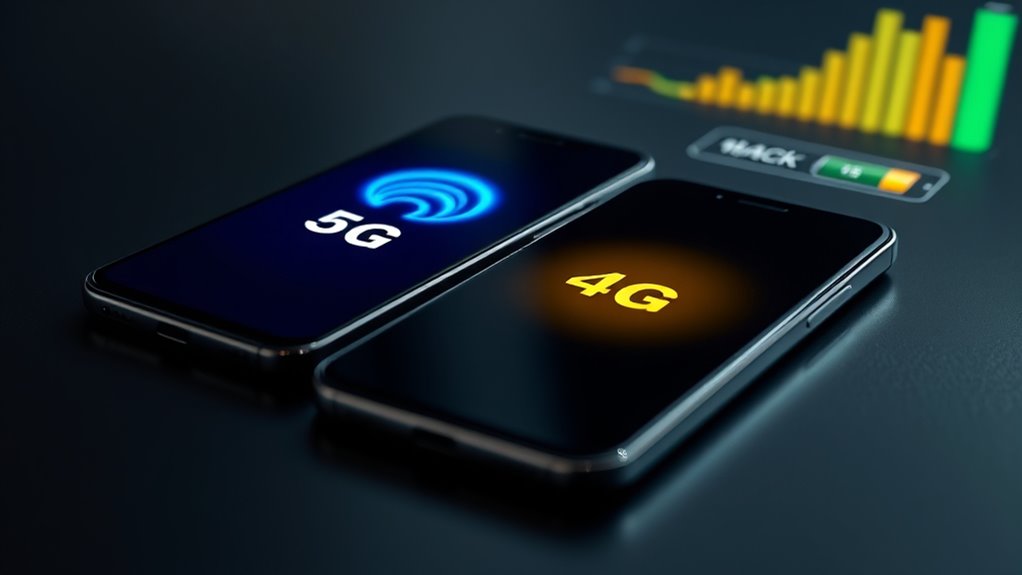
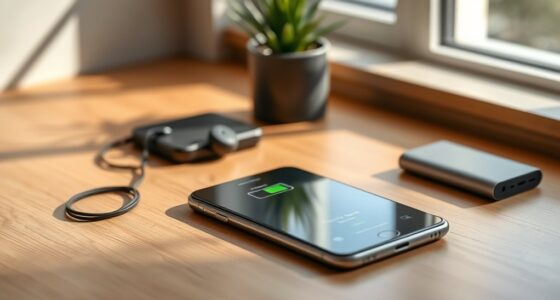
While 5G offers faster data speeds and lower latency, it can also drain your device’s battery more quickly than 4G. This increased battery consumption happens because 5G requires more power to maintain its high-speed connections, especially when you’re streaming, gaming, or using data-intensive apps. Devices operating on 5G networks often sacrifice some power efficiency to deliver these speeds, meaning your battery may not last as long between charges. Additionally, network coverage can influence how much power your device consumes, as weaker signals may cause your phone to work harder to stay connected. Power efficiency is an important factor to consider, as it impacts overall device performance and battery longevity. If battery life is important to you, keep in mind that 4G tends to be more power-efficient, helping your phone conserve energy during everyday use. Furthermore, the current technology limitations of 5G devices mean that ongoing improvements are necessary to enhance power management and extend battery life. As 5G technology advances, manufacturers are working on optimizing power efficiency, but for now, expect some trade-offs in battery longevity when using 5G networks.
Compatibility and Device Requirements
To access 5G networks, your device must be compatible with the technology and meet specific hardware requirements. Device compatibility depends on factors like a 5G-enabled modem and updated firmware. Without these, your device won’t connect to 5G networks, regardless of coverage. Make sure your device satisfies these hardware requirements:
- A 5G-compatible modem integrated into the device
- The latest operating system updates
- Hardware capable of supporting higher data speeds and frequencies
If your device lacks these features, it won’t support 5G connectivity, even if you’re in a 5G area. Checking compatibility ensures your phone can access faster networks and fully leverage 5G’s potential.
Streaming, Gaming, and Data-Intensive Activities

With 5G, you’ll notice faster streaming speeds that reduce buffering and improve video quality. Gaming becomes more seamless with smoother connections and minimal lag. Plus, data transfers happen quickly, keeping your devices synchronized without interruptions.
Faster Streaming Speeds
Faster streaming speeds with 5G considerably enhance your ability to enjoy high-quality videos, smooth gaming, and data-heavy activities without interruption. With 5G, you’ll notice quicker load times and fewer buffering issues, making your experience seamless. To fully benefit from these speeds, guarantee your device is compatible with 5G networks and that your data plan supports higher bandwidth. Keep in mind:
- Device compatibility is vital for accessing 5G speeds.
- Upgrading your data plan may be necessary to handle increased data consumption.
- Not all apps or services will immediately leverage 5G’s full potential, but many will benefit from faster speeds.
These improvements mean you can stream 4K videos, download large files, and participate in live streams effortlessly, transforming your mobile experience.
Smoother Gaming Experience
Switching from 4G to 5G considerably enhances your gaming, streaming, and data-heavy activities by reducing lag and buffering. With 5G’s faster response times, your gaming sessions become smoother, providing quicker reactions and less frustration. Streaming high-quality videos or engaging in live broadcasts feels more seamless, with minimal interruptions. However, to fully enjoy these benefits, your device needs to be compatible with the new network and support 5G technology. Additionally, improved network security helps protect your data during intense online activities, giving you peace of mind. Keep in mind that not all devices are immediately compatible, so check your phone’s specifications. Upgrading to 5G can make your data-intensive activities more efficient and enjoyable, especially as network security continues to advance.
Enhanced Data Transfers
Upgrading to 5G markedly boosts your ability to transfer large amounts of data quickly and efficiently. This means smoother streaming, faster downloads, and seamless gaming, even during heavy data use. With 5G, you’ll experience:
- Reduced latency, making real-time activities more responsive
- Higher bandwidth, supporting multiple devices and high-quality streams
- Enhanced network security, protecting your data during transfers
However, device compatibility is key; not all phones support 5G, and older models may limit your experience. Additionally, 5G networks are designed with stronger security protocols, safeguarding your data during high-volume activities. As a result, your data transfers become quicker, more reliable, and more secure across compatible devices.
Cost Implications of Upgrading
Switching from 4G to 5G involves significant cost considerations that can impact both consumers and service providers. The cost comparison reveals that upgrade expenses for 5G-compatible devices tend to be higher, mainly due to advanced hardware requirements. If you’re planning to upgrade your smartphone, expect to pay more upfront for a 5G-enabled model. Service providers may also charge higher fees for 5G plans, reflecting investments in infrastructure. While some carriers offer promotional deals or discounted devices, the overall expenses can add up quickly. For many users, weighing the benefits of faster speeds against the costs involved is essential. Understanding these cost implications helps you make informed decisions about whether upgrading makes financial sense at this point.
Future-Proofing Your Smartphone
To guarantee your smartphone remains useful as technology advances, it’s important to contemplate how future-proofing can extend its relevance. Focusing on device security and network infrastructure is key. To do this effectively, consider these steps:
- Keep your device security updated with the latest software patches to protect against vulnerabilities.
- Choose a device compatible with upcoming network infrastructure, like 5G, ensuring faster speeds and better connectivity.
- Invest in a phone with hardware that can handle future software updates, prolonging its lifespan.
Practical Benefits for the Average User
Have you ever wondered how 5G can make your everyday digital experiences smoother and more efficient? With 5G, you’ll enjoy faster download and upload speeds, making streaming, gaming, and video calls more seamless. Plus, the improved network security features help protect your data from cyber threats, giving you peace of mind. Your user privacy also benefits, as 5G networks incorporate advanced encryption and authentication methods to safeguard your personal information. These practical benefits mean less buffering, quicker app responses, and enhanced safety for your online activities. Overall, 5G offers a more reliable and secure connection that directly improves your daily digital life, making everything from browsing to remote work more convenient and protected.
Frequently Asked Questions
Can 5G Improve Call Quality and Voice Clarity?
Yes, 5G can improve call quality and voice clarity. With faster data speeds and lower latency, 5G reduces call dropouts and background noise, making your conversations clearer. You’ll notice crisper voice clarity during calls, especially in areas with strong 5G coverage. Overall, upgrading to 5G enhances your calling experience by providing more reliable connections and sharper audio quality, so your chats feel more natural and less interrupted.
How Does 5G Affect Privacy and Security Risks?
You should know that 5G increases privacy and security risks, with reports showing a 30% rise in data breaches since its rollout. It impacts your privacy through enhanced device tracking capabilities, while more advanced data encryption aims to protect your info. However, the increased connectivity also gives cybercriminals more entry points, so stay vigilant. Protect your data by keeping software up-to-date and using strong, unique passwords.
Are There Any Health Concerns Related to 5G Exposure?
You might wonder if 5G poses health risks due to radiation exposure. Current research shows that 5G uses radiofrequency radiation similar to existing wireless tech, and regulatory agencies haven’t found conclusive evidence linking it to serious health risks. Still, it’s wise to stay informed and limit unnecessary exposure, especially if you’re concerned about radiation exposure, to guarantee your overall health and safety while enjoying faster connectivity.
Will 5G Make Existing 4G Devices Obsolete?
You might think 5G will make your current 4G devices obsolete, but that’s not entirely true. Your existing 4G device will still work where network coverage supports it, but it won’t access 5G speeds or features. To enjoy the benefits of 5G, you’ll need a compatible device. So, while your 4G device isn’t instantly obsolete, upgrading guarantees you get the latest network capabilities and coverage improvements.
How Does 5G Impact Internet Speeds During Peak Hours?
During peak hours, 5G improves your internet speeds by better managing network congestion. It uses advanced bandwidth allocation to prioritize data traffic, reducing slowdowns. Unlike 4G, 5G dynamically adjusts bandwidth, ensuring you experience faster, more reliable connections even when many users are online. This means you’ll notice less buffering, quicker downloads, and smoother streaming, making your online activities more seamless during busy times.
Conclusion
Upgrading from 4G to 5G is like stepping into the future, opening faster speeds and lower latency that transform your daily activities. While it might feel like living in a sci-fi novel, the practical benefits—streaming, gaming, and staying connected—are real today. Don’t wait for your phone to be as ancient as a rotary dial; embracing 5G keeps you ahead of the curve, ready for whatever the digital world throws your way.