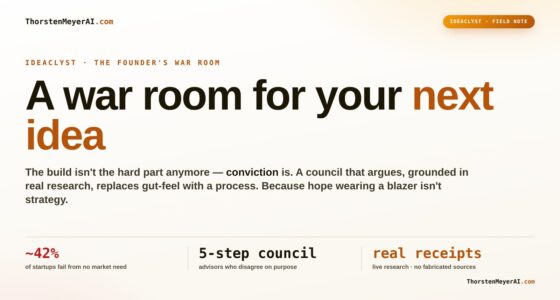

📊 Full opportunity report: IdeaClyst: The Engine That Decides What’s Worth Building on ThorstenMeyerAI.com — validation score, market gap, and execution plan.

Get the latest gadgets delivered free with Prime
- Fast, free delivery on millions of items
- Prime Video, Amazon Music and more included
- Member-only deals all year
TL;DR
IdeaClyst is an AI-powered idea engine that helps founders generate validated, targeted product ideas by analyzing roadmaps and market data. It aims to solve ideation gaps and prioritize valuable work.
IdeaClyst, an AI-driven idea engine designed to help product teams determine what’s worth building, has been publicly launched. It analyzes existing roadmaps and market opportunities to generate validated, targeted ideas, addressing a common gap in product development processes. This development matters because it aims to improve ideation quality at scale, reducing the risk of building less valuable features or missing adjacent opportunities.
IdeaClyst is built to fill a critical tooling gap in product management: the lack of scalable, validated ideation. It works by reading a team’s existing roadmap, identifying gaps, and proposing specific work across three categories: features, spin-offs, and services. The engine uses a council of AI models—Claude and Codex—that collaborate to generate, critique, and refine ideas, producing suggestions grounded in real market opportunities. These ideas are then scored and backed by web research, ensuring relevance and potential impact. The tool aims to prevent teams from falling into the trap of reusing familiar ideas, instead surfacing innovative and valuable opportunities that align with the current product strategy.According to Thorsten Meyer, the creator of IdeaClyst, the engine addresses the common problem of ideation not scaling well because it relies heavily on willpower and existing mental grooves. By automating the generation and validation of ideas, it seeks to diversify and elevate the quality of product planning. The engine also reads the roadmap in a deterministic way, ensuring consistent gap analysis and targeted suggestions, rather than random ideas. The proposals include concrete features, potential spin-offs, and new services, all scored for impact and effort, enabling teams to prioritize effectively.
The engine that decides what’s worth building
Every roadmap tool assumes you arrive knowing what to build. IdeaClyst inverts that — it generates the candidate work, aims it at the real gaps in a roadmap it can read, scores it, backs it with research, and drops it where you decide.
Most tools wait for you to know what to build
Ideation is real work — and the work most likely to get skipped under pressure, because it has no deadline and ships nothing the day you do it. So the roadmap fills with whatever was easiest to think of. IdeaClyst closes that gap.
A council, not a single prompt
One model produces a confident, plausible, slightly generic list. A council — models proposing, critiquing, refining against each other — catches the weak ideas that sound good and pushes the survivors sharper.
The Claude–Codex council
Like brainstorming with a sharp colleague who isn’t afraid to say “that one’s obvious — dig deeper.”
Scouts the web for opportunities
Ideas in a vacuum are guesses; ideas grounded in a real market are proposals. The engine researches the landscape and anchors what it suggests.
Roadmap → gap map → three lanes → Inbox
This is “Roadmap Intelligence.” Pick a Threlmark project; IdeaClyst reads it read-only, maps the gaps, and three lanes propose scored work that lands in your Inbox. Watch it run.
How a proposal is born
Deterministic gap map in, scored proposals out — aimed at the holes you actually have.
Not “build X” — a small, defensible case
Each suggestion arrives scored on the same four axes Threlmark ranks by, so it slots straight into a prioritized backlog — and carries its provenance: what kind, why, and the sources behind it.
Anatomy of an IdeaClyst proposal
A proposal is a stack of evidence, not a one-liner. Here’s one as it lands in the Inbox.
An open contract, not magic
IdeaClyst can read your roadmap and write proposals into it only because Threlmark keeps everything as open files. No API to be granted, no account to connect — just a small layer speaking the file shapes.
Reads everything · writes only suggestions
IdeaClyst reads roadmaps read-only (computing the same priority, building the gap map) and writes only the Inbox — dropping one suggestion file via the same atomic pattern, never touching your board. And because the contract is open, any tool can do the same: IdeaClyst is the first complete example, not a gatekeeper.
Why IdeaClyst Changes Product Roadmapping
IdeaClyst introduces a new approach to product ideation that leverages AI to systematically identify valuable opportunities, reducing reliance on intuition alone. By grounding suggestions in real market data and existing roadmaps, it helps teams avoid the common pitfall of building what’s easiest or most familiar. This can lead to more innovative, competitive products and more efficient use of development resources. For startups and established companies alike, the tool’s ability to surface adjacent product ideas and new revenue streams enhances strategic agility and long-term growth potential.
As an affiliate, we earn on qualifying purchases.
The Evolution of Product Ideation Tools
Traditional roadmap tools assume teams already know what to build, often leading to incremental updates rather than innovative leaps. Prior to IdeaClyst, most ideation relied on manual brainstorming, which is limited by cognitive biases and time constraints. Recent trends have seen the emergence of AI-assisted product planning, but most tools focus on prioritization rather than generating new ideas. The launch of IdeaClyst builds on advancements in large language models and market research automation, aiming to automate and validate the ideation process itself. It complements existing tools like Threlmark, which helps teams execute roadmaps, by focusing on the upstream challenge of what should be on the roadmap in the first place.
“IdeaClyst addresses the tooling gap in scalable ideation, helping teams generate validated, targeted ideas grounded in real market opportunities.”
— Thorsten Meyer
As an affiliate, we earn on qualifying purchases.
Unanswered Questions About IdeaClyst’s Effectiveness
It is not yet clear how well IdeaClyst performs in real-world product teams, including its accuracy in identifying valuable gaps and the quality of its proposals over time. The long-term impact on product innovation and team workflows remains to be studied, as the tool is newly launched and user feedback is still emerging. Additionally, the extent to which it can adapt to different industries or complex product ecosystems is still unknown.
As an affiliate, we earn on qualifying purchases.
Next Steps for Adoption and Validation
Following its launch, the next steps include gathering user feedback from early adopters, conducting case studies to assess its impact on product planning, and refining the AI models based on real-world use. Wider availability and integration with existing product management tools are expected to follow, along with potential enhancements to the research and scoring capabilities. Observers will watch whether IdeaClyst can become a standard part of the product development process or remain a niche tool for early adopters.
As an affiliate, we earn on qualifying purchases.
Key Questions
How does IdeaClyst generate ideas?
It uses a council of AI models—Claude and Codex—that collaborate to propose, critique, and refine ideas based on the current roadmap and market research.
What types of ideas does it propose?
It proposes features to fill functional gaps, spin-offs for adjacent products, and new services around the existing product, all scored for impact and effort.
Can IdeaClyst integrate with existing product tools?
It reads roadmap files in a read-only manner, making integration feasible, but full integration features are still under development.
What are the main benefits of using IdeaClyst?
It helps generate validated, targeted ideas at scale, diversifies the innovation pipeline, and improves prioritization based on real market gaps.
What remains uncertain about its future impact?
Its effectiveness in diverse industries, long-term influence on product innovation, and how well it integrates into existing workflows are still to be proven.
Source: ThorstenMeyerAI.com
Halloween Picks
halloween
As an affiliate, we earn on qualifying purchases.