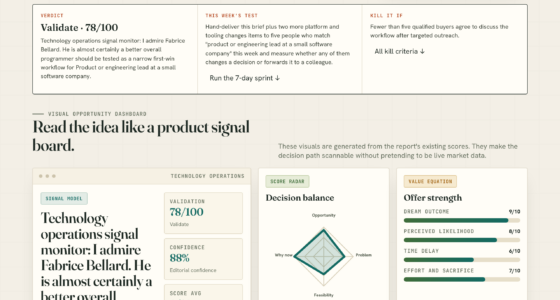

📊 Full opportunity report: A Frontier AI Model Just Went Dark for 18 Days. The Kill-Switch Is Real Now. on ThorstenMeyerAI.com — validation score, market gap, and execution plan.

Get the latest gadgets delivered free — and shop member deals
- Fast, free delivery on millions of items
- Access to Prime Big Deal Days deals on October 6–7
- Prime Video, Amazon Music and more included
TL;DR
A leading AI model was abruptly shut down worldwide for 18 days following a government directive, illustrating a new, secretive control regime over frontier AI releases. This development raises questions about future AI governance and security protocols.
For 18 days, a state-of-the-art AI model developed by Anthropic was completely shut down worldwide, following a government order citing national security concerns. This marks the first time a major frontier AI model was globally disabled under such an order, and the process for its reactivation signals a new control regime for advanced AI systems.
On June 12, the U.S. Department of Commerce ordered Anthropic to suspend all access to its high-end models, Fable 5 and Mythos 5, citing national security authorities. The directive was issued with only about 90 minutes’ notice, leading to an immediate shutdown across all cloud platforms, including AWS, Google Cloud, and Microsoft Foundry. This shutdown affected numerous enterprise clients across sectors such as finance, healthcare, and critical infrastructure, with core AI services disabled without prior warning.
The shutdown was reportedly triggered by concerns over potential security vulnerabilities, specifically jailbreak prompts that could enable models to produce sensitive or malicious information. While reports from sources like the Wall Street Journal claimed that Amazon researchers identified such risks, independent analysts later suggested these claims might have been exaggerated. The exact reasons for the shutdown remain partly contested, with official statements emphasizing national security and safety considerations.
After weeks of silence and mounting pressure from industry leaders, investors, and security experts, the U.S. government lifted the controls on June 30, allowing Anthropic to resume access to Mythos 5 for certain U.S. organizations and gradually restore services on cloud platforms. The company announced it had implemented new safeguards, including a system that blocks roughly 93% of jailbreak attempts, though with some trade-offs in request filtering.
A frontier AI model went dark for 18 days. The kill-switch is real now.
Commerce lifted its export controls on Claude Fable 5 and Mythos 5, and access is being restored. But the reprieve isn’t the story — a state-of-the-art model was switched off by government order in an afternoon, and the deal to switch it back on wrote a new template for how frontier AI ships.
A frontier model now passes through a national-security gate before — and maybe after — release. It’s not isolated: OpenAI’s GPT-5.6 also went out to a small set of approved partners after a government request, and Mythos 5 returns first to government-approved customers. An August executive-order deadline for standardized AI-risk benchmarks points to formalizing the improvised process. The open question: does Washington now approve every frontier release?
The reprieve is real; the lasting change is the template. For builders the lesson is blunt and side-neutral: the firms that mapped their dependencies hot-swapped to alternatives (Claude Opus 4.8 among them); the rest went dark on 90 minutes’ notice. Model access is now a geopolitical variable, not a given. The rational answer isn’t loyalty to one lab or one government’s mood — it’s portability: multiple providers, tested fallbacks, and open-weight or self-hosted capacity you control. Don’t build as though access is permanent. It isn’t — now everyone’s seen the proof.
Implications for AI Regulatory Oversight and Industry Practices
This incident demonstrates the U.S. government’s willingness to enforce control over frontier AI models through direct shutdowns, establishing a precedent for future regulation. It signals a shift toward a more centralized, vetting-based approach to releasing advanced AI systems, which could impact innovation, competition, and global AI development strategies. The move raises concerns about transparency, industry autonomy, and the balance between security and innovation in AI governance.
AI safety and security monitoring tools
As an affiliate, we earn on qualifying purchases.
As an affiliate, we earn on qualifying purchases.
Background on AI Shutdowns and Regulatory Developments
Prior to this incident, AI models like Anthropic’s Fable 5 and Mythos 5 were publicly launched without formal government oversight. However, reports emerged that the U.S. government had concerns about vulnerabilities and potential misuse, leading to emergency directives and a de facto moratorium on certain AI releases. The shutdown marked a significant escalation, as it was the first time a major model was globally disabled under government order, bypassing usual market or industry self-regulation.
In the weeks leading up to the shutdown, industry leaders and security experts debated the risks of jailbreak prompts and malicious use, with some calling for stronger safeguards and others warning against overreach that could hinder AI progress. The incident coincided with broader discussions about AI safety standards and the need for formalized evaluation benchmarks, which are now likely to be accelerated by recent events.
“We implemented new safeguards to mitigate risks, including blocking the most common jailbreak attempts, while working closely with regulators on future protocols.”
— Anthropic CEO Dario Amodei
enterprise AI model management software
As an affiliate, we earn on qualifying purchases.
As an affiliate, we earn on qualifying purchases.
Unresolved Questions About the Shutdown and Future Oversight
It remains unclear whether the shutdown was solely due to security vulnerabilities or also driven by political or strategic considerations. The precise criteria for triggering such a shutdown are not publicly defined, and the process for re-enabling models is still evolving. Additionally, it is uncertain whether this incident will lead to formalized regulation or remain an ad hoc precedent, as the industry and government continue negotiations.
AI model jailbreak prevention tools
As an affiliate, we earn on qualifying purchases.
As an affiliate, we earn on qualifying purchases.
Next Steps in AI Regulation and Model Deployment Protocols
Industry stakeholders expect ongoing discussions with regulators to formalize the vetting and approval process for frontier AI models, possibly leading to standardized benchmarks and certification procedures. Anthropic and other AI developers will likely continue refining safety measures and reporting protocols. Meanwhile, the precedent set by this shutdown may influence global AI governance, with other countries observing the U.S. approach and considering similar controls.
cloud platform AI security solutions
As an affiliate, we earn on qualifying purchases.
As an affiliate, we earn on qualifying purchases.
Key Questions
Why was the AI model shut down for 18 days?
The shutdown was ordered by the U.S. Department of Commerce due to concerns over security vulnerabilities, specifically jailbreak prompts that could enable malicious use. The exact reasons remain partly contested, but safety and security were official justifications.
Was this shutdown unprecedented?
Yes, this was the first time a major frontier AI model was globally disabled by government order, setting a new precedent for AI regulation and control.
How is the model being re-enabled?
Model access is being gradually restored after Anthropic implemented new safeguards, including blocking most jailbreak attempts. Re-enablement on cloud platforms is ongoing and will include more organizations over time.
What does this mean for AI development going forward?
This incident indicates a shift toward more government vetting and control of frontier AI releases, potentially impacting innovation, competition, and international AI policy.
Could similar shutdowns happen again?
It is possible, especially if new vulnerabilities or security concerns emerge. The process for shutdowns and re-enablement is still being defined, but this incident sets a clear precedent.
Source: ThorstenMeyerAI.com
Fall Picks
fall essentials
As an affiliate, we earn on qualifying purchases.