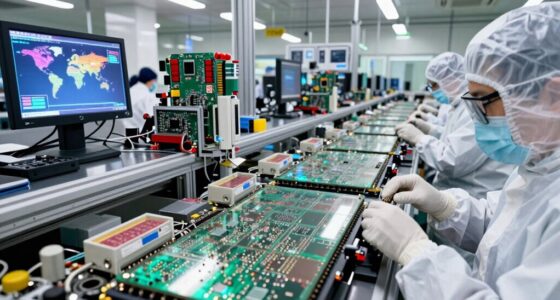

Moore’s Law is slowing down because physical limits and new technologies make traditional silicon chip miniaturization harder. This means your devices might see smaller performance jumps and less cost reduction over time. Industry is shifting focus to innovations like quantum computing and specialized chips, which could boost performance in different ways. If you want to understand how these changes could impact your tech in the future, explore what’s next in the semiconductor world.
Key Takeaways
- Moore’s Law is slowing due to physical limits, rising costs, and emerging alternative materials.
- Traditional performance gains in consumer devices are plateauing, affecting speed and affordability.
- Industry is shifting focus from miniaturization to new architectures, quantum computing, and specialized chips.
- Advances in AI hardware and energy-efficient technologies are shaping future innovations.
- Overall, chip growth slowdown prompts a move towards smarter, more efficient computing solutions beyond traditional scaling.
Top picks for "moore dead slow"
Open Amazon search results for this keyword.
As an affiliate, we earn on qualifying purchases.
The Origins and Promise of Moore’s Law

Moore’s Law originated in 1965 when Gordon Moore, co-founder of Intel, observed that the number of transistors on a microchip doubled approximately every two years. This prediction fueled the drive for semiconductor scaling, where engineers continually shrink transistors to fit more onto each chip. Transistor miniaturization enables faster processing speeds, lower power consumption, and increased efficiency. As semiconductor technology advances, chip performance improves markedly without drastically increasing size or cost. Moore’s Law became a guiding principle for the electronics industry, setting ambitious targets for innovation. Your devices, from smartphones to supercomputers, rely on this relentless miniaturization process. It’s this continuous push for transistor scaling that has powered decades of rapid technological progress, shaping the digital world you experience every day. Miniaturization also depends on advancements in fabrication techniques and materials to sustain progression, which are critical for maintaining Moore’s Law’s momentum.
Signs That the Trend Is Slowing Down

Despite decades of rapid progress, signs are emerging that the trend of transistor doubling is slowing down. You can see this in several ways:
Signs indicate the slowing of transistor doubling and the end of Moore’s Law.
- Quantum computing advances threaten to revolutionize processing, reducing reliance on traditional silicon chips. Quantum computing offers a fundamentally different approach to processing power that could bypass traditional scaling limits.
- Manufacturers face physical limits, making further miniaturization difficult and costly. Physical limits present significant challenges that hinder continued scaling.
- Alternative materials like graphene and transition metal dichalcogenides are gaining attention but haven’t yet matched silicon’s performance.
- The pace of innovation in chip architecture is plateauing, signaling that the exponential growth of transistor counts may be ending.
- Additionally, manufacturing challenges such as extreme technical complexity and rising costs are hindering further improvements.
These signs suggest that the traditional path of Moore’s Law is losing momentum, prompting the tech industry to explore new solutions beyond just shrinking transistors.
How Reduced Chip Growth Affects Consumer Technology

As chip growth slows, you may notice that the rapid performance improvements and cost reductions you’ve come to expect from new devices are starting to level off. This means your smartphones, laptops, and other gadgets might not see the same leaps in speed or affordability as before. While traditional chips hit limits, quantum computing offers a potential future boost, but it’s still in early stages. Meanwhile, manufacturers are focusing on energy efficiency to make devices last longer and reduce power consumption. Reduced chip growth may limit the pace of innovation, but it also pushes companies to optimize existing hardware, making your devices more energy-efficient and reliable. Additionally, advancements in connected appliances are increasingly emphasizing energy management and automation, aligning with these shifts in chip development. The shift toward energy-efficient design ensures that even as raw performance growth tapers, devices can still become smarter and more sustainable over time.
Impacts on Industry Innovation and Future Developments
The slowdown in chip growth challenges the tech industry to find new avenues for innovation. You’ll see companies turning to groundbreaking technologies like quantum computing and AI integration to stay ahead. Key impacts include:
- Accelerated development of quantum processors for specialized tasks
- Increased investment in AI hardware optimized for faster, more efficient learning
- Focus on innovation in software and algorithms to compensate for slower hardware progress
- Collaboration across industries to harness emerging technologies beyond traditional silicon chips
- The adoption of generative AI techniques to enable smarter and more adaptable software solutions.
These shifts mean you’ll experience smarter, more powerful devices driven by novel computing methods. Industry leaders aim to overcome physical limits by exploring quantum solutions and seamless AI integration, ensuring future tech remains innovative despite Moore’s Law slowing.
What to Expect Moving Forward in the Semiconductor World

Moving forward, the semiconductor industry is poised to prioritize innovation beyond traditional chip scaling. You’ll see advancements in quantum computing, which promises to revolutionize processing power for specific tasks, bypassing limits of classical chip miniaturization. As Moore’s Law slows, companies are investing in new architectures and materials that enhance performance without shrinking chips further. Expect increased focus on specialized chips, like AI accelerators, to meet growing computational demands. While chip miniaturization remains important, it won’t be the sole driver of progress. Instead, you’ll notice a shift toward leveraging quantum technologies and alternative approaches to boost efficiency and capabilities. This evolution means your devices may soon benefit from more powerful, energy-efficient, and innovative semiconductors, even if traditional scaling hits a plateau, with Youngster Choice highlighting how industry figures are adapting to these changes. Additionally, research into nanomaterials is opening new avenues for enhancing chip performance without further miniaturization. In this landscape, new materials research is expected to play a crucial role in overcoming current limitations. Moreover, ongoing materials innovation is fueling the development of next-generation semiconductors that could redefine industry standards, as scientists explore alternative semiconductor materials for better performance and sustainability.
Frequently Asked Questions
How Does Moore’s Law Influence Everyday Consumer Devices?
Moore’s Law influences your everyday devices by driving improvements in battery efficiency and performance. As chip growth slows, you might notice slightly less rapid upgrades, but devices like smartphones and wearable technology still get smarter and more efficient. This means longer battery life and better functionality over time. While progress may slow, innovation continues, ensuring your devices remain useful and advanced, even as chip improvements become more incremental.
What Alternative Technological Advancements Are Emerging as Chip Scaling Slows?
Think of technology as a race slowing down its pace; new tracks are emerging instead. Quantum computing and neuromorphic chips are leading these innovative routes, offering breakthroughs beyond traditional scaling. Quantum computing harnesses strange physics to process complex problems quickly, while neuromorphic chips mimic the brain’s neural networks for smarter, more efficient devices. These advancements make sure your gadgets stay sharp and powerful, even as chip miniaturization hits its limits.
Will Slower Chip Development Affect Global Technology Innovation?
Slower chip development may temporarily slow innovation, but it won’t halt progress. You’ll see advancements driven by quantum computing and AI acceleration, which aren’t solely dependent on traditional chip scaling. These emerging technologies offer new pathways for breakthroughs, meaning you’ll still benefit from faster, smarter devices. While progress might shift direction, innovation will continue, transforming industries and enhancing your everyday experiences in ways that traditional chip growth alone couldn’t achieve.
How Might Slowing Moore’s Law Impact the Cost of Electronics?
Slowing Moore’s Law could blow up your electronics costs, making every gadget you love more expensive than a spaceship! As manufacturing costs rise, companies might cut corners or delay new releases, hitting your wallet hard. Product affordability shrinks faster than a shrinking spaceship! So, brace yourself—slower chip growth might mean you pay more for the tech you crave, turning your favorite devices into luxury items instead of everyday essentials.
Are There Geographic Regions Leading in Semiconductor Innovation Despite the Slowdown?
Yes, regions like East Asia, particularly Taiwan and South Korea, lead in semiconductor innovation despite the slowdown. These manufacturing hubs focus heavily on regional innovation, investing in advanced fabs and R&D. Their strong ecosystem, government support, and skilled workforce keep them at the forefront, ensuring you benefit from cutting-edge chips and technology. This regional leadership helps maintain supply chains and fosters ongoing advancements, even as Moore’s Law‘s pace slows.
Conclusion
As you hold your sleek device, imagine the tiny chips inside—once racing ahead like a speeding train, now slowing to a steady crawl. Though the explosive growth of Moore’s Law may be fading, innovation still burns brightly, guiding us through a landscape of new possibilities. So, stay curious and adaptable, because even in a world where progress feels gentler, the future remains a vibrant horizon waiting to be explored.