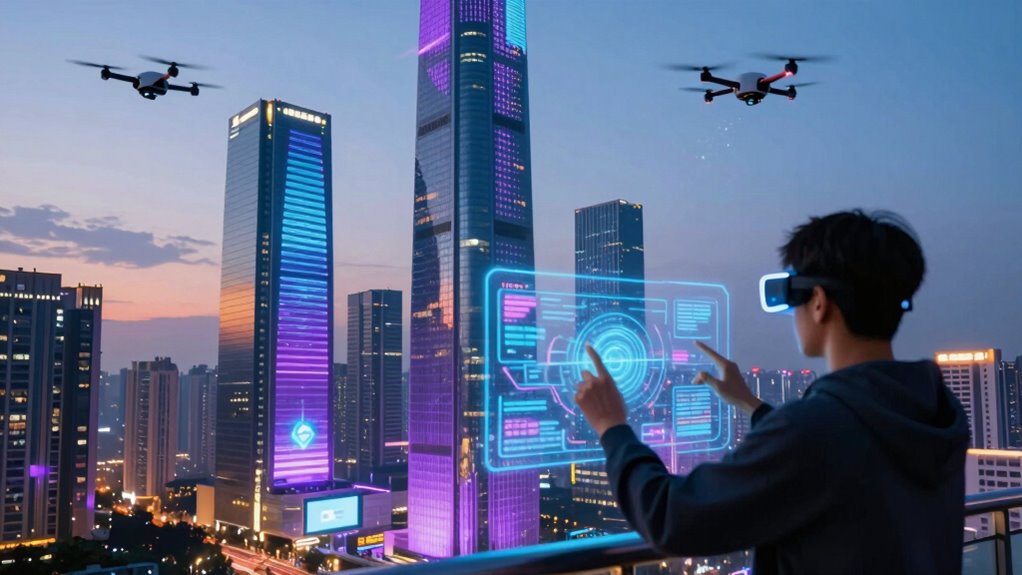

In 2026, expect AI to be seamlessly woven into your daily routines, from smart homes to wearable health tech, with ethical frameworks guiding responsible use. Quantum computing will revolutionize data security, making encryption almost unbreakable. Digital ecosystems will connect your devices for smarter environments, while autonomous vehicles hit new milestones, transforming transportation. Space tech will open new frontiers for business and exploration. Keep exploring to discover how these bold trends will reshape your future.
Key Takeaways
- AI will achieve unprecedented levels of integration, automating daily routines and enhancing personalized experiences with ethical standards.
- Quantum computing will revolutionize cybersecurity, enabling unbreakable encryption and quantum-resistant algorithms.
- Space industries will expand with commercial lunar mining, space habitats, and luxury tourism becoming mainstream markets.
- Autonomous vehicles will become fully reliable, with widespread adoption transforming urban and rural transportation networks.
- Global regulatory frameworks will solidify responsible AI and space resource management, ensuring safety, privacy, and cross-border cooperation.

Kasa Smart Plug HS103P4, Smart Home Wi-Fi Outlet Works with Alexa, Echo, Google Home & IFTTT, No Hub Required, Remote Control, 15 Amp, UL Certified, 4-Pack, White
Voice control: Kasa smart plugs that work with Alexa and Google Home Assistant. Enjoy the hands free convenience…
As an affiliate, we earn on qualifying purchases.
As an affiliate, we earn on qualifying purchases.
AI Becomes Ubiquitous in Daily Life

As AI continues to advance, it becomes seamlessly integrated into your daily routines. Your smart home adjusts thermostats, lights, and security systems automatically, creating a personalized environment that responds to your habits. Wearable tech tracks your health, providing real-time insights and alerts without interrupting your day. AI-powered assistants anticipate your needs, whether scheduling meetings or suggesting healthy meals. With these technologies working together, your life feels more efficient and connected. You no longer need to manually control devices or manage multiple apps; AI handles it all effortlessly. This ubiquity of AI makes daily tasks simpler, smarter, and more tailored to your preferences, transforming how you live, work, and stay healthy. The integration of home automation technology further enhances convenience and energy efficiency, making your environment more adaptable and responsive. As cloud infrastructure becomes more robust, these AI-driven solutions will become even more reliable and capable, enabling smarter environments at home and work. It’s a future where technology intuitively supports your lifestyle at every turn.

iSo Tech Smart Bracelet for Men Women, Activity Health Fitness Trackers with 60-Day Battery Life, 24/7 Continuous Heart Rate Blood Pressure SpO2 HRV Stress Sleep Monitor, 170+ Sports Modes, Sub-Free
【All-Day Health Guardian】Equipped with advanced optical sensors, this fitness tracker bracelet provides 24/7 real-time monitoring of heart rate,…
As an affiliate, we earn on qualifying purchases.
As an affiliate, we earn on qualifying purchases.
Quantum Computing Revolutionizes Data Security
Have you ever wondered how secure your data truly is in a digital world increasingly threatened by cyberattacks? Quantum computing is transforming data security through quantum encryption, which leverages the principles of quantum mechanics to create virtually unbreakable codes. Unlike traditional encryption, quantum methods rely on qubit stability, making it extremely difficult for hackers to intercept or decode information without detection. As qubit stability improves, quantum encryption becomes more reliable, offering a new level of security for sensitive data. This revolution means your information could soon be protected by technologies that are fundamentally more secure than current systems. Additionally, quantum key distribution utilizes quantum principles to detect eavesdropping attempts, further enhancing data protection. As the technology advances, the importance of understanding quantum-resistant algorithms becomes crucial for future-proofing cybersecurity measures. The development of post-quantum cryptography is also essential to ensure existing data remains secure against future quantum attacks. Researchers are also exploring quantum error correction, which is vital for maintaining qubit stability and overall system reliability. With quantum computing advancing rapidly, you’ll need to stay informed about how these powerful tools reshape data security boundaries.

Cryptography Apocalypse: Preparing for the Day When Quantum Computing Breaks Today's Crypto
As an affiliate, we earn on qualifying purchases.
As an affiliate, we earn on qualifying purchases.
Digital Ecosystems Enable Seamless Interconnectivity

Digital ecosystems are transforming how devices, applications, and services connect and communicate, enabling a level of interconnectivity that was previously unattainable. You’ll see a world where:
Digital ecosystems revolutionize connectivity, creating seamless interactions across devices, applications, and services for a smarter, more integrated world.
- Smart homes automatically coordinate with your devices, adjusting lighting and temperature seamlessly.
- Healthcare systems share data securely across platforms, improving patient outcomes.
- Retailers sync inventory updates in real-time, ensuring product availability.
- Vehicles communicate with infrastructure, optimizing traffic flow.
Additionally, interoperability standards are being developed to facilitate smoother integration among disparate systems. The development of unified communication protocols is also helping to address these challenges. Moreover, standardized data formats are being introduced to enhance compatibility across platforms. However, interoperability challenges persist, making it difficult for diverse systems to work smoothly together. Data privacy remains a critical concern, as sensitive information flows across interconnected platforms. Overcoming these hurdles is essential to access the full potential of digital ecosystems, providing a seamless, secure experience, as data security measures become increasingly vital.

Dxtvate Livox Tele-15 Long-Range High-Precision LiDAR for Autonomous Vehicles – 500m Detection, 0.03° Angular Precision, Built-in IMU
Ultra-Long Detection Range and Customization Upgrade Features a large-diameter double aspherical lens that effectively addresses optical defocusing in…
As an affiliate, we earn on qualifying purchases.
As an affiliate, we earn on qualifying purchases.
Autonomous Vehicles Reach New Milestones

Advancements in digital ecosystems are accelerating the development of autonomous vehicles, pushing them closer to widespread adoption. With improvements in autonomous vehicle safety, these vehicles can now navigate complex environments more reliably, reducing accidents caused by human error. Enhanced vehicle-to-everything tech enables seamless communication between cars, infrastructure, pedestrians, and other devices, creating a safer and more efficient transportation network. As these technologies mature, you’ll see autonomous vehicles handling increasingly challenging scenarios, from busy city streets to rural roads. Regulatory approvals are catching up, and pilot programs are expanding globally. This progress marks a significant milestone, making autonomous vehicles a practical, safe, and integral part of your daily commute and logistics operations. StyleGuru.org
Personalized Digital Environments Transform Workspaces

As workplaces become more personalized, digital environments are revolutionizing how you work and collaborate. Virtual work feels more seamless as digital customization adapts to your preferences, making every interaction intuitive. Imagine this:
- Your virtual workspace dynamically adjusts lighting and layout based on your mood.
- Customized dashboards display only the tools relevant to your tasks, boosting efficiency.
- AI-powered assistants anticipate your needs, scheduling meetings or suggesting resources proactively.
- Collaborative spaces morph in real-time to suit project demands, fostering creativity and focus. This personalization transforms traditional offices into adaptive, immersive digital environments. You’re no longer confined by static setups; instead, you experience a workspace tailored to your habits and goals. Digital customization enhances productivity and makes virtual work more engaging and natural. Practical organizational strategies can help you optimize these digital workspaces for better focus and efficiency.
Ethical AI Frameworks Gain Global Adoption

As ethical AI frameworks become more widely adopted, international standards are setting common ground for responsible development. Regulatory policies are evolving rapidly to keep pace with technological advances, ensuring accountability. Meanwhile, companies are increasingly embracing their role in promoting ethical AI practices, shaping a more trustworthy digital future. This shift reflects a broader awareness of the supernatural realm as an area where understanding and responsibility are equally vital, and establishing clear privacy policies is essential for maintaining user trust in this evolving landscape. Incorporating auditory processing assessments into AI-driven user interfaces can further enhance accessibility and personalization. Additionally, integrating transparency measures such as performance cookies can support transparency by providing insights into how these policies are effectively protecting user data.
International Ethical Standards
Have you noticed how international ethical standards for AI are now gaining widespread adoption? You’re witnessing a global shift toward unified principles that address cross border compliance and cultural considerations. Imagine:
- Governments aligning their AI policies to a shared ethical baseline.
- Companies steering through diverse cultural norms with adaptable AI systems.
- International organizations setting enforcement standards for ethical AI use.
- Developers integrating universal fairness and transparency into their algorithms.
This movement guarantees AI respects local values while adhering to global safety and fairness benchmarks. As standards spread, you’ll find organizations balancing compliance with cultural sensitivities, fostering trust across borders. The result is a more cohesive, ethical AI landscape that champions responsible innovation worldwide.
Regulatory Policy Development
With international ethical standards for AI gaining widespread adoption, governments and organizations are now actively developing regulatory policies that reflect these global principles. You’ll see a rise in unified regulatory frameworks designed to ensure compliance standards are met consistently across borders. These frameworks help you navigate complex legal landscapes and promote responsible AI use. As adoption accelerates, organizations will align their internal policies with evolving regulations to avoid penalties and build trust. Here’s a snapshot of how these developments shape the landscape:
| Aspect | Focus | Impact |
|---|---|---|
| Regulatory Frameworks | Harmonization across nations | Easier compliance, global trade |
| Compliance Standards | Mandatory ethical benchmarks | Increased accountability |
| Enforcement | Real-time monitoring | Reduced misuse and bias |
Corporate Responsibility Push
Why are companies increasingly adopting ethical AI frameworks on a global scale? Because they recognize that corporate responsibility and sustainability initiatives are essential for long-term success. As public awareness grows, organizations are taking action to align their AI practices with societal values. Envision this:
- Implementing transparent algorithms that reduce bias and ensure fairness.
- Developing guidelines to protect user privacy in every interaction.
- Investing in sustainable tech solutions that minimize environmental impact.
- Building trust by openly sharing their AI ethics journey with stakeholders.
These steps help companies demonstrate accountability, improve their reputation, and meet evolving regulations. Ethical AI frameworks are now central to their corporate responsibility efforts, fostering trust and sustainability in an increasingly interconnected world.
Space Technology Opens New Frontiers for Commercial Use

You’ll see that privatization of space missions accelerates, making space more accessible for businesses. Emerging markets like space tourism are attracting investors and entrepreneurs enthusiastic to capitalize on new experiences. Meanwhile, lunar and Martian industries are starting to take shape, opening doors for resource extraction and settlement opportunities. Additionally, advancements in space technology are driving innovations in propulsion, communication, and habitat construction, further enabling sustainable activities beyond Earth. Notably, launch system improvements are also contributing to decreased costs and increased reliability of launches, fostering a more competitive landscape. As satellite and space station operations become more cost-effective, space-based infrastructure will play a crucial role in supporting these expanding activities. Furthermore, ongoing developments in launch systems are significantly reducing launch costs, thereby broadening commercial participation in space endeavors. These innovations are also facilitating automated spacecraft, which are essential for expanding our capabilities in distant environments.
Privatization of Space Missions
As private companies increasingly invest in space technology, the landscape of space missions is transforming rapidly. You’ll see a shift driven by government privatization, where public agencies partner with private space ventures to push boundaries. Imagine this:
- Launchpads bustling with commercial rockets instead of solely government crafts.
- Satellites designed by startups, expanding global connectivity.
- Private companies building space stations as alternatives to NASA’s ISS.
- Space resource extraction ventures, mining asteroids for rare materials.
This new era makes space more accessible and cost-effective. Private space ventures take on roles once reserved for government agencies, accelerating innovation and reducing costs. As a result, space isn’t just a government domain anymore—it’s a growing frontier for commercial enterprise.
Emerging Space Tourism Markets
The surge in private space activities is opening up exciting opportunities beyond traditional missions, especially in the domain of space tourism. Soon, you’ll have access to luxury accommodations in orbit, transforming space travel into a high-end experience. Orbital resorts are emerging as the next frontier, offering immersive stays with stunning views of Earth and beyond. Companies are investing in designing comfortable, luxurious habitats that cater to affluent travelers seeking adventure and exclusivity. These resorts will feature state-of-the-art amenities, private cabins, and unique experiences that only space can provide. As technology advances, space tourism will become more accessible, allowing you to enjoy the thrill of zero gravity and cosmic vistas in unparalleled comfort. This new market promises to redefine luxury and leisure in the 21st century. Ensuring safety and reliable power systems will be essential as these ventures develop, making backup power solutions a crucial consideration for future space habitats. Additionally, advancements in life-support systems are vital to sustain long-term human occupancy in these environments, highlighting the importance of home maintenance principles even in space.
Lunar and Martian Industries
How is space technology transforming industries on the Moon and Mars? You’ll see lunar mining and martian colonization become essential economic activities. As robots and AI advance, you’ll witness:
- Mining operations extracting water and rare minerals from lunar crusts.
- Habitats constructed with local materials, reducing Earth supply needs.
- Autonomous vehicles paving routes across Martian landscapes, opening new trade routes.
- Production of fuel and building supplies directly on-site, lowering costs for future missions.
These innovations enable the development of sustainable lunar and Martian industries, turning them into commercial hubs. Space tech not only supports colonization but also creates opportunities for resource extraction and manufacturing, transforming distant planets into profitable frontiers for your investments and enterprise.
Frequently Asked Questions
How Will AI Impact Employment Across Different Industries by 2026?
By 2026, AI will likely cause some job displacement in industries like manufacturing and customer service, but you’ll see new opportunities emerge. To stay competitive, you’ll need to focus on workforce reskilling, adapting your skills to work alongside AI technologies. Embracing continuous learning will help you navigate AI-driven changes, ensuring you remain valuable in the evolving job market and can seize the new roles AI creates.
What Are the Biggest Cybersecurity Challenges Posed by Quantum Computing?
Quantum computing poses significant cybersecurity challenges, especially with vulnerabilities in traditional encryption methods. You need to prioritize quantum encryption, which leverages quantum mechanics to secure data against future threats. As quantum computers could crack current cybersecurity measures, you must update your defenses now. Otherwise, your sensitive information risks exposure through emerging vulnerabilities, making it essential to stay ahead by adopting quantum-resistant security solutions.
How Will Digital Ecosystems Affect Data Privacy and User Consent?
Digital ecosystems are a double-edged sword, like a vast web that can trap or empower you. They reshape how you manage user privacy and data ownership, offering seamless experiences but risking personal data exposure. You must stay vigilant, ensuring your consent is clear and your privacy protected. As these ecosystems grow, taking control of your data becomes essential, turning the tide in your favor rather than being swept away.
What Safety Regulations Will Govern Autonomous Vehicle Deployment?
You’ll see safety regulations for autonomous vehicles grounded in liability frameworks and ethical standards. Governments will enforce strict standards to ensure responsible deployment, making manufacturers accountable for accidents and safety breaches. Ethical standards will guide AI decision-making, focusing on minimizing harm and prioritizing human safety. These regulations aim to build public trust, ensuring autonomous vehicles operate safely and transparently, with clear accountability and adherence to moral considerations in their design and operation.
How Will Space Technology Advancements Influence Everyday Consumer Products?
Space technology advancements will substantially influence your everyday products through satellite integration, enhancing connectivity and data access. As space tourism grows, you’ll see more consumer gadgets with space-inspired features, like improved GPS accuracy and global internet coverage. These innovations make your devices smarter and more reliable, bridging the gap between space exploration and daily life, and opening up exciting new possibilities for entertainment, communication, and navigation right at your fingertips.
Conclusion
As you step into 2026, these bold tech trends will reshape your world like a tidal wave of innovation. AI’s reach will feel as natural as breathing, and quantum leaps in security will guard your data like an unbreakable fortress. With seamless digital ecosystems and autonomous vehicles becoming everyday reality, the future is not just approaching—it’s rushing toward you. Embrace these changes; they’re the dawn of a new era where technology becomes your most trusted partner.