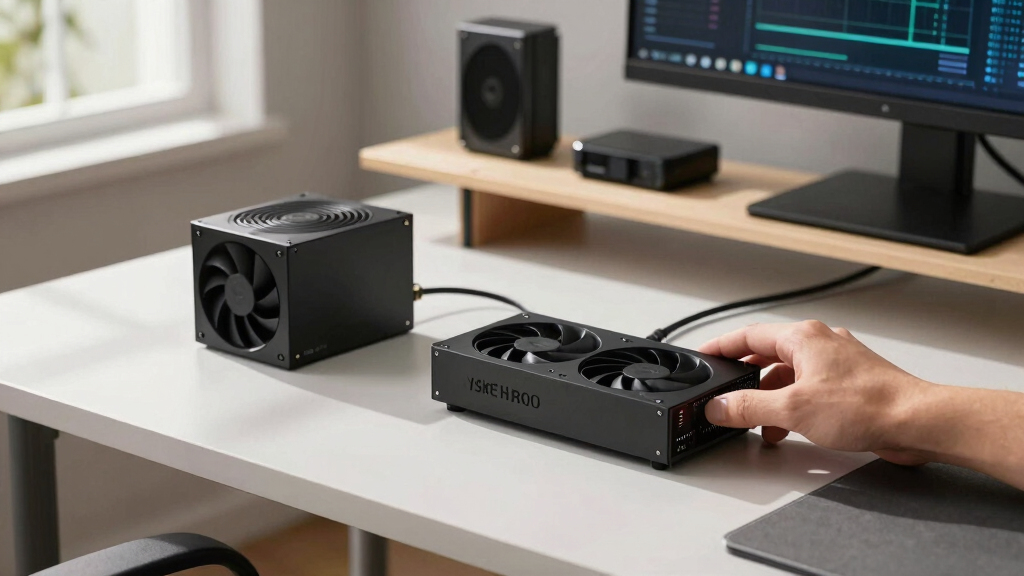

📊 Full opportunity report: The Real Cost Of A Local-Inference Rig In 2026 on ThorstenMeyerAI.com — validation score, market gap, and execution plan.

Get the latest gadgets delivered free — and shop member deals
- Fast, free delivery on millions of items
- Access to Prime Big Deal Days deals on October 6–7
- Prime Video, Amazon Music and more included
TL;DR
Owning a local inference rig in 2026 involves significant hardware costs, primarily driven by VRAM needs. Used GPUs like the RTX 3090 offer better value than newer flagship cards for inference tasks. The choice of hardware depends on model size and budget, with multi-GPU setups and Apple Silicon options emerging as alternatives.
In 2026, the cost of building a local AI inference rig is dominated by VRAM capacity and the specific model size targeted, making hardware choices crucial for cost-effectiveness. Recent analyses reveal that owning hardware can be more economical than cloud renting for steady, high-utilization AI workloads, but only if the hardware fits the model’s VRAM requirements.
The core challenge in local inference hardware lies in the VRAM cliff: if a model exceeds the GPU’s VRAM, inference speed drops by 5 to 20 times, rendering it impractical. For example, a 70B parameter model requires approximately 43GB of VRAM at full precision, pushing most single GPUs to their limits. Model compression techniques like quantization (Q4) help reduce memory needs, enabling smaller models to run on more affordable hardware.
Hardware choices are driven by VRAM capacity rather than raw compute power, with used GPUs like the RTX 3090 (24GB) offering superior VRAM-per-dollar ratios compared to newer flagship cards such as the RTX 5090. Multiple used 3090s can be pooled via NVLink to handle larger models cost-effectively.
For models larger than 70B parameters, multi-GPU setups or large Macs with >60GB RAM become necessary, increasing costs significantly. The article emphasizes that the value metric is VRAM per dollar, not raw performance, which favors older, used hardware for inference tasks.
The real cost of a local-inference rig
Owning beats renting for steady AI work — so what does a local rig cost in 2026? The unintuitive, good news: the most expensive build is almost never the smartest one. It all comes down to one rule.
The difference is only whether the weights fit. LLM inference is memory-bandwidth-bound — VRAM capacity is the hard limit you build around. Compute specs are mostly noise.
The squeeze reframes the rig like everything else in this series: discipline beats maximalism. VRAM is exactly the memory under most pressure, so over-buying it is the 128GB-“to-be-safe” trap, only worse per gigabyte. Take the cheap, high-value step to 24GB (the gateway to the 30B class), reach for used 3090s and MoE models, and use quantization to climb a tier without buying silicon. Sized right, the rig pays for itself against the cloud’s ever-rising hidden bill. Next: Apple Silicon’s quiet memory advantage.
Implications of Hardware Choices for Cost-Effective AI Inference
Understanding hardware costs and VRAM limitations in 2026 is vital for organizations and individuals aiming to run large language models locally. Strategic hardware investments can reduce cloud dependency and ongoing expenses, but require careful balancing of VRAM capacity, model size, and budget. The trend toward multi-GPU setups and used hardware makes local inference more accessible and affordable, but only if aligned with the specific model requirements.
used NVIDIA RTX 3090 GPU for AI inference
As an affiliate, we earn on qualifying purchases.
As an affiliate, we earn on qualifying purchases.
2026 Hardware Landscape for Local AI Inference
Recent years have seen a shift from cloud reliance toward local inference, driven by privacy concerns and cost considerations. The hardware landscape is characterized by a VRAM cliff: models must fit into available GPU memory to run efficiently. Model sizes range from small 7–8B models manageable on entry-level GPUs to 100B+ giants requiring multi-GPU or large-memory Macs.
Older GPUs like the RTX 3090 remain highly valuable for inference due to their VRAM capacity and cost-efficiency, especially when pooled via NVLink. The trend toward quantization (Q4) also makes larger models more feasible on consumer hardware.
“For inference, VRAM capacity trumps raw compute power; fitting the model in memory is the key to speed and cost-efficiency.”
— Thorsten Meyer
high VRAM graphics card for machine learning
As an affiliate, we earn on qualifying purchases.
As an affiliate, we earn on qualifying purchases.
Unresolved Questions About Future Hardware and Models
It remains unclear how rapidly hardware prices will change and whether new GPU architectures will alter the VRAM-per-dollar landscape. Additionally, the impact of emerging model compression techniques and unified memory systems like Apple Silicon on local inference costs is still evolving. The feasibility of large models on consumer hardware continues to depend on future developments in both hardware and software optimization.
multi-GPU NVLink bridge for AI workloads
As an affiliate, we earn on qualifying purchases.
As an affiliate, we earn on qualifying purchases.
Next Steps for Building Cost-Effective Local Inference Setups
In the coming months, expect further analysis on the evolving hardware market, including the availability and pricing of used GPUs. Advances in model quantization and multi-GPU pooling will likely improve affordability. Users aiming for local inference should monitor hardware prices, test multi-GPU configurations, and consider alternative architectures like Apple Silicon for large models.
As an affiliate, we earn on qualifying purchases.
Key Questions
What is the main hardware cost factor for local inference in 2026?
The primary cost factor is VRAM capacity. Models must fit into available GPU memory to run efficiently, making VRAM size and cost per gigabyte critical considerations.
Are newer GPUs always better for local inference?
Not necessarily. For inference, VRAM-per-dollar is more important than raw compute power. Older GPUs like the RTX 3090 often offer better value due to their higher VRAM at lower prices.
Can multi-GPU setups reduce costs?
Yes. Pooling multiple used GPUs via NVLink can provide large VRAM pools at a lower total cost, enabling larger models to run locally without the expense of the latest flagship cards.
What hardware options exist for very large models?
Large models (>70B parameters) typically require multi-GPU rigs, large-memory Macs, or Apple Silicon systems with unified memory, which tend to be more costly and complex to set up.
Will model compression techniques change hardware needs?
Yes. Quantization and other compression methods can reduce VRAM requirements, making larger models feasible on more affordable hardware, but the impact on model quality varies.
Source: ThorstenMeyerAI.com
Fall Picks
fall essentials
As an affiliate, we earn on qualifying purchases.