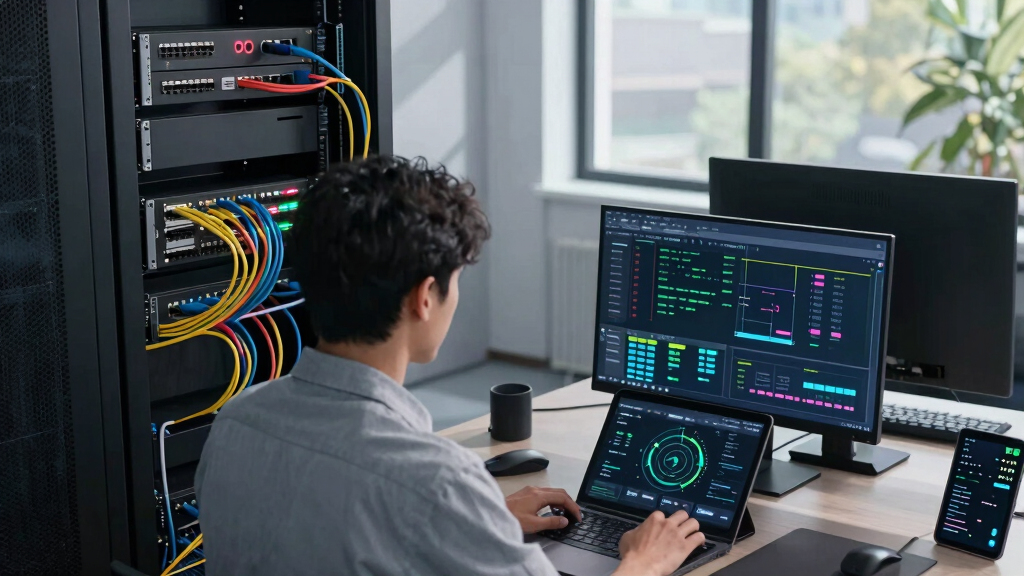

📊 Full opportunity report: Why The AI Bottleneck Is Moving Toward Data Plumbing Challenges on ThorstenMeyerAI.com — validation score, market gap, and execution plan.

Get the latest gadgets delivered free with Prime
- Fast, free delivery on millions of items
- Prime Video, Amazon Music and more included
- Member-only deals all year
TL;DR
The primary bottleneck in AI deployment has moved from model capability to data infrastructure and integration. Small operators owning their entire stack have a competitive advantage, shifting the industry focus to orchestration and governance.
Recent industry reports confirm that the majority of AI deployment challenges in 2026 now center on system integration and infrastructure, rather than model performance or cost. This is related to the power bottleneck in AI data centers. This shift is reshaping competitive dynamics, favoring operators who own their entire tech stack. Controlling infrastructure is crucial, especially considering the power bottleneck in AI data centers.
Multiple surveys and analyses, including the Anthropic State of AI Agents report, indicate that 46% of teams building AI agents cite integration with existing systems as their primary obstacle. This includes connecting to CRMs, internal APIs, and databases, rather than model capabilities or expenses. The industry is witnessing a transition where orchestration frameworks and governance protocols are becoming the new battlegrounds.
While model capabilities have matured and become commoditized—reflected in rapid refresh cycles and open-weight prices—the infrastructure layer remains complex, expensive, and fragmented. The ongoing cost of inference, projected to surpass $150 billion in 2026, dwarfs training expenses and underscores the importance of efficient, integrated data infrastructure pipelines.
This environment favors small, vertically integrated operators who can control every layer of their stack, avoiding the ‘integration tax’ that enterprise systems face. A recent demonstration by a solo operator shows how owning the entire infrastructure can bypass the bottleneck, enabling rapid deployment of specialized AI products.
The Agent Bottleneck Moved —
It’s Not the Models, It’s the Plumbing
Same-day-verified meta-trend · the one finding the conflicting surveys agree on
The survey chaos, plotted honestly
The inversion
2024–25: WHICH MODEL?
Capability was scarce, so the model was the moat. That race now resets weekly — frontier-class open weights every few weeks, from multiple labs.
2026: WHOSE PLUMBING?
Orchestration, tool access, evaluation harnesses, queues, audit trails, inference economics. Capability commoditized; infrastructure didn’t.
STEELMAN: WHY ENTERPRISES ARE SLOW
Not stupidity — their agents touch payroll, patients, and production, where cascading failures have consequences a solo builder’s stack never faces. Bounded autonomy and governance gaps are rational responses to real risk. Small operators defer that reckoning; they don’t escape it.
The signal: stop watching model benchmarks to predict who wins the agent era. Watch who owns the plumbing. The bottleneck moved there, the money is following — and the structural advantage runs, for once, toward operators small enough to own their whole stack.
Implications of Infrastructure-Centric AI Development
This shift signifies that the competitive advantage in AI is moving away from model innovation towards system integration, orchestration, and governance. Companies that own their entire stack can deploy faster and more reliably, reducing the impact of the widespread ‘integration bottleneck.’ This trend could democratize AI innovation, enabling smaller players to compete with large enterprises, provided they manage their infrastructure effectively.
Furthermore, the focus on infrastructure investment may reshape the AI market, with increased spending on orchestration tools, evaluation pipelines, and governance frameworks. As a result, the industry is transitioning from a model-centric race to one driven by system architecture and operational control.
As an affiliate, we earn on qualifying purchases.
The Evolving Landscape of AI Infrastructure in 2026
Historically, advancements in AI have been driven by improvements in model architecture and training data. However, recent data shows that, by 2026, the bottleneck has shifted to system integration and infrastructure. Surveys from Gartner, EY, and other industry trackers reveal a wide variance in reported adoption rates, but a consistent finding across sources is that integration challenges dominate deployment hurdles.
The industry has seen rapid progress in model capabilities, with frontier models now refreshing on a weekly cycle and available at open-weight prices. Yet, the infrastructure—comprising orchestration layers, APIs, security, and governance—lags behind, creating a friction point for scaling AI in enterprise environments. This has led to a new focus on building resilient, standardized pipelines that can handle complex, regulated systems.
The trend aligns with broader industry observations that the cost of inference is now a primary driver of AI economics, surpassing training costs and shifting the competitive landscape towards infrastructure ownership.
“Owning our entire stack allows us to deploy AI solutions without the costly and slow integration processes enterprise systems face.”
— a small operator
As an affiliate, we earn on qualifying purchases.
Unresolved Questions About Infrastructure and Deployment
While the trend toward infrastructure bottlenecks is clear, it remains uncertain how quickly enterprises will adapt their architectures or whether new standards will emerge to simplify integration. The precise impact of governance and security requirements on deployment speed is still being evaluated, and the extent to which small operators can scale without facing enterprise-level compliance challenges remains unclear.
As an affiliate, we earn on qualifying purchases.
Next Steps for Industry and Developers in 2026
Industry players are expected to accelerate investments in orchestration, evaluation, and governance tools over the coming months. Large vendors and small operators alike are racing to own the connective tissue that links models to enterprise systems, with a focus on creating standardized, scalable pipelines. Monitoring how these infrastructural innovations influence deployment speed and security will be critical in the second half of 2026.
Furthermore, as inference costs continue to dominate AI economics, expect increased emphasis on optimizing inference pipelines, reducing latency, and improving reliability—especially for mission-critical applications.
As an affiliate, we earn on qualifying purchases.
Key Questions
Why has the focus shifted from model capabilities to infrastructure?
Because models have become commoditized and capable enough, the bottleneck now lies in integrating them securely and reliably with existing enterprise systems, which is complex and costly.
How does owning the entire stack benefit small operators?
Owning all layers of infrastructure allows small operators to bypass costly and slow integration processes, enabling faster deployment and innovation.
Will this trend make AI deployment easier for enterprises?
Potentially, if standardized orchestration and governance frameworks mature, but currently, integration remains a significant challenge due to legacy systems and security concerns.
What is the biggest financial impact of this shift?
The ongoing cost of inference, projected to exceed $150 billion in 2026, is now the primary expense in AI deployment, emphasizing the importance of infrastructure efficiency.
Are small operators at a disadvantage despite owning their stack?
While they can avoid integration bottlenecks, small operators still face challenges in scaling and passing security reviews for enterprise deployment, which can limit their reach.
Source: ThorstenMeyerAI.com
Fall Picks
fall essentials
As an affiliate, we earn on qualifying purchases.