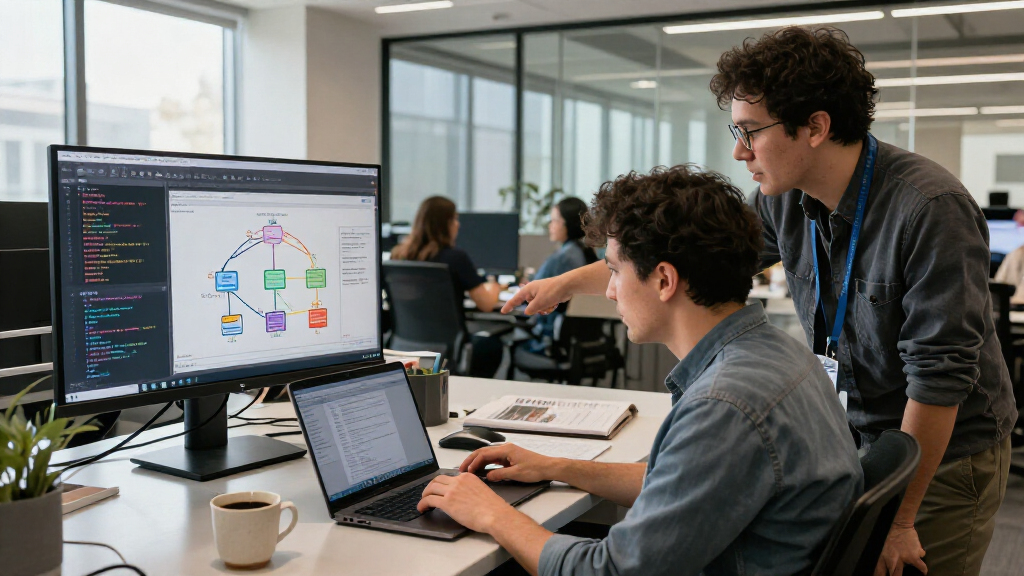

🔍 Read the full analysis: How AI Could Change Career Paths In The Workforce Middle on ThorstenMeyerAI.com

Get the latest gadgets delivered free with Prime
- Fast, free delivery on millions of items
- Prime Video, Amazon Music and more included
- Member-only deals all year
TL;DR
Computerization helped shrink the share of U.S. work hours in middle-skill occupations from 38% in 1970 to 23% in 2016, as routine office and production tasks were automated. Economist David Autor argues that AI differs from earlier computers and could either pressure higher-skill work or help rebuild middle-skill roles; that remains an argument, not a settled forecast.
Computers helped reduce middle-skill work in the United States over several decades, and economist David Autor argues AI could change that pattern—but he presents this as an argument, not a forecast. A November 25 article from ThorstenMeyerAI.com traces how software took over codifiable office and production tasks, helping reshape career options for workers without college degrees.
The article draws on Autor’s research to describe a shift in the U.S. job mix. In a 2019 lecture, he grouped work hours into low-, middle- and high-skill categories: middle-skill jobs accounted for 38.4% in 1970 and 23.3% in 2016. Over the same period, high-skill work rose from 30.2% to 46.2%, while low-skill work moved from 31.4% to 30.6%. These figures describe shares of work hours, not the number of people in each category.
The mechanism, as described in the article, was the automation of routine tasks that could be written as explicit steps. Bookkeeping calculations, record sorting and repeated production-line movements were among the kinds of tasks computers could perform. The article cites a 2003 study by Autor, Frank Levy and Richard Murnane on routine work, and says many such tasks were concentrated in middle-paying occupations.
Work requiring judgment, persuasion or problem-solving was less readily codified, while hands-on services performed in changing, in-person settings also proved difficult to automate. The article says computers could support professionals by reducing information-gathering time, while many service roles remained dependent on human labor. It presents AI as potentially different: Autor argues that it may be weaker at fixed rules and stronger at learning from examples.
Infographic 01 · The number to remember
The middle fell from 38% to 23%
In 1970, more than a third of all US work hours were in middle-skill jobs. By 2016, less than a quarter. In total the middle mostly moved up; workers without a degree mostly moved down.
US · share of all work hours · 1970 → 2016
US workers without a college degree · share of their work in middle-skill jobs
Why the middle?
- Routine tasks follow rules that can be written down: bookkeeping sums, filing records, repeating a movement on a line. Computers took them over (Autor, Levy & Murnane, 2003).
- Top: judgment and problem solving, made more productive by computers. Bottom: hands-on work in person (food service, cleaning, care, security), hard to program.
Autor (2019): US Current Population Survey, ages 16-64, hours worked; low = service and manual, middle = production, office and sales, high = professional, technical and managerial occupations. Service-job growth: Autor & Dorn (2013), Census/ACS hours.
Sources: D. Autor, Work of the Past, Work of the Future, NBER WP 25588 (2019); Autor & Dorn, American Economic Review 103(5), 2013.
Powered by Thorsten Meyer AI
How Automation Reshaped the Job Ladder
The history matters because career paths can change even when employment does not simply disappear. As routine tasks move to software, occupations may lose tasks, change their skill requirements or decline, while work expands elsewhere. For workers who once could enter stable office or production jobs without a degree, that can mean fewer routes into the middle of the labor market.
The article’s account also cautions against treating automation as a uniform threat. Past computerization benefited some professional work, did not readily replace many in-person service tasks and reduced the relative share of middle-skill occupations. AI’s effect could differ by task and occupation, and an overall shift in job shares does not tell readers which workers will gain, lose or move into new roles.
That uncertainty has practical implications for employers, educators and workers planning training. If AI handles some tasks that previously required professional expertise, it may alter higher-paying roles. If it helps workers perform tasks now requiring more experience or specialized knowledge, it could also support new or redesigned middle-skill jobs. Those are possibilities raised by the argument, not reported outcomes.
Products Worth Considering

Apple AirPods Pro (2nd Generation) Wireless Earbuds with USB-C MagSafe Charging Case

Bose Lifestyle Ultra Wireless Home Speaker, White Smoke

Samsung 27-Inch Odyssey OLED G6 QHD Gaming Monitor (G61SH)
As an affiliate, we earn on qualifying purchases.
Why Computers Hit Routine Work
After the Second World War, U.S. automation did not prevent the middle of the labor market from growing. The article says that as agricultural employment declined between 1940 and 1980, clerical and sales work expanded, alongside professional, technical and managerial employment. Large organizations, including hospitals and universities, employed professionals as well as clerical staff to support them.
The pattern shifted around 1980, according to the article’s summary of Autor’s work: professional and managerial jobs continued to grow, while skilled blue-collar work and clerical and sales roles reversed direction. Researchers explain part of this through the difference between tasks that can be codified and tasks that depend on tacit judgment. Philosopher Michael Polanyi’s phrase, “We know more than we can tell,” captures why some human abilities are hard to express as computer instructions.
Economists Maarten Goos and Alan Manning named a related pattern “lousy and lovely jobs” in a 2003 paper on Britain: employment grew in higher-paid professional and managerial jobs and lower-paid service work, while jobs between them lost share. The article says similar middle-job declines appeared in the European countries it reviewed, though the scale varied, and that Japan moved in the same direction more slowly.
AI’s Effect on Jobs Is Unsettled
No evidence in the source establishes that AI has already reversed job polarization or shows how many jobs it will create or displace. Autor’s claim about AI’s capabilities is presented as an interpretation of how the technology may differ from earlier computing, not as a measured labor-market result.
The article does not provide a specific timeline, occupation-by-occupation forecast or estimate of how AI adoption will affect wages and hiring. It also does not establish whether AI will complement workers, replace particular tasks, or do both within the same job. Outcomes may vary by workplace and by the tasks involved.
Watch for Changes in Job Tasks
The next evidence will come from how employers adopt AI and whether that adoption changes job duties, staffing, wages and training needs. Tracking tasks within occupations—not only job titles will help distinguish software that assists workers from systems that replace work they previously performed.
Further labor-market data can show whether middle-skill employment shares stabilize, decline further or grow in new forms. Until those changes are measured, the historical account offers a framework for asking what AI can do, but not a definitive prediction of which career paths will expand.
Key Questions
What does job polarization mean?
Job polarization describes a shift in employment toward higher- and lower-paid work as middle-paying occupations lose share. The article uses the term for changes associated in part with automation of routine tasks.
How much did the U.S. middle-skill share change?
In figures attributed to David Autor’s 2019 lecture, middle-skill occupations accounted for 38.4% of U.S. work hours in 1970 and 23.3% in 2016. These are shares of work hours, not counts of workers.
Why did computers affect middle-skill jobs?
Many middle-skill roles included routine tasks that could be specified as rules, such as basic calculations, record sorting and repeated production steps. Computers could perform those codifiable tasks, while other parts of work remained harder to automate.
Will AI bring middle-skill jobs back?
That is not known. David Autor argues AI may work differently from earlier computers and could help rebuild middle-skill roles, but the article describes this as an argument, not a confirmed trend or forecast.
Source: ThorstenMeyerAI.com