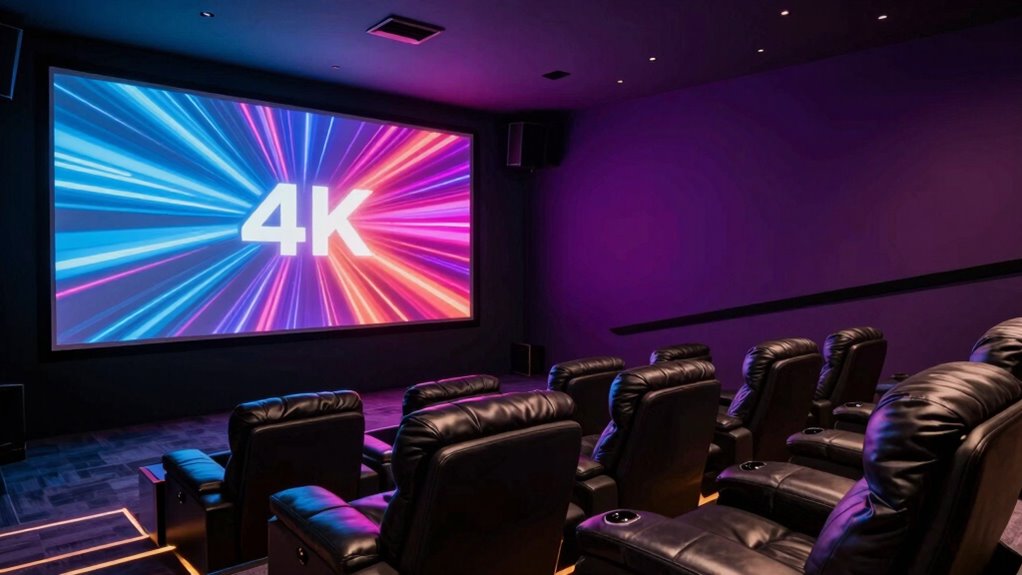

When searching for the best 4k projectors with HDR tone mapping, it’s essential to balance image quality, brightness, and color accuracy. The Optoma GT3900UHD stands out as the best overall choice, offering true 4K resolution paired with HDR compatibility in a short-throw design. For those prioritizing cinematic color, the BenQ HT5550 delivers rich Rec. 709 and DCI-P3 coverage, ensuring vivid images. Meanwhile, the Sony VPL-XW5000ES provides a premium, laser-based experience with excellent HDR tone mapping. Buyers often face tradeoffs between price, brightness, and color accuracy—continue reading to see how these options compare across key features.

Get the latest gadgets delivered free with Prime
- Fast, free delivery on millions of items
- Prime Video, Amazon Music and more included
- Member-only deals all year
Complete the kit



Key Takeaways
- Top projectors combine true 4K resolution with advanced HDR tone mapping for vibrant, detailed images.
- Brightness levels vary widely, impacting usability in different lighting conditions—higher lumens are better for bright rooms.
- Laser light sources generally offer longer lifespan and more consistent HDR performance compared to lamp-based models.
- Color coverage, especially DCI-P3 and Rec. 709, is a significant factor for cinematic realism.
- Price often correlates with features like brightness, build quality, and sophisticated tone mapping—more expensive models tend to perform better with HDR.
| Optoma GT3900UHD – True 4K UHD, 4,000 Lumens, DuraCore 30,000-Hour Laser, Golf Simulator Ready, HDR Compatible, Low Input Lag Gaming, Short Throw Laser Projector |  | Best Overall for Versatile 4K HDR Gaming and Short-Throw Needs | Resolution: True 4K UHD | Brightness: 4,000 lumens | Laser Lifespan: 30,000 hours | VIEW ON AMAZON | See Our Full Breakdown |
| Epson Home Cinema 3800 4K PRO-UHD 3-Chip 3LCD Projector with HDR |  | Best for Bright, Vivid Home Theater with Excellent Color Fidelity | Resolution: Pixel-shift 4K | Brightness: 3,000 lumens | Contrast Ratio: 100,000:1 | VIEW ON AMAZON | See Our Full Breakdown |
| JVC LX-NZ30W 4K HDR Home Theater Laser Projector |  | Best for Long-Term Durability and Versatile Connectivity | Resolution: Pixel-shift 4K | Brightness: 3,300 lumens | Laser Life: 20,000 hours | VIEW ON AMAZON | See Our Full Breakdown |
| Epson QB1000 4K HDR Laser Projector, 3,300 Lumens (Black) |  | Best for Easy Setup and Versatile HDR in Bright Rooms | Resolution: Pixel-shift 4K | Brightness: 3,300 lumens | Laser Life: 20,000 hours | VIEW ON AMAZON | See Our Full Breakdown |
| XGIMI Horizon 20 4K RGB Triple Laser Home Projector, 3200 ISO Lumens |  | Best for Premium Cinematic Experience and Gaming Features | Resolution: Native 4K | Brightness: 3,200 ISO lumens | Contrast Ratio: High (exact ratio not specified) | VIEW ON AMAZON | See Our Full Breakdown |
| ViewSonic PX701-4K UHD Projector, 3200 ANSI Lumens, 240Hz, HDR, Auto Keystone DLP |  | Best for Gaming and Bright Rooms | Resolution: 4K UHD (3840x2160p) | Brightness: 3,200 ANSI lumens | Refresh Rate: 240Hz | VIEW ON AMAZON | See Our Full Breakdown |
| Optoma UHZ36 4K UHD Laser HDR Home Theater Projector – Black |  | Best for High-Contrast Home Theater | Resolution: 4K UHD | Display Technology: Laser | HDR Support: Yes | VIEW ON AMAZON | See Our Full Breakdown |
| Sony VPL-XW5000ES 4K HDR Laser Home Theater Projector, Black |  | Best for Native 4K and Premium Color | Resolution: Native 4K (SXRD 3,840 x 2,160) | Brightness: 2,000 lumens | Light Source: Laser | VIEW ON AMAZON | See Our Full Breakdown |
| Epson Home Cinema 5050UB 4K PRO-UHD 3-Chip LCD Projector with HDR |  | Best for Accurate, Colorful HDR Content | Projection Technology: 3-Chip 3LCD | Resolution: 4K PRO-UHD (pixel-shift) | HDR Support: Full 10-bit | VIEW ON AMAZON | See Our Full Breakdown |
| BenQ HT5550 True 4K UHD Home Theater Projector with HDR-PRO | 100% DCI-P3 & 100% Rec. 709 for Best Colors | Frame Interpolation for Fluid Picture, Black |  | Best for Advanced Tone Mapping in Dark Rooms | HDR Technology: HDR-PRO with Active Iris | Color Gamut: 100% DCI-P3, 100% Rec. 709 | Frame Interpolation: Yes | VIEW ON AMAZON | See Our Full Breakdown |
| LG HU810PW 4K UHD Smart Dual Laser CineBeam Projector (White) |  | Best Overall for Large-Scale Home Cinema | Resolution: 4K UHD (3840 x 2160) | Max Screen Size: 300 inches | Brightness: 2700 ANSI lumens | VIEW ON AMAZON | See Our Full Breakdown |
| Epson Home Cinema LS11000 4K PRO-UHD Laser Projector with HDR10+ |  | Best for Bright Rooms with Accurate Colors | Resolution: 3840 x 2160 (4K PRO-UHD) | Brightness: 2,500 lumens | Contrast Ratio: 1,200,000:1 | VIEW ON AMAZON | See Our Full Breakdown |
| BenQ W4100i 4K HDR Smart Home Theater Projector, 3200 Lumens |  | Best for Flexible Installations and Long-Lasting LED Light Source | Resolution: 3840 x 2160 (4K UHD) | Brightness: 3200 lumens | Light Source: LED (10+ years) | VIEW ON AMAZON | See Our Full Breakdown |
| KOGATA GC357 Smart Projector with WiFi and Bluetooth, 4K Decoding, AI Auto Focus, 6D Keystone, Dolby Audio, HDR10+ |  | Best for Compact, Cost-Effective 4K Decoding with Smart Features | Native Resolution: 1920 x 1080 | Max Display Resolution: 3840 x 2160 | Brightness: 550 lumens | VIEW ON AMAZON | See Our Full Breakdown |
| 4k projectors with hdr tone mapping | Resolution | Brightness | HDR Support |
|---|---|---|---|
| Optoma GT3900UHD | True 4K UHD | 4,000 lumens | — |
| Epson Home Cinema 3800 4K PRO- | Pixel-shift 4K | 3,000 lumens | Full 10-bit |
| JVC LX-NZ30W 4K HDR Home Theat | Pixel-shift 4K | 3,300 lumens | HDR10, HLG |
| Epson QB1000 4K HDR Laser Proj | Pixel-shift 4K | 3,300 lumens | HDR10, HDR10+, HLG |
| XGIMI Horizon 20 4K RGB Triple | Native 4K | 3,200 ISO lumens | Dolby Vision, HDR10+ |
| ViewSonic PX701-4K UHD Project | 4K UHD (3840x2160p) | 3,200 ANSI lumens | HDR/HLG |
| Optoma UHZ36 4K UHD Laser HDR | 4K UHD | — | Yes |
| Sony VPL-XW5000ES 4K HDR Laser | Native 4K (SXRD 3,840 x 2,160) | 2,000 lumens | — |
| Epson Home Cinema 5050UB 4K PR | 4K PRO-UHD (pixel-shift) | 2,200 lumens | Full 10-bit |
| BenQ HT5550 True 4K UHD Home T | — | — | — |
| LG HU810PW 4K UHD Smart Dual L | 4K UHD (3840 x 2160) | 2700 ANSI lumens | HDR10 and HLG |
| Epson Home Cinema LS11000 4K P | 3840 x 2160 (4K PRO-UHD) | 2,500 lumens | HDR10+, HDR, HLG |
| BenQ W4100i 4K HDR Smart Home | 3840 x 2160 (4K UHD) | 3200 lumens | HDR10+ |
| KOGATA GC357 Smart Projector w | — | 550 lumens | HDR10+ |
More Details on Our Top Picks
Optoma GT3900UHD – True 4K UHD, 4,000 Lumens, DuraCore 30,000-Hour Laser, Golf Simulator Ready, HDR Compatible, Low Input Lag Gaming, Short Throw Laser Projector
The Optoma GT3900UHD stands out for its true 4K resolution combined with a short throw lens, making it ideal for smaller spaces and immersive golf simulations. Its 4,000 lumens brightness ensures vibrant images even in ambient-lit rooms, and HDR compatibility enhances contrast and color depth. Compared to the Epson QB1000, which relies on pixel-shifting, this model offers genuinely sharp 4K detail, though it trades some native resolution for affordability. The low input lag and support for 4K/60Hz gaming make it a strong choice for gamers, but it’s less suited for dedicated home theater setups where native 4K panels might matter more. The laser’s long lifespan reduces maintenance, but the short throw lens limits placement flexibility outside specific use cases like gaming or golf simulation.
Pros:- True 4K UHD resolution for sharp, detailed imagery
- Bright 4,000 lumens performance works well in ambient light
- Short throw lens ideal for small spaces and golf simulators
- Low input lag suits fast-paced gaming
Cons:- Limited placement flexibility due to short throw design
- Does not feature native 4K panels, relying on pixel-shifting
Best for: Gamers and golf enthusiasts who want a compact, bright, true 4K laser projector with short-throw capabilities.
Not ideal for: Home theater purists seeking native 4K panels or larger, dedicated cinema setups, as the short throw limits placement options.
- Resolution:True 4K UHD
- Brightness:4,000 lumens
- Laser Lifespan:30,000 hours
- Throw Ratio:0.496:1
- HDR Compatibility:Yes
- Input Lag:Low (supports 1080p at 240Hz)
Our verdict“Best suited for gamers and compact spaces needing true 4K resolution with HDR support.”
Epson Home Cinema 3800 4K PRO-UHD 3-Chip 3LCD Projector with HDR
The Epson Home Cinema 3800 offers a compelling blend of color accuracy and brightness, thanks to its 3-chip 3LCD technology. It delivers 3,000 lumens of both color and white brightness, providing vibrant images even in well-lit rooms, a notable advantage over pixel-shifting models like the JVC LX-NZ30W. Its full 10-bit HDR support and high contrast ratio produce rich, detailed images, but the pixel-shifting method means it doesn’t feature native 4K resolution, which may matter to cinephiles seeking pixel-perfect clarity. The inclusion of dual 10W speakers and Bluetooth adds convenience, but the limited internal audio power may necessitate external sound systems for larger rooms. Overall, this projector appeals to home theater enthusiasts prioritizing vivid color and bright images over native 4K resolution.
Pros:- Bright 3,000 lumens for ambient-lit environments
- Excellent color and contrast with 3-chip 3LCD technology
- Full 10-bit HDR support enhances contrast and depth
- Built-in Bluetooth and dual 10W speakers add convenience
Cons:- Uses pixel-shifting to simulate 4K resolution, not native 4K
- Limited internal audio power may require external speakers
Best for: Homeowners seeking a bright, color-accurate projector for lively movie nights and HDR content in well-lit spaces.
Not ideal for: Purists wanting native 4K panels or those prioritizing ultra-sharp detail over brightness and vivid color.
- Resolution:Pixel-shift 4K
- Brightness:3,000 lumens
- Contrast Ratio:100,000:1
- HDR Support:Full 10-bit
- Speakers:Dual 10W
- HDMI:HDMI 2.0
Our verdict“Ideal for viewers prioritizing brightness and vivid color in ambient-lit rooms over native 4K resolution.”
JVC LX-NZ30W 4K HDR Home Theater Laser Projector
The JVC LX-NZ30W emphasizes longevity and flexible setup with a laser phosphor light source that lasts up to 20,000 hours and a manual zoom and focus. Its 3,300 lumens brightness comfortably handles rooms with some ambient light, and HDR10 and HLG support ensure good contrast and color depth. Compared to the Optoma GT3900UHD, which offers shorter throw capabilities, the JVC’s manual zoom might be less convenient but allows for more flexible placement. Its use of pixel-shifting technology means it isn’t native 4K, but the automatic picture mode selection and tone mapping improve HDR performance. The broad connectivity options, including HDMI 2.3 and DisplayPort, make it suitable for various devices. This model suits those looking for a reliable, long-term home theater projector with good HDR support.
Pros:- Bright 3,300 lumens laser light source for ambient light handling
- Long 20,000-hour laser lifespan reduces maintenance
- Supports HDR10 and HLG with automatic tone mapping
- Flexible connectivity options including HDMI 2.3 and DisplayPort
Cons:- Manual zoom and focus may complicate setup
- Pixel-shifting technology does not produce native 4K resolution
Best for: Home theater enthusiasts who value long-term durability and flexible installation options in a dedicated viewing room.
Not ideal for: Setup novices or those needing a native 4K panel for the sharpest possible image quality.
- Resolution:Pixel-shift 4K
- Brightness:3,300 lumens
- Laser Life:20,000 hours
- HDR Support:HDR10, HLG
- Connectivity:HDMI 2.3, DisplayPort
Our verdict“Best for users seeking a durable, feature-rich HDR projector with flexible placement options for dedicated home theaters.”
Epson QB1000 4K HDR Laser Projector, 3,300 Lumens (Black)
The Epson QB1000 offers a compelling option for those needing a bright, reliable projector capable of HDR support. Its 3,300 lumens brightness and 20,000-hour laser life make it suitable for rooms with ambient light, and the motorized lens shift with 10 memory positions simplifies installation. Compared with the JVC LX-NZ30W, the Epson’s setup features are more user-friendly, especially for non-experts. Like others in pixel-shifting, it doesn’t feature native 4K panels, but its wide connectivity—including HDMI 2.0 and USB-C—ensures compatibility with most devices. The tradeoff involves relying on pixel-shifting for 4K, which might not satisfy those demanding the highest native resolution, but it delivers excellent color and HDR performance for everyday use.
Pros:- Bright 3,300 lumens for well-lit environments
- Motorized lens shift with multiple memory positions for easy setup
- Supports HDR10, HDR10+, and HLG for enhanced contrast
- Long-lasting laser light reduces maintenance
Cons:- Uses pixel-shifting technology instead of native 4K panels
- Focus and zoom are manual, requiring effort during setup
Best for: Home users seeking an easy-to-install HDR projector with strong brightness and flexible placement.
Not ideal for: Cinephiles wanting native 4K resolution or those prioritizing ultra-sharp detail over ease of setup.
- Resolution:Pixel-shift 4K
- Brightness:3,300 lumens
- Laser Life:20,000 hours
- HDR Support:HDR10, HDR10+, HLG
- Lens Shift:Motorized, 10 positions
Our verdict“Ideal for users needing a bright, easy-to-install HDR projector with flexible placement in casual or multi-purpose rooms.”
XGIMI Horizon 20 4K RGB Triple Laser Home Projector, 3200 ISO Lumens
The XGIMI Horizon 20 excels with an RGB triple laser engine producing 3,200 ISO lumens, offering vibrant, cinema-grade visuals supported by Dolby Vision and HDR10+. Its built-in Harman Kardon speakers and Google TV create a complete entertainment package, while gaming features like 240Hz refresh rate and 1ms response cater to gamers seeking smooth, responsive gameplay. Unlike pixel-shifting models like the Epson QB1000, it provides native 4K resolution, which results in sharper detail. However, its higher price point reflects its premium feature set, and its brightness, while excellent, may fall short in very bright environments. This projector is most suitable for dedicated home cinema rooms that double as gaming hubs, where native 4K and cinematic quality are priorities.
Pros:- Native 4K resolution with rich, detailed images
- RGB triple laser engine with 3,200 ISO lumens for vivid visuals
- Supports Dolby Vision, HDR10+, and IMAX Enhanced for cinematic quality
- Excellent gaming features including 240Hz, 1ms response, VRR
Cons:- Higher price compared to pixel-shifting models
- Brightness may be limiting in very bright rooms without controlled lighting
Best for: Home theater enthusiasts and gamers wanting native 4K resolution with immersive sound and advanced HDR support.
Not ideal for: Budget-conscious buyers or those needing a portable, ultra-bright projector for large spaces.
- Resolution:Native 4K
- Brightness:3,200 ISO lumens
- Contrast Ratio:High (exact ratio not specified)
- HDR Support:Dolby Vision, HDR10+
- Gaming Features:240Hz, 1ms, VRR
- Speakers:Harman Kardon
Our verdict“Best for home cinephiles and gamers seeking native 4K quality with premium HDR and sound features.”
ViewSonic PX701-4K UHD Projector, 3200 ANSI Lumens, 240Hz, HDR, Auto Keystone DLP
The ViewSonic PX701-4K stands out for delivering true 4K resolution combined with an impressive 3,200 lumens brightness, making it ideal for rooms with ambient light. Its 240Hz refresh rate and 4.2ms input lag position it as a top choice for gamers seeking smooth visuals and low latency, outperforming many competitors with less refresh rate support. While it offers excellent flexibility with auto-keystone and four-corner correction, its limited 1.1x zoom can restrict placement options, and it lacks built-in streaming apps, requiring external devices for content. Compared to the Sony VPL-XW5000ES, it offers a brighter image suited for practical living spaces but falls short on native 4K accuracy and advanced color processing.
Pros:- Bright 3,200 lumens for ambient light environments
- High refresh rate and low input lag ideal for gaming
- Flexible setup with auto-keystone and four-corner adjustment
Cons:- Limited 1.1x optical zoom restricts placement flexibility
- No built-in streaming apps, needs external devices
Best for: Gamers and families needing a bright, versatile projector for lively rooms
Not ideal for: Home theater enthusiasts seeking native 4K precision and advanced color grading
- Resolution:4K UHD (3840x2160p)
- Brightness:3,200 ANSI lumens
- Refresh Rate:240Hz
- Input Lag:4.2ms
- Max Screen Size:150 inches
- HDR Support:HDR/HLG
- Optical Zoom:1.1x
- Inputs:Dual HDMI, powered USB-A
- Mounting:Ceiling mount compatible
Our verdict“This projector is perfect for gamers and casual users in bright rooms but less suited for cinematic precision or smart features.”
Optoma UHZ36 4K UHD Laser HDR Home Theater Projector – Black
The Optoma UHZ36 excels as a dedicated home theater projector with 4K UHD resolution and laser illumination that promises long-term brightness stability. Its HDR support enhances contrast and color richness, while the inclusion of FILMMAKER MODE ensures content is displayed as intended by directors, a feature that elevates its cinematic appeal compared to less feature-rich models. However, its limited online reviews and lack of detailed performance metrics mean potential buyers should consider it as a high-end option requiring further research. This model is better suited for dark-room viewing where laser brightness and accurate tone mapping can be fully appreciated.
Pros:- 4K UHD resolution for sharp images
- Laser light source offers durability and consistent brightness
- HDR support enhances contrast and color depth
Cons:- Limited user reviews make real-world performance uncertain
- No integrated smart or streaming features
Best for: Home theater enthusiasts prioritizing accurate color and long-lasting brightness
Not ideal for: Bright room setups or casual gaming, where high lumen output and robust smart features are preferred
- Resolution:4K UHD
- Display Technology:Laser
- HDR Support:Yes
- Color:Black
- Brand:Optoma
- Model:UHZ36
Our verdict“This projector is ideal for dedicated home theaters seeking longevity and color accuracy, but may require external streaming solutions.”
Sony VPL-XW5000ES 4K HDR Laser Home Theater Projector, Black
The Sony VPL-XW5000ES offers native 4K resolution via SXRD panels, delivering highly detailed images that are ideal for discerning cinephiles. Its X1 Ultimate processing and TRILUMINOS PRO color technology ensure vibrant, true-to-life colors, surpassing pixel-shift or simulated 4K options. With a brightness of 2,000 lumens, it is better suited for dimmer rooms, but the laser source promises up to 20,000 hours of consistent performance. While its compact size and low input lag make it versatile, the relatively modest lumen output compared to bright-room projectors limits its use in well-lit areas. This model balances native 4K fidelity with premium tone mapping, making it ideal for dedicated dark-room viewing.
Pros:- Native 4K SXRD panel delivers true 4K resolution
- High-quality color with TRILUMINOS PRO technology
- Long-lasting laser light source up to 20,000 hours
Cons:- Lower brightness at 2,000 lumens limits ambient light use
- No built-in smart features or streaming apps
Best for: Cinephiles and home theater purists seeking native 4K clarity with premium color fidelity
Not ideal for: Bright living rooms or casual gaming setups where higher brightness and smart features are desired
- Resolution:Native 4K (SXRD 3,840 x 2,160)
- Brightness:2,000 lumens
- Light Source:Laser
- Light Source Life:Up to 20,000 hours
- Color Gamut:95% DCI-P3
- Input Lag:Under 21 ms (4K 60Hz)
Our verdict“This projector is best for dedicated dark-room settings where native 4K detail and rich colors are prioritized over brightness.”
Epson Home Cinema 5050UB 4K PRO-UHD 3-Chip LCD Projector with HDR
The Epson 5050UB combines 3LCD technology with pixel-shift enhancement to produce exceptionally sharp 4K images, while its full 10-bit HDR processing ensures rich, accurate tone mapping. Unlike single-chip DLP models, its 3-chip design eliminates rainbow artifacts, making it a favorite among viewers sensitive to color fringing. Its advanced black level capabilities and 12-bit digital imaging deliver smooth tonal transitions, although its 2,200 lumens brightness may fall short in bright rooms. This projector makes a clear choice for those who value color fidelity and subtle tone mapping over sheer brightness, especially in controlled lighting environments.
Pros:- 3-chip 3LCD design eliminates rainbow artifacts
- Full 10-bit HDR processing for accurate contrast
- Pixel-shift technology delivers sharp 4K images
Cons:- Lower brightness at 2,200 lumens limits use in bright environments
- Heavy and bulky chassis may be less flexible for placement
Best for: Home theater fans seeking natural color reproduction and smooth HDR tone mapping
Not ideal for: Bright rooms or users who prioritize high brightness over color accuracy and tone mapping finesse
- Projection Technology:3-Chip 3LCD
- Resolution:4K PRO-UHD (pixel-shift)
- HDR Support:Full 10-bit
- Video Processing:12-bit digital
- Brightness:2,200 lumens
Our verdict“This projector suits those requiring superb color accuracy and delicate tone mapping in a dim or controlled lighting space.”
BenQ HT5550 True 4K UHD Home Theater Projector with HDR-PRO | 100% DCI-P3 & 100% Rec. 709 for Best Colors | Frame Interpolation for Fluid Picture, Black
The BenQ HT5550 is tailored for serious cinephiles who want precise tone mapping and vibrant colors, thanks to its HDR-PRO technology with Active Iris and Dynamic Black. These features work together to boost perceived contrast, revealing shadow details while preventing bright scenes from washing out. Its support for 100% DCI-P3 and Rec. 709 ensures accurate, rich colors, making it a strong contender for those who demand cinematic fidelity. However, it may be overkill for casual viewing or bright living rooms due to its focus on contrast rather than high brightness. Compared to the Epson 5050UB, it offers better contrast and HDR tone mapping, but at a higher price point and with less brightness.
Pros:- Advanced HDR-PRO with Active Iris and Dynamic Black
- Supports 100% DCI-P3 and Rec. 709 for accurate colors
- Enhanced contrast reveals shadow details effectively
Cons:- Lower brightness may limit use in well-lit spaces
- Higher cost compared to some competitors
Best for: Home theater lovers wanting refined contrast and color in controlled lighting
Not ideal for: Bright rooms or casual users who need high lumen output for daylight viewing
- HDR Technology:HDR-PRO with Active Iris
- Color Gamut:100% DCI-P3, 100% Rec. 709
- Frame Interpolation:Yes
- Black Level:Enhanced with Dynamic Black
Our verdict“This projector is ideal for dedicated dark-room setups where precise tone mapping and color accuracy matter most.”
LG HU810PW 4K UHD Smart Dual Laser CineBeam Projector (White)
This model stands out for its ability to project true 4K UHD resolution on screens up to 300 inches, making it ideal for immersive home theater setups. Its dual laser technology not only provides a high brightness of 2700 ANSI lumens but also results in an impressive contrast ratio of 2,000,000:1, delivering vibrant, detailed images even in well-lit rooms. Compared with the Epson LS11000, it offers a larger maximum screen size and a more integrated smart platform, but at a likely higher cost and larger footprint. The wide 97% DCI-P3 color coverage ensures vivid, accurate colors, supported by HDR10 and HLG for dynamic range enhancements. The built-in webOS 5.0 platform with AirPlay, Miracast, and Bluetooth simplifies smart streaming, although its size and price may deter casual users or those with limited space.
Pros:- True 4K UHD resolution supporting up to 300-inch screens
- Exceptional contrast ratio of 2,000,000:1 for detailed dark scenes
- Wide 97% DCI-P3 color coverage with dual laser brightness
Cons:- Premium price point may be prohibitive for budget-conscious buyers
- Large form factor requiring dedicated installation space
Best for: Homeowners seeking a large, cinematic experience with integrated smart features and excellent HDR tone mapping.
Not ideal for: Those with limited space or budget constraints, as this projector’s size and premium price are significant factors.
- Resolution:4K UHD (3840 x 2160)
- Max Screen Size:300 inches
- Brightness:2700 ANSI lumens
- Contrast Ratio:2,000,000:1
- Color Coverage:97% DCI-P3
- HDR Support:HDR10 and HLG
Our verdict“This projector is perfect for dedicated home theaters where size and budget are secondary to image quality and smart features.”
Epson Home Cinema LS11000 4K PRO-UHD Laser Projector with HDR10+
The Epson LS11000 excels in delivering bright, vibrant images thanks to its 2,500 lumens of both color and white brightness, making it a strong choice for rooms with ambient light. Its true 3-chip 3LCD design effectively prevents rainbowing issues common in single-chip models like the KOGATA GC357, producing consistent, accurate colors. Compared to the LG HU810PW, it offers a more precise color rendition and better motion handling with a 120 Hz refresh rate, but it uses pixel-shifting technology rather than native 4K panels, which may slightly affect sharpness. The full 10-bit HDR processing with HDR10+ support ensures dynamic range is well handled, and its high contrast of over 1,200,000:1 enhances dark scene detail. Overall, this projector suits those who prioritize color accuracy and smooth motion over sheer size or raw brightness.
Pros:- High 2,500 lumens brightness suitable for ambient light conditions
- True 3LCD technology for consistent, rainbow-free images
- Full 10-bit HDR processing with HDR10+ support
Cons:- Pixel-shifting technology may result in slightly less sharpness compared to native 4K panels
- Premium price and size may be a barrier for some buyers
Best for: Home theater enthusiasts who want accurate colors and excellent HDR tone mapping in well-lit rooms.
Not ideal for: Users seeking native 4K resolution or ultra-large screens, as it relies on pixel-shifting technology and has moderate size limitations.
- Resolution:3840 x 2160 (4K PRO-UHD)
- Brightness:2,500 lumens
- Contrast Ratio:1,200,000:1
- HDR Support:HDR10+, HDR, HLG
- Refresh Rate:Up to 120 Hz
- Display Technology:3-Chip 3LCD
Our verdict“This projector is a great fit for users wanting accurate color and HDR performance in a variety of lighting conditions, with less concern about native 4K native resolution.”
BenQ W4100i 4K HDR Smart Home Theater Projector, 3200 Lumens
The BenQ W4100i offers a compelling mix of true 4K UHD resolution and HDR-PRO tone mapping, ensuring sharp detail and vibrant colors right out of the box. Its factory-calibrated 100% DCI-P3 coverage guarantees accurate colors, making it suitable for cinephiles who value color fidelity. The 3200 lumens LED light source provides long-term brightness with minimal maintenance—rated for over 10 years—making it well-suited for dedicated theaters or versatile setups. Compared with the KOGATA GC357, it provides a more robust installation with features like 2D lens shift and 1.3x zoom, but it lacks native 4K panels and has no built-in streaming apps, which means more setup complexity. Its flexible mounting options make it ideal for fixed installations but less so for portable use.
Pros:- True 4K UHD resolution with factory-calibrated 100% DCI-P3 color coverage
- Long-lasting LED light source rated for over 10 years
- Flexible installation with 2D lens shift and 1.3x zoom
Cons:- No built-in streaming apps, requiring external devices for content
- Pixel-shifting technology means slightly less sharpness than native 4K models
Best for: Home theater owners who want a durable, high-quality projector with flexible installation options and excellent HDR tone mapping.
Not ideal for: Casual users seeking a portable or budget-friendly option, or those who prefer native 4K panels over pixel-shifting technology.
- Resolution:3840 x 2160 (4K UHD)
- Brightness:3200 lumens
- Light Source:LED (10+ years)
- Contrast Ratio:Not specified
- HDR Support:HDR10+
- Lens Adjustment:2D lens shift
Our verdict“This projector suits users who prioritize long-term durability, flexible installation, and accurate HDR tone mapping over native 4K resolution or built-in streaming.”
KOGATA GC357 Smart Projector with WiFi and Bluetooth, 4K Decoding, AI Auto Focus, 6D Keystone, Dolby Audio, HDR10+
The KOGATA GC357 offers a native 1080P resolution with full 4K decoding, providing up to 3840 x 2160 pixels through software processing. Its key strength lies in smart features like AI auto focus, 6D keystone correction, and built-in streaming apps such as Netflix, YouTube, and Prime Video, making it accessible for casual users without external devices. Compared with the BenQ W4100i, it’s more compact and easier to set up but sacrifices native 4K resolution, which may impact overall sharpness. Its HDR10+ support enhances dynamic range, although its 550 lumens brightness limits daytime usability. The inclusion of Wi-Fi 6 and dual Bluetooth channels offers lag-free streaming and speaker pairing, making it a versatile portable option.
Pros:- Supports full 4K decoding with HDR10+ for enhanced dynamic range
- Built-in streaming apps (Netflix, YouTube, Prime Video) for convenience
- AI auto focus and 6D keystone for quick setup
Cons:- Native resolution is only 1080P, relying on decoding for 4K
- Brightness of 550 lumens may be insufficient in bright rooms
Best for: Budget-conscious users needing a smart, easy-to-use projector capable of decoding 4K content without native 4K panels.
Not ideal for: Those seeking native 4K resolution or high-brightness for daytime viewing, as the native resolution is 1080P and brightness is limited.
- Native Resolution:1920 x 1080
- Max Display Resolution:3840 x 2160
- Brightness:550 lumens
- HDR Support:HDR10+
- Connectivity:Wi-Fi 6, Bluetooth
- Auto Focus:Yes
Our verdict“This projector is best suited for casual users seeking smart features and 4K decoding in a portable, budget-friendly package, with some resolution compromises.”
How We Picked
The selection process focused on performance, usability, and value. I prioritized models with true 4K resolution and effective HDR tone mapping, emphasizing color accuracy and contrast. Brightness was also key, especially for versatile room conditions, alongside build quality and longevity of light sources. Cost-effectiveness was considered, but only when features justified the price. The ranking reflects a balance between these factors, aiming to guide buyers toward options that excel in HDR tone mapping without unnecessary compromises.Factors to Consider When Choosing 4k Projectors With Hdr Tone Mapping
Choosing a 4k projector with HDR tone mapping requires understanding several key aspects beyond basic specs. These factors affect image quality, usability, and overall value, helping you avoid common pitfalls like overestimating brightness or ignoring color coverage. A thoughtful approach ensures your investment delivers the cinematic experience you desire, whether for movies, gaming, or casual viewing.Brightness and Room Conditions
Brightness, measured in lumens, determines how well a projector performs in different lighting environments. Higher lumens are necessary for rooms with ambient light, ensuring images remain vivid without washing out. Conversely, in dark rooms, lower brightness levels may suffice and help with contrast and color accuracy. Matching your room’s lighting with projector brightness avoids disappointment and ensures HDR elements are properly visible.
HDR Tone Mapping and Compatibility
Effective HDR tone mapping is vital for accurate color and contrast, especially in scenes with high dynamic range. Not all projectors handle HDR equally; some may boost brightness but distort color or lose detail in dark areas. Look for models explicitly designed with advanced HDR processing and compatibility with HDR10+ or Dolby Vision if possible. These features enhance picture fidelity, making your viewing more lifelike and immersive.
Color Coverage and Accuracy
Color coverage, like DCI-P3 or Rec. 709, impacts how vibrant and true-to-life images appear. A projector with broader color gamuts delivers richer reds, greens, and blues, which is crucial for cinematic content. Be cautious of models claiming 4K resolution but lacking robust color processing—HDR benefits are only maximized when color fidelity is also high. Balance resolution with color performance for the most engaging experience.
Light Source Longevity and Maintenance
Laser light sources typically last longer and maintain performance better than traditional lamps, making them worth the higher initial cost for many users. They also tend to produce more consistent HDR tone mapping over time. However, laser projectors can be pricier and may have more complex cooling requirements. Weigh these factors against your budget and maintenance willingness to choose the right setup.
Price and Feature Tradeoffs
Higher-priced models usually offer superior HDR tone mapping, brightness, and color accuracy, but many affordable options still provide excellent performance for casual viewing. Be wary of low-cost projectors that lack true HDR support or have limited brightness—these can diminish the benefits of HDR tone mapping. Consider your primary use, room conditions, and budget to find a balance that delivers the best overall value without sacrificing essential features.
Frequently Asked Questions
How do I know if a projector’s HDR tone mapping is effective?
Effective HDR tone mapping in a projector means it can accurately reproduce scenes with high contrast and wide color ranges, showing details in both dark and bright areas. Look for reviews or specifications mentioning HDR10+ or Dolby Vision support, and check for models known for high contrast ratios and good black levels. Visual demonstrations or professional calibration can also reveal how well a projector handles HDR content, ensuring it enhances your viewing experience.
Can I use a 4k projector with HDR tone mapping in a bright room?
Using a 4k projector with HDR tone mapping in a bright room is possible but challenging. Brightness, measured in lumens, plays a critical role here; higher luminance allows HDR content to remain visible and impactful despite ambient light. For well-lit environments, select a projector with at least 3,000 lumens or more. Additionally, consider room darkening options like blackout curtains to optimize HDR performance and image clarity.
Is laser or lamp-based light source better for HDR tone mapping?
Laser light sources generally outperform lamps when it comes to HDR tone mapping because they provide more consistent brightness and color accuracy over their lifespan. They also tend to have higher contrast ratios, which are essential for effective HDR rendering. However, laser projectors usually come at a higher initial cost and may require more maintenance. For long-term performance and superior HDR handling, laser-based models are typically the better choice.
How important is color coverage for HDR content?
Color coverage is vital for HDR content because it determines how vividly and accurately colors are reproduced. Broader color gamuts like DCI-P3 allow for more lifelike images, especially in scenes with rich reds and greens. Without sufficient color coverage, even a high-resolution projector with good HDR tone mapping might produce flat or oversaturated images. Prioritizing models with high color coverage ensures your HDR content looks as intended by filmmakers.
Should I prioritize brightness or contrast for HDR performance?
Both brightness and contrast are essential, but for HDR content, contrast often has a more significant impact. High contrast enhances the depth and detail in dark scenes, making HDR tone mapping more effective. Brightness, on the other hand, ensures scenes are visible in well-lit conditions. Ideally, look for a projector that balances high brightness (for versatility) with excellent contrast ratios to maximize HDR performance across different environments.
Conclusion
For those seeking the best overall experience, the Optoma GT3900UHD offers a compelling combination of true 4K resolution, HDR support, and brightness. The BenQ HT5550 is ideal for cinephiles prioritizing color and cinematic accuracy, while the Sony VPL-XW5000ES provides a premium, long-lasting laser setup for dedicated home theaters. Beginners or casual viewers should consider more affordable, easy-to-use models like the XGIMI Horizon 20. For users with specific needs, such as bright rooms or gaming, options like the ViewSonic PX701-4K or KOGATA GC357 can provide tailored performance. Tailor your choice based on room conditions, desired image quality, and budget to get the most satisfying HDR-rich 4K projection experience in 2026.
As an affiliate, we earn on qualifying purchases.Fall Picks
fall essentials