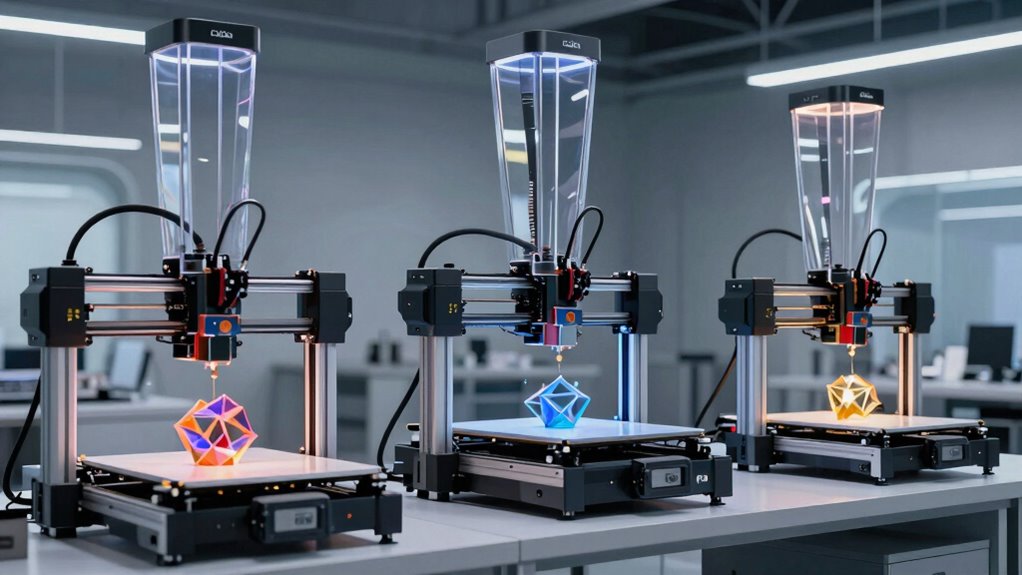

If you’re looking for the best tall delta 3D printers in 2026 for large-scale projects, I recommend the FLSUN T1 Max for its massive build volume and fast setup. The FLSUN S1 with AI combines high speeds, auto-leveling, and intelligent optimization, making complex prints easier. The FLSUN S1 Delta offers large, enclosed dimensions perfect for big, detailed models. Keep exploring, and you’ll discover all the features that make these options stand out.
Key Takeaways
- Top models like FLSUN T1 Max, S1, and S1 Delta offer large build volumes suitable for tall and complex projects.
- Advanced auto-leveling and resonance compensation ensure high precision and stability during large-scale printing.
- Speeds up to 1200mm/s significantly reduce production time for large and tall models.
- Enclosed frames and noise reduction features make these printers ideal for continuous, large-volume work environments.
- Compatibility with diverse high-temperature filaments and durable components ensures long-term reliability and high-quality output.
| FLSUN T1 Max Delta 3D Printer with Auto-Leveling | 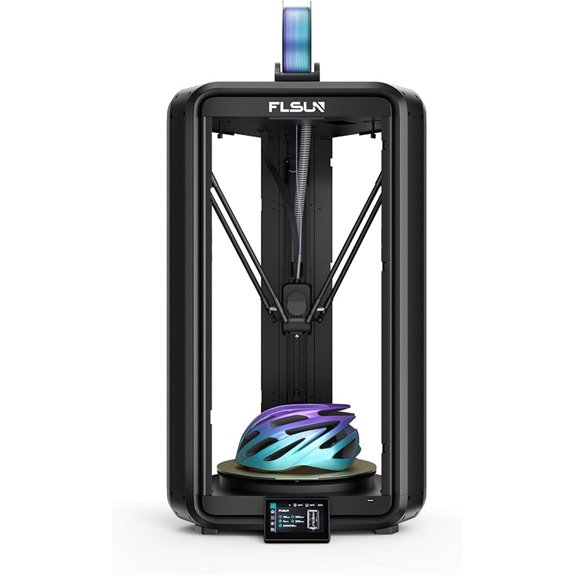 | Largest Build Volume | Speed: 1000mm/s | Build Volume: 300mm diameter bed | Auto-Leveling: Yes | VIEW LATEST PRICE | https://chatgpt.com/c/692 |
| FLSUN S1 3D Printer with Auto Leveling and AI | 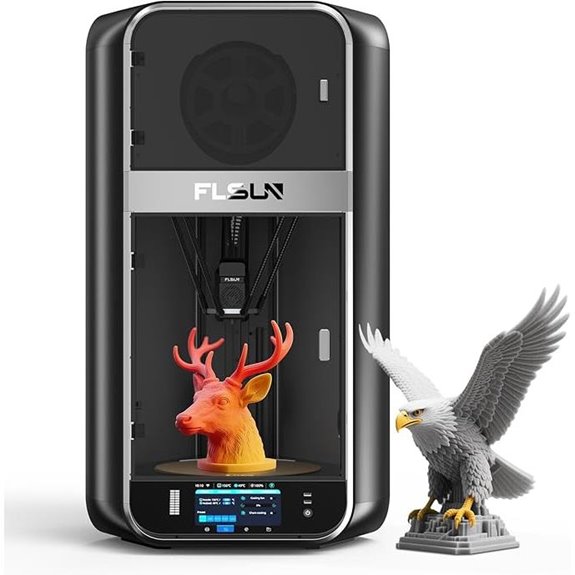 | Fastest Intelligent Printing | Speed: 1200mm/s | Build Volume: Not specified | Auto-Leveling: Yes | VIEW LATEST PRICE | https://chatgpt.com/c/692 |
| FLSUN S1 Delta 3D Printer with Auto Leveling |  | Most Versatile Speed & Size | Speed: 1200mm/s | Build Volume: 13″×13″×17″ (approx. 330×330×432mm) | Auto-Leveling: Yes | VIEW LATEST PRICE | https://chatgpt.com/c/692 |
More Details on Our Top Picks
FLSUN T1 Max Delta 3D Printer with Auto-Leveling
If you’re looking for a tall delta 3D printer that combines speed, precision, and ease of setup, the FLSUN T1 Max is an excellent choice. Its large 300mm heated bed supports big projects like dragons, cosplay props, or prototypes. Assembly takes just 15 minutes thanks to its tool-free design, much faster than traditional printers. It reaches speeds up to 1000mm/s with high accuracy, thanks to resonance compensation and auto-bed leveling. The dual-gear extruder ensures detailed prints with abrasive filaments. Plus, its quiet operation, WiFi connectivity, and long-lasting components make the T1 Max ideal for continuous, reliable printing in any environment.
- Speed:1000mm/s
- Build Volume:300mm diameter bed
- Auto-Leveling:Yes
- Material Compatibility:Multiple filaments including abrasive
- Connectivity:WiFi 6, Flsun App
- Operation Time:Suitable for 24/7/continuous use
- Additional Feature:Quick tool-free assembly
- Additional Feature:Quiet operation at 56dB
- Additional Feature:Reinforced, long-lasting belts
FLSUN S1 3D Printer with Auto Leveling and AI
The FLSUN S1 3D Printer with Auto Leveling and AI stands out for makers who need fast, reliable, and user-friendly tall delta printers. It uses advanced delta technology with synchronized robotic arms, reaching speeds of up to 1200 mm/s and rapid acceleration of 40,000 mm/s². The printer is quick to set up—just 10 minutes from unboxing—and features full auto-leveling and an AI camera for self-optimization and problem alerts. Its versatile extruder handles high-temperature materials like PETG and carbon fiber, while the enclosed design with dual filters guarantees safe, high-quality printing in any environment.
- Speed:1200mm/s
- Build Volume:Not specified
- Auto-Leveling:Yes
- Material Compatibility:Wide range including high-temp filaments
- Connectivity:Not specified, but supports file transfer
- Operation Time:Not explicitly specified
- Additional Feature:AI camera for self-optimization
- Additional Feature:Wide material support up to 350°C
- Additional Feature:Automated print issue alerts
FLSUN S1 Delta 3D Printer with Auto Leveling
For those seeking a high-performance tall delta 3D printer that combines speed, stability, and ease of use, the FLSUN S1 stands out as an excellent choice. It can print at speeds up to 1200mm/s with rapid acceleration, thanks to its ultra-stable all-metal frame and delta structure. The large build volume of 13″×13″×17″ allows for big projects or multiple parts simultaneously. With fully automatic one-click leveling and an onboard camera for real-time monitoring, setup is quick and straightforward. Its versatile extruder and heated chamber support a wide range of materials, making it ideal for large-scale, high-quality prints with minimal effort.
- Speed:1200mm/s
- Build Volume:13″×13″×17″ (approx. 330×330×432mm)
- Auto-Leveling:Yes
- Material Compatibility:Broad range including high-temp filaments
- Connectivity:Onboard camera, real-time monitoring
- Operation Time:Ready to print within 10 minutes
- Additional Feature:Real-time monitoring via onboard camera
- Additional Feature:Rapid single-layer cooling in 1s
- Additional Feature:Fully automatic one-click leveling
Factors to Consider When Choosing Delta 3D Printers Tall
When choosing a tall delta 3D printer, I look at factors like build volume capacity to guarantee it can handle larger projects. Printing speed and quality are also key since they impact efficiency and finish, while auto-leveling features save time and improve accuracy. Additionally, I consider material compatibility and noise levels to match my workspace needs and preferences.
Build Volume Capacity
Choosing a delta 3D printer with the right build volume capacity is essential if you want to print tall or large models in a single run. Larger build volumes let you create taller, more complex objects without needing to piece them together, saving time and reducing potential errors. Many delta printers feature vertical build heights over 17 inches, which is ideal for tall prototypes or sculptures. A generous build volume also minimizes the need for segmentation, resulting in better print quality on large projects. Keep in mind that the printer’s frame height and gantry design directly influence maximum object height. Matching the build volume to your project requirements guarantees you get the most out of your printer’s capabilities and streamlines your workflow.
Printing Speed & Quality
Speed and print quality are key factors to consider with tall delta 3D printers, especially since their high speeds can substantially cut down production times. Some models can print at up to 1200mm/s, enabling rapid fabrication of large parts. The synchronized robotic arms in delta printers ensure precise nozzle control, resulting in smooth surfaces and high accuracy. However, maintaining consistent quality at high speeds demands advanced auto-leveling and resonance compensation features. Increased speeds can also cause vibrations and print defects, so stability and a robust structural design are essential. High-end delta printers incorporate rapid cooling systems and precise temperature control, which improve layer adhesion and overall finish. Balancing speed with stability and quality is vital for achieving ideal results in large-scale printing projects.
Auto-Leveling Features
Auto-leveling features play an essential role in ensuring consistent print quality, especially in tall delta 3D printers where bed surface irregularities can considerably affect results. These systems use sensors or probes to detect the bed surface and automatically adjust the nozzle height, ensuring a perfect first layer every time. Advanced auto-leveling mechanisms, like mesh bed leveling and resonance compensation, provide precise adjustments across uneven surfaces, which is vital for large build areas. They greatly reduce setup time and manual calibration efforts, allowing for quicker transitions between prints. Reliable auto-leveling is vital for tall delta printers, as it helps maintain accuracy and print quality over large distances, preventing layer shifts and ensuring smooth, successful prints throughout the entire build process.
Material Compatibility
When selecting a tall delta 3D printer, ensuring material compatibility is essential for successful prints across various filament types. I look for printers that support a wide range of materials like PLA, ABS, PETG, TPU, and specialty filaments such as carbon fiber or PVA. The maximum extruder temperature should be at least 350°C to handle high-temp materials like ABS and ASA effectively. A heated bed reaching around 100°C or higher is vital for good adhesion and print quality. If I plan to use abrasive filaments like PETG-HS, I verify that the printer’s nozzles are hardened or wear-resistant. Additionally, I check if the firmware and hardware allow seamless switching between filament types, ensuring crucial performance and versatility for large-scale printing projects.
Operation Noise Levels
Choosing a tall delta 3D printer often involves considering how loud it operates, especially if you’ll be using it in shared or quiet spaces. Noise levels are typically below 60dB in quieter models, comparable to normal conversation, making them suitable for classrooms or offices. The noise mainly comes from components like fans, stepper motors, and belts. High-quality parts and vibration-dampening features can considerably reduce sound during operation. Silent stepper drivers also help keep noise levels low. Additionally, the printer’s design, including enclosure and frame materials, influences sound insulation and vibration absorption. Selecting a quieter model ensures that your large-scale printing doesn’t disrupt your environment, providing a more comfortable and focused workspace without compromising print quality.
Assembly & Setup Time
Because setup time can greatly affect your workflow, it’s important to contemplate how quickly a delta 3D printer can be assembled. Many tall delta models can be put together in just 10 to 15 minutes, which is considerably faster than traditional XY-frame printers that can take over two hours. Tool-free assembly mechanisms make the process even easier, eliminating the need for specialized tools and technical skills. Clear, step-by-step instructions and pre-calibrated parts help new users get started without hassle. Some models feature automatic bed leveling and pre-assembled arms, allowing you to start printing immediately. A shorter assembly time means less downtime, increased productivity, and the ability to jump into large-scale projects faster, especially in commercial or educational settings.
Connectivity & Software
Reliable connectivity options like WiFi, Ethernet, or USB are vital for seamless file transfer and remote monitoring of tall delta 3D printers. These features allow me to easily upload print files without interruptions and keep an eye on progress from anywhere. I also look for software that supports popular slicing programs and offers an intuitive interface, so setup and adjustments are quick and straightforward. Firmware updates and OTA capabilities are essential for maintaining security and performance over time, ensuring my printer stays current. Additionally, integrated cloud or app-based ecosystems enable real-time control, monitoring, and management via mobile devices, which boosts productivity. Advanced automation features like auto-leveling and self-diagnosis further reduce manual work and troubleshooting, making the entire printing process smoother and more dependable.
Maintenance & Durability
To guarantee long-term performance, I pay close attention to the durability and maintenance needs of tall delta 3D printers. Regularly inspecting belts, motors, and joints helps prevent wear and keeps print quality consistent. I prefer models with reinforced belts rated for over 6,000 hours of use, which reduces the frequency of replacements. Choosing a printer with high-quality, corrosion-resistant components like hardened steel nozzles and sealed frames ensures it can withstand prolonged use. Maintenance tasks such as auto-leveling and resonance compensation are essential for maintaining stability and extending the lifespan of critical parts. A well-designed delta printer minimizes moving parts under load, reducing component fatigue and boosting long-term reliability. These factors are vital for dependable large-scale printing.
Frequently Asked Questions
What Is the Maximum Build Volume for These Tall Delta Printers?
The maximum build volume for these tall delta printers typically ranges from around 300mm to over 600mm in height, with some models reaching up to 1 meter or more. I’ve found that the specific size depends on the model and manufacturer. If you need large prints, I suggest looking for printers with at least 400mm in height and a sizable cross-section, ensuring they meet your project’s requirements comfortably.
How Do Auto-Leveling Features Improve Large-Scale Printing Accuracy?
Auto-leveling features considerably boost large-scale printing accuracy by ensuring the print bed is perfectly level before each print. I find this especially helpful because it compensates for any unevenness or shifts over time, reducing errors and improving layer adhesion. With auto-leveling, I spend less time troubleshooting issues and more time focusing on perfecting my large-scale projects, resulting in cleaner, more precise prints every time.
Are These Printers Suitable for Industrial or Commercial Use?
Ever wondered if these tall delta 3D printers are fit for industry? Yes, many models are designed for commercial use, offering high precision, reliability, and rapid throughput. They handle large-scale projects efficiently, making them ideal for prototyping, manufacturing, or custom production. While some are perfect for industrial settings, others suit small businesses or advanced hobbyists. It all depends on your specific needs and the printer’s capabilities.
What Maintenance Is Required for Long-Term Large-Scale Printing?
For long-term large-scale printing, I regularly check and clean the print bed and nozzles to prevent buildup. I lubricate moving parts like arms and joints weekly and replace worn components as needed. I also keep the firmware updated and monitor filament quality to avoid clogs or inconsistencies. Consistent maintenance helps make certain smooth operation, minimizes downtime, and extends the lifespan of my tall delta printer.
How Do These Printers Handle Complex or Multi-Material Prints?
These printers excel with complex or multi-material prints thanks to their precise, multi-axis movements and versatile extruder setups. I find them handle intricate designs smoothly, thanks to advanced slicing software and multi-material capabilities. They often feature multiple extruder heads or swappable nozzles, allowing me to print with different materials seamlessly. Overall, they bring a high level of detail and versatility, making challenging projects more manageable and impressive.
Conclusion
In choosing the right tall delta 3D printer, consider the balance of size, features, and reliability. Think about auto-leveling for precision, AI integration for smarter printing, and build volume for large projects. Prioritize ease of use, durability, and support to guarantee your investment pays off. Ultimately, selecting a printer that matches your needs, enhances your workflow, and inspires your creativity will lead to successful, large-scale 3D printing adventures.